
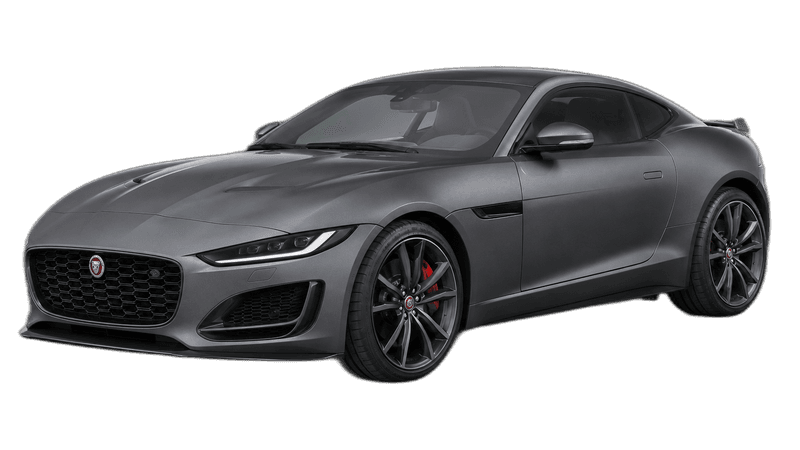
Jaguar F-Type P450
£48,000
usedIndicative market price, updated periodically.
444bhp
Power
4.6s
0-100 km/h
285km/h
Top Speed
£48,000
Price Used
How hard it pulls.
Peak g-force the instant you bury the throttle, estimated from the car's 0–100 time and drivetrain.
Jaguar F-Type P450Estimated peak launch g from the 0–100 time and drivetrain: an honest approximation, not a measured figure.
The Jaguar F-Type P450 is a coupe by Jaguar, with 444 bhp, 580 Nm of torque, a 0-100 km/h time of 4.6 seconds and a top speed of 285 km/h. Indicative used value: approximately £48,000. Actual values vary with specification, condition and history.
Dream Car Garage Editorial · Edited by José Teo Lorente Vallecillos · Last updated 2 November 2026
Overview
We have not driven this car. This review is based on published specifications and the sources listed below.
A supercharged V8 below the R
The Jaguar F-Type P450 is the facelifted two-seat sports car that Jaguar revealed in December 2019 and sold until the end of the 2024 model year. It sits between the four-cylinder P300 and the all-wheel-drive R, and it is the supercharged V8 with the lower output. This guide is scoped to the P450 coupe. Our catalogue lists a 5.0L supercharged V8 petrol engine producing 444 bhp and 580 Nm, with 0 to 100 km/h in 4.6 seconds and a 285 km/h top speed. We have not driven this model for this article. It is a desk-researched ownership guide built from Jaguar's October 2022 technical specification sheet, a PistonHeads used buying guide dated May 2025 and the government recall check. The PistonHeads guide was written about the 575 hp R rather than the P450, so where it describes shared parts we say so, and where it describes R-only parts we flag that too. Confirm every detail on the car you are viewing.
Checking the figures
Jaguar's specification sheet gives the P450 a maximum output of 450 PS (331 kW) at 6,000 rpm and 580 Nm between 2,500 and 5,000 rpm from a 5,000 cc, eight-cylinder, 32-valve vee engine. The 450 PS figure is the metric rating, which converts to the 444 bhp in our catalogue. Jaguar's US release for the 2022 model year quotes the same engine as 444 hp and 428 lb ft, and the PistonHeads reveal story of December 2019 prints it as 450hp, so adverts that say 450 and 444 describe the same car in different units. Jaguar quotes 0 to 60 mph in 4.4 seconds and 0 to 100 km/h in 4.6 seconds, with a top speed of 177 mph or 285 km/h. The PistonHeads reveal gives 0 to 62 mph in 4.6 seconds, which is the same benchmark as 0 to 100 km/h.
Three things can mislead you. First, the P450 was sold in rear-wheel drive and all-wheel drive form, and Jaguar's sheet gives both the same 4.6 second and 285 km/h figures. Our catalogue row lists rear-wheel drive. The coupe weighs 1,781 kg unladen to the EU definition in rear-wheel drive form and 1,855 kg with all-wheel drive, so the rear-driven car is the lighter one, by about 74 kg on Jaguar's numbers and about 80 kg according to PistonHeads. Second, the convertible shares the same engine, the same 4.6 seconds and the same 285 km/h, but weighs 1,793 kg in rear-wheel drive form and has far less luggage space. Third, the neighbouring models are different cars. The P300 uses a 2.0-litre four-cylinder with 300 PS, 400 Nm, 5.9 seconds and 250 km/h. The R has 575 PS, 700 Nm, 3.7 seconds and 300 km/h, and it is all-wheel drive only. The facelifted UK range dropped the supercharged V6 and the old SVR. Jaguar's North American 2021 model year release still listed a 380 hp V6 with all-wheel drive, so a V6 car is not a P450, whatever the market. Pre-facelift V8 S and R cars with 490 hp and 540 hp are also a different generation.
Engine and gearbox
The P450 uses a supercharged 5.0-litre V8 with a bore and stroke of 92.5 by 93 mm and a 9.5 to 1 compression ratio, according to Jaguar's sheet. Jaguar's US release says the engine is built at its Wolverhampton plant. A gasoline particulate filter is standard, the fuel tank holds 70 litres, and the WLTP combined figure for the rear-wheel-drive coupe is roughly 27 mpg with CO2 of 236 to 240 g/km, so expect high running costs. A switchable active exhaust is standard, and a Quiet Start function keeps the exhaust subdued until the car is under load, so a cold car that sounds mild is not necessarily faulty. Do check that the valves open in Dynamic mode or with the exhaust button.
PistonHeads says the faults that earlier F-Types were known for, including coolant getting into the water pump bearing housing, rattling timing chains, knocking supercharger couplings and whirring supercharger bearings, were pre-facelift problems, and that later cars got better water pumps and pipework. It adds that it found no evidence of these problems continuing on facelift cars, and that exhaust valves had occasionally jammed on earlier cars. Look for powdery coolant deposits around the water pump anyway, and listen for any whirring from the top of the engine. The guide stresses that battery condition is essential, because a weak battery can cause faults across the car, so ask when it was last replaced.
The gearbox is a ZF eight-speed automatic that Jaguar calls Quickshift, driven through a SportShift selector or steering-wheel paddles. PistonHeads stresses that it is not a dual-clutch unit and that no manual was offered with the V8. The fluid is sold as sealed for life, but PistonHeads suggests planning a change at around 70,000 miles, and says no facelift V8 had reached that distance when it wrote. It also notes that odd transmission calibration or incorrectly programmed engine control units have been raised, so ask whether any software updates were carried out.
Chassis, brakes and wheels
The structure is a bonded and riveted aluminium platform with aluminium double-wishbone suspension at both ends, and Jaguar fits Adaptive Dynamics with Configurable Dynamics and electric power steering across the V8 range. Jaguar's 2022 US release lists an electronic active differential, larger brakes and 20-inch wheels for the P450, and its 2023 release says 20-inch wheels were standard on every F-Type. We did not find P450 brake disc or tyre sizes in the sources we read. PistonHeads gives 380 mm front and 376 mm rear discs and 265/35 and 305/30 tyres for the R, which are not P450 figures, so measure and read the sidewalls on the car you inspect.
PistonHeads says the facelift brought new springs with adaptive dampers, new anti-roll bars, new wheel bearings and tighter rear knuckle bushes and ball joints. It also says bushings and ball joints wore quickly on the 575 cars and were strengthened, that dampers had been known to fail on the original F-Types, and that anyone buying should watch the front suspension components. Its earlier 2020 guide, which covers pre-facelift cars, mentions crumbling rear bushes and rust on some rear subframes. Those are not facelift findings, but a worn, clunking rear end deserves a lift inspection. PistonHeads also reports power steering problems on the R and a Jaguar technical bulletin that lists many possible causes, so check for a notchy or heavy wheel. On all-wheel-drive cars, ask whether the driveline has ever shown a warning, because the same guide describes an R that dropped into front-wheel-drive-only mode when the differential overheated until a software reset fixed it. Inspect all four wheels for kerb damage, and check that the tyres wear evenly.
Body, interior and electronics
The facelift was styled under Julian Thomson, with new bonnet vents, a larger grille, Pixel LED headlamps and slim rear lights, so a car with older-style lamps is an earlier model. The coupe is 4,470 mm long and 1,923 mm wide, and 2,042 mm with the mirrors unfolded. Jaguar gives the coupe 336 litres of dry load space and the convertible only 132 litres, while PistonHeads quotes 310 litres for the coupe and about 130 litres for the convertible with the space-saver spare fitted. The convertible has a fabric roof that PistonHeads says weighs about 20 kg more than the metal coupe roof, and it describes the electric roof operation as fault-prone on many cars, so cycle it several times. Earlier cars had problems with grit scratching the side windows and with boot seals, both reportedly fixed on newer cars.
Inside, the facelift has a 12.3-inch digital cluster and a 10-inch Touch Pro screen. PistonHeads says the screen is hard to read in bright sunlight and that this system is not the later Pivi Pro. Apple CarPlay was wired only on 2020 cars, and the guide mentions an embedded Spotify app. Its known electronic fault is a stuttering speedometer and tachometer needle on the driver's display. The seating position is low, and PistonHeads says the cabin may feel tight for taller drivers. It also says cabin quality is hard to reconcile with the price of the dearer models. Heated and cooled seats were options, and the audio is a standard 180 w system with Meridian upgrades. Test every seat function, the parking sensors and the infotainment.
Recalls and history
PistonHeads lists three recalls for facelift cars: a damaged seatbelt pretensioner tube, an extra layer of mesh in the passenger airbag door and an incorrect front bumper reinforcement panel. It contrasts these with the pre-facelift recalls, which it says included loss of control, compromised stability, fuel leaks and fire. That list comes from a guide written about the R, so it may not match every P450, and we cannot say which individual cars were affected. Enter the registration into the DVSA recall service and ask the seller for dealer paperwork showing any open work was completed. Ask for a full service history. PistonHeads mentions a 48-month Jaguar service plan, so check whether the car had one and which services were done. Confirm that the car is a P450 and not a P300, a 75 edition or an R, because the badging and wheels look similar at a glance.
Buying decision
PistonHeads concludes that Jaguar fixed past faults in the 2020 facelift and improved the driving experience, calling the result a car that almost anyone can enjoy without fear. It adds that Jaguar stopped building the F-Type, with the official announcement in summer 2024 and production possibly ending a little earlier. Jaguar's own release called the 2024 model year the final one. We have left dated price examples out, so compare current adverts. The best car has a documented history, a recent battery, matching tyres, a cooling system with no coolant residue, a quiet suspension with no wear in the front joints, working electronics and every recall closed. Decide between rear-wheel drive and all-wheel drive on traction and weight, and decide on the coupe over the convertible for boot space and a lighter body. If you want the extra performance, drive an R back to back, but remember it costs more and has different brakes, tyres and servicing needs.
Specifications
Engine
5.0L supercharged V8 petrol
Displacement
5.0L
Power
444 bhp
Torque
580 Nm
0-100 km/h
4.6s
Top Speed
285 km/h
Drivetrain
RWD
Country
UK
Body Style
coupe
Years
2020–2024
Price Used
£48,000
Specifications are manufacturer-published figures.
More from Jaguar
Featured in Carpedia
Frequently Asked Questions
What are the specifications of the Jaguar F-Type P450?
The Jaguar F-Type P450 is a coupe by Jaguar, with 444 bhp, 580 Nm of torque, a 0-100 km/h time of 4.6 seconds and a top speed of 285 km/h. Indicative used value: approximately £48,000. Actual values vary with specification, condition and history.
How much does a Jaguar F-Type P450 cost?
Indicative used value: approximately £48,000. Actual values vary with specification, condition and history.
What drivetrain does the Jaguar F-Type P450 use?
The Jaguar F-Type P450 is configured with rear-wheel drive.
What type of car is the Jaguar F-Type P450?
The Jaguar F-Type P450 is a gts manufactured by Jaguar in UK. Production ran from 2020 to 2024.