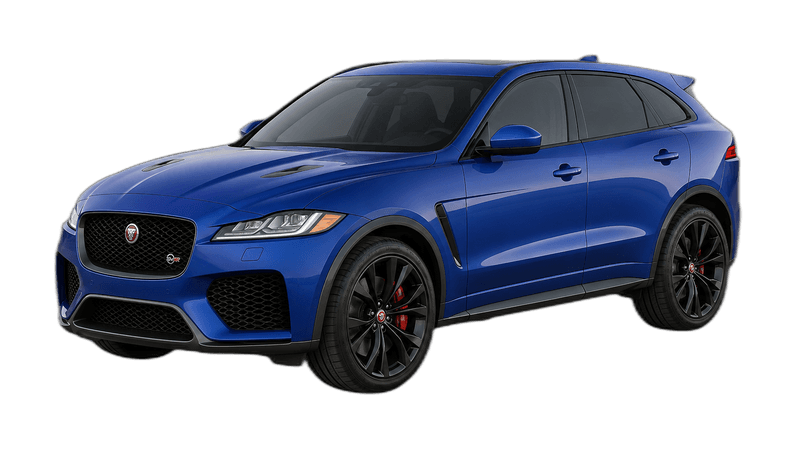
Jaguar F-Pace SVR
£52,000
usedIndicative market price, updated periodically.
542bhp
Power
4s
0-100 km/h
286km/h
Top Speed
£52,000
Price Used
The Jaguar F-Pace SVR produces 542 bhp, reaches 100 km/h in 4 seconds and has a top speed of 286 km/h. A representative example is worth about £52,000.
How hard it pulls.
Peak g-force the instant you bury the throttle, estimated from the car's 0–100 time and drivetrain.
Jaguar F-Pace SVREstimated peak launch g from the 0–100 time and drivetrain: an honest approximation, not a measured figure.
Dream Car Garage Editorial · Edited by José Teo Lorente Vallecillos · Last updated 2 November 2026
Overview
We have not driven this car. This review is based on published specifications and the sources listed below.
The supercharged V8 family SUV
The Jaguar F-Pace SVR is the range-topping, V8-powered version of Jaguar's mid-size SUV, built by the company's Special Vehicle Operations department. This guide is scoped to the facelifted 2021 model year F-Pace SVR, announced by Jaguar on 2 December 2020 and, according to December 2025 reports covered below, built until F-Pace production ended at the end of 2025. The original car, announced in March 2018 and on sale from 2019, shares the engine and its 550 PS rating but has different torque, acceleration and top speed figures, and a different cabin, so it is described only for comparison below. Our catalogue lists a 5.0L supercharged V8 petrol engine producing 542 bhp and 700 Nm, with 0 to 100 km/h in 4.0 seconds, a top speed of 286 km/h, an eight-speed automatic gearbox and all-wheel drive. We have not driven this model for this article. This is a desk-researched ownership guide built from Jaguar Land Rover's December 2020 press release, a PistonHeads used buying guide for the 2021-on car published in November 2024 and the government recall check, with a few clearly named secondary reads where those three are silent.
Checking the figures
Jaguar's release gives the engine as 550PS and 700Nm, with 0 to 100 km/h in 4.0 seconds, 0 to 60 mph in 3.8 seconds and a top speed of 178mph (286km/h). PS is the metric horsepower unit. 550 PS is about 542 bhp, which is the figure in our catalogue, and 700 Nm is about 516 lb ft. PistonHeads prints 550hp and 516 lb ft for the facelifted car, and lists 4.0 seconds to 62 mph and 178 mph, so an advert that says 550 PS, 550hp, 405 kW or 542 bhp describes the same engine. The 405 kW figure comes from a trade reprint of the Jaguar release, because the release itself gives no kilowatt figure.
Do not confuse the facelift with the original car. Jaguar's release says the facelift added 20 Nm of torque, cut 0 to 60 mph by three-tenths of a second and raised the top speed by 2 mph. Independent reports of the 2018 launch give 680 or 681 Nm (502 lb ft), 4.3 seconds for 0 to 100 km/h, 4.1 seconds for 0 to 60 mph and 283 km/h (176 mph). PistonHeads' October 2022 listing for a 2019 car also shows 550hp and 502 lb ft. One trade reprint of the facelift release says the top speed rose by 5 km/h, which does not match 176 mph to 178 mph, so we use Jaguar's own mph figures and the 286 km/h it states. The catalogue figures therefore apply to the facelift, not to a 2019 or 2020 car.
Two other cars are easy to mix up with it. The limited SVR Edition 1988, announced in June 2022 with 394 cars, is described by Jaguar and by the coverage we read as using the same 550 PS engine. PistonHeads also mentions a 575hp SVR Edition for the 2024 model year still listed on Jaguar's website in November 2024. We could not corroborate that figure from any other source, so we do not rely on it. PistonHeads' weight figure is 2,133 kg, which it says is 70 kg more than the previous model, and it cautions that its spec data is best treated as relative. Jaguar's release does not state a weight.
Engine and gearbox
The engine is the 5.0-litre supercharged V8 with a revised torque curve. PistonHeads gives 550hp at 6,250 to 6,500 rpm and peak torque between 3,500 and 5,000 rpm, calls it the last AJ V8-powered series-production car from Jaguar Land Rover, and says its character and sound are the main attraction. It reports that later cars make fewer pops and crackles because the exhaust valves no longer stay open in Dynamic mode, and that some owners have removed the sound resonator or fitted straight pipes. Ask what has been changed and whether the car is still on the standard exhaust, since that affects both the paperwork and the noise.
The gearbox is a ZF 8HP70 eight-speed automatic. Jaguar's release says the car uses the same torque converter as the XE SV Project 8, and PistonHeads says full torque is available in every gear, whereas pre-facelift cars limited torque in the lower gears. The facelift also added Dynamic Launch, which uses driveline inertia to keep power flowing through gearchanges. PistonHeads says some owners find the function seems to disappear if launch mode is not fully engaged, and says it found no factory launch limit, so ask the seller how often the car has been launched. Official combined economy is up to 23.1 mpg with 275 g/km of CO2 on the WLTP cycle, and PistonHeads says real-world use is around 23 mpg, with gentle driving approaching 30 mpg. PistonHeads' guide notes that some F-Paces suffered water pump drivebelt problems that could stop coolant flow, but says it is unclear whether the SVR was affected. Its separate guide to the standard F-Pace, which covers mainly the four-cylinder and diesel cars, lists oil, coolant reservoir and turbo problems that are not about the V8, so we do not treat them as SVR faults. PistonHeads' overall key finding for the 2021-on SVR is that nothing much seems to go wrong, which is one reviewer's summary and not a failure-rate statistic.
Chassis, brakes and wheels
Jaguar describes standard all-wheel drive with Intelligent Driveline Dynamics and a rear-wheel-drive bias. PistonHeads gives the torque split as 10/90 front to rear in Dynamic, 30/70 in Comfort and 50/50 in Rain-Ice-Snow, and says the electronic locking rear differential was retuned for the facelift. The suspension is double wishbone at the front and an integral link at the rear with coil springs, with Adaptive Dynamics dampers retuned for a more refined low-speed ride and revised chassis bushes. PistonHeads reports that 70 per cent of the bushes are new along with new rear toe-links and front control arm links. For the original SVR, PistonHeads' standard F-Pace guide says the springs were stiffened by 30 per cent at the front and 10 per cent at the rear. The steering is electrically assisted with a variable ratio, and the facelift added a new electronic assistance system. PistonHeads calls it sharp and says odd steering behaviour was reportedly fixed by software updates.
The front discs are 395 mm two-piece units with four-piston fixed calipers and the rear discs are 396 mm with single-piston sliding calipers. The facelift added an Integrated Power Booster, an electric unit, and retuned pedal feel. PistonHeads says some owners find the assistance too strong at low speeds, though braking performance drew no complaints. It also reports owner cases of the electronic parking brake not releasing even though the display said it had, cured by cycling through reverse, neutral and drive, and of the emergency anti-collision braking activating unnecessarily. Check the pedal feel and the parking brake on your test drive and ask for the brake service record. PistonHeads gives the standard wheel sizes as 9x21 front and 10x21 rear with 265/45 and 295/40 tyres and says Pirelli P Zero was the usual tyre. Jaguar's release adds a 22-inch forged five-spoke wheel in Gloss Black with Satin Grey inserts for the facelift. Because the front and rear sizes differ, tyres cannot be rotated front to rear, so inspect each tyre for uneven wear and each wheel for kerb damage.
Body, interior and electronics
The facelift bodywork has a larger front intake, side vents, a longer vented bonnet and quad tailpipes. Jaguar says it reduces aerodynamic lift by 35 per cent and drag from 0.37 Cd to 0.36 Cd, and pixel LED headlights were optional. PistonHeads says the boot is 650 litres and that rear legroom is tighter than in a BMW X3, and that the optional panoramic roof reduces front headroom. Check panel gaps and the lower front bumper for repairs, because the large front intakes and low bumper are exposed on a car of this size.
Inside, Jaguar lists Alcantara on the seat and door inserts, Windsor leather, a 12.3-inch driver display and an optional semi-aniline leather sports seat. The biggest practical difference from the original car is the Pivi Pro infotainment on an 11.4-inch curved-glass touchscreen. Jaguar says it has dual SIMs and software-over-the-air updates, and PistonHeads calls the screen a strong reason to prefer the facelift. It reports owner complaints of "SOS service not available" messages and says the steering-wheel touch buttons are fiddly, and that the gear selector has to be pulled back twice to reach manual mode. Test every screen function, the cameras, the driver assistance systems and the connected services, and ask which software version the car is running and whether updates are current.
Recalls and history
PistonHeads' guide lists recalls on 2020 and 2021 cars for premature deactivation of the automatic locking retractors on the seatbelts, which could leave a child seat insecure, on 2022 cars for damaged front seatbelt pretensioner tubes, and on some 2022 cars for wrong-specification tailgate lamps. We did not find an official Jaguar or DVSA recall listing for the SVR that we could read, so treat those as PistonHeads' report and check the actual car. Enter the registration in the DVSA vehicle recall service, and ask a Jaguar retailer to check the VIN for open campaigns and for the software updates the car has received. Also ask for the full service history, evidence of accident repair and a list of modifications, particularly exhaust or software changes, which can alter the car's emissions and noise paperwork.
Buying decision
PistonHeads calls the 2021-on SVR a last-chance car and recommends the facelift over the pre-facelift car where there is a choice, naming heavier, less powerful or more expensive rivals including the BMW X6 M, Audi RS Q8 and Porsche Cayenne GTS Coupe. Reports dated 22 and 23 December 2025, from Autocar India and Guideautoweb, say F-Pace production ended on 19 December 2025 at Solihull and that the last car built was a black SVR, destined for the Jaguar Daimler Heritage Trust. We did not read a Jaguar statement on this, and PistonHeads' November 2024 guide says a 2024 model year SVR Edition had no new price because production had ended, so any new-car availability is a question for a Jaguar retailer. The car is a heavy, thirsty petrol V8, so budget for fuel, tyres and brakes accordingly. Compare current used adverts instead of relying on a price quoted here. Prefer a car with a documented service history, matching tyres in good condition, a clear recall record and an exhaust that still looks standard.
Specifications
| Engine | 5.0L supercharged V8 petrol |
|---|---|
| Displacement | 5.0L |
| Power | 542 bhp |
| Torque | 700 Nm |
| 0-100 km/h | 4s |
| Top Speed | 286 km/h |
| Drivetrain | AWD |
| Country | UK |
| Body Style | 4/5 seater suv/sports utility vehicle |
| Years | 2021–2025 |
| Price Used | £52,000 |
Specifications are manufacturer-published figures.
Frequently Asked Questions
What is a Jaguar F-Pace SVR worth?
A representative example is worth about £52,000. Actual values vary with specification, condition and history.
How much power does the Jaguar F-Pace SVR have?
The Jaguar F-Pace SVR produces 542 bhp and 700 Nm of torque.
How fast is the Jaguar F-Pace SVR from 0 to 100 km/h?
The Jaguar F-Pace SVR accelerates from 0 to 100 km/h in 4 seconds.
What is the top speed of the Jaguar F-Pace SVR?
The Jaguar F-Pace SVR has a top speed of 286 km/h.
What engine does the Jaguar F-Pace SVR have?
The Jaguar F-Pace SVR uses a 5.0L supercharged V8 petrol.
When was the Jaguar F-Pace SVR built?
The Jaguar F-Pace SVR was built from 2021 to 2025.
Is the Jaguar F-Pace SVR all-wheel drive?
Yes. The Jaguar F-Pace SVR is configured with all-wheel drive.