
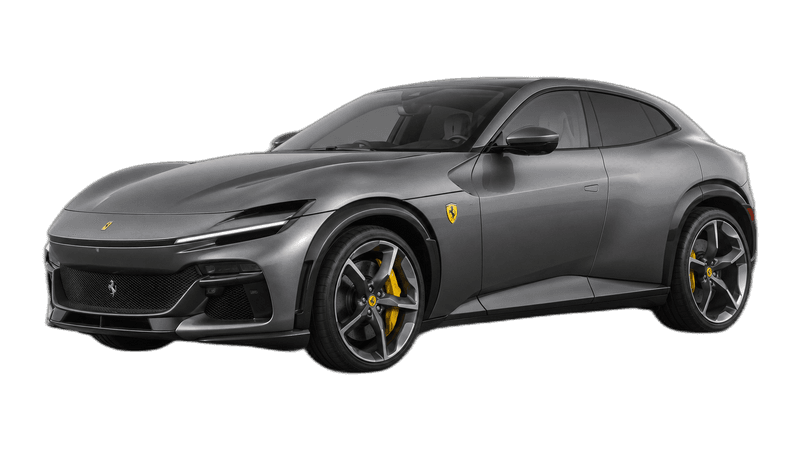
Ferrari Purosangue
£380,000
usadoIndicative market price, updated periodically.
715cv
Potencia
3.3s
0-100 km/h
310km/h
Velocidad Máxima
£380,000
Precio Usado
Cómo empuja.
La fuerza g máxima en el instante en que pisas a fondo, estimada a partir del 0–100 y la tracción del coche.
Ferrari PurosangueG de salida estimada a partir del 0–100 y la tracción: una aproximación honesta, no una cifra medida.
The Ferrari Purosangue is a 4-door, 4-seat by Ferrari, with 715 bhp, 716 Nm of torque, a 0-100 km/h time of 3.3 seconds and a top speed of 310 km/h. Indicative used value: approximately £380,000. Actual values vary with specification, condition and history.
Dream Car Garage Editorial · Edited by José Teo Lorente Vallecillos · Last updated 2 November 2026
Visión General
We have not driven this car. This review is based on published specifications and the sources listed below.
Scope of this guide
This guide is scoped to the Ferrari Purosangue in its standard form, with the 6.5L naturally aspirated V12 petrol engine, 715 bhp and all-wheel drive, the four-door, four-seat car that Ferrari unveiled on 13 September 2022. It is not a guide to the Handling Speciale configuration that Ferrari announced in April 2026, or to any other version Ferrari may add later, and where we know a variant differs we say so below. A listing that says only "Purosangue" can describe a 2023 car or a newer one, so check the exact configuration and options.
We have not driven this model for this article. Everything here comes from three cited sources: Ferrari's launch press release and technical specification (a PDF on cdn.ferrari.com), PistonHeads' UK review of 20 March 2024, and the government recall checker. We also read PistonHeads' first drive of 9 March 2023, Wikipedia's page on the car and the US safety regulator's acknowledgement letter for a 2025 recall, and we rely on press-report summaries for the variant and the volume cap, which we flag. Where sources disagree we say so rather than pick a winner quietly. Prices are history, not valuations.
The figures at a glance
- Engine: 6.5L naturally aspirated V12 petrol, code-named F140IA, a 65-degree V12 with dry-sump lubrication and direct injection. Ferrari gives 6496 cc, a bore and stroke of 94 mm by 78 mm and a compression ratio of 13.6:1. PistonHeads prints the same 6,496cc.
- Power: 715 bhp. Ferrari states 725 cv (metric horsepower, the same unit as PS) at 7750 rpm, with a footnote that the figure uses 98 RON petrol and includes 5 cv of dynamic ram air effect. Our conversion is 725 x 0.98632, which is 715 bhp, and Wikipedia prints 715 hp and 533 kW for the same figure. PistonHeads prints 725hp, which is the metric number, so a magazine saying 725 and a catalogue saying 715 are describing the same engine.
- Torque: 716 Nm at 6250 rpm, which PistonHeads prints as 528 lb ft (716 Nm is about 528 lb ft). Ferrari says 80 per cent of it is available from 2100 rpm.
- 0-100 km/h: 3.3 seconds, Ferrari's claim, with 0-200 km/h in 10.6 seconds. PistonHeads' spec table says 3.4 seconds for 0-62 mph, which is a slightly longer distance and a different table, so the two are close rather than in conflict.
- Top speed: over 310 km/h. We store 310 km/h, which is the floor of Ferrari's claim, not a measured maximum. PistonHeads prints 193 mph, the same number in other units.
- Drive: all-wheel drive. The engine sits behind the front axle, a layout Ferrari calls mid-front, and the eight-speed dual-clutch gearbox sits at the rear in a transaxle. A power transfer unit in front of the engine sends drive to the front wheels. Ferrari quotes a 49 per cent front and 51 per cent rear weight distribution.
- Weight: 2033 kg dry, but Ferrari footnotes that as including the optional lightweight content. PistonHeads quotes 2,033 kg dry and 2,100 kg wet for the same equipment, Wikipedia gives a 2,170 kg kerb weight, and the PistonHeads text says "getting on for 2.5 tonnes". Treat 2.1 to 2.2 tonnes as the realistic range for a normal car.
What the figures do not say about it being an SUV
The press release sets the Purosangue against "so-called crossovers and SUVs", and says it chose a completely different layout and proportions from them. Wikipedia reports that Ferrari has repeatedly said it does not consider the car an SUV, but we did not find that wording in the release itself. Our catalogue stores the category as SUV because that is how most buyers will search, and we leave that alone. The body style we store is simply four-door, four-seat. The Purosangue has a high driving position by Ferrari standards, a large boot and a carbon-fibre roof as standard, but it is not a seven-seater and is not offered with a hybrid or four-cylinder engine in the standard car.
Engine and gearbox
The V12 is a development of Ferrari's recent twelve-cylinder engines, with cylinder heads derived from the 812 Competizione, a redesigned intake, timing and exhaust, and a longer stroke from a modified crankshaft. Ferrari says it was tuned for torque at low revs without losing the top-end character, hence 80 per cent of peak torque at 2100 rpm. The redline is 8250 rpm on Ferrari's sheet and on Wikipedia, while the PistonHeads first drive says the tachometer redlines at 8,000 rpm. We would use Ferrari's figure and not rely on the other.
The gearbox is an eight-speed dual-clutch unit with ratios shared with the SF90 Stradale and 296 GTB, according to Ferrari, a dry-sump oil-bath design with a more compact clutch than the earlier seven-speed. Ferrari says the new clutch handles up to 1200 Nm of dynamic torque during shifts. A dual-clutch gearbox in a car that will see town traffic and short journeys is worth asking a Ferrari specialist about, particularly the service history and software updates.
Chassis, suspension and tyres
Ferrari's active suspension, which it says is enabled by Multimatic's True Active Spool Valve system, combines an electric motor with a spool-valve damper at each wheel. PistonHeads says there are no anti-roll bars and quotes Ferrari's claim of 30 per cent less roll and pitch than a conventional set-up. The car also has four-wheel steering, and Ferrari lists wheels of 22 inches at the front (255/35 R22) and 23 inches at the rear (315/30 R23), with 398 mm front and 380 mm rear brake discs. PistonHeads says the brakes are ceramic and that Sport mode can feel a little unforgiving on B roads, with Comfort better for everyday use.
For a buyer, the practical points are the cost and availability of the large wheels and tyres, the condition of the active dampers and a record of any alignment or software work. We have not found a published service schedule or parts price list, so any figure you are given is an estimate.
Space, doors and boot
Ferrari describes four separate, independently adjustable, heated electric seats and says the cabin will comfortably take four adults. The front doors are conventional, with a 63-degree opening, and the rear doors are rear-hinged coach doors that open to 79 degrees. The boot is 473 litres, which PistonHeads says is 23 litres more than the GTC4Lusso, with a high load lip. PistonHeads also says rear headroom is limited for anyone over about six feet tall. Ferrari adds that the rear seats fold to increase luggage space, and the tailgate is electric.
Which cars this covers, and when
Ferrari unveiled the car on 13 September 2022 in Lajatico, Italy, so our catalogue year of 2022 is the reveal year, not a delivery year. Press reports on Ferrari's earnings put the first customer deliveries in the second quarter of 2023, and the earliest PistonHeads drive is dated March 2023, so a car cannot be a 2022 registration unless it is a pre-production or press car. The end year is open because the car is still in production. In April 2026 Ferrari announced a Handling Speciale configuration. We could not open Ferrari's own PDF for it, which returned an access-denied error that we did not try to get around, so we rely on trade press summaries, which say the 6.5 litre engine and 725 PS output are unchanged and that the change is a suspension and gearbox recalibration. A later Ferrari document, as quoted in a search summary, gives the torque as 716 Nm across a range of 3,000 to 5,750 rpm, which is a different way of stating the peak, so treat the 6250 rpm figure as the 2022 launch wording.
How many were built
No production count is published, and our catalogue leaves it empty. Press reports of Ferrari's chief executive say the car is capped at an average of 20 per cent of Ferrari's annual output, and that is a ceiling, not a number. Reports differ on whether it applies per year or over the life of the car. We read those reports only as search summaries because the publisher page returned a block, so we have not verified the wording. A buyer should not assume any number of cars and should ask for the chassis number and build date.
What to check before buying
- Confirm the configuration: standard car, Handling Speciale or a later variant, and the optional lightweight content that the 2033 kg dry weight depends on.
- Ask for the full dealer service history, software updates and any warranty or approved-programme coverage, and have an independent specialist inspect it.
- Inspect all four large wheels and tyres for kerb damage, and check the brake discs and the active suspension for leaks or warning messages.
- Check the front wheel arches and underbody for stone chips and scrapes, since the car sits higher than other Ferraris but still has a low front splitter.
- Confirm that every recall has been done, as described in the next section.
- Check how the car is registered and insured where you live, and whether it was an import.
Recalls and the DVSA check
The government page says you can use a registration number, or the manufacturer, model and year, to check whether a vehicle has been recalled for a serious safety problem. It shows outstanding safety recalls and MOT history, and says non-safety recalls come from the manufacturer directly. We did not run it, because we are not looking at a specific car.
We found one safety recall in the United States, not the UK. NHTSA campaign 25V479, reported by Ferrari North America on 23 July 2025, covers 541 Purosangues of model years 2023 to 2025. Ferrari says the fuse box power supply and the passenger-side footrest may touch, which can short-circuit and set off the brake warning light, reducing braking ability. The remedy is a plastic spacer fitted free of charge, and Ferrari's reference is RC 92. We found no UK notice for this car, but absence from our sources is not a clean bill of health, so run the registration and ask the selling dealer whether the work has been done.
About the photograph
The picture at the top of this page shows a black Purosangue in what looks like a showroom, photographed in January 2023 by Calreyn88 and used under a Creative Commons licence from Wikimedia Commons. It has no visible number plate. We cropped it and blurred a display screen in the background. Its Commons description does not give the configuration, so we use it only to show the shape of the standard car.
Verdict
The standard Ferrari Purosangue in this guide is a 6.5L naturally aspirated V12 petrol car with 715 bhp (Ferrari's 725 cv), 716 Nm, a claimed 3.3 seconds to 100 km/h and a top speed of over 310 km/h, with all-wheel drive, four seats and an eight-speed dual-clutch gearbox at the rear. It is a rare layout, a naturally aspirated V12 in a four-door, and its appeal depends on the active suspension and the engine being in good order. Verify the configuration, the history and the recall status, treat every published figure as a manufacturer claim, and remember that we have not driven it, so use the sources and a proper inspection to decide.
Especificaciones
Motor
6.5L naturally aspirated V12 petrol
Cilindrada
6.5L
Potencia
715 cv
Par Motor
716 Nm
0-100 km/h
3.3s
Velocidad Máxima
310 km/h
Tracción
AWD
País
Italy
Carrocería
4-door, 4-seat
Años
2022–present
Precio Usado
£380,000
Specifications are manufacturer-published figures.
Más de Ferrari
Destacado en Carpedia
Best Luxury SUVs 2026
From Tesla's 1,020bhp Model X Plaid to the Bentley Bentayga Speed, these are the ten luxury SUVs of 2026 that set the agenda for the world's most contested automotive segment.
The Ultimate Dream Garage 2026
If money were no object and the garage had ten bays, which cars would you choose? Our editorial team has done the hard work, selecting one champion from each category to assemble the definitive Dream Garage of 2026.
Porsche Cayenne Turbo GT vs Lamborghini Urus Performante vs Ferrari Purosangue
When Ferrari, Lamborghini, and Porsche each build a performance SUV, the result is not a homogeneous category: it is a study in how three very different engineering cultures interpret the same brief. The Cayenne Turbo GT, Urus Performante, and Purosangue share a segment but almost nothing else.
Preguntas Frecuentes
What are the specifications of the Ferrari Purosangue?
The Ferrari Purosangue is a 4-door, 4-seat by Ferrari, with 715 bhp, 716 Nm of torque, a 0-100 km/h time of 3.3 seconds and a top speed of 310 km/h. Indicative used value: approximately £380,000. Actual values vary with specification, condition and history.
How much does a Ferrari Purosangue cost?
Indicative used value: approximately £380,000. Actual values vary with specification, condition and history.
What drivetrain does the Ferrari Purosangue use?
The Ferrari Purosangue is configured with all-wheel drive.
What type of car is the Ferrari Purosangue?
The Ferrari Purosangue is a suvs manufactured by Ferrari in Italy. Production started in 2022.