
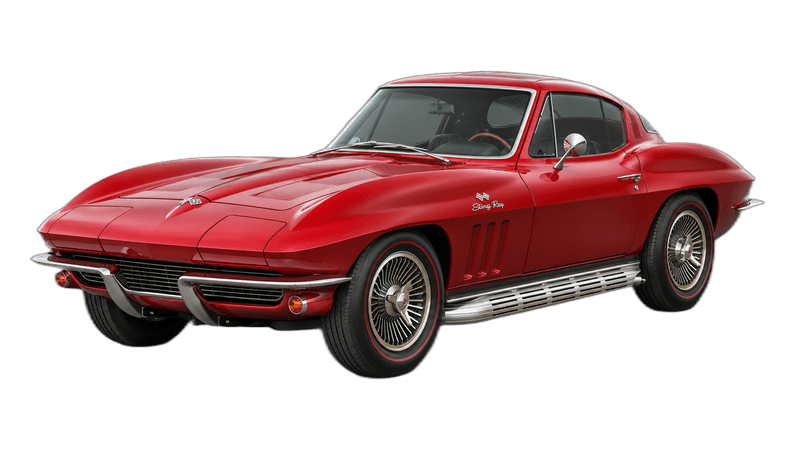
Chevrolet Corvette Sting Ray 427 (C2)
425cv
Potencia
245km/h
Velocidad Máxima
The Chevrolet Corvette Sting Ray 427 (C2) is a 2-door coupé or convertible by Chevrolet, with 425 bhp, 624 Nm of torque and a top speed of 245 km/h.
Dream Car Garage Editorial · Edited by José Teo Lorente Vallecillos · Last updated 3 November 2026
Visión General
We have not driven this car. This review is based on published specifications and the sources listed below.
Scope of this guide
This guide is scoped to the Chevrolet Corvette Sting Ray 427 (C2), the second-generation Corvette fitted with the 427 cubic inch big-block V8 in the 1966 and 1967 model years. It is a front-engine, rear-wheel drive two-door car sold as a coupe and as a convertible, with a fibreglass body on a ladder frame. We cover the 390 bhp form (RPO L36) and the 425 bhp form (RPO L72). The 400 and 435 bhp Tri-Power cars (L68 and L71), the L88 and the L89 appear only as context, because they are separate engines with their own histories. We also leave out the small-block Sting Rays of the same years.
We have not driven this model for this article. We are an editorial desk that reads sources, and everything below comes from pages we opened: two Wikipedia articles, a Wikipedia article on horsepower, two corvettestory.com specification pages, two Corvsport guides, an Ultimatecarpage specification sheet, a Greg Wapling year-by-year page and an RM Sotheby's lot page. Parts of this subject are collectible, and a guide like this cannot replace an inspection by a specialist who knows these cars. This page is for research, not a buying recommendation.
The figures at a glance
- Engine: 7.0L naturally aspirated V8, 427 cubic inches, with a 4.25 inch bore and a 3.76 inch stroke. It is a cast-iron overhead-valve engine with two valves per cylinder.
- Power: 425 bhp for the L72 and 390 bhp for the L36. These are period ratings, quoted before the industry moved to net figures, so we read them as SAE gross. See the next section for how sure we are of that.
- Torque: 624 Nm. Both 427 engines are listed at 460 lb-ft. We converted at 1 lb-ft = 1.355818 Nm, which gives 623.7 and rounds to 624 Nm. The L36 peaks at 3,600 rpm and the L72 at 4,000 rpm in the corvettestory.com and Corvsport tables.
- 0-100 km/h: no figure shown. We found 0-60 mph times (4.8, 5.4 and 5.6 seconds depending on source, gearing and test), but a 0-60 mph time is not a 0-100 km/h time and we do not relabel one as the other.
- Top speed: 245 km/h, which is the 152 mph printed by Ultimatecarpage and by the RM Sotheby's lot page, converted at 1 mph = 1.609344 km/h (about 244.6). Other sources give 140 mph, about 225 km/h. See below.
- Drive: rear-wheel drive. Corvsport says the 427 required Positraction and a four-speed manual, and Greg Wapling says no other transmission was offered with it.
- Weight: 3,614 lb for a 1966 L72 with the four-speed and 3,612 lb for the L36, per corvettestory.com. It says a 427 adds about 200 lb over a small-block car. For 1967 the same site lists 3,626 lb for the L36.
- Size: 98.0 inch wheelbase and 175.1 inch length, per corvettestory.com.
- Option prices in 1966: $181.20 for the L36 and $312.85 for the L72, on a base price of $4,295 for the coupe and $4,084 for the convertible. In 1967 the L36 cost $200.15 on a base price of $4,388 for the coupe and $4,240 for the convertible.
- Production by option: 5,116 L36 and 5,258 L72 in 1966; 3,832 L36 in 1967. Total Corvette production was 27,720 in 1966 and 22,940 in 1967.
Where the sources disagree
The L72 was not a 1967 engine. Wikipedia's L72 article says the L72 was no longer offered in the Corvette from 1967 on, the corvettestory.com 1967 page lists no L72 in its options, and the Corvsport 1967 guide does not mention one. So the 425 bhp engine in this guide exists only in the 1966 cars. In 1967 the 390 bhp L36 carried on, joined by the 400 bhp L68 and the 435 bhp L71. We keep the 1966-1967 range because the L36 spans both years, and we say plainly that 425 bhp applies to 1966.
Gross or net is the next question. None of the Corvette pages we read states whether 425 bhp is gross or net, and Wikipedia's L72 article says it is not specified. Wikipedia's horsepower article says that US ratings before the 1972 model year excluded accessories such as the alternator and water pump, which is the SAE gross basis, and that automakers moved to SAE net around 1971 and 1972. Applying that rule to a 1966 car, we treat 425 bhp as SAE gross. That is our inference from the era, not a line in a Corvette source, and a net figure would be lower.
The 425 figure itself is also contested. Corvsport says the L36 was first badged 400 bhp and the L72 first badged 450 bhp. Wikipedia's L72 article says the L72 was initially rated at 450 hp and then reduced to 425 with no change in output. The Wikipedia Corvette article says ratings were understated for insurance and NHRA reasons, and the Greg Wapling page says 420 and 450 bhp are closer to the real figures. We use 425 because it is the published rating all of our sources agree on, while treating it as a rating and not a measurement.
Peak power rpm differs too. corvettestory.com, Corvsport and Greg Wapling put the L72 peak at 5,600 rpm, while Ultimatecarpage prints 6,400 rpm. We side with the three that agree.
Performance times differ more. Corvsport, citing Car and Driver, gives 4.8 seconds to 60 mph, 11.2 seconds to 100 mph and a 12.8 second quarter mile at 112 mph with 4.11 gearing, and about 5.4 seconds to 60 mph with 3.36 gearing. Greg Wapling gives the same 4.8 and 11.2 with 4.11 gearing and a 140 mph top speed, but ties 5.4 seconds and the 12.8 second quarter to 3.36 gearing, and also lists 5.6 seconds to 60 mph with a 13.4 second quarter mile at 105 mph. Corvsport ties the roughly 140 mph top speed to the 3.36 car instead. So the sources disagree on which axle goes with which result. Ultimatecarpage and the RM Sotheby's lot page print 152 mph and 4.8 seconds, with no test named. We show 245 km/h because two sources print 152 mph, but 225 km/h (140 mph) is the more cautious number.
Displacement is printed as 6,993 cc by Wikipedia and 6,999 cc by Ultimatecarpage. We use the stated 427 cubic inches and call it 7.0L.
Finally, RM Sotheby's prints 5,528 buyers of the L72, while corvettestory.com, Corvsport and Ultimatecarpage print 5,258. We think the RM number is a transposition, but that is our reading.
History and what changed
The 427 replaced the 396 big-block for 1966. Both Wikipedia and Corvsport put its torque at 460 lb-ft against 415 lb-ft for the 396. The two 427s differ in more than a rating. Per Corvsport and Wikipedia, the L36 has 10.25:1 compression, hydraulic lifters and a Holley four-barrel on a cast-iron intake. The L72 has 11.0:1 compression, mechanical lifters, larger intake valves, a larger Holley (Corvsport says 780 cfm) on an aluminium manifold and four-bolt main bearing caps. corvettestory.com lists the L72 with 170 psi cranking pressure and the L36 with 160.
Corvsport says the 427 came with required equipment: Positraction, the four-speed, F41 special suspension, shot-peened half-shafts and U-joints, a heavier radiator and sump, and the bulged hood. RM Sotheby's adds that the L72 required K66 transistor ignition. corvettestory.com lists Positraction on 24,056 of 27,720 1966 cars.
The 1966 car lost its horizontal grille bars for an egg-crate insert, lost the coupe's roof extractor vents, and gained standard backup lights, according to Corvsport and Wikipedia. Four-wheel disc brakes were already standard: Corvsport describes 11.75 inch rotors with four-piston calipers, with power assist (J50) on 5,464 cars and the heavy-duty J56 package on 382. Side-mounted exhaust (N14) was fitted to 3,617 cars at $131.65.
For 1967, per Wikipedia and Corvsport, the car got five smaller front fender vents in place of three larger ones, flattened rocker panels, a single backup light above the number plate, bolt-on six-inch Rally wheels in place of knock-offs, and a parking brake moved to the centre console. Corvsport adds that a dual-circuit brake master cylinder arrived. The 427 hood bulge became a scoop, per Wikipedia.
Context: the other 427 Corvettes
- L68 and L71 (1967): Tri-Power with three two-barrel carburettors, rated 400 bhp and 435 bhp. corvettestory.com counts 2,101 L68 and 3,754 L71 cars.
- L88 (1967): rated 430 bhp, 20 built per both Wikipedia and corvettestory.com. Wikipedia estimates real output at about 560 bhp at 6,400 rpm and Corvsport gives 540 to 560. It needed 103-octane fuel and deleted the heater.
- L89 (1967): aluminium heads on the L71, 16 built per corvettestory.com.
What to check before buying
Everything here is drawn from the Corvsport buying notes and the 1967 guide, and none of it is a substitute for a specialist.
- Engine pad and casting: Corvsport says a 427 should carry a Tonawanda T prefix, an IH, IK or IL suffix, and a block date before the build date. An L72 needs a four-bolt block, an aluminium intake and a 780 Holley.
- Specification logic: Corvsport says a 427 car without Positraction, the four-speed or F41 suspension is wrong somewhere, and that the 450 bhp badge is easy to reproduce and proves nothing about an early car.
- Paperwork: ask for dates and scores on NCRS judging sheets, not only the award, and for the tank sticker and Protect-O-Plate. RM Sotheby's, for its 1992-1993 NCRS Top Flight and Bloomington Gold car, did not mention either document on the page we read.
- Rust: windshield frame, door hinge pillars and, on coupes, the rear window frame; and the ladder frame at the kickups and trailing-arm mounts.
- Wear: trailing-arm bushings, half-shaft U-joints, and brake fluid weeping from the four-piston calipers unless sleeved in stainless.
- Cooling: Corvsport says a big block that runs hot often has a radiator or shroud problem, and that cars which have sat need tires, brakes and fuel-system work.
Running costs and known issues
We found no source giving running costs, a service schedule, fuel consumption or failure rates for these cars, so we give none. The weak points above come from one specialist site and are a checklist, not data. Anyone quoting repair costs without a source is guessing. We also did not search a recall database, so we cannot say whether any recall applies; the absence of a recall in our pages is not a clean bill of health.
Market and value notes
Prices vary widely and a few sales do not make a valuation. RM Sotheby's lists a 1966 427/425 convertible in Silver Pearl, a documented NCRS Top Flight winner, as sold for $143,000 at its Auburn Fall 2015 auction; the page gives no sale date or estimate. Corvsport's 1966 guide reports these results without dating them on the page we read: $121,000 for a 76-mile L72 coupe at Mecum Fort Worth, $202,720 for an L72 convertible with hardtop at Kruse, $125,000 for an L36 convertible with hardtop on Bring a Trailer, and $76,000 for an 88,000-mile L36 coupe. It also quotes dealer asking prices of $175,000 to $250,000 for L72 cars and $100,000 to $172,000 for L36 cars, and warns that asking prices and unsold high bids are not sales. For 1967 it reports L36 bids of $55,500 to $90,000 that did not meet reserve. These figures cover different cars, conditions and years, so treat them as a spread.
What we could not find
We found no 0-100 km/h figure in any source, so the catalogue entry for it is no figure shown. We found no maker document: no Chevrolet or General Motors page and no National Corvette Museum page was opened in this pass, so every figure here is from secondary sources, and we found no original Car and Driver text, only citations of it. We could not confirm gross versus net from any Corvette source. We found no combined production count for the 390 and 425 bhp engines across both years, only counts per option code. We found no running-cost, recall or crash-safety data.
About the photograph
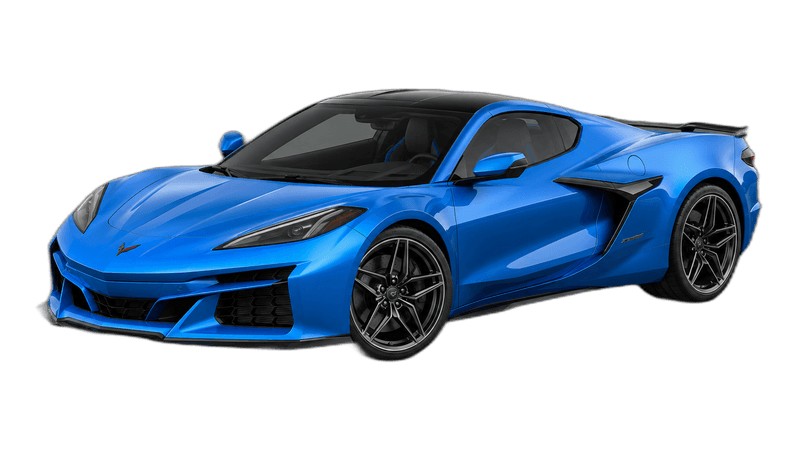
This page uses the catalogue photograph for the car. Its credit is listed on the credits page.
Verdict
The Sting Ray 427 is a front-engine, rear-wheel drive Corvette with a 7.0L naturally aspirated V8, rated 425 bhp in the 1966 L72 (390 bhp in the L36) and 624 Nm on the converted torque figure, with a quoted top speed of 245 km/h and no 0-100 km/h figure shown. The rating is a gross, pre-1972 rating and may understate the engine, and the performance numbers depend on axle ratio and source. Production was 5,116 L36 and 5,258 L72 cars in 1966, and 3,832 L36 cars in 1967. Our reading is that the details that matter are engine pad and casting codes, mandatory-equipment logic, paperwork and rust. We have not driven it, so use the sources, the seller's records and an independent specialist inspection to decide.
Sources
- Wikipedia: Chevrolet Corvette (C2)
- Wikipedia: Chevrolet L72
- Wikipedia: Horsepower (gross and net ratings)
- Corvette Story: 1966 Corvette specs and options
- Corvette Story: 1967 Corvette specs and options
- Corvsport: 1966 Corvette overview
- Corvsport: 1967 Corvette overview
- Ultimatecarpage: Chevrolet Corvette C2 Sting Ray 427 Coupe specifications
- Greg Wapling: 1966 Corvette year by year
- RM Sotheby's: 1966 Corvette Sting Ray 427/425 convertible (Auburn Fall 2015)
Especificaciones
Motor
7.0L naturally aspirated V8
Cilindrada
7.0L
Potencia
425 cv
Par Motor
624 Nm
Velocidad Máxima
245 km/h
Tracción
RWD
País
United States
Carrocería
2-door coupé or convertible
Años
1966–1967
Specifications are manufacturer-published figures.
Más de Chevrolet


Preguntas Frecuentes
What are the specifications of the Chevrolet Corvette Sting Ray 427 (C2)?
The Chevrolet Corvette Sting Ray 427 (C2) is a 2-door coupé or convertible by Chevrolet, with 425 bhp, 624 Nm of torque and a top speed of 245 km/h.
What drivetrain does the Chevrolet Corvette Sting Ray 427 (C2) use?
The Chevrolet Corvette Sting Ray 427 (C2) is configured with rear-wheel drive.
What type of car is the Chevrolet Corvette Sting Ray 427 (C2)?
The Chevrolet Corvette Sting Ray 427 (C2) is a gts manufactured by Chevrolet in United States. Production ran from 1966 to 1967.