
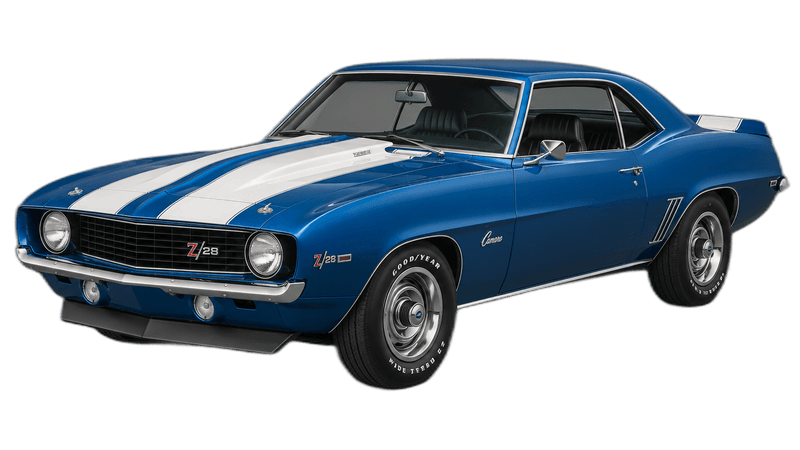
Chevrolet Camaro Z/28 (1969)
£78,000
usedIndicative market price, updated periodically.
290bhp
Power
214km/h
Top Speed
£78,000
Price Used
The Chevrolet Camaro Z/28 (1969) produces 290 bhp and has a top speed of 214 km/h. A representative example is worth about £78,000.
Dream Car Garage Editorial · Edited by José Teo Lorente Vallecillos · Last updated 3 November 2026
Overview
We have not driven this car. This review is based on published specifications and the sources listed below.
Scope of this guide
This guide is scoped to the Chevrolet Camaro Z/28 (1969), the 1969 model-year car from the first generation of the Camaro, built with the Special Performance Package (RPO Z28) and its 302 cubic inch small-block V8. It is a front-engine, rear-wheel drive two-door car, and the museum example we read is a coupe. It is not a guide to the 1967 or 1968 Z/28, to the 1970 and later cars that dropped the 302 for a 350, to the big-block 396 or the 7-litre ZL1 and Yenko Camaros, or to ordinary 1969 Camaros with other engines. We mention those only so that nobody confuses them with this one.
We have not driven this model for this article. We are an editorial desk that reads sources, and everything below comes from pages we opened: Wikipedia, the Audrain Automobile Museum, the Newport Car Museum, Old Cars Weekly, Silodrome, Chevy Hardcore, Carscoops, Jalopnik and the Wikipedia page on horsepower. A 1969 Z/28 is a collector car, and a guide like this cannot replace an inspection by a specialist who knows these cars. This page is for research, not a buying recommendation.
The figures at a glance
- Engine: 4.9L naturally aspirated V8, the 302 cubic inch small-block, with a 4.00 inch bore and 3.00 inch stroke. Wikipedia calls it 302 cubic inches (4.9 L), Audrain prints 302cid/4.95L, and three other pages give 302.4 cubic inches, which is about 4,955 cc at 16.387 cc per cubic inch.
- Power: 290 bhp at 5,800 rpm. Wikipedia prints 290 hp (294 PS, 216 kW), and Audrain, Newport, Silodrome and Old Cars Weekly all agree on 290 at 5,800 rpm. This is a period American rating, not a modern metric-standard figure. See the next section.
- Torque: 393 Nm at 4,200 rpm. The sources print 290 lb-ft, and Wikipedia prints 393 N-m alongside it. We checked the conversion ourselves: 290 lb-ft multiplied by 1.3558 is about 393 Nm.
- 0-100 km/h: no figure shown. We found no 0-100 km/h time. The only acceleration time we found is a 0-60 mph time of 7.4 seconds, reported by Old Cars Weekly from a Car Life test. A 0-60 mph time is not a 0-100 km/h time and we have not relabelled it.
- Top speed: 214 km/h. Old Cars Weekly gives 133 mph from the same Car Life test, and 133 mph multiplied by 1.609 is about 214 km/h. It was a tested speed on a test car, not a maker claim.
- Drive: rear-wheel drive, with a Muncie four-speed manual gearbox, a Hurst shifter and a 12-bolt rear axle with 3.73 gears as standard, per Wikipedia.
- Compression: 11.0:1, per Silodrome and Chevy Hardcore, with forged pistons, a forged steel crankshaft and forged connecting rods.
- Production: 20,302 cars for the 1969 model year, per Wikipedia, Old Cars Weekly, Newport Car Museum and Silodrome.
What the 290 figure means
Chevrolet rated the 302 at 290 at 5,800 rpm, and almost every page we read repeats it. The unit is the question. The Wikipedia page on horsepower says that before the 1972 model year US makers quoted bhp as SAE gross horsepower, measured on a stock test engine without accessories, and that gross figures ran higher than European figures for the same engine because fewer accessories were fitted. It says the term bhp fell into disuse in 1971-1972 as makers moved to SAE net figures. None of the Z/28 pages we read states whether the 290 is gross or net, and Silodrome simply writes 290 bhp. Given the date of the car and the horsepower page, a gross basis is the likely reading, but that is our inference and not something the Z/28 pages say. Either way, 290 bhp here is a US rating of its time, not a figure from a metric standard, and we keep the label bhp only because the catalogue and Silodrome do.
The bigger story is that nobody treats 290 as the real number. Silodrome calls it deliberately conservative, kept under one horsepower per cubic inch, and says this helped insurance costs for younger buyers and avoided scrutiny in racing classification. Silodrome reports a Richard Holdener dyno comparison at 357 bhp at 6,700 rpm and 333 lb-ft at 4,300 rpm with a 750 cfm carburettor and dyno headers, and says period insiders cited about 375 bhp at 6,800 rpm. The Newport Car Museum page lists 375 or more at 7,000 rpm and says dyno tests at close to 400 hp made a joke of the 290 rating. Carscoops says the engine was ludicrously underrated and made closer to 400. Those are claims from museum and enthusiast pages and we could not trace them to a published test sheet, so treat them as a range of opinion. We use 290 bhp throughout because it is the rating, not because we think it is the output.
Where the sources disagree
- Production. Wikipedia, Old Cars Weekly, Newport and Silodrome say 20,302. Audrain says an astounding 19,000 for 1969, which reads as a rounded figure. Carscoops says more than 20,000. We use 20,302. None of the pages we read breaks the total down by body style or option.
- Carburettor. Silodrome and Chevy Hardcore give a 780 cfm Holley four-barrel as standard for all three years. Old Cars Weekly says the factory unit was a single 850-cfm Holley. The 780 figure is in two pages, so we use it, but a buyer should check what is on a given car.
- Cross-ram induction. Chevy Hardcore says buyers could order an aluminium cross-ram intake with two 585 cfm Holleys in 1969. Silodrome says a cross-ram with two 600 cfm Holleys was an over-the-counter service part and not a factory option. Old Cars Weekly describes a JL8 Cross Ram Induction package, while Wikipedia says RPO JL8 was optional four-wheel disc brakes. These accounts do not fit together and we cannot settle them.
- Camshaft lift. Silodrome gives 0.485 inch of valve lift on a solid-lifter 30-30 cam with 0.030 inch hot lash. Chevy Hardcore gives .452 and .455 inch on a Duntov 30/30 cam.
- Displacement. 4.00 inch by 3.00 inch gives about 301.6 cubic inches, while three pages print 302.4. Nothing we read explains the gap, and the difference is under one percent.
- Performance. The Car Life test car in Old Cars Weekly ran special twin 600 cfm Holleys in place of the standard carburettor and had rear disc brakes, so it was not a standard car. The same page notes an earlier test of a single-carb 1968 Z/28 that ran a quicker 14.85 second quarter mile at 101.4 mph, compared with 15.12 seconds at 94.8 mph here.
History and why the car exists
The Z/28 was a homologation car. Audrain and Newport say it began in 1966 as a street-legal version of Chevrolet's SCCA racing effort. Audrain says engineer Vince Piggins promised SCCA officials a Chevrolet entry for the 1967 Trans-Am series, and that the rules required a back seat, a wheelbase no longer than 116 inches, an engine no larger than 305 cubic inches and at least 1,000 street-legal sales. Audrain also says Chevrolet sold 602 Z/28s in 1967 through a loophole involving the regular Camaro, and Piggins had wanted to call it the Camaro Cheetah.
The 302 was built by combining parts of two engines. Carscoops, Silodrome and Jalopnik describe a 327 block with a 283 crankshaft, which kept the displacement under the 305 cubic inch Trans-Am limit. Silodrome says the 302 was fitted only to the first-generation Z/28, from 1967 to 1969, and was not carried into the second-generation car, which got the 350 LT-1.
Sales climbed from 602 in 1967 to 7,199 in 1968 and 20,302 in 1969, per Silodrome, with Audrain giving the same first two figures. Newport says the Penske team, with Mark Donohue at the wheel, beat Ford to win the second Trans-Am championship in 1969, and Carscoops says the Z28 was the car Chevrolet used for the 1969 title, its second in a row. Old Cars Weekly records that GM president Pete Estes predicted 27,000 sales in 1969 and notes that the guess was a little high.
What changed and the options that matter
The sources say little about running changes within the 1969 model year, so we list what they do say.
- Engine: Silodrome says the 1969 block had four-bolt main caps and calls it the only factory 302 to get that upgrade. Chevy Hardcore says all 1968 and 1969 302s used the same carburettor, while the 1967 Van Nuys engines differed because of air-injection requirements.
- Brakes: Wikipedia says power front discs were standard, and that optional four-wheel discs (RPO JL8, four-piston calipers) cost 500.30 US dollars with only 206 units produced.
- Styling: Carscoops says the RS package gave semi-covered headlight doors in 1969. Audrain says about 950 Z/28s, or 5 percent, were Rallye Green in 1969, and Hugger Orange was the most popular colour at 12 percent.
What to check before buying
We found no source listing known faults, and we give none. These are questions we would put to a specialist, drawn from the facts above and not from reported failure data.
- Which engine is in the car. The DZ 302 is the car's defining feature, and a Z/28 is only as significant as its documentation. Ask for build records and how the engine number was verified.
- Carburettor and intake. The sources disagree on the standard unit and on cross-ram availability, so ask what is fitted and whether it is correct for the car.
- Valve lash. Silodrome says the solid-lifter cam is set at 0.030 inch hot lash, so ask when it was last adjusted. We found no interval.
- Brakes. Four-wheel discs were rare (206 units, per Wikipedia), so check whether a claimed set is original.
- Colour and options. Ask for the paperwork behind a claimed rare colour, RS package or option code.
- Body style. The example we read is a coupe, and our sources do not discuss other body styles.
Running costs, parts and recalls
We found no running costs, service schedule, insurance cost, failure statistics or parts-supply information for this car in any page we read, so we give none. Anyone quoting repair costs without a source is guessing. We also found no recall notice and no crash-test or safety-equipment data. That is not a clean bill of health, because we did not search a recall database. A car of this age has no modern crash structure.
Market and value notes
We found no recorded auction result that we could open, so we give no sale price. What we read: Carscoops, on 24 November 2021, cited Hagerty valuation data suggesting well over 100,000 US dollars for a nut-and-bolt restored RS Z28 headed to a Mecum auction. Old Cars Weekly, in an undated article, listed collector values from 69,000 US dollars for the best condition down to 13,800 for the lowest, said documented Z/28s in fine to excellent condition typically sit in the mid-five figures and said cars with rare performance options command six figures. Those values come from different dates and conditions, so treat them as a spread, not a price list.
What we could not find
We found no maker document for this car: no Chevrolet brochure or GM Heritage page gave us torque, acceleration or top speed, so our figures come from museums, Wikipedia and enthusiast press. We found no 0-100 km/h time, and the Car Life 0-60 mph and top speed numbers reach us through Old Cars Weekly, not the original magazine. Nothing we read labels the 290 rating as gross or net. The Old Cars Weekly price series was ambiguous about what it priced, so we left it out. We found no running costs, no recall data and no crash-safety data.
About the photograph
This page uses the catalogue photograph for the car. Its credit is listed on the credits page.
Verdict
The 1969 Camaro Z/28 is a front-engine, rear-wheel drive homologation special built around a 4.9L naturally aspirated V8 rated at 290 bhp and 393 Nm, with a tested 133 mph, which is 214 km/h, and 20,302 made. The rating is widely described as far below the engine's real output, though those claims come from enthusiast pages and not from a test sheet we could read. We show no 0-100 km/h time because we found none, and the 7.4 second 0-60 mph test result is not the same measurement. What the sources point to for any buyer is engine originality, correct induction and brake equipment, and paperwork, checked by a specialist. We have not driven it, so use the sources and an independent inspection to decide.
Sources
- Wikipedia: Chevrolet Camaro (first generation)
- Audrain Automobile Museum: 1969 Chevrolet Camaro Z/28 2 Door Coupe
- Newport Car Museum: Car of the Month, October 2023 (1969 Camaro Z/28)
- Old Cars Weekly: Car of the Week, 1969 Camaro Z/28
- Silodrome: Camaro Z/28 DZ 302 V8 engine
- Silodrome: Camaro Z28 DZ 302 V8 engine listing
- Chevy Hardcore: The Heart Of A Legend, Z/28 Camaro's Small-Block DZ 302
- Carscoops: The RS Z28 was the GT3 Touring of Chevy's 69 Camaro range (24 November 2021)
- Jalopnik: Chevy's 302 Small Block Engine Was Meant To Break The Rules (14 October 2025)
- Wikipedia: Horsepower (SAE gross and net)
Specifications
| Engine | 4.9L naturally aspirated V8 |
|---|---|
| Displacement | 5.0L |
| Power | 290 bhp |
| Torque | 393 Nm |
| Top Speed | 214 km/h |
| Drivetrain | RWD |
| Country | United States |
| Body Style | 2-door coupé |
| Years | 1969 |
| Production | 20,302 |
| Price Used | £78,000 |
Specifications are manufacturer-published figures.
Frequently Asked Questions
What is a Chevrolet Camaro Z/28 (1969) worth?
A representative example is worth about £78,000. Actual values vary with specification, condition and history.
How much power does the Chevrolet Camaro Z/28 (1969) have?
The Chevrolet Camaro Z/28 (1969) produces 290 bhp and 393 Nm of torque.
What is the top speed of the Chevrolet Camaro Z/28 (1969)?
The Chevrolet Camaro Z/28 (1969) has a top speed of 214 km/h.
What engine does the Chevrolet Camaro Z/28 (1969) have?
The Chevrolet Camaro Z/28 (1969) uses a 4.9L naturally aspirated V8.
How many Chevrolet Camaro Z/28 (1969) were made?
Chevrolet produced 20,302 units of the Chevrolet Camaro Z/28 (1969).
When was the Chevrolet Camaro Z/28 (1969) built?
The Chevrolet Camaro Z/28 (1969) was built from 1969 to 1969.
Is the Chevrolet Camaro Z/28 (1969) all-wheel drive?
No. The Chevrolet Camaro Z/28 (1969) is configured with rear-wheel drive.
More from Chevrolet
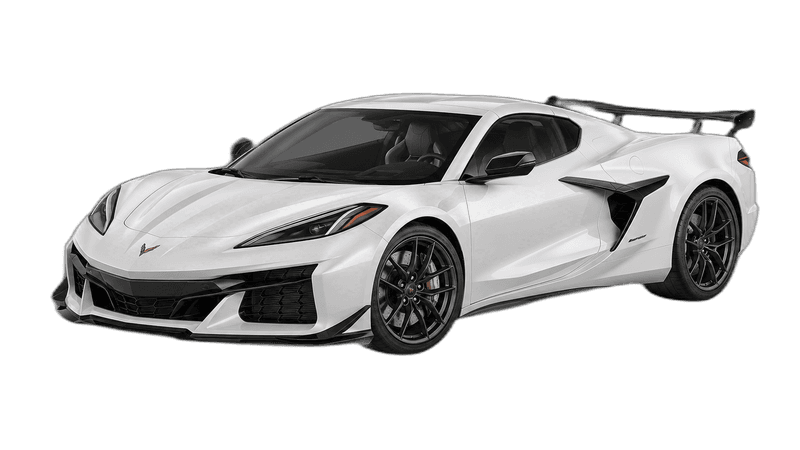 670 hp
Chevrolet Corvette Z06 C8
£120,000
 755 hp
Chevrolet Corvette ZR1 C7
£110,000
 655 hp
Chevrolet Corvette E-Ray
£95,000
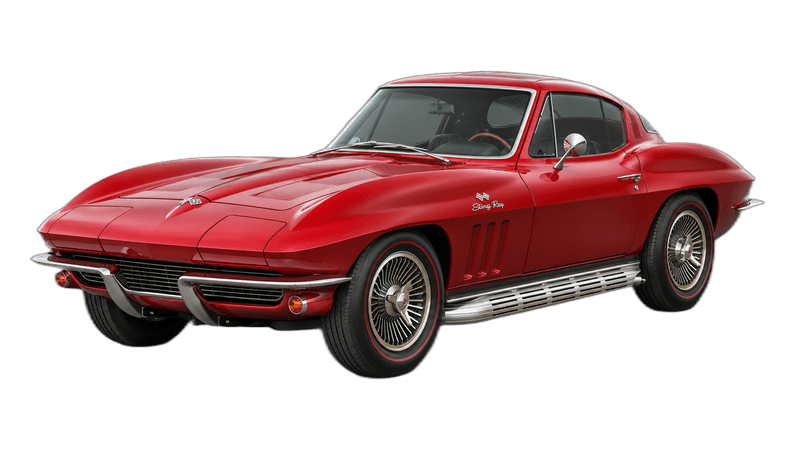 425 hp
Chevrolet Corvette Sting Ray 427 (C2)
£86,000
 490 hp
Chevrolet Corvette Stingray C8
£75,000
 460 hp
Chevrolet Corvette Grand Sport C7
£55,000