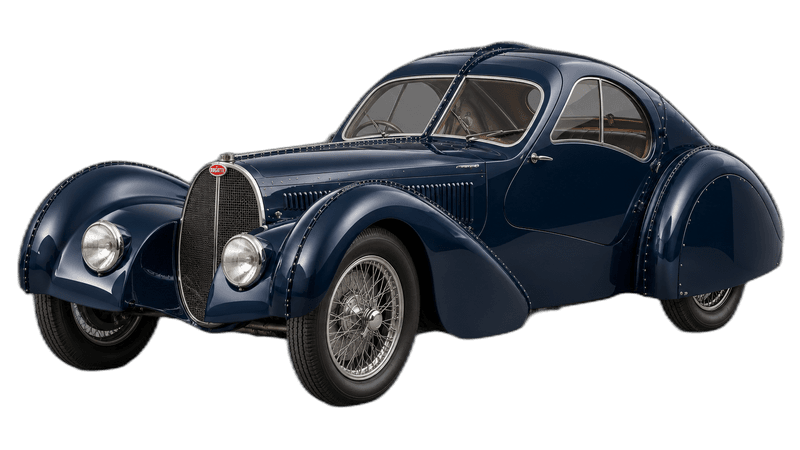
Bugatti Type 57SC Atlantic
200cv
Potencia
200km/h
Velocidad Máxima
The Bugatti Type 57SC Atlantic produces 200 bhp and has a top speed of 200 km/h.
Dream Car Garage Editorial · Edited by José Teo Lorente Vallecillos · Last updated 3 November 2026
Visión General
We have not driven this car. This review is based on published specifications and the sources listed below.
Scope of this guide
This guide is scoped to the Bugatti Type 57SC Atlantic, the aluminium-bodied two-door coupe that Jean Bugatti designed on the short, lowered Type 57S chassis and that Bugatti built at Molsheim between 1936 and 1938. It is a front-engine car with rear-wheel drive, a 3.3L supercharged inline-eight and a four-speed manual gearbox. It is not a guide to the ordinary Type 57 road cars, to the other Type 57S bodies such as the Atalante, or to the 2019 one-off that Bugatti named La Voiture Noire, which is a modern car and not the 1930s Atlantic. We mention the Aerolithe prototype because the Atlantic cannot be explained without it, but it was a show car and not a customer car.
We have not driven this model for this article. We are an editorial desk that reads sources, and everything below comes from pages we opened: a Bugatti press release, Wikipedia, a press item carried by conceptcarz that repeats the Mullin Automotive Museum's own wording, The Shop magazine, Supercars.net, Ultimatecarpage, Bugatti Revue, Autozine and a conceptcarz specification table. The Atlantic is a collector car that almost never comes to market, and the few examples that exist are held by museums and private collectors. A guide like this cannot replace a specialist inspection, and this page is for research, not a buying recommendation.
The figures at a glance
- Engine: 3.3L supercharged inline-eight, a twin-cam, two-valve-per-cylinder, dry-sump unit. Displacement is 3,257 cc in the Wikipedia, Autozine and Supercars.net pages, with a 72 mm bore and 100 mm stroke given by Wikipedia.
- Power: 200 bhp. Wikipedia gives 200 hp for the supercharged 57SC. Bugatti's own press release says up to 200 PS, which converts to about 197 bhp at 0.98632. Supercars.net and Autozine print 210 bhp or 210 hp, and Bugatti Revue says roughly 220 hp. We show 200 bhp because it is the figure closest to the maker's own wording and to Wikipedia, and we treat the higher numbers as period or later claims we cannot confirm.
- Torque: no figure shown. None of the pages we read gives a torque figure for the Atlantic, so we do not show one.
- 0-100 km/h: no figure shown. Supercars.net gives about 10 seconds for 0-60 mph, but that is a different measurement from 0-100 km/h and we do not convert or relabel it.
- Top speed: 200 km/h. Bugatti says over 200 km/h, and Supercars.net says about 200 km/h (124.3 mph). Wikipedia prints 217 km/h (135 mph) for the supercharged 57SC, and Autozine prints an estimated 120 mph. Bugatti Revue says a handful of sports cars of the era could exceed 130 mph and this was one of them. We chose 200 km/h because two sources land on it and the maker's wording sits just above it.
- Drive: rear-wheel drive through a four-speed manual gearbox, which the conceptcarz table calls non-synchromesh.
- Weight: about 950 kg. Wikipedia gives 950 kg for the Type 57 and 57S, and Supercars.net gives 953 kg. The conceptcarz table prints 1,628 kg (3,590 lb), which is much heavier and may be a different measurement. The sources do not explain the gap.
- Wheelbase: 2,979 mm on the short chassis per Wikipedia and Supercars.net. The conceptcarz table prints 3,299 mm (129.9 in), which matches the long Type 57 and not the short chassis described elsewhere.
- Production: four cars, 1936 to 1938, per Bugatti and Ultimatecarpage.
Where the sources disagree
The Atlantic is one of the most written-about cars in the world and still the sources do not agree on basic facts. We list the disagreements here so that you can see how much of the story rests on which page.
Production count. Bugatti, Wikipedia, Ultimatecarpage, Bugatti Revue and the Mullin wording on conceptcarz all say four were built. Autozine says three production cars, and The Shop magazine calls the Mullin car the first of only three models ever produced. Wikipedia explains the mismatch: for a long time the count was three because chassis 57453 and 57473 were thought to be the same car, and the historian Pierre-Yves Laugier confirmed in 2004 that they were separate. We use four.
Survivors. Bugatti says three cars survive. The Mullin wording, Supercars.net and Wikipedia also say three. Ultimatecarpage and Bugatti Revue say two, and Autozine says two of the three production cars remain largely original. The difference mostly comes from chassis 57473, which was wrecked in a train collision. Bugatti says it was restored decades later but its engine could not be saved, Wikipedia says it was rebuilt and now sits in a collection in Spain, and Bugatti Revue says its authenticity is still disputed. Wikipedia also notes that at Pebble Beach in 2010 it won no prize and was considered a replica. Whether you count it as a survivor depends on how much original material you require. We write three known cars, with one of them disputed, and a fourth that is missing.
Which car came first. Bugatti Revue calls the factory demonstrator, which disappeared before the Second World War, the first example built. Wikipedia says chassis 57374, the Rothschild car, was completed in September 1936 before 57453 in October 1936, and yet calls 57453 the second Atlantic. Bugatti says 57453 was Jean Bugatti's own car. The Mullin wording on conceptcarz calls the Mullin car the first of four. We cannot settle the order from what we read.
Aerolithe chassis. Bugatti gives chassis number 57 104 for the prototype. Wikipedia lists the prototype as chassis 57331 and says a replica was built on chassis 57104 between 2008 and 2013. These cannot both be right, and we do not know which is correct.
Supercharging. The name 57SC means supercharged, but Wikipedia says chassis 57453 was the only Atlantic fitted with a supercharger at the factory, and that 57374 and 57591 received theirs in 1939. Bugatti says the Rothschild car had no supercharger when new. Wikipedia also says only two 57SC cars were built new. Autozine, by contrast, says most 57S owners converted at the factory. Put simply, the car is called an SC today, but several of the cars were not supercharged when first delivered.
From Aerolithe to Atlantic
Bugatti says the Atlantic was developed from the one-off Aerolithe prototype, which it also calls the Coupe Special or Coupe Aero. The Aerolithe was shown at the 1935 Paris Motor Show, and Wikipedia says it later appeared at the British International Motor Show in London. Its body was made of Elektron, which Bugatti describes as an aviation magnesium-aluminium alloy of roughly 90 percent magnesium and 10 percent aluminium. Elektron is light and strong but cannot be welded, so the panels were riveted, and that is where the long dorsal seam comes from. Bugatti Revue notes that some historians doubt Elektron was actually used, which is another place where the record is not firm.
The production Atlantic kept the riveted seam as a styling feature but used aluminium, according to Bugatti, Ultimatecarpage and Bugatti Revue. Supercars.net says the rivets were a deliberate choice for the earlier magnesium parts to reduce the fire risk, and that the lowered Type 57S chassis was used for production. Autozine says the Aerolithe drew only three orders. The Atlantic name comes from the aviator Jean Mermoz, who crossed the South Atlantic and did not return from a South Atlantic crossing in 1936. Wikipedia adds that it was first called the Coupe Aero and renamed after Mermoz was lost.
What happened to the prototype is unclear. Wikipedia says historians lost track of it after 1936, that a former Bugatti chief mechanic said it was broken up for parts, and that chassis 57374 is said to use parts from the prototype. Those two statements sit awkwardly together, and Wikipedia does not resolve them. Bugatti Revue says two prototypes were built, but not at the same time, and that neither survives. The Mullin wording uses a term that is worth knowing: it says the Mullin car is the only surviving Aero Coupe, a designation for the first two cars that were mechanically very similar to the Aerolithe.
The four cars
All of the following comes from the pages named, and the chassis numbers are as those pages print them.
- 57374, the Rothschild car. Delivered new in 1936 to Victor Rothschild, third Baron Rothschild, in grey-blue and without a supercharger, per Bugatti. Bugatti Revue says it was sold in February 1936. Wikipedia lists later owners Mike Oliver, Briggs Cunningham and Peter Williamson, and says it sold in 2010 for 30 million US dollars to a collector linked to the Mullin museum. Autozine says Williamson bought it at auction in 1971 for 59,000 US dollars and that it later sold for 36 million, and Bugatti Revue also gives 59,000 dollars for 1971. The car is now co-owned by Peter and Merle Mullin and Rob and Melani Walton and is cared for by the Mullin Automotive Museum.
- 57473, the Holzschuch car. Delivered to Jacques Holzschuh of France in October 1936 per Bugatti, with the family name spelled in two ways across our sources. Destroyed in a level-crossing collision, dated to 1955 by Wikipedia and Autozine, and rebuilt, with the disputed authenticity described above.
- 57591, the Pope car. Completed in May 1938 for the Briton R.B. Pope according to Bugatti, though Bugatti Revue says March 1938 for the sale. It carries the original UK registration EXK6, per Autozine, and Ralph Lauren has owned it since 1988, per Wikipedia and Autozine. Autozine says it is the most original of the three and was restored by Paul Russel.
- 57453, La Voiture Noire. Jean Bugatti's own car, used for brochure photographs and motor-show demonstrations, per Bugatti. It has not been found since 1938 per Bugatti, while Wikipedia says its whereabouts are unknown and that a 1941 rail record lists the number as 57454.
What changed over the run
The sources describe the changes car by car and not as model years. The Shop and the Mullin wording say the Mullin car was delivered in 1936. Autozine says it returned to Bugatti in 1939 for a supercharger, which agrees with Wikipedia's note that 57374 and 57591 were supercharged in 1939. Bugatti Revue says the Rothschild car was fitted with a supercharger and a Cotal electromagnetic gearbox. Autozine says the Holzschuch car went back to the factory in 1937 and received louvres and extended rear fenders in 1939, and that the Pope car was supercharged in 1939. Bugatti Revue says Pope had the roof raised by one inch and ventilation slots cut into the body, and that the Holzschuch car's fenders were later restyled, possibly by Figoni and Falaschi. Wikipedia says hydraulic brakes replaced cable brakes across the Type 57 range in 1938, and Supercars.net lists drum brakes at the front and rear.
Bugatti Revue describes the interior as close-coupled, cramped and poorly ventilated, with Jaeger instruments on a polished wood fascia, and calls the car impractical. That is a useful correction to the picture of an easy grand tourer.
What the rarity means
Nobody can responsibly give a checklist for buying an Atlantic from a web page. With three known cars, all of them in the hands of long-term collectors and museums, and one missing, the practical questions are about history, not condition. If a car were ever offered, the questions the sources raise would be these.
- Which chassis is it, and does the paperwork match the numbers above, including the 57453 versus 57454 question?
- How much of the car is original? The Holzschuch car shows that a car can be rebuilt around fragments and still be argued over.
- Was it supercharged at the factory or converted in 1939, and does the engine match?
- Is the riveted dorsal seam original, and how were the panels made, given that the Elektron question is disputed?
This page is for research, not a buying recommendation, and it is not a substitute for an expert who can inspect the car and its records in person.
Running costs and known issues
We found no source giving running costs, service intervals, parts supply or failure rates for the Atlantic, so we give none. Anyone quoting a repair cost without a source is guessing. What the sources do say about use is limited to Bugatti Revue's remarks that the car was cramped and poorly ventilated, and its description of the engine as supercharged and roughly 220 hp from an old road test, which does not match the 200 bhp we show. We note that conflict and do not hide it.
Recalls and safety
We found no recall notice for the Atlantic, but that is not a clean bill of health, because we did not search a recall database and a car of this age would not be in one. The car predates modern crash structures, and we found no crash-test or safety-equipment data. The sources describe an aluminium body over ash wood supports on a steel frame, per Supercars.net, which tells you about construction and nothing about crash performance.
Market and value notes
Public sale prices are scarce, and several figures are estimates and not sales. Wikipedia reports 30 million US dollars for chassis 57374 in 2010 and 59,000 US dollars in an earlier sale around 1971. Autozine says 36 million for the same car and also 59,000 for 1971. Bugatti Revue gives 59,000 dollars for the 1971 sale and says the Pope car sold in 1967 for 3,000 pounds, about 8,500 dollars, and values the cars at nearly 10 million dollars, an old figure. Bugatti says experts estimate that the missing La Voiture Noire would be worth more than 100 million euros if it reappeared, and Wikipedia says an estimate of about 114 million US dollars has been given for it and that 57591 was appraised at 100 million dollars by Shawn Henry. These are estimates and not transactions. The 2010 figure differs between pages, so we do not give one price as settled.
Recognition is well documented. The Mullin car was named Best of Show Concours d'Etat at Chantilly Arts and Elegance in 2017, won the Peninsula Best of the Best award in 2018 according to Supercars.net, and was named the Nethercutt Most Elegant Closed Car at Pebble Beach on 15 August 2021 according to the Mullin wording on conceptcarz. Wikipedia and Autozine say the Rothschild car won Best of Show at Pebble Beach in 2003 and the Pope car won in 1990, though these dates need the context that the Rothschild car was owned by Williamson at the time.
What we could not find
We found no torque figure and no 0-100 km/h time for the Atlantic, which is why no figure shown appears against those fields. We found no maker-published specification sheet for the 57SC Atlantic, no running costs, no recall data, no crash data and no settled production, survivor or chassis story. We did not search registries or auction archives for the Rothschild car, and we have no sale price for any Atlantic other than those quoted above. We also could not find an agreed account of what became of the Aerolithe.
About the photograph
This page uses the catalogue photograph for the car. Its credit is listed on the credits page.
Verdict
The Atlantic is a front-engine, rear-wheel-drive coupe with a 3.3L supercharged inline-eight making 200 bhp on the figure we chose, a top speed of about 200 km/h, and no reliable torque or 0-100 km/h figure in the sources we read. What it really offers is rarity and design: four built between 1936 and 1938, three known today with one disputed, and the Aerolithe story behind the riveted spine. The careful way to use this page is to treat the numbers as indicative, to note how often the sources disagree, and to rely on specialist records for any real decision. We have not driven it, so this is a reading guide and not a buying recommendation.
Sources
- Bugatti Newsroom: The Bugatti Type 57 SC Atlantic, a style icon
- Wikipedia: Bugatti Type 57
- Wikipedia: Bugatti Type 57S
- conceptcarz: Mullin Automotive Museum's 1936 Bugatti Type 57SC Atlantic
- conceptcarz: Bugatti Type 57SC Atlantic specifications
- The Shop: 1936 Bugatti Type 57SC Atlantic
- Supercars.net: Bugatti Type 57SC Atlantic
- Supercars.net: 1936 Bugatti Type 57SC Atlantic (Mullin car)
- Ultimatecarpage: Bugatti Type 57 SC Atlantic Coupe
- Bugatti Revue: the Atlantic
- Autozine: Bugatti Type 57SC Atlantic
Especificaciones
| Motor | 3.3L supercharged inline-eight |
|---|---|
| Cilindrada | 3.3L |
| Potencia | 200 cv |
| Velocidad Máxima | 200 km/h |
| Tracción | RWD |
| País | France |
| Carrocería | 2-door coupé |
| Años | 1936–1938 |
| Producción | 4 |
Specifications are manufacturer-published figures.
Preguntas Frecuentes
How much power does the Bugatti Type 57SC Atlantic have?
The Bugatti Type 57SC Atlantic produces 200 bhp.
What is the top speed of the Bugatti Type 57SC Atlantic?
The Bugatti Type 57SC Atlantic has a top speed of 200 km/h.
What engine does the Bugatti Type 57SC Atlantic have?
The Bugatti Type 57SC Atlantic uses a 3.3L supercharged inline-eight.
How many Bugatti Type 57SC Atlantic were made?
Bugatti produced 4 units of the Bugatti Type 57SC Atlantic.
When was the Bugatti Type 57SC Atlantic built?
The Bugatti Type 57SC Atlantic was built from 1936 to 1938.
Is the Bugatti Type 57SC Atlantic all-wheel drive?
No. The Bugatti Type 57SC Atlantic is configured with rear-wheel drive.