
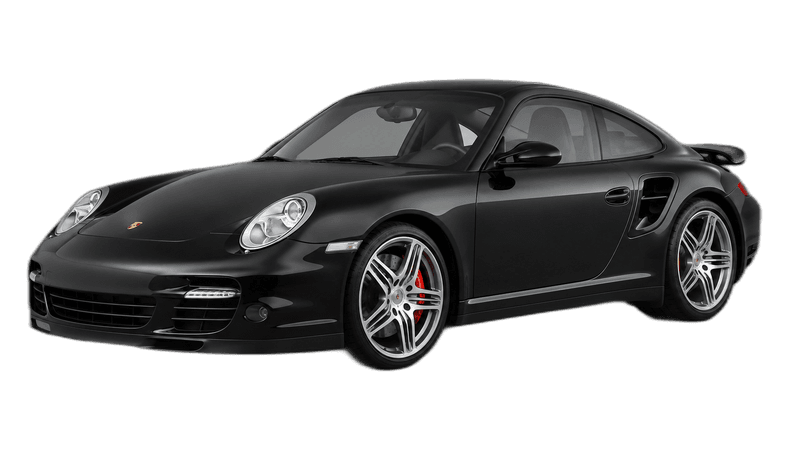
Porsche 911 Turbo (997)
£85,000
usedIndicative market price, updated periodically.
£85,000
Price Used
The Porsche 911 Turbo (997) is a 2+2 coupe / cabriolet by Porsche, powered by a 3.6L (997.1) / 3.8L (997.2) twin-turbocharged flat-6. Indicative used value: approximately £85,000. Actual values vary with specification, condition and history.
Dream Car Garage Editorial · Last updated 27 October 2026
Overview
We have not driven this car. This review is based on published specifications and the sources listed below.
One name, two distinct Turbo phases
The 997 Turbo launched with a 3.6-litre twin-turbocharged Mezger engine producing 480 PS and 620 Nm. Variable turbine geometry was central to its response, and an overboost function could temporarily provide additional torque in the appropriate conditions. Buyers could choose a six-speed manual or five-speed Tiptronic. The later 997.2 Turbo moved to a 3.8-litre direct-injection engine with 500 PS and offered seven-speed PDK alongside the manual.
This is a desk-researched ownership guide. We have not driven this model for this article. The shared model name should not collapse those phases into one specification. An advertised horsepower figure, transmission description or maintenance assumption can refer to a different car unless the model year and original build information agree.
Start with the build record
Obtain the factory option and build information, then reconcile it with the car presented. Establish whether it is a 997.1 or 997.2, standard Turbo or another factory variant, and which engine and transmission are installed now. A replacement engine or gearbox is not automatically unacceptable, but its origin, specification and supporting invoices need to be clear.
The early Mezger unit should not be confused with the ordinary 997 Carrera's M97 engine or with the later direct-injection Turbo engine. That distinction matters when reading general 997 advice. Do not transfer a Carrera bore-scoring or intermediate-shaft discussion to the Turbo merely because both are called 997. Conversely, do not treat the Turbo's reputation as a substitute for examining leaks, cooling, running condition and prior repairs.
Inspect the cooling and front-end environment
The 9Werks 997.1 guide highlights coolant-pipe corrosion, air-conditioning condensers and the central radiator. Inspect accessible pipework, radiators, condensers and mounting points, and ask a specialist which areas need additional access. Corrosion in one front-end component is a reason to examine its neighbours, not proof of a particular systemic failure in every car.
Check coolant and oil for evidence of leakage and review any overheating or repeated refrigerant work. Test the air conditioning after a full warm-up. Fresh coolant or recently cleaned radiator fins tell you little about concealed corrosion by themselves. Ask for photographs from previous work if they help establish what was repaired and what remains original.
Assess the transmission that is actually fitted
A 997.1 manual, a 997.1 Tiptronic and a 997.2 PDK are three different ownership experiences. On a manual, examine clutch engagement, gear selection and synchromesh behaviour. On Tiptronic, assess ordinary and full-load shifts, engagement and fluid-history evidence. On PDK, check low-speed behaviour, shift quality and service documentation. None should be diagnosed from a generic 997 checklist alone.
Published acceleration varies with engine phase, transmission and launch procedure. Avoid combining the quickest figure from one combination with another car's torque or top-speed claim. Overboost also has operating conditions and, on the early car, a time limit; it is not a second permanent torque rating to use without explanation.
Steering, suspension and cooling-air hardware
The 997.1 retains hydraulic steering, which is part of its appeal but also means the steering rack and associated hardware deserve inspection. 9Werks advises checking for steering-rack leaks and corrosion around front suspension components. Dampers, bushes, control arms and engine mounts should be assessed for actual wear, noises and alignment findings.
Examine wheels and tyres for damage, correct sizes, matching specification and consistent dates. All-wheel drive does not make tyre condition less important. Modifications to springs, dampers, wheels or engine software should be documented as a complete specification, with original parts where available. An aggressive setup is not inherently an improvement for road use.
Turbo-specific corrosion and brake checks
The 9Werks guide also identifies turbo-housing corrosion as an inspection point. Ask the specialist to examine accessible housings and associated hardware rather than treating surface appearance elsewhere in the engine bay as sufficient. Any boost abnormality, smoke or unusual noise warrants diagnosis; a visual check cannot establish the internal condition of a turbocharger.
PCCB was optional. Establish whether the car retains ceramics, uses steel discs or has been converted. Inspect and measure the fitted system, including pads, hoses and evidence of inactivity. Ceramic-disc damage or an undocumented conversion should be resolved before purchase rather than converted into an assumed future expense without evidence.
Coupe, Cabriolet and cabin checks
The model line includes coupe and Cabriolet forms. Check accident repairs, panel alignment, structural mounting points and underside condition. On a Cabriolet, operate the roof repeatedly where appropriate and inspect seals, drains and damp areas. Do not let a clean hood exterior substitute for checking the mechanism and cabin for water ingress.
Test seat movement, windows, mirrors, climate control, locks and the PCM equipment fitted. Check warning lights and stored faults with appropriate diagnostic equipment. Modifications to audio or electronics should be assessed for installation quality and battery drain, not dismissed as period character.
Choose from evidence, not generation hierarchy
A later 997.2 is not automatically the right purchase, and an early 997.1 is not automatically the more characterful or better documented example. Compare the precise engine, transmission, body, options and condition. Request a written inspection with separate repair priorities for safety, maintenance and cosmetic work.
This guide offers no valuation floor, failure-rate estimate or resale forecast. A car that can be inspected and maintained with known scope is a stronger proposition than one whose appeal depends on a broad claim about collectability. Retain independent findings and allow for work that only further diagnosis can resolve.
How this review was compiled
We used Porsche's official Turbo-generation history, the 9Werks 997.1 Turbo buying guide and StuttCars' wider 997 reference. We did not drive the car, survey completed sales or measure failure frequency. Inspection points are evidence-led questions for a Porsche specialist, not assurances that a fault is present or absent.
Specifications
Engine
3.6L (997.1) / 3.8L (997.2) twin-turbocharged flat-6
Drivetrain
AWD
Country
Germany
Body Style
2+2 coupe / cabriolet
Years
2006–2013
Price Used
£85,000
Specifications are manufacturer-published figures.
More from Porsche


Featured in Carpedia
Frequently Asked Questions
What are the specifications of the Porsche 911 Turbo (997)?
The Porsche 911 Turbo (997) is a 2+2 coupe / cabriolet by Porsche, powered by a 3.6L (997.1) / 3.8L (997.2) twin-turbocharged flat-6. Indicative used value: approximately £85,000. Actual values vary with specification, condition and history.
How much does a Porsche 911 Turbo (997) cost?
Indicative used value: approximately £85,000. Actual values vary with specification, condition and history.
Is the Porsche 911 Turbo (997) AWD or RWD?
The Porsche 911 Turbo (997) uses a AWD drivetrain configuration in a 2+2 coupe / cabriolet body style.
What type of car is the Porsche 911 Turbo (997)?
The Porsche 911 Turbo (997) is a sports cars manufactured by Porsche in Germany. Production ran from 2006 to 2013.