
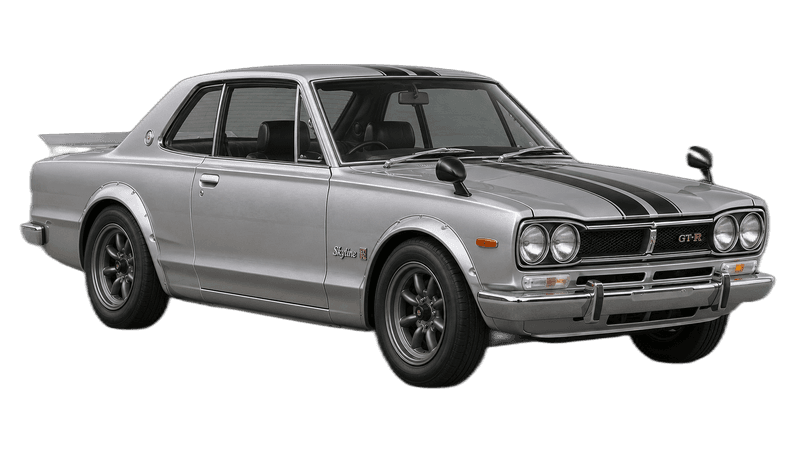
Nissan Skyline KPGC10 GT-R
158bhp
Power
201km/h
Top Speed
The Nissan Skyline KPGC10 GT-R is a 2-door coupé by Nissan, with 158 bhp, 176 Nm of torque and a top speed of 201 km/h.
Dream Car Garage Editorial · Last updated 3 November 2026
Overview
We have not driven this car. This review is based on published specifications and the sources listed below.
Scope of this guide
This guide is scoped to the Nissan Skyline KPGC10 GT-R, the two-door hardtop coupe version of the first-generation Skyline GT-R, nicknamed Hakosuka, sold in Japan from 1970 to 1972. It is a front-engine, rear-wheel drive car with the DOHC S20 inline-six and a five-speed manual gearbox. It is not a guide to the four-door PGC10 saloon, which was the first Skyline GT-R and went on sale in February 1969 before the coupe existed. The two share an engine and a nickname, and many web pages blend their figures, so we keep them apart wherever the sources let us.
We have not driven this model for this article. We are an editorial desk that reads sources, and everything below comes from pages we opened: Nissan's own Heritage Collection page for the KPGC10, Wikipedia, two auction houses (RM Sotheby's and BH Auction), the Conceptcarz and Gentleman Racer pages, a Skyline specification page at JB Skyline, and a kit review at Modeling Madness. This is a rare collector car that seldom comes to market, and a guide like this cannot replace an inspection by a specialist who knows the S20 and the KPGC10 chassis. This page is for research, not a buying recommendation.
The figures at a glance
- Engine: 2.0L naturally aspirated inline-six, the S20, a DOHC four-valve-per-cylinder engine. Nissan lists 1,989 cc. The pages we read describe triple side-draft carburettors and none mentions a turbocharger or supercharger, which is why we call it naturally aspirated.
- Power: 158 bhp. Nissan prints 118 kW (160 PS) at 7,000 rpm. We convert 160 PS to bhp at x0.98632, which gives 157.8, rounded to 158 bhp. Converting Nissan's 118 kW at x1.34102 gives 158.2, which agrees. Wikipedia and Modeling Madness print 119 kW, 162 PS and 160 bhp instead, so the sources do not fully agree. We chose Nissan's figure because it is the maker's own and is specific to the KPGC10.
- Torque: 176 Nm. Nissan prints 176 Nm (18.0 kgf-m) at 5,600 rpm and Wikipedia prints the same 176 Nm (130 lb-ft). JB Skyline prints 180 Nm (133 lb-ft) at the same engine speed.
- 0-100 km/h: no figure shown. None of the pages we read gives a 0-100 km/h or 0-60 mph time for the coupe.
- Top speed: 201 km/h. Only JB Skyline gives a top speed, 125 mph for both the saloon and the coupe. We convert at 1.609 km/h per mph, which gives about 201 km/h. This is a single third-party figure, not a maker figure, and Nissan's page does not list a top speed, so treat it as a claim. The round 200 km/h that circulates is not printed on any page we read.
- Drive: rear-wheel drive, five-speed manual, with a limited-slip rear differential per Wikipedia.
- Weight and size: Nissan lists 1,100 kg kerb weight, a 2,570 mm wheelbase that was shortened by 70 mm for the hardtop, and overall dimensions of 4,330 x 1,665 x 1,370 mm.
- Production: about 1,197 coupes, from Wikipedia and BH Auction, with other counts discussed below.
Coupe versus saloon
The coupe is the second body style of the first-generation GT-R. Nissan's page says the saloon became dominant in domestic touring car racing and that the hardtop followed it, with a smaller body, full bucket seats without recliners and a bare-bones interior. Nissan says the hardtop is over 20 kg lighter than the sedan, and JB Skyline lists 1,100 kg against 1,120 kg for the PGC10, which fits.
Wikipedia says the coupe arrived in October 1970 as a minor change to the base Skyline, and lists the KPGC10-specific changes as black fibreglass over-bumpers at the rear wheel arches, Talbot-shaped mirrors in place of bullet-shaped ones and a redesigned grille. RM Sotheby's puts the debut in October 1970 and a public introduction in March 1971, and Modeling Madness also says the coupe became available in March 1971. We read this as a late-1970 debut with sales building through 1971. The PGC10 saloon is covered by Gentleman Racer and Conceptcarz, which both say 832 GT-R saloons were built, and we do not use those pages for the coupe's own specification.
History and the S20 engine
Wikipedia says the first GT-R was sold through the Nissan Prince Store network and was advertised alongside the R380 racing car. Nissan's page says the S20 used technology from the R380 prototype, and Conceptcarz says the engine was derived from the R380, which raced the Porsche 906 at the 1966 Japan Grand Prix. Conceptcarz also describes a 7,500 rpm redline, a cross-flow head with four valves per cylinder, and says the engine was used only in the GT-R and the Fairlady Z 432. We did not independently confirm the Fairlady Z detail beyond that page.
The chassis is conventional for the period. Nissan lists strut front suspension, an independent semi-trailing arm rear, front disc and rear drum brakes, 6.45H-14-4PR tyres and a 100 L fuel tank. RM Sotheby's lists the same layout.
Production numbers: what the sources say
This is where the web is least consistent, and the catalogue figure should be treated as an estimate.
- Wikipedia says 832 PGC10 and 1,197 KPGC10 cars were produced, a total of 2,029. The page cites a source for the 832 saloons but shows none for the 1,197 coupes.
- BH Auction, in a 2025 lot description, says an estimated total of just 1,197 units.
- RM Sotheby's says it is believed that about 1,115 GT-R coupes were built between 1970 and 1972.
- Conceptcarz also gives 2,029 for the GT-R overall, with 832 saloons.
- Modeling Madness says a total of 1,945 PGC and KPGC10 cars were produced. That is a combined figure for both bodies, not the coupe alone. If one subtracts the 832 saloons from it, the arithmetic gives 1,113 coupes, which is close to RM Sotheby's 1,115. That subtraction is ours and no page we read states it.
We use about 1,197 for the coupe because two of the pages we read agree on it, but we flag that it is an estimate and that a count near 1,115 is also in print. Nissan's own page gives no production count.
Racing record
Race victory counts are repeated loosely and the pages disagree. Nissan says the GT-R reached 50 victories in March 1972 at domestic touring car races and finished with 52 wins when the works team stopped racing in October 1972. Wikipedia gives 50 motorsport victories from 1968 to 1972, including 49 consecutive wins on Japanese circuits, and elsewhere says the saloon scored 33 victories in the one and a half years it raced. Conceptcarz says 33 straight victories, and RM Sotheby's says 46 straight and outright class wins and more than 50 overall. These totals cover the GT-R as a family, saloon and coupe together, so none is a coupe-only record. We cite Nissan's 52 as the maker's figure and treat the rest as approximate.
What to check before buying
None of our sources is a buying guide, so this is a list of questions the sources raise, not a checklist from a specialist.
- Chassis and engine numbers. RM Sotheby's lists a car with chassis KPGC10-001445 and BH Auction lists KPGC10-000058 with engine S20-001235. A coupe should carry a KPGC10 chassis prefix and an S20 engine number, and a seller should explain any mismatch.
- Engine specification. BH Auction describes its car as having the final K4-specification cylinder head, with longer valves, lightweight valve lifters and a reinforced block. Ask which specification a car has and whether the engine has been rebuilt.
- Modifications. BH Auction lists reupholstered seats and an aftermarket exhaust on its car. Originality matters to value on a car like this.
- Colour and early cars. BH Auction says Skyline Brown was available only in the earliest 1970 production period.
- Documentation and history, including the first registration. RM Sotheby's notes that its car was first registered in Aichi, Japan, in July 1972.
Running costs and known issues
We found no service schedule, no parts prices, no repair costs, no fuel-consumption figure and no failure rates for the KPGC10 in any page we read, so we give none. We will not guess. Nissan's page lists a 100 L fuel tank, but no consumption figure. Insurance, maintenance and parts availability for a 1970s Japanese-market sports coupe are matters for a specialist and an insurer.
Recalls and safety
We found no recall notice for this model in any page we read, but that is not a clean bill of health, because we did not search a recall database. We found no crash-test or safety-equipment data. The car has front discs and rear drums per Nissan, and a bare-bones interior. A specialist check of brakes, tyres, steering and fuel system is sensible before any road use.
Market and value notes
Prices on the pages we read are few and a handful of data points do not make a valuation.
- RM Sotheby's Monterey 2014: a 1972 KPGC10 sold for 242,000 US dollars. The page text calls it Lot 201 while the web address contains r205; we do not know which is right. The page does not list the sale date or the estimate.
- BH Auction, Tokyo Bay, 7 to 9 November 2025, Lot 20: a 1970 KPGC10 with 9,911 km carried an estimate of 49,000,000 to 51,000,000 yen. No sale result or final price is shown on the page we read.
These are an auction result and an estimate eleven years apart, in different currencies. We found no current valuation guide and will not invent one.
What we could not find
We found no maker figure for top speed or for 0-100 km/h, so the speed figure is a single third-party claim and the acceleration is no figure shown. We found no production count from Nissan itself, and the coupe count rests on Wikipedia and an auction house estimate against another auction house's lower figure. We found no running-cost data, no recall data and no crash-safety data. The Encycarpedia page for the Hakosuka coupe returned an access-forbidden error, and a Sydney Automotive forum thread on production figures returned the same, so we did not read either and did not work around them. We read the first part of the Wikipedia page, which covers the first generation, and not its later sections on newer GT-R generations.
About the photograph
This page uses the catalogue photograph for the car. Its credit is listed on the credits page.
Verdict
The KPGC10 GT-R is a front-engine, rear-wheel drive coupe with a 2.0L naturally aspirated inline-six rated by Nissan at 160 PS, which we convert to 158 bhp, and 176 Nm. It has a claimed top speed that converts to 201 km/h and no 0-100 km/h figure shown, because no source gave one. It was built from 1970 to 1972 in a quantity that sources put between about 1,115 and 1,197. The practical lessons from our reading are to keep the coupe separate from the saloon, to verify chassis and engine numbers, to ask about the cylinder head specification, and to expect disagreement between sources on almost every number. We have not driven it, so use the sources, the seller's records and an independent specialist inspection, and treat this page as research, not a buying recommendation.
Sources
- Nissan Global Heritage Collection: Skyline Hardtop 2000GT-R (KPGC10)
- Wikipedia: Nissan Skyline GT-R, first generation
- RM Sotheby's: 1972 Nissan Skyline HT 2000GT-R Hakosuka (Monterey 2014)
- BH Auction: 1970 Nissan Skyline 2000 GT-R KPGC10 (Tokyo Bay, November 2025)
- JB Skyline: C10 GT-R specifications
- Conceptcarz: Nissan Skyline 2000GT-R
- The Gentleman Racer: 1970 Nissan Skyline 2000GT-R Hakosuka (2014)
- Modeling Madness: Arii 1/32 1971 Nissan Skyline KPGC10 (GT-R)
Specifications
Engine
2.0L naturally aspirated inline-six
Displacement
2.0L
Power
158 bhp
Torque
176 Nm
Top Speed
201 km/h
Drivetrain
RWD
Country
Japan
Body Style
2-door coupé
Years
1970–1972
Production
1,197
Specifications are manufacturer-published figures.
More from Nissan

Frequently Asked Questions
What are the specifications of the Nissan Skyline KPGC10 GT-R?
The Nissan Skyline KPGC10 GT-R is a 2-door coupé by Nissan, with 158 bhp, 176 Nm of torque and a top speed of 201 km/h.
How many Nissan Skyline KPGC10 GT-R were made?
Nissan produced 1,197 units of the Nissan Skyline KPGC10 GT-R.
What drivetrain does the Nissan Skyline KPGC10 GT-R use?
The Nissan Skyline KPGC10 GT-R is configured with rear-wheel drive.
What type of car is the Nissan Skyline KPGC10 GT-R?
The Nissan Skyline KPGC10 GT-R is a sports cars manufactured by Nissan in Japan. Production ran from 1970 to 1972.