
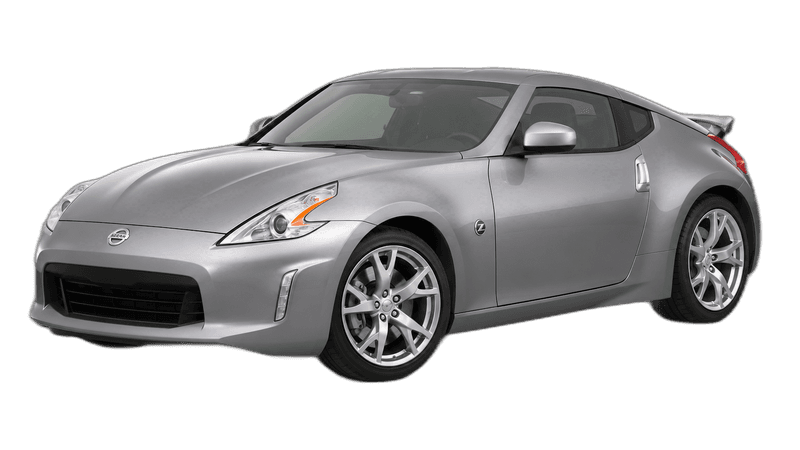
Nissan 370Z
£18,000
usedIndicative market price, updated periodically.
332bhp
Power
5.4s
0-100 km/h
250km/h
Top Speed
£18,000
Price Used
How hard it pulls.
Peak g-force the instant you bury the throttle, estimated from the car's 0–100 time and drivetrain.
Nissan 370ZEstimated peak launch g from the 0–100 time and drivetrain: an honest approximation, not a measured figure.
The Nissan 370Z is a 2-door fastback coupé2-door roadster by Nissan, with 332 bhp, 366 Nm of torque, a 0-100 km/h time of 5.4 seconds and a top speed of 250 km/h. Indicative used value: approximately £18,000. Actual values vary with specification, condition and history.
Dream Car Garage Editorial · Last updated 30 October 2026
Overview
We have not driven this car. This review is based on published specifications and the sources listed below.
The 370Z refines the 350Z formula
The 370Z carried the Z car through a long production run with a larger 3.7-litre V6 and a choice of coupe, roadster, manual and automatic. Our catalogue uses the standard rear-wheel-drive car: a 3696 cc VQ37VHR V6 with 332 bhp, 366 Nm, 0 to 100 km/h in 5.4 seconds and a 250 km/h maximum. We have not driven this model for this article. This is a desk-researched ownership guide using Nissan's 2018 370Z press kit, the PistonHeads 370Z used buying guide and the DVSA recall service. Their evidence should be converted into checks, not treated as a verdict on every example.
Nissan's 2018 press kit lists the standard VQ37VHR at 332 hp and 270 lb-ft, with a six-speed manual or seven-speed automatic. PistonHeads records the UK launch car at 331 hp and a 5.5-second 0-62 mph time for the manual. Small differences between source conventions and catalogue rounding do not change the buying question. The important point is to establish which gearbox, model year and market specification the car actually has before comparing prices or modifications.
Service proof matters more than a reputation for toughness
The VQ37VHR is chain-driven and generally robust, but PistonHeads still recommends normal service discipline and notes a 9,000-mile or 12-month schedule with a more involved service around 54,000 miles. Ask for invoices rather than verbal assurance. The oil should be clean, the coolant service dated and the engine free from unexplained leaks. The Z car's relatively simple layout makes inspection easier, but it does not make neglect harmless.
Listen for cold-start chain noise, top-end rattle and exhaust leaks. The engine should rev cleanly and return to idle without hunting. Check the clutch engagement, shifter feel and, on manual cars, the SynchroRev Match system. PistonHeads advises verifying that the feature operates as intended and notes that the 2018 update introduced a new Exedy high-performance clutch. On automatic cars, test low-speed smoothness, kickdown response and signs of overheating or neglected fluid service. If the car has been remapped, supercharged or turbocharged, ask for calibration details and proof that the cooling and fuel system were upgraded to match.
Chassis wear shows quickly on the right roads
The 370Z uses a front-mid-engine, rear-wheel-drive layout, and its handling depends on healthy dampers, bushings, wheel bearings, steering components and tyres. PistonHeads identifies front droplinks as a source of clonks and warns that optional 19-inch wheels can make the ride very stiff. Test over broken surfaces and listen for loose crashing noises. The car should feel taut, not harsh and disconnected. Uneven tyre wear, mismatched tyres or a steering wheel that does not sit straight are signs that alignment and suspension condition need attention.
Brakes should be measured for pad thickness, disc condition and hose age. Track use is not automatically bad, but it should be disclosed. Look for tyre sidewall scuffing, gravel rash, heat-cycled brakes, oil-cooler fitment and missing underbody protection. The Z is robust enough for track days when maintained, yet a car that has been used hard and serviced cheaply will hand the next owner the bill.
Roadster and body checks are part of the mechanical file
For a roadster, PistonHeads highlights roof motors and the way the windows drop and rise as the roof operates. Work the roof several times, inspect the fabric and rear window, and check the drains. Water ingress can affect carpets, harness connectors and audio equipment. On coupes, inspect hatch struts, panel alignment, paint thickness variation and overspray. Boot struts may seem minor, but they hint at how completely the car has been maintained.
Use the VIN to confirm model year, import status and equipment. Nissan changed details across the run, including GT Edition, facelift and equipment updates. PistonHeads records a mid-2011 GT Edition, a late-2012 facelift and a mid-2017 update, while Nissan's 2018 kit confirms the later clutch refinement. A low-mileage car with no invoices is not automatically stronger than a higher-mileage car with a thick file. The DVSA recall service and Nissan should be used to close campaign checks before money changes hands.
Model-year changes should be verified, not assumed
Because the 370Z ran for many years, small changes can be as important as the headline output. Nissan's press material confirms the VVEL V6 and the later clutch refinement, while PistonHeads records the GT Edition, facelift and equipment updates. Use the VIN to establish the correct year, then check that the wheels, brakes, seats, climate equipment and infotech match that year. A later-style wheel or exhaust may be an upgrade, but it should not be used to imply the whole car is a later specification. Clear photographs, invoices and a data check reduce the chance of paying a facelift price for a pre-facelift car with cosmetic changes.
Buy a used Z with a complete second-half file
The 370Z's long life means condition varies more than badges suggest. A sound car should have clear engine and gearbox history, straight body evidence, healthy tyres and brakes, functioning roof equipment if fitted, and no unexplained warning lights. Nissan supplies the factory specification, while PistonHeads provides the buyer-level inspection list. Use both to separate a maintained sports car from a tired one with fresh polish.
The value in a 370Z comes from its simplicity and durability only when those qualities have been preserved. This guide combines Nissan's historical specifications and the sources listed below. It assigns no exact production count to the standard 370Z.
Specifications
Engine
3.7 L ''VQ37VHR'' V6
Displacement
3.7L
Power
332 bhp
Torque
366 Nm
0-100 km/h
5.4s
Top Speed
250 km/h
Drivetrain
RWD
Country
Japan
Body Style
2-door fastback coupé2-door roadster
Years
2008–2020
Price Used
£18,000
Specifications are manufacturer-published figures.
More from Nissan
Frequently Asked Questions
What are the specifications of the Nissan 370Z?
The Nissan 370Z is a 2-door fastback coupé2-door roadster by Nissan, with 332 bhp, 366 Nm of torque, a 0-100 km/h time of 5.4 seconds and a top speed of 250 km/h. Indicative used value: approximately £18,000. Actual values vary with specification, condition and history.
How much does a Nissan 370Z cost?
Indicative used value: approximately £18,000. Actual values vary with specification, condition and history.
What drivetrain does the Nissan 370Z use?
The Nissan 370Z is configured with rear-wheel drive.
What type of car is the Nissan 370Z?
The Nissan 370Z is a sports cars manufactured by Nissan in Japan. Production ran from 2008 to 2020.