
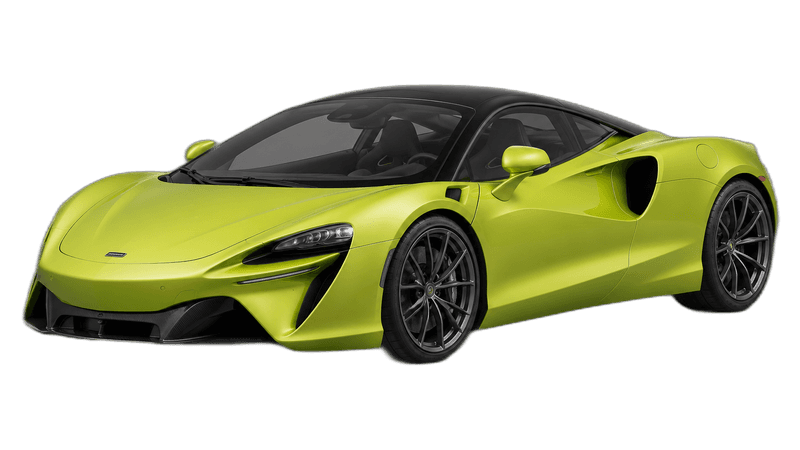
McLaren Artura
£175,000
usedIndicative market price, updated periodically.
690bhp
Power
3s
0-100 km/h
330km/h
Top Speed
£175,000
Price Used
How hard it pulls.
Peak g-force the instant you bury the throttle, estimated from the car's 0–100 time and drivetrain.
McLaren ArturaEstimated peak launch g from the 0–100 time and drivetrain: an honest approximation, not a measured figure.
The McLaren Artura is a 2-door coupe by McLaren, with 690 bhp, 720 Nm of torque, a 0-100 km/h time of 3 seconds and a top speed of 330 km/h. Indicative used value: approximately £175,000. Actual values vary with specification, condition and history.
Dream Car Garage Editorial · Last updated 2 November 2026
Overview
We have not driven this car. This review is based on published specifications and the sources listed below.
McLaren's first series-production plug-in hybrid
The McLaren Artura is a two-seat, mid-engined, rear-wheel-drive plug-in hybrid supercar. It pairs a 3.0-litre twin-turbo V6 with an axial-flux electric motor and an eight-speed dual-clutch gearbox, and it sits on McLaren's carbon fibre MCLA architecture with a built-in battery compartment. PistonHeads says it was announced in early 2021, launched in 2022 with deliveries from the third quarter of that year, and aimed straight at the Ferrari 296 GTB. Our catalogue describes the coupe, with the 3.0L twin-turbo V6 plug-in hybrid (M630) powertrain producing 690 bhp and 720 Nm, 0 to 100 km/h in 3 seconds and a 330 km/h top speed. We have not driven this model for this article. This is a desk-researched ownership guide built from two sources: McLaren's Artura Features and Options Guide (version 04, based on UK and EU specifications as at 26 February 2024), a PistonHeads used buying guide published in January 2026. We did not consult the government recall check for this article, and you should use it yourself. A Spider and a GT4 race version also exist, so we say below where those differ.
Checking the figures
McLaren's guide gives the peak output as 700 PS (515 kW) at 7,500 rpm, split into 605 PS from the combustion engine and 95 PS from the electric motor, with 720 Nm (531 lb ft) at 2,250 rpm. A footnote says the China market car is rated at 680 PS, made up of 585 PS from the engine and 95 PS from the motor, with the same 720 Nm. The 700 PS rating converts to the 690 bhp in our catalogue, a figure McLaren's own table also prints as 690 (with a typo in the unit). PS is the metric horsepower, about 0.986 of a British bhp, and 515 kW is the same output again in kilowatts, so adverts that say 700 PS, 690 bhp or 515 kW describe one rating.
There are two power ratings to keep apart. PistonHeads' specification box gives 670 hp in total and its text mentions a 20 hp power boost for the 2025 model year, which is consistent with a move from about 680 PS to 700 PS. McLaren's document carries no model year, so reading 700 PS as the 2025 model year rating is our inference from those two statements. McLaren's China-market 680 PS rating converts to about 671 bhp, close to PistonHeads' 670 hp, so the launch rating may have been about that level, but that is our inference. PistonHeads reports McLaren's claim of 481 hp per tonne from a 1,395 kg dry weight, which works out at about 671 hp and fits the launch rating, but that arithmetic is ours. The 3 second sprint (0 to 60 mph in PistonHeads, 0 to 100 km/h and 0 to 60 mph in McLaren), the 8.3 seconds to 200 km/h, the 21.5 seconds to 300 km/h and the 330 km/h (205 mph) top speed agree between the sources, and McLaren's 1,498 kg DIN kerb weight and 1,395 kg dry weight match PistonHeads. The guide says its figures are best read as relative rather than definitive.
Not everything lines up. PistonHeads lists 431 lb ft of torque overall, which is about 584 Nm and does not match McLaren's 531 lb ft (720 Nm); PistonHeads says its figure includes the electric assistance, which does not reconcile with McLaren's, so use the McLaren figure. PistonHeads quotes 129 g/km and over 50 mpg where McLaren's table gives 108 g/km, 4.8 litres per 100 km and 33 km of electric-only range under EU WLTP, against PistonHeads' 19 miles in normal driving. McLaren's table lists a 65 litre fuel tank but converts it to 15.8 UK gallons, which is the 72 litres PistonHeads gives, so the tank size is unclear. PistonHeads lists the Spider at 1,560 kg, and McLaren's document does not cover the Spider at all.
Engine, hybrid system and gearbox
PistonHeads says the all-aluminium dry-sump V6 is McLaren's first direct-injection petrol engine and has a 120-degree layout that allows an 8,500 rpm redline. McLaren lists twin electrically actuated turbochargers. The gearbox started as a seven-speeder; McLaren removed the reverse gear, added an extra forward gear and reverses on the electric motor, which is why the box is described as an eight-speed with e-reverse. A 7.4 kWh battery supplies electric running, and PistonHeads says the car starts in E-mode, with Comfort, Sport and Track as the other powertrain modes. It also says it can be charged to 80 per cent in about 2.5 hours, and that electric-only top speed was 81 mph, revised to 75 mph on the 2025 Spider.
On reliability PistonHeads is direct: McLaren has not enjoyed the best reputation for build quality, and early cars had their share of software and hardware problems. It reports at least one electric motor failure, a few drained 12V batteries, oil leaks in the first 500 to 700 miles on some cars and coolant pumps that leaked, in some cases leading to long warranty work. Warning messages reported include hybrid performance decreased, cannot change drive mode, a start button that did not respond and a blank odometer, and the hybrid system sometimes denied access to odd-numbered gears. Owners found that locking the car and walking away with the fob in a pocket for at least 15 minutes sometimes, but not always, cleared the fault, and one hybrid performance fault was cured by topping up the dielectric fluid. Ask the seller what messages the car has shown, check for stored faults and whether the software is up to date, and read any warranty work invoices.
PistonHeads adds ownership habits that owners say reduce software problems: charge the drive battery overnight through the high-voltage port rather than leave it to the power management, which also pre-heats the engine once charging is finished, and let the engine stop on its own after a drive instead of using the start button. The key fob battery has a reputation for not lasting long, especially if the fob is stored near the car. McLaren recommends a retailer service every 9,000 miles (15,000 km) or 12 months. Neither source gives battery degradation data, so we cannot say what a worn drive battery looks like; ask for the state of the battery and any charging history from a McLaren retailer. PistonHeads says a sports exhaust was an optional extra and that real-world fuel economy on petrol alone was in the mid to low 20s mpg when driven enthusiastically and the low 30s when driven steadily.
Chassis, brakes and tyres
PistonHeads describes an 82 kg carbon tub with aluminium subframes at each end, adaptive dampers, double wishbones at the front and a multi-link rear with a hydraulic anti-roll system, plus electro-hydraulic steering. It says the Artura won Autocar's 2024 best driver's car test at Cadwell Park, although some drivers found Track mode too jiggly on public roads. The rear has an electronically controlled limited-slip differential, with a Variable Drift Control mode. PistonHeads says the 2025 model year revisions brought stiffer engine mounts, new damper valving and a damper control unit that runs 90 per cent quicker, and says shift speed was increased by 25 per cent, which suggests the 2025 cars may drive differently from the earlier ones (our inference).
On the wheels, McLaren lists 19-inch front and 20-inch rear alloys with Pirelli P Zero tyres in 235/35 and 295/35 sizes and Pirelli Cyber Tyre technology, which PistonHeads says works with the stability control, and PistonHeads notes the tyre pressure monitoring can be adjusted without triggering warnings. McLaren's guide lists the wheel widths two ways, 9.0J and 11.0J in one place and 8.5J and 10.5J in another, so confirm the fitted size. Standard brakes are carbon ceramic discs of 390 mm at the front and 380 mm at the rear, with six-piston and four-piston calipers, which PistonHeads says work smoothly even in town. Inspect the discs for wear and damage, ask what has been replaced and check the tyres for even wear. PistonHeads also says anti-roll bar links have loosened themselves on some cars and damaged their threads, so look under the car for those.
Body, interior and electronics
PistonHeads says the body panels are a mix of superformed aluminium and composite, with a carbon fibre windscreen surround, and that the intakes below the doors have no screen, so dead leaves collect in them. The windows, and the rear glass on the Spider, can be a little squeaky. The alarm on Spiders has been known to play up, with sensor replacement the usual cure. For the Spider's roof, the guide warns that the 12V battery must be kept in tip-top condition, especially if you plan many engine-off roof demonstrations, since McLarens are sensitive to voltage stability and a weak battery can cause startup problems when the brake pedal pressure sensor does not validate. It also says one reviewer had trouble operating the roof from the fob, although it worked from inside the car. McLaren gives the luggage space as 160 litres, matching PistonHeads' front boot, with a small parcel shelf behind the seats.
Inside, PistonHeads reports the two-screen infotainment system as slow, with a screen that sometimes blanks or takes minutes to start; holding the side button for 30 seconds sometimes brings it back, and that was also the suggested fix when Bluetooth or CarPlay switched off. PistonHeads says CarPlay was available from the start, that Android was not immediately available on UK press cars, and that, as far as it is aware, neither is wireless. Some owners turned off keyless entry because the car failed to lock and power down, leaving lights and screens on, and the parking camera can stay on screen longer than wanted. Air conditioning and tyre pressure monitoring have played up, there have been reports of rattles from the central dash area, and the Bowers and Wilkins speakers reflect in the windscreen. Over-the-air updates are possible because of the electrical architecture. Test every screen, switch, key and camera function on a warm and a cold car.
Recalls, history and warranty
Neither source supplies a recall list for the Artura, and we do not quote recall numbers or dates here. Enter the registration in the DVSA recall service and ask the seller for dealer paperwork showing that any open work, including software updates, was completed. McLaren's document lists a five-year unlimited mileage vehicle warranty, a six-year battery warranty limited to 45,000 miles (75,000 km), a ten-year anti-perforation warranty and three years of inclusive servicing, whereas PistonHeads says five years or 47,000 miles for the car and six years or 47,000 miles for the drive battery. The two sources disagree, and cover on a used car may depend on its age and history, so ask the seller and a McLaren retailer to confirm the remaining cover in writing.
Buying decision
PistonHeads says the Artura is a valid choice even in today's market, as quick as anyone needs in the real world, and a manageable size with an easier-going character than other McLarens, helped by the ability to leave home quietly on electric power. It is less taken by the engine note and says used values have not been rock solid, which reflects doubts over McLaren reliability and little market interest in hybrid V6 cars. PistonHeads' prices are dated, so we omit them; compare current adverts. The guide adds that some McLaren community members think cars built from 2024 suffer fewer issues than earlier ones, and that it was hard to find owner complaints about the revised 2025 cars, which cost more. That is anecdotal, so judge each car on evidence. The best car has a full retailer service history, documented software updates and warranty repairs, a healthy 12V battery, a screen and key that behave, even tyres, tidy carbon brakes, no keyless faults and every recall closed.
Specifications
Engine
3.0L twin-turbo V6 plug-in hybrid (M630) with axial-flux electric motor
Displacement
3.0L
Power
690 bhp
Torque
720 Nm
0-100 km/h
3s
Top Speed
330 km/h
Drivetrain
RWD
Country
UK
Body Style
2-door coupe
Years
2022–present
Price Used
£175,000
Specifications are manufacturer-published figures.
More from McLaren
Frequently Asked Questions
What are the specifications of the McLaren Artura?
The McLaren Artura is a 2-door coupe by McLaren, with 690 bhp, 720 Nm of torque, a 0-100 km/h time of 3 seconds and a top speed of 330 km/h. Indicative used value: approximately £175,000. Actual values vary with specification, condition and history.
How much does a McLaren Artura cost?
Indicative used value: approximately £175,000. Actual values vary with specification, condition and history.
What drivetrain does the McLaren Artura use?
The McLaren Artura is configured with rear-wheel drive.
What type of car is the McLaren Artura?
The McLaren Artura is a supercars manufactured by McLaren in UK. Production started in 2022.