
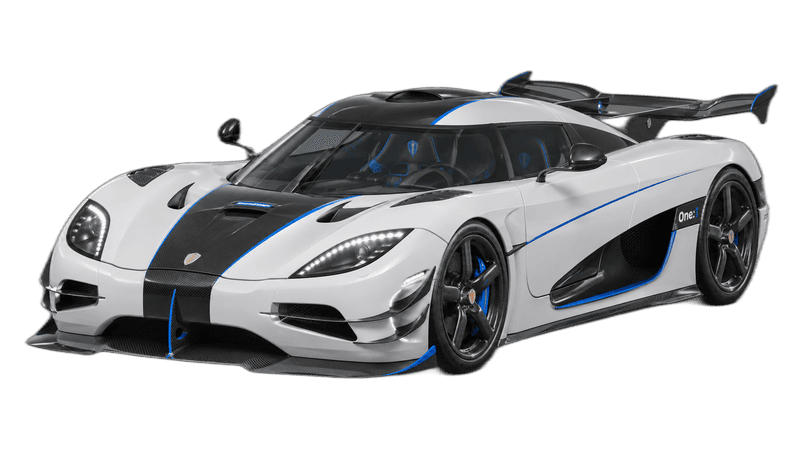
Koenigsegg One:1
1341bhp
Power
The Koenigsegg One:1 is a 2-door coupé by Koenigsegg, with 1341 bhp and 1371 Nm of torque.
Dream Car Garage Editorial · Last updated 3 November 2026
Overview
We have not driven this car. This review is based on published specifications and the sources listed below.
Scope of this guide
This guide is scoped to the Koenigsegg One:1, the two-door coupe that Koenigsegg showed at the Geneva Motor Show in March 2014 and built in Angelholm, Sweden, in 2014 and 2015. It is a mid-engine car with rear-wheel drive, a 5.0L twin-turbocharged V8 behind the cabin and a seven-speed dual-clutch gearbox. It is not a guide to the standard Agera R, Agera S or Agera RS, which share the platform but have different power, weight and production runs, and we mention them only where a source compares them with the One:1.
We have not driven this model for this article. We are an editorial desk that reads sources, and everything below comes from pages we opened: the Koenigsegg model page, a GTspirit report on the February 2014 announcement, Koenigsegg's own record update as relayed by New Atlas, an evo report on the same record, a supercars.net profile, Wikipedia, and an auto-data.net specification page. This is a collector and competition-grade car that almost never comes to market, so a guide like this cannot replace an inspection by a specialist who knows the car. This page is for research, not a buying recommendation.
The figures at a glance
- Engine: 5.0L twin-turbocharged V8, built by Koenigsegg in aluminium. Koenigsegg's page says only "5.0 Liters V8 displacement". Wikipedia's Agera table prints the capacity as 5,032.5 cm3 in one column and 5,065.48 cm3 in another, and auto-data.net prints 5065 cm3, so the exact capacity is a point where sources disagree. We use the 5.0-litre label that the maker uses.
- Power: 1341 bhp. Koenigsegg's page says "1 MW Output" and its video caption says 1,360 hp. GTspirit quotes 1 megawatt and about 1,341 hp, and Wikipedia prints 1,000 kW, 1,360 PS and 1,341 hp. One megawatt is 1,000 kW, and 1,000 kW multiplied by 1.34102 is about 1341 bhp. The metric figure is 1,360 PS, and 1,360 PS multiplied by 0.98632 also gives about 1341 bhp. The 1,360 and 1,341 figures are therefore the same output in different units, and we show 1341 bhp. The auto-data.net page prints 1360 hp at 7500 rpm.
- Torque: 1371 Nm. Koenigsegg's page prints 1371 Nm and its caption gives 1,371 Nm (1,011 lb-ft) at 6000 rpm. GTspirit agrees, saying torque is rated at 1371 Nm from 6000 rpm. The supercars.net profile prints 1370.7 Nm, which is the same number rounded differently.
- Rev limit: 8,250 rpm, per Koenigsegg and GTspirit.
- 0-100 km/h: no figure shown, because the maker has not published one. See the section on what we could not find.
- Top speed: no figure shown, for the same reason.
- Drive: rear-wheel drive through a seven-speed dual-clutch gearbox with an electronic differential, per GTspirit and Wikipedia.
- Weight: 1,360 kg. Koenigsegg's page gives 1360 kg curb weight, and GTspirit says this is with 50 percent fuel and 100 percent fluids and no driver.
- Production: 7 cars on the Koenigsegg page, which says "Made in only 7 examples". See the next section for why other sources say six.
Where the sources disagree
We list the disagreements instead of choosing silently.
On production, Koenigsegg's page says 7 examples, built between 2014 and 2015. Supercars.net says 7 cars including one prototype. GTspirit's February 2014 report says only six cars will leave the factory, and the same report says most were destined for Chinese buyers with two staying in Europe. Wikipedia says the car debuted in Geneva in March 2014 and that Koenigsegg built six more, all sold before the show. Taken together, these fit seven cars in total, the show car plus six customer cars. We show 7 because it is the maker's own number and the other sources can be read consistently with it. That reconciliation is our reading, not something every source states in those words.
On the model years, Koenigsegg says 2014 to 2015 and auto-data.net says 2014 to 2015. Wikipedia's text heading gives 2014-2015 but its sidebar gives 2014-2016. We use 2014-2015 because the maker and two other pages agree.
On the weight ratio, supercars.net quotes a power-to-weight of 986.03 bhp per tonne, while the name and the maker's page describe a 1:1 ratio between the 1,360 figure and the 1,360 kg curb weight. The two statements are consistent: the 1:1 ratio counts 1,360 PS, and the 986 bhp per tonne counts 1341 bhp against the same 1,360 kg.
On the short list of other numbers, compression is given as 9.2:1 and as 9.0:1 within the same supercars.net page, and brake disc diameter is given as 392 mm and 397 mm on that page. GTspirit gives 397 mm for the front discs. We do not rely on any of these.
History and the one-megawatt idea
Koenigsegg describes the One:1 as a sibling of the Agera R and says the company was the first extreme car maker to use green technology with the biofuel CCXR in 2007. The One:1 name refers to its target of a one-to-one ratio between power and weight: 1,360 PS against 1,360 kg. Koenigsegg also uses the word megacar for it, indicating one megawatt of output. Wikipedia and GTspirit repeat this explanation.
GTspirit's report on the official announcement of 28 February 2014 gives the engineering changes from the Agera R. It says boost rose to 1.8 bar from 1.4 bar and that the bore grew from 91.7 mm to 92 mm. Koenigsegg's page gives the engine weight as 197 kg. The car runs on E85 biofuel, race fuel or regular petrol according to supercars.net. The seven-speed dual-clutch gearbox weighs 81 kg according to Wikipedia. Supercars.net describes a carbon fibre and Kevlar body over a carbon and aluminium honeycomb semi-monocoque.
Koenigsegg describes upgraded Aircore carbon fibre wheels. GTspirit lists custom Michelin Cup tyres at 265/35 on 19-inch fronts and 345/30 on 20-inch rears, with a tyre speed rating of 440 km/h. A tyre rating is a limit on the tyre, not a measured top speed for the car, so we did not use it as one. GTspirit says braking from 100 km/h to a stop takes only 28 metres. Wikipedia describes the car as track-focused with limited boot space.
The 0-300 km/h record run
On 8 June 2015 the One:1 was run at Koenigsegg's own test track in Angelholm, and Koenigsegg reported 0-300-0 km/h in 17.95 seconds. New Atlas, relaying Koenigsegg's update, gives 11.922 seconds to reach 300 km/h and 6.032 seconds to stop, and says the times were verified with a Racelogic VBox. Koenigsegg also said in its update that this was not an official record. Evo reports the same figures and adds 0-200 mph in 14.328 seconds and 0-200-0 mph in 20.71 seconds, and says the run was 3.24 seconds quicker than the Agera R's earlier result.
These are 0-300 km/h measurements. They are not 0-100 km/h times, and we did not use them to fill that field. We also note that evo's page does not say how many cars were built, and that New Atlas names driver Robert Serwanski for a separate run, so we do not name a driver for the 17.95-second run.
What to check, and what the rarity means
With seven cars built in two years and six of them sold before the show, a One:1 is something you research, not something you browse for. We found no listings, so we cannot tell you how one is offered. The practical points from our reading are limited to what the sources say.
- Which car it is. Seven cars were built, so any claim of a One:1 should be traceable to the maker. Ask Koenigsegg's factory records, not a seller's description.
- The prototype question. Supercars.net counts one prototype among the seven, and Wikipedia describes a show car followed by six more. Whether a given car is the show car is something only the maker or the seller can document.
- Fuel. The car is described as able to run on E85, race fuel or petrol. Which fuel a given car has been run on, and with what tune, is for a specialist to establish.
- Mid-engine track-focused packaging. Wikipedia and GTspirit both stress limited luggage space and a track focus, so it is not an everyday car in the sense a grand tourer is.
- A specialist inspection. Koenigsegg-trained specialists, not a web page, can judge a car of this kind, and we cannot.
Running costs, recalls and safety
We found no source giving running costs, a service schedule, an engine-out interval, insurance cost or failure rates for the One:1, so we give none. We also found no recall notice and no crash-test or safety-equipment data in any page we read. That is not a clean bill of health, because we did not search a recall database. We found no price from a maker price list: supercars.net lists a price field with a garbled currency symbol and an apparent figure of 2,000,000, but we cannot confirm the currency or that it was ever a sale price, so we do not repeat it. GTspirit says the price was undisclosed and expected to be in the multiple million range.
Market and value notes
We did not find any auction result, dealer listing or valuation for a One:1 in the pages we read, and we will not guess. A car with seven examples will trade privately, if at all, and a published number would be a single data point, not a market. If you need a valuation, it has to come from a specialist, an auction house or the maker, and not from this page.
What we could not find
The numbers we left blank are the ones the maker does not publish. Koenigsegg's One:1 model page gives power, torque, weight and the production count, but it does not state 0-100 km/h, 0-200 km/h, 0-300 km/h or a top speed. GTspirit's report on the announcement says explicitly that Koenigsegg chose not to release a 0-100 km/h time. For 0-100 km/h there is therefore no figure shown in the catalogue, because no maker figure exists for us to cite.
Other pages do print numbers. Auto-data.net prints 0-100 km/h as 2.8 s and a maximum speed of 440 km/h, supercars.net prints roughly 2.9 seconds for 0-60 mph and about 439.26 km/h, and Wikipedia lists 2.8 s and 400 km/h across the Agera range without separating the One:1. These pages disagree with each other, are not the maker, and a 0-60 mph time is not a 0-100 km/h time, so we did not adopt any of them. The 440 km/h appears to coincide with the tyre speed rating that GTspirit gives, which is another reason we did not treat it as measured. For top speed there is likewise no figure shown, and the catalogue field stays blank.
We could not open the Koenigsegg technical specifications page, which returned not found, and we could not open the autoevolution page, which refused access, so we did not work around either. We found no running-cost, recall, safety-equipment or valuation data, and no consistent engine capacity, since sources print 5,032.5 cm3 and 5,065 cm3.
About the photograph
This page uses the catalogue photograph for the car. Its credit is listed on the credits page.
Verdict
The Koenigsegg One:1 is a mid-engine, rear-wheel-drive, two-door coupe with a 5.0L twin-turbocharged V8 making 1341 bhp and 1371 Nm, a curb weight of 1,360 kg and a production run of 7 cars across 2014 and 2015. The best-supported performance claim we found is the maker's own 0-300-0 km/h run of 17.95 seconds at its test track, which is a different measurement from the 0-100 km/h and top speed fields that Koenigsegg leaves blank. The sources disagree on engine capacity, on whether the run was six cars or seven, and on aggregator times, and we have said which we chose and why. We have not driven it, and nothing here replaces the maker's records and a specialist inspection.
Specifications
Engine
5.0L twin-turbocharged V8
Displacement
5.0L
Power
1341 bhp
Torque
1371 Nm
Drivetrain
RWD
Country
Sweden
Body Style
2-door coupé
Years
2014–2015
Production
7
Specifications are manufacturer-published figures.
More from Koenigsegg

Frequently Asked Questions
What are the specifications of the Koenigsegg One:1?
The Koenigsegg One:1 is a 2-door coupé by Koenigsegg, with 1341 bhp and 1371 Nm of torque.
How many Koenigsegg One:1 were made?
Koenigsegg produced 7 units of the Koenigsegg One:1.
What drivetrain does the Koenigsegg One:1 use?
The Koenigsegg One:1 is configured with rear-wheel drive.
What type of car is the Koenigsegg One:1?
The Koenigsegg One:1 is a hypercars manufactured by Koenigsegg in Sweden. Production ran from 2014 to 2015.