
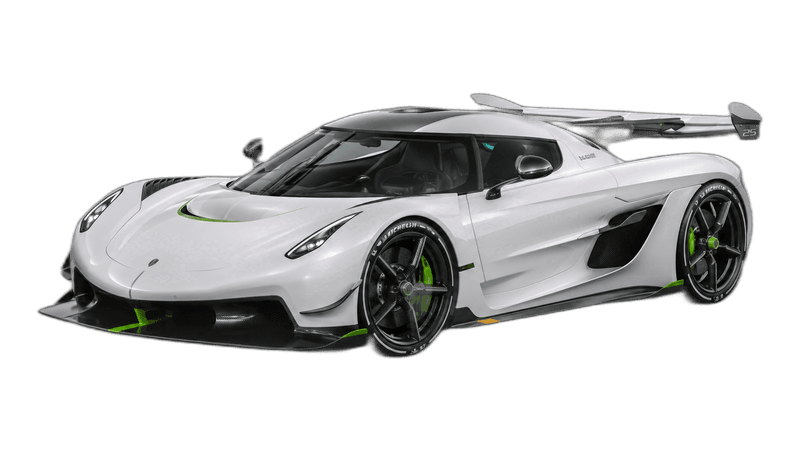
Koenigsegg Jesko
£3,500,000
usedIndicative market price, updated periodically.
1280bhp
Power
2.5s
0-100 km/h
480km/h
Top Speed
£3,500,000
Price Used
How hard it pulls.
Peak g-force the instant you bury the throttle, estimated from the car's 0–100 time and drivetrain.
Koenigsegg JeskoEstimated peak launch g from the 0–100 time and drivetrain: an honest approximation, not a measured figure.
The Koenigsegg Jesko is a 2-door targa top by Koenigsegg, with 1280 bhp, 1500 Nm of torque, a 0-100 km/h time of 2.5 seconds and a top speed of 480 km/h. Indicative used value: approximately £3,500,000. Actual values vary with specification, condition and history.
Dream Car Garage Editorial · Edited by José Teo Lorente Vallecillos · Last updated 2 November 2026
Overview
We have not driven this car. This review is based on published specifications and the sources listed below.
Scope of this guide
This guide is scoped to the Koenigsegg Jesko Attack, the track-focused, mid-engine, rear-wheel drive hypercar with the 5.0L twin-turbo V8 petrol (5065 cc) engine and a nine-speed Light Speed Transmission, revealed in March 2019. It is not a guide to the Jesko Absolut, the low-drag sibling that has its own entry in our catalogue. We say below where the Absolut differs, so that you can tell which car an advert or a brochure describes. Where a figure depends on the fuel, we state the fuel next to the number.
We have not driven this model for this article. Everything here comes from three cited sources: the Koenigsegg technical specification page for the Jesko Attack, a PistonHeads report by Matt Bird on the Geneva 2019 reveal (5 March 2019), and the government vehicle recall checker. We also read other pages and flag every point that rests on them: the Koenigsegg Jesko Attack and Jesko Absolut model pages, the Absolut specification page, an Outlook India report on the Geneva specification, a Motor1 Italia report, and a Belgian specification database. Where sources disagree we say so instead of choosing a winner quietly. Prices are history or ranges, not valuations.
The figures at a glance
- Engine: 5.0L twin-turbo V8 petrol (5065 cc), an aluminium unit with 4 valves per cylinder, a 92 mm bore and a 95.25 mm stroke on Koenigsegg's page. Koenigsegg writes 5.0 litres; the 5065 cc figure is our own check, because those two dimensions work out at about 5066 cc.
- Power on pump petrol: 1280 bhp at 7800 rpm, with an 8500 rpm redline. Koenigsegg writes 1280 hp. The same list in the Outlook India report gives 955 kW for it, and 955 kW is 1280 mechanical horsepower (955 divided by 0.7457), so the maker's hp is the same unit as bhp and we make no conversion. In metric horsepower the same output is 1298 PS, which is how that report words it in its text. PistonHeads prints 1,280hp and the fuel as 95 RON. Koenigsegg's page says only gasoline.
- Power on E85: 1600 bhp, which Koenigsegg's specification page prints as 1600 hp. Converting by our own arithmetic gives about 1623 PS, and a Belgian specification database prints 1,623 PS and 1,194 kW. Boost is 1.7 bar on petrol and 2.2 bar on E85. The Attack specification table lists 1600 hp on its own, so a headline of 1600 refers to the biofuel and not to petrol.
- Torque: 1500 Nm at 5100 rpm, with 1000 Nm available from 2700 to 6170 rpm. Koenigsegg's model page does not print torque, but its specification page and several other pages do.
- 0-100 km/h: 2.5 seconds. Koenigsegg publishes no 0-100 km/h time for the Attack, so this is a flagged substitute: a Motor1 Italia report prints it without naming a source, and we treat it as a press figure, not a maker claim.
- Top speed: 480 km/h. Koenigsegg publishes no top speed for the Attack either. The same Motor1 Italia report prints 480 km/h, which is another flagged substitute, and we do not know whether it is a calculation, a simulation or a copy of the Absolut figure. Our earlier catalogue value of 300 looks like a mix-up of units, and we have replaced it.
- Drive: rear-wheel drive, with the nine-speed Light Speed Transmission and an electronic differential. PistonHeads says the Jesko has four-wheel steering, the first on a Koenigsegg.
- Weight: 1320 kg dry and 1420 kg kerb weight on the specification page (Koenigsegg writes curb). PistonHeads prints 1,420kg kerbweight.
What the Jesko Attack is
The Attack is the version with the very large rear wing, a deep front splitter and the highest downforce. PistonHeads quotes Koenigsegg as saying the wing is said to be the largest ever fitted to a production car, and reports a reworked carbon monocoque, Triplex dampers at both ends, an electric compressor feeding the turbochargers to reduce lag, and a flat-plane crank that allows 8500 rpm. The wheels are carbon, 20 inch at the front and 21 inch at the rear, with Michelin Cup 2 R tyres as an option. The Koenigsegg page gives the gearbox as a nine-speed unit weighing 90 kg, and its model page says seven wet multi-disc clutches while PistonHeads says six, so ask a seller what the transmission actually contains.
How many were built
The count is the weakest number in this guide. PistonHeads says 125 will be built over three years at about 3 million dollars each. Koenigsegg's Attack model page words it as 125 Jesko Attack and Jesko Absolut being produced, which reads as one shared run and not as 125 of each. No source we read gives an Attack-only total, so the 125 in our catalogue is the combined figure and must not be read as the number of Attacks. Start dates also differ. Our catalogue says 2020, a Belgian specification database says 2021 and another page says the first customer delivery was in 2022, and we could not settle it. If a seller quotes a build number, ask which count it belongs to.
Why the quoted figures vary
Three things move the numbers. First, fuel: 1280 bhp is the pump petrol output and 1600 bhp needs E85, so a car run on ordinary fuel is not making the headline figure. Second, units: Koenigsegg writes hp, and outlets that print PS give 1298 and 1,623 for the same engine, so a PS figure and an hp figure are not interchangeable. Third, the page you read: Koenigsegg lists a compression ratio of 9.0 to 1 on the specification page but 8.6 to 1 in the table on the model page, and we cannot say which is right.
Downforce shows the same pattern. The specification page gives 700 kg at 250 km/h, 1000 kg at 290 km/h and 1400 kg at the maximum. PistonHeads prints about 1,000kg at 170mph, which is roughly 274 km/h by our conversion, so it does not match the 290 km/h point. Treat downforce as a claim and ask which speed a figure belongs to.
How the Jesko Attack differs from the Absolut
The Absolut shares the V8, the gearbox and the quoted power. Koenigsegg's Absolut page says it removes the Attack's large rear wing, cutting downforce from 1400 kg to 150 kg, adds an elongated tail, streamlined front winglets and removable wheel covers, and quotes a drag coefficient of 0.278 Cd. Its specification page gives 1390 kg kerb weight and a length of 4845 mm, against 1420 kg and 4626 mm for the Attack. Koenigsegg's Absolut page gives no top speed, only the claim that it will go faster than any previous Koenigsegg, and PistonHeads says a less aero-heavy car will target 300 mph in time. Those statements belong to the Absolut, not to the Attack, so a speed claim in an advert for an Attack should be questioned.
Dimensions and practicalities
The specification page gives a length of 4626 mm, a width of 2030 mm, a height of 1210 mm and a wheelbase of 2700 mm, with a fuel tank of 72 litres. Our catalogue lists the body as a two-door targa top. We found no published service intervals, parts prices, insurance figures or luggage volumes for the Attack, so we give none. A car with a splitter this deep and a wing this large will need care on ramps, and it will also need a specialist for anything beyond routine checks.
Known faults and recalls
We did not find a recall list for the Jesko in the sources we read, and we are not claiming there is none. The government checker covers safety recalls: for a car it uses the registration number, or the manufacturer, model and year, and the page says the manufacturer tells owners about non-safety recalls itself. A car this rare may be sold without a UK registration or may have been imported, in which case the check may return little and the maker becomes the only reliable source.
What to check before buying
- Confirm the chassis number with Koenigsegg and that the car is an Attack, not an Absolut or a one-off special.
- Ask for the full service and software history, and for written confirmation of any open campaign from the maker.
- Ask what fuel the car has been run on and whether it has been mapped for E85, because the 1600 bhp figure depends on it.
- Check the carbon splitter, wing and bodywork for repairs, and the tyre age and specification against the wheel sizes above.
- Ask for the import, registration and customs paperwork if the car was not first sold in the UK.
- Run the registration through the government check described below.
Recalls and the government check
We did not run the checker, because it needs a registration number, or the make, model and year, and we are not looking at a specific car. The page says the manufacturer should fix or replace a faulty item and that you will not usually pay for repairs or parts. Run the registration yourself, and treat the result as one input beside a written statement from Koenigsegg.
Verdict
The Jesko Attack is 1280 bhp on pump petrol and 1600 bhp on E85, 1500 Nm, rear-wheel drive and mid-engine, with a press figure of 2.5 seconds to 100 km/h and a press figure of 480 km/h that the maker does not publish. It is part of a shared run of 125 cars with the Absolut. It suits an owner who deals directly with the maker and who understands that the headline numbers belong to a fuel, a wing setting and a source. If you are shopping for one, confirm the version, the fuel history and the paperwork, and treat the published figures as claims with the caveats above. We have not driven it, so use the sources and a proper inspection to decide.
Specifications
Engine
5.0L twin-turbo V8 petrol (5065 cc)
Displacement
5.1L
Power
1280 bhp
Torque
1500 Nm
0-100 km/h
2.5s
Top Speed
480 km/h
Drivetrain
RWD
Country
Sweden
Body Style
2-door targa top
Years
2020–present
Production
125
Price Used
£3,500,000
Specifications are manufacturer-published figures.
More from Koenigsegg
Featured in Carpedia
What Cars Should I Put in My Dream Garage?
A comprehensive guide to building a dream garage at every budget. Five balanced 5-car garages, from under GBP 100K total to unlimited, each covering daily driving, weekends, track days, road trips, and special occasions.
The 25 Fastest Cars from 0-100 km/h, Ranked
The 25 fastest production and limited-production cars ranked by 0-100 km/h time. From the 1.81-second Rimac Nevera to the 2.5-second Chevrolet Corvette E-Ray, every car backed by verified data.
Koenigsegg Jesko Absolut vs Bugatti Chiron Super Sport 300+ vs SSC Tuatara
Above 400 km/h the language of normal automotive comparison breaks down. The Jesko Absolut, the Chiron Super Sport 300+, and the SSC Tuatara are not products: they are engineering manifestos about the limits of what a road car can achieve. Each one believes it is the fastest. Only physics will arbitrate.
Frequently Asked Questions
What are the specifications of the Koenigsegg Jesko?
The Koenigsegg Jesko is a 2-door targa top by Koenigsegg, with 1280 bhp, 1500 Nm of torque, a 0-100 km/h time of 2.5 seconds and a top speed of 480 km/h. Indicative used value: approximately £3,500,000. Actual values vary with specification, condition and history.
How much does a Koenigsegg Jesko cost?
Indicative used value: approximately £3,500,000. Actual values vary with specification, condition and history.
How many Koenigsegg Jesko were made?
Koenigsegg produced 125 units of the Koenigsegg Jesko.
What drivetrain does the Koenigsegg Jesko use?
The Koenigsegg Jesko is configured with rear-wheel drive.
What type of car is the Koenigsegg Jesko?
The Koenigsegg Jesko is a hypercars manufactured by Koenigsegg in Sweden. Production started in 2020.