
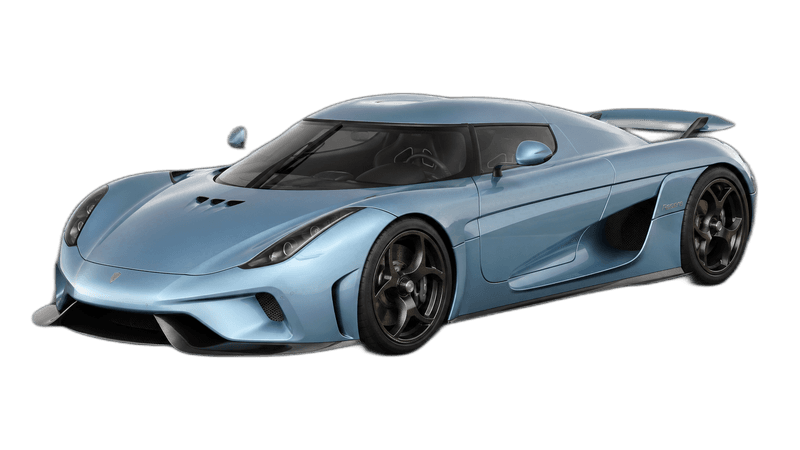
Koenigsegg Regera
£2,800,000
usedIndicative market price, updated periodically.
1479bhp
Power
2.8s
0-100 km/h
403km/h
Top Speed
£2,800,000
Price Used
How hard it pulls.
Peak g-force the instant you bury the throttle, estimated from the car's 0–100 time and drivetrain.
Koenigsegg RegeraEstimated peak launch g from the 0–100 time and drivetrain: an honest approximation, not a measured figure.
The Koenigsegg Regera is a 2-door targa top by Koenigsegg, with 1479 bhp, 2000 Nm of torque, a 0-100 km/h time of 2.8 seconds and a top speed of 403 km/h. Indicative used value: approximately £2,800,000. Actual values vary with specification, condition and history.
Dream Car Garage Editorial · Edited by José Teo Lorente Vallecillos · Last updated 2 November 2026
Overview
We have not driven this car. This review is based on published specifications and the sources listed below.
Scope of this guide
This guide is scoped to the production Koenigsegg Regera, the two-door, targa-topped, mid-engine, rear-wheel drive hybrid hypercar with the 5.0L twin-turbocharged V8, three electric motors and Koenigsegg Direct Drive, as specified for customer cars built from 2016 to 2022. It is not a guide to the 2015 Geneva show car, whose battery, weight and electric output were different, and we say below where the two differ so that you can tell which car a brochure or an advert describes. Where a number depends on the fuel, we use the E85 figure, because that is the one Koenigsegg quotes for the headline output.
We have not driven this model for this article. Everything here comes from three cited sources: the Koenigsegg technical specification page for the Regera, a PistonHeads report by Matt Bird on the 0-400-0 km/h record (16 June 2023), and the government vehicle recall checker. We also read other pages and flag each point that rests on them: the Koenigsegg model and history pages, a PistonHeads Geneva 2015 report by Dale Lomas, and a GTSpirit report on the 2016 production specification. Where sources disagree we say so instead of choosing a winner quietly. Prices are history or ranges, not valuations.
The figures at a glance
- Engine: 5.0L twin-turbocharged V8, an aluminium dry-sump unit with 4 valves per cylinder, a 92 mm bore and a 95.25 mm stroke on Koenigsegg's specification page. Koenigsegg writes 5.0L and no cubic-centimetre figure. We carry 5000 cc as the nominal size, although our own arithmetic from the bore and stroke gives about 5066 cc, so treat 5000 as a rounded name and not a measurement.
- Power: 1479 bhp. Koenigsegg quotes the total as over 1500 hp on E85, or 1.11 MW, and the V8 alone as 1100 hp on premium petrol and 1500 hp on E85. We treat 1500 hp as metric horsepower (PS) and convert it ourselves: 1500 x 0.98632 is about 1479.5, rounded down to 1479 bhp. The 1.11 MW figure points the same way, because it is about 1509 PS and about 1488 bhp. If Koenigsegg meant mechanical horsepower, the figure would be 1500 bhp, a difference of about 1.4 per cent, and we have no way to confirm which it meant.
- Torque: 2000 Nm. Koenigsegg says over 2000 Nm in total. PistonHeads prints more than 1,475 lb ft on E85, which converts to the same figure (1475 x 1.3558 is about 2000). The V8 alone is given as 1000 Nm from 2700 to 6170 rpm and, in a separate line on the same page, a maximum of 1280 Nm at 4100 rpm, so even the maker's own page does not give one engine torque.
- 0-100 km/h: 2.8 seconds, a claim reported by GTSpirit from the 2016 production announcement. Neither Koenigsegg's specification page nor PistonHeads gives it.
- Speed: 403 km/h. Koenigsegg reported that the car reached 403 km/h, limited by engine speed in its single gear, during the 2019 record run. A 410 km/h figure also circulates as an electronic limit, but we found it in one general explainer only, so we do not use it.
- Drive: rear-wheel drive. The V8 and the electric motors drive the rear wheels, and the front axle is not driven. There is no conventional gearbox.
- Weight: 1590 kg fully fuelled (Koenigsegg's own word is curb weight, which we would call kerb weight) and 1420 kg dry on the specification page, against 1470 kg dry in the 2016 production announcement.
What the production Regera is
The Regera was shown at the Geneva motor show in March 2015 and described by PistonHeads as a hybrid with a "standard" 1,100 hp twin-turbo V8 plus three electric motors, built as a run of 80. The production-specification car followed at Geneva in 2016. Koenigsegg Direct Drive, or KDD, takes the place of the usual gearbox: the V8 is joined to the rear wheels through a locking hydraulic coupling, with one electric motor on the crankshaft and one on each rear wheel. PistonHeads calls it a single-speed car with a fixed final drive ratio, and Koenigsegg's model page says it covers 0-400 km/h in one gear.
The pack is 800 volts and 4.5 kWh, with 525 kW of discharge and up to 200 kW of recharge. Koenigsegg gives the electric output as 700 hp on its specification page and 670 hp on its model page, so the two do not agree. The pack weighs 75 kg on the specification page and 90 kg in the GTSpirit report. These are small disagreements, but they are the kind that appear in advert copy, so ask what a seller is quoting.
How many were built
Koenigsegg's model and history pages say 80 Regeras were built in total, and PistonHeads says the specification matches all 80 customer cars and that the final examples were built in 2022. Our production row held 85, which may include prototypes or pre-series cars; we found no source for 85, so we use 80 and state the gap openly. If a seller quotes a build number, ask whether it counts customer cars only.
Why the quoted figures vary
Three things move the numbers. First, fuel: the V8 makes 1100 hp on premium petrol and 1500 hp on E85, so a car run on pump petrol is not producing the headline figure. Second, units: Koenigsegg writes hp, many outlets copy it, and a few convert it to bhp or PS without saying so. Third, the show car and the production car are not the same. The 2015 report gives a 115 kg battery of 9.27 kWh, 1628 kg wet weight and a theoretical 697 hp of electrical output, whereas the production car has a 4.5 kWh pack and a 1590 kg kerb weight. Always match a figure to a version before comparing cars.
Records and what they mean for owners
Koenigsegg reports a 0-400-0 km/h run of 31.49 seconds on 23 September 2019 at the Råda airfield, which we saw only as a search summary of its own report. PistonHeads reports 28.81 seconds in June 2023 at Örebro Airport, with 20.68 seconds accelerating and 8.13 seconds braking, on Michelin Cup 2R tyres, verified by Racelogic, with the car described as mechanically identical to the 2019 car and matching all 80 customer cars. A later Jesko Absolut run beat that time, and the dates differ in what we read, so we give none. These are manufacturer-run, prepared-surface attempts. They show what the layout can do, not what a used car will do on the road.
Dimensions, tyres and running costs
The specification page gives a length of 4560 mm, a width of 2050 mm, a height of 1110 mm and a wheelbase of 2662 mm. Ground clearance is 105 mm at low speed, 85 mm in track mode and 150 mm with the front lift active, which matters for ramps and car-park entrances. Luggage space is 150 litres and the fuel tank holds 82 litres. The wheels are 19 inch at the front (255/35) and 20 inch at the rear (335/30), fitted with Michelin Pilot Sport 2 or Cup tyres. We found no published service intervals, parts prices or insurance figures, so we give none. For one data point, a PistonHeads classified for a 2022 car appeared in a search summary at 2.6 million pounds from a trade seller; we did not open the listing and treat it as an example, not a market value.
Known faults and recalls
We did not find a recall list for the Regera in the sources we read, and we are not claiming there is none. The government checker covers safety recalls: for a car it uses the registration number through the MOT service, or the make, model and year, and the manufacturer tells owners about non-safety recalls itself. A car this rare may not have a UK registration, or may have been imported, in which case the check may return little and the manufacturer becomes the only reliable source.
What to check before buying
- Confirm the chassis number with Koenigsegg and that it is a production customer car, not a show or pre-series car.
- Ask for the complete service and software history, and for evidence that the 800 volt battery and the KDD coupling have been inspected by the maker.
- Ask what fuel the car has been run on and whether it has been used on E85, because the headline output depends on it.
- Check tyre age and specification against 255/35-19 and 335/30-20, and look at the carbon bodywork and roof panels for repairs.
- Ask for the import, registration and customs paperwork if the car was not first sold in the UK.
- Run the registration through the government check described below and ask Koenigsegg to confirm any outstanding recall in writing.
Recalls and the government check
We did not run the checker, because it needs a registration number or the make, model and year, and we are not looking at a specific car. The page says the manufacturer will write to the owner about a serious safety defect and that repairs are not usually charged. Run the registration yourself, and treat the result as one input beside a written statement from the maker.
Verdict
The production Regera is 1479 bhp, 2000 Nm, a claimed 2.8 seconds to 100 km/h and 403 km/h reached in a single gear, rear-wheel drive and mid-engine, in a run of only 80 cars. It rewards an owner who deals directly with the maker and who understands that the headline figures belong to E85. If you are shopping for one, confirm the version, the fuel history and the paperwork, and treat the published numbers as claims with the caveats above. We have not driven it, so use the sources and a proper inspection to decide.
Specifications
Engine
5.0L twin-turbocharged V8
Displacement
5.0L
Power
1479 bhp
Torque
2000 Nm
0-100 km/h
2.8s
Top Speed
403 km/h
Drivetrain
RWD
Country
Sweden
Body Style
2-door targa top
Years
2016–2022
Production
80
Price Used
£2,800,000
Specifications are manufacturer-published figures.
More from Koenigsegg
Featured in Carpedia
Best Hypercars 2026
From Koenigsegg's 2,000bhp Regera to the twin-turbocharged fury of the Hennessey Venom F5, these are the ten hypercars that define the absolute limit of automotive engineering in 2026.
The Ultimate Dream Garage 2026
If money were no object and the garage had ten bays, which cars would you choose? Our editorial team has done the hard work, selecting one champion from each category to assemble the definitive Dream Garage of 2026.
Frequently Asked Questions
What are the specifications of the Koenigsegg Regera?
The Koenigsegg Regera is a 2-door targa top by Koenigsegg, with 1479 bhp, 2000 Nm of torque, a 0-100 km/h time of 2.8 seconds and a top speed of 403 km/h. Indicative used value: approximately £2,800,000. Actual values vary with specification, condition and history.
How much does a Koenigsegg Regera cost?
Indicative used value: approximately £2,800,000. Actual values vary with specification, condition and history.
How many Koenigsegg Regera were made?
Koenigsegg produced 80 units of the Koenigsegg Regera.
What drivetrain does the Koenigsegg Regera use?
The Koenigsegg Regera is configured with rear-wheel drive.
What type of car is the Koenigsegg Regera?
The Koenigsegg Regera is a hypercars manufactured by Koenigsegg in Sweden. Production ran from 2016 to 2022.