
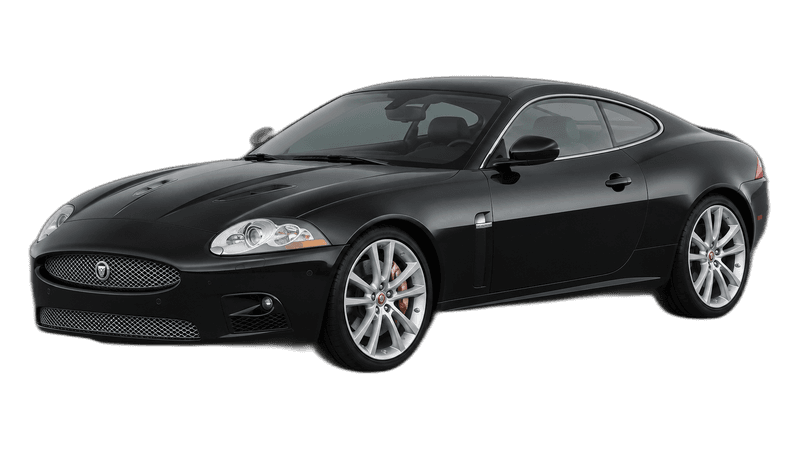
Jaguar XKR
£28,000
usedIndicative market price, updated periodically.
503bhp
Power
250km/h
Top Speed
£28,000
Price Used
The Jaguar XKR is a 2+2 seater fixed-head coupé by Jaguar, with 503 bhp, 625 Nm of torque and a top speed of 250 km/h. Indicative used value: approximately £28,000. Actual values vary with specification, condition and history.
Dream Car Garage Editorial · Last updated 2 November 2026
Overview
We have not driven this car. This review is based on published specifications and the sources listed below.
A supercharged V8 coupé from the X150 family
The Jaguar XKR covered here is the two-door, 2+2 grand tourer that sat above the naturally aspirated XK in Jaguar's range. It has a front-mounted supercharged V8, a six-speed automatic gearbox and rear-wheel drive. Our catalogue lists a 5.0L supercharged V8 petrol engine producing 503 bhp and 625 Nm. This guide is scoped to the Jaguar XKR from the 2009 model year onward, meaning the X150 car with the 5.0-litre AJ133-family direct-injection engine, which Wikipedia dates from 2009 to 2014. The earlier X100 XKR, which had a 4.0-litre supercharged V8, is out of scope, and so is the 4.2-litre supercharged XKR that preceded the 5.0. Everything below concerns the 5.0-litre car. We have not driven this model for this article. This is a desk-researched ownership guide built from a Jaguar press release of February 2010, a PistonHeads used buying guide published in January 2021 and the government recall check. The PistonHeads guide covers the whole X150 XK range, so we use it for ownership experience and say where a point may not apply to the XKR.
Checking the figures
Jaguar's release gives the supercharged 5.0-litre as 510PS and also writes 510bhp SAE, with 625Nm of torque. Our catalogue stores 503 bhp, which is the usual conversion of 510 PS into British horsepower: 510 multiplied by 0.986 is about 503. evo's 2009 road test also quotes 503bhp and 461lb ft, and 461 lb ft is the same torque as 625 Nm. So adverts that say 510 PS, 510 hp or 503 bhp are describing one engine measured in different units, and you should not read the gap as a tuned car.
Our catalogue lists 0 to 100 km/h in 4.6 seconds, and we need to be plain about that number. Jaguar's release gives 0 to 60 mph in 4.6 seconds, not 0 to 100 km/h, and 60 mph is slightly slower than 100 km/h, so the true metric time would be a little longer. evo also calls 4.6 seconds the claimed figure. PistonHeads prints 4.9 seconds for 0 to 62 mph in its own specification table. We therefore treat 4.6 seconds as a manufacturer claim for 0 to 60 mph, which is the closest figure available, and not as a test result.
The top speed needs more care still. The release says the XKR is electronically limited to 155 mph, which is 250 km/h, and that it reaches 174 mph, or 280 km/h, with the optional Speed Pack. A later Jaguar release of February 2012 says the Dynamic Pack raises the limit to 174 mph for the 2013 model year. So 250 km/h is the standard car's limiter, not what the engine could do unrestricted. An advert or database entry quoting 300 km/h is describing a different car: Wikipedia lists the later XKR-S, with 550 PS, as limited to 186 mph, which is about 300 km/h. If a seller claims 300 km/h for an XKR, ask which model it is.
Engine and gearbox
Jaguar describes the engine as its Gen III R direct-injection 5.0-litre AJ-V8 with a supercharger, and says its compression ratio was raised from 9.1:1 to 9.5:1. It is chain-driven with four camshafts, and PistonHeads says that design addressed the timing chain tensioner and water pump weaknesses of the older XK engines. PistonHeads reports that the supercharged V8 can start to rattle at around 50,000 miles if the oil was neglected or was the wrong grade. It names 5W-20 as the correct oil for the 5.0 and 10,000 miles as the service interval. A rattle from the variable valve timing is hydraulic in origin and usually needs a new unit, so listen carefully on a cold start. Ask for invoices that show oil changes at sensible intervals, and treat a long gap as a reason to negotiate or walk away.
The gearbox is a six-speed automatic with steering-wheel paddles and the JaguarDrive rotary selector. PistonHeads identifies the unit as a ZF 6HP26, while Wikipedia lists a 6HP28, so we cannot say which designation applies and you should read the plate or the paperwork. PistonHeads says leaks most often come from the connector sleeve and advises a fluid change at 60,000 miles. Check that shifts are smooth, that the paddles respond, and that there is no fluid under the car.
PistonHeads also covers cooling. It advises checking the thermostat, the radiator and the cooling fans, because overheating is costly on any V8. Make sure the temperature gauge settles at the same point every time and that the fans operate when they should.
Chassis, brakes and wheels
Jaguar's release describes an all-aluminium structure, Adaptive Dynamics damping and an Active Differential Control system on the XKR. The February 2012 release adds that the structure is riveted and bonded and that adaptive damping is standard. PistonHeads reports that the electronically controlled differential on early XKRs can vibrate on cornering and under acceleration, so test the car on a quiet road with the steering on both locks and under power, and ask whether any work has been done on it.
The adaptive dampers, which PistonHeads calls CATS, are described as wearing by about 60,000 miles. Floaty body control, a knock over bumps or a warning message on the dashboard are all reasons to ask for an inspection. Brakes are 355 mm at the front according to PistonHeads, and the electronic parking brake can fail. It also needs to be put into a service mode before a pad change. Ask whether the brake has been serviced and how it was done.
The wheels are large. PistonHeads gives 9 x 18 and 10 x 18 sizes with 245/45 and 275/40 tyres and says 20-inch rims can warp in potholes. Jaguar's release lists 20-inch Kasuga wheels on the Speed Pack and Kalimnos wheels on the Black Pack, with red R-logo brake calipers on the Speed Pack. The February 2012 release names Venom and Orona 20-inch designs on the special edition. Inspect every rim for kerb damage and cracks, check that the tyres are matched across each axle and not too old, and ask whether a previous owner replaced the standard wheels. The release also says the Instant Mobility tyre repair system came with UK and European cars from 2010. Check what kit the car carries and whether the sealant is in date.
Body, interior and electronics
PistonHeads says the body is aluminium, so rust is not the issue it would be on steel, but corrosion can occur at the rear wing and door opening and where steel fittings meet aluminium on the bumper, the arch liners and the undertray. Look at those areas with a torch. The guide also warns that the pedestrian-safety bonnet can deploy because of a bad earth connection. A blocked air-conditioning drain can leak into the footwell, so lift the mats and feel for damp. The coupé boot holds 300 litres by PistonHeads' figure.
Inside, Jaguar's release lists a 7-inch touchscreen, 16-way adjustable seats, a Bowers & Wilkins audio system of 525 watts and the rotary gear selector. Test every function of the screen, the audio and the seats, because PistonHeads says that many faults on these cars come down to battery drain. It advises replacing the battery about every four years or using a trickle charger if the car stands unused. Ask when the battery was last changed and how the car has been stored.
Recalls and history
Neither source gives a full recall list for this car, and the United States safety regulator records are for the American market, so use them only as hints. Its database lists several campaigns on the XK, including a fuel pump relay software issue for 5.0-litre XK and XF cars of the 2010 and 2011 model years, power steering pipe corrosion on early 2010 model-year XKs, rear toe links on 2013 and 2014 cars, front side lamps switching off after a few minutes on 2012 to 2015 cars and a spare tyre placard error on 5.0-litre cars. We read these as American recalls and do not know whether any applied to UK cars. Enter the registration at the DVSA recall service and ask the seller for dealer paperwork showing that any open work was completed. Also ask for a full service history, any accident repair evidence, and records for the oil, gearbox fluid, battery and brake service work described above.
Production figures are hard to pin down. Wikipedia says X150 production ran to July 2014 and totalled 27,612 cars, but that figure covers the whole XK range, not only the XKR, so we do not have a figure for the XKR alone. Do not confuse the standard XKR with the limited XKR 75 and XKR 175, the XKR-S or the XKR-S GT, which have more power and their own specifications.
Buying decision
PistonHeads' verdict is that the XKR is the best value choice for buyers who prioritise performance, and it says to expect real-world fuel economy in the late teens, in miles per gallon. evo's 2009 road test called it the best car Jaguar makes and a little edgier and harder than the XFR. Prices change, so we have not repeated any figures from the guide; compare current adverts instead. The best car is one with a documented service history, evidence of regular oil changes, a quiet engine from cold, a smooth gearbox, an undamaged set of wheels, working dampers and brakes, a healthy battery and every recall closed. A car with a speed limiter at 250 km/h is normal, and so is one with the Speed Pack at 280 km/h, but one that claims to do 300 km/h is not an XKR.
Specifications
Engine
5.0L supercharged V8 petrol
Displacement
5.0L
Power
503 bhp
Torque
625 Nm
Top Speed
250 km/h
Drivetrain
RWD
Country
UK
Body Style
2+2 seater fixed-head coupé
Years
2009–2014
Price Used
£28,000
Specifications are manufacturer-published figures.
More from Jaguar
Frequently Asked Questions
What are the specifications of the Jaguar XKR?
The Jaguar XKR is a 2+2 seater fixed-head coupé by Jaguar, with 503 bhp, 625 Nm of torque and a top speed of 250 km/h. Indicative used value: approximately £28,000. Actual values vary with specification, condition and history.
How much does a Jaguar XKR cost?
Indicative used value: approximately £28,000. Actual values vary with specification, condition and history.
What drivetrain does the Jaguar XKR use?
The Jaguar XKR is configured with rear-wheel drive.
What type of car is the Jaguar XKR?
The Jaguar XKR is a gts manufactured by Jaguar in UK. Production ran from 2009 to 2014.