Jaguar XKSS
£9,000,000
usedIndicative market price, updated periodically.
250bhp
Power
240km/h
Top Speed
£9,000,000
Price Used
The Jaguar XKSS produces 250 bhp and has a top speed of 240 km/h. A representative example is worth about £9,000,000.
Dream Car Garage Editorial · Edited by José Teo Lorente Vallecillos · Last updated 3 November 2026
Overview
We have not driven this car. This review is based on published specifications and the sources listed below.
Scope of this guide
This guide is scoped to the Jaguar XKSS, the road-going roadster that Jaguar made in 1957 by converting unsold D-Type racing cars. It is a front-engine car with a 3.4L inline-six, a four-speed manual gearbox and rear-wheel drive. A note on the layout words: none of the pages we read used the phrase front-engine, so that description is ours, based on the fact that the sources describe a converted D-Type with the engine ahead of a cockpit that gained a passenger door. Rear-wheel drive comes from Wikipedia, which files the car under rear-wheel-drive vehicles.
This page is about the original 1957 cars only. It is not a guide to the nine continuation cars that Jaguar Classic built in 2016 and 2017, which we mention only as context because they appear in the same auction listings and are easy to confuse with the originals.
We have not driven this model for this article. We are an editorial desk that reads sources, and everything below comes from pages we opened: RM Sotheby's (an editorial story and a lot page for a continuation car), Gooding and Company (a press release and an Amelia Island listing as reproduced by Racecar), Wikipedia (the XKSS article and the Jaguar XK engine article), Supercars.net and Conceptcarz. This is a collector car that almost never comes to market. A guide like this cannot replace an inspection by a specialist who knows the car, and this page is for research, not a buying recommendation.
The figures at a glance
- Engine: 3.4L inline-six, the Jaguar XK twin-cam six. Wikipedia and RM Sotheby's both call it a 3.4L XK six. The engine article on Wikipedia gives the 3.4-litre block as 3,441 cc with an 83 mm bore and 106 mm stroke. Other listings round that to 3,442 cc, but we only saw that figure in search summaries, so we use 3,441 cc.
- Power: 250 bhp. Supercars.net states 250 bhp for the XKSS. The Gooding and Company listing says the D-Type engine "produced at least 250 bhp". Neither page is a factory document, so treat 250 bhp as the widely quoted figure and not as a measured number for any single car. Search summaries also showed listings quoting 262 bhp, which we did not open and cannot assess.
- Torque: no figure shown. None of the pages we read gives a torque figure for the XKSS, so we do not give one.
- 0-100 km/h: no figure shown. Supercars.net says "0-60mph in around 5 seconds", which is a 0-60 mph claim from a general page and not a 0-100 km/h time, so we do not convert or relabel it.
- Top speed: 240 km/h. The Gooding listing says Road and Track recorded 149 mph for the XKSS in its 1957 road test. 149 mph is about 240 km/h. Supercars.net says 150 mph, which is about 241 km/h. The two agree within a few km/h and we chose the tested figure.
- Gearbox: four-speed manual, per Wikipedia and RM Sotheby's.
- Weight: 921 kg (2,030 lb) kerb weight on the RM Sotheby's lot page. Supercars.net repeats the figure but its overview also says "under 2000 lbs", so that page contradicts itself slightly.
- Size: 3,990 mm long, 1,660 mm wide, 1,120 mm high on a 2,300 mm wheelbase, per the RM Sotheby's lot page.
- Production: 16 built and sold in 1957, from a planned run of 25.
Where the sources disagree
We would rather show the disagreements than hide them. On power, the sources we could actually read are thin: 250 bhp is stated on a general site and implied by a D-Type engine statement at an auction house, and we found no maker brochure with a figure for the XKSS. On top speed, 149 mph and 150 mph differ by one mph. On weight, one page gives 921 kg and the same page's overview says under 2,000 lb, which is about 907 kg.
On the fire, the counts agree: sixteen cars finished and nine lost. One search summary mentioned a much larger toll across the plant, but the pages we opened only count the nine XKSS chassis, so we use nine. On the fire date, RM Sotheby's says early February 1957 and calls it a Tuesday, while Gooding, Wikipedia and the Racecar page give the evening of 12 February 1957.
On carburettors, see the engine section below. The sources we read do not settle the make and model for every car.
History and why only 16 were built
According to the Gooding press release, Jaguar planned an exclusive run of 25 road-going sports cars, and RM Sotheby's describes the project as a way of reinventing the company's remaining, unsold D-Types. Wikipedia credits Sir William Lyons with the decision to convert a number of them to road-going specification. RM Sotheby's describes the result as a dual-purpose machine and notes that Jaguar's disc brakes were, apart from the D-Type itself, the first on any production car.
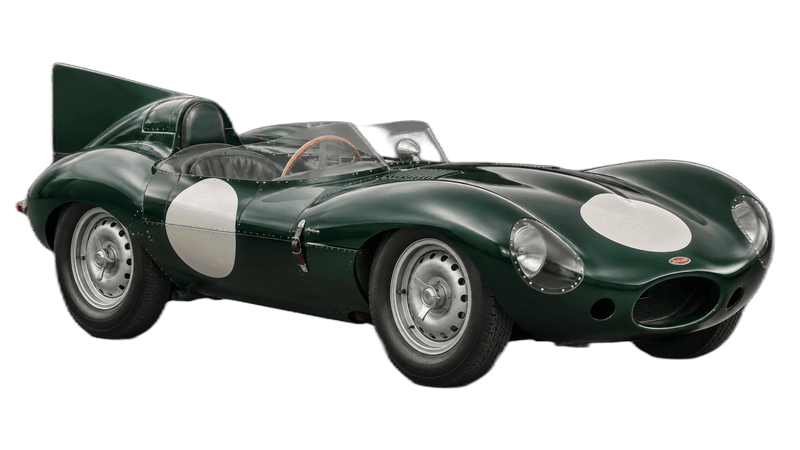
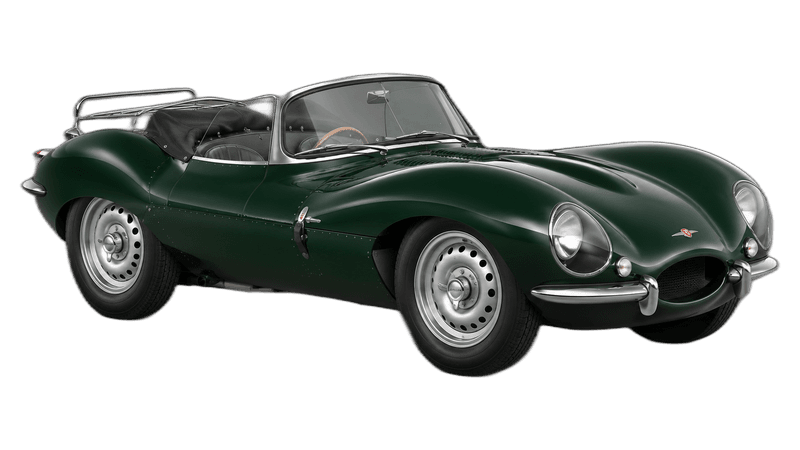
The conversion changed the D-Type in visible ways. Per RM Sotheby's and Wikipedia, the bulkhead was removed to create a full cockpit, the rear fin was eliminated, and a passenger-side door was added. A full two-abreast interior, a full-width chrome windscreen, sidescreens, a folding fabric roof, chrome bumpers and XK140 rear light clusters followed.
Then came the fire. Gooding and Wikipedia both say that on the evening of 12 February 1957 a fire broke out at Jaguar's Browns Lane plant and destroyed the remaining nine cars in mid-production. RM Sotheby's says it began in the tyre storage room and consumed nearly a quarter of the plant, citing a newsreel figure of 3,000,000 pounds of damage. Jaguar had moved to Browns Lane fewer than five years earlier, according to the same story. Production ended with 16 cars, and Wikipedia adds that only 16 were built and sold at the time.
The Gooding listing says 12 of the 16 went to the United States, 2 to Canada, 1 to Hong Kong and 1 stayed in Britain. Actor and racer Steve McQueen had to have one, per Gooding, and Wikipedia says he owned one for personal use, painted British racing green, and called it the Green Rat. We did not verify the ownership history of any particular car.
The engine and mechanicals
The XKSS used the 3.4L XK six in D-Type form. Wikipedia's engine article notes a wide-angle cylinder head for the D-Type 3.4 from 1955 and lists the XK-SS among cars with it. Supercars.net says the engine has dry-sump lubrication, and the Gooding listing says the D-Type had it too.
On carburation, the Gooding listing says the D-Type engine used three Weber 45 DCO3 carburettors. The RM Sotheby's continuation lot says its newly cast engine has three Weber DC03 units, with new blocks and heads built to original specification. A Conceptcarz profile of one original car says it retains two of its three carburettors and that the front one was replaced. Search summaries also mentioned other makes, which we did not open. For these reasons we say three Weber carburettors is the commonly described original layout, and we cannot confirm it for every car.
RM Sotheby's quotes a period Road and Track review calling the throttle response as near to instantaneous as any carburetted engine the magazine had driven, and notes the car did not overheat in traffic. The same story says the car had no limited-slip differential and no formal flywheel. These are statements about the cars as tested in 1957, not claims we can make ourselves.
What the rarity means for buyers
With 16 cars, there is no used market in the ordinary sense. The Gooding and Company Amelia Island listing for chassis XKSS 716, offered on 10 March 2017, carried an estimate of 16,000,000 to 18,000,000 US dollars. We did not open a page that states the outcome, so we do not claim a sale price. For comparison, the RM Sotheby's Elkhart Collection listing shows a Jaguar Classic continuation car, not an original, as sold for 1,985,000 US dollars. The page does not state the auction date, and we have not tried to compare the two figures further.
Because we read no inspection reports, we cannot list common faults, running costs or recalls. What the sources do give is a list of things a specialist would be asked to confirm:
- Chassis identity. The RM Sotheby's story says the car it describes is stamped XKSS 707 and that the original XKD number was ground down in preparation. Numbers, stamps and conversion history are central to authenticity.
- Originality of the engine and fuel system, including the carburettors, given the fitment questions above.
- Whether a car is an original 1957 car or one of the nine continuations. They share the model name, but the continuation chassis numbers were those of the destroyed cars.
- Any restoration documentation. The sources we read do not discuss it in detail, so ask for everything in writing.
The continuation cars, as context only
In March 2016 Jaguar announced that it would build the nine lost cars to complete the original run of 25. Wikipedia lists them as 2016 to 2017 and says they were expected to sell for more than 1,000,000 pounds each. RM Sotheby's describes one as one of nine produced by Jaguar Classic, with only 51 miles at cataloguing. We did not research these cars further, and nothing in this guide should be read as applying to them.
What we could not find
We found no torque figure for the XKSS and no 0-100 km/h time, so those are no figure shown. We found no maker brochure or period road test text, and the 250 bhp and 240 km/h figures come from the secondary pages named above, plus the Road and Track figure as quoted by Gooding. We did not find a page that states the front-engine layout in those words. We found no costs of ownership, no failure rates and no recall information. The Classic and Sports Car page we tried returned no usable text, and we did not try to work around it.
About the photograph
This page uses the catalogue photograph, and its credit is listed on the credits page.
Verdict
The Jaguar XKSS is best understood as a short, famous episode: a D-Type turned into a road car, cut short by a fire at Browns Lane after sixteen had been completed. The 3.4L inline-six, the four-speed manual and rear-wheel drive are well supported. The 250 bhp and 240 km/h figures are widely quoted, and we show them with their caveats. Torque and a 0-100 km/h time are not in the pages we read.
If you are researching the car, the useful questions are about identity, originality and history, not about numbers. A guide cannot replace a specialist inspection, and nothing here is a buying recommendation. We have not driven this model for this article, and we offer only what we read.
Sources
- RM Sotheby's - Flameproof: The Origin of the XKSS
- RM Sotheby's - 1957 Jaguar XKSS Continuation (Elkhart Collection)
- Gooding and Company - 1957 Jaguar XKSS, Amelia Island 2017 press release
- Racecar - Iconic 1957 Jaguar XKSS offered at Amelia Island Auction
- Supercars.net - Jaguar XKSS (1957)
- Conceptcarz - 1957 Jaguar XKSS
- Wikipedia - Jaguar XKSS
- Wikipedia - Jaguar XK engine
Specifications
| Engine | 3.4L inline-six |
|---|---|
| Displacement | 3.4L |
| Power | 250 bhp |
| Top Speed | 240 km/h |
| Drivetrain | RWD |
| Country | United Kingdom |
| Body Style | 2-door roadster |
| Years | 1957 |
| Production | 16 |
| Price Used | £9,000,000 |
Specifications are manufacturer-published figures.
Frequently Asked Questions
What is a Jaguar XKSS worth?
A representative example is worth about £9,000,000. Actual values vary with specification, condition and history.
How much power does the Jaguar XKSS have?
The Jaguar XKSS produces 250 bhp.
What is the top speed of the Jaguar XKSS?
The Jaguar XKSS has a top speed of 240 km/h.
What engine does the Jaguar XKSS have?
The Jaguar XKSS uses a 3.4L inline-six.
How many Jaguar XKSS were made?
Jaguar produced 16 units of the Jaguar XKSS.
When was the Jaguar XKSS built?
The Jaguar XKSS was built from 1957 to 1957.
Is the Jaguar XKSS all-wheel drive?
No. The Jaguar XKSS is configured with rear-wheel drive.