
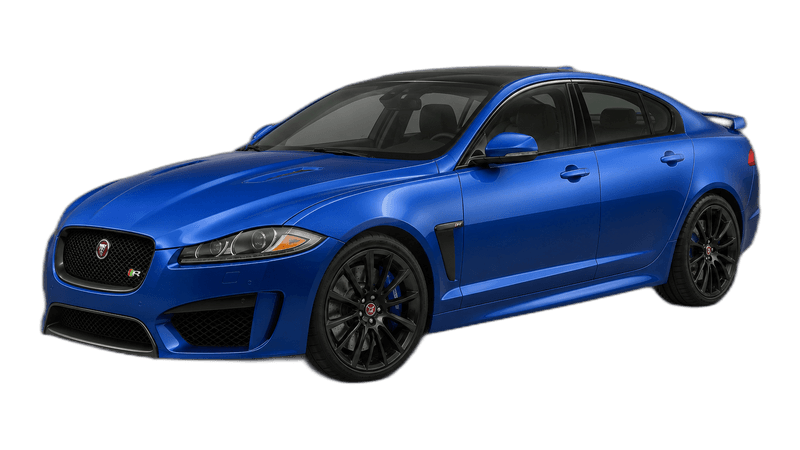
Jaguar XFR-S
£32,000
usedIndicative market price, updated periodically.
542bhp
Power
4.8s
0-100 km/h
300km/h
Top Speed
£32,000
Price Used
How hard it pulls.
Peak g-force the instant you bury the throttle, estimated from the car's 0–100 time and drivetrain.
Jaguar XFR-SEstimated peak launch g from the 0–100 time and drivetrain: an honest approximation, not a measured figure.
The Jaguar XFR-S is a 4/5 seater saloon/sedan by Jaguar, with 542 bhp, 680 Nm of torque, a 0-100 km/h time of 4.8 seconds and a top speed of 300 km/h. Indicative used value: approximately £32,000. Actual values vary with specification, condition and history.
Dream Car Garage Editorial · Last updated 1 November 2026
Overview
We have not driven this car. This review is based on published specifications and the sources listed below.
The XF body with the fullest Jaguar V8
The Jaguar XFR-S was the short-lived, harder-edged version of the first-generation XF. Our catalogue records the 2013 to 2015 saloon with a 5.0L supercharged V8 petrol engine, 542 bhp, 680 Nm, 0 to 100 km/h in 4.8 seconds and a 300 km/h maximum, with rear-wheel drive. We have not driven this model for this article. This is a desk-researched ownership guide using Jaguar's official 14MY XF brochure, the PistonHeads XFR buying guide and the DVSA recall service.
Jaguar's own brochure material lists the XFR-S at 550 PS and 680 Nm, with 0 to 100 km/h in 4.6 seconds and a 300 km/h top speed. PistonHeads describes the same basic car as 550 hp and 502 lb ft, with a 4.6-second 0-62 mph time and a 186 mph limited maximum. The catalogue's 542 bhp and 4.8 seconds are not a clean conversion or restatement of those source figures. Treat the exact output and acceleration claim as specification and test-cycle dependent, then verify the particular car's build date, market and equipment rather than relying on a headline number.
Supercharged V8 first, gearbox history second
The XFR-S uses Jaguar's supercharged 5.0-litre V8 with an eight-speed automatic and rear-wheel drive. PistonHeads associates the XFR-S with the newer eight-speed gearbox, while earlier XFR cars used a six-speed unit. That makes the transmission identity a useful first check: confirm what is fitted, whether it behaves properly when cold, and whether fluid or repair work is documented. A gearbox that flares, shudders or hesitates should be diagnosed before purchase, not after.
The engine itself is the main attraction, but it still needs evidence. Look for a complete service history with the correct oil specification and no unexplained top-up routine. Supercharger whine should be present under load, yet it should not become a harsh rattle or metallic slap. PistonHeads highlights general XFR strengths and weaknesses rather than proving that every XFR-S failure is unique to the model. That means the sensible approach is to inspect the specific car for cooling health, belt condition, tensioner noise, pulley alignment and any signs of repeated overheating.
Cooling deserves particular care on a heavy supercharged saloon. Check the coolant level and colour, look for dried deposits around hoses and joints, and inspect the radiator areas for impact damage or debris. An electric fan that runs excessively, a thermostat that opens late or a temperature gauge that wanders can all turn a fast saloon into an expensive recovery job. Ask for invoices for pumps, thermostats, hoses or radiator work. The absence of such paperwork is not proof of failure, but it raises the importance of a cold start and a long test drive.
Suspension, brakes and tyres under real power
The XFR-S was set up more firmly than the standard XFR, with revised suspension and a prominent aerodynamic package. PistonHeads describes much stiffer springs and a front suspension revision, so a smooth, quiet, tightly controlled car is the target. Listen for knocks from the front and rear over broken roads. Worn control-arm bushes, damper mounts, anti-roll-bar links and rear axle bushes can all make the car feel less precise than it should.
Brakes must match the performance. Check the discs for scoring, lip formation and uneven wear, and ask for pad and fluid history. Cars that have seen track use may have consumed pads quickly, while cars used only gently can suffer corrosion and seized calipers. Either is manageable, but both need evidence. Tyres should be the correct size and speed rating, with a matching set across an axle where possible and date codes that make sense for the mileage. A low-mileage car with old tyres is not a bargain; it is a car that needs immediate expenditure.
The XFR-S also used an electronic limited-slip differential. On the test drive, feel for smooth lock-up out of slower corners rather than binding, clunks or warning lights. Any traction-control, differential or driveline message should be investigated. PistonHeads links the wider XFR story with strong performance hardware and fast road ability; your task is to establish whether the individual car has been maintained well enough to keep that hardware healthy.
Body, cabin and rare-car provenance
This is a rare Jaguar, so originality and ownership history matter. Check the body for mismatched paint, repair labels, uneven panel gaps and damage around the lower bumpers and side skirts. The large rear wing can attract attention at parking barriers and in tight garages. Make sure it is secure, undamaged and original in appearance. A clean, complete car with ordinary stone chips is preferable to a heavily repaired example presented as perfect.
Inside, check the sports seats for bolster wear, the steering wheel and gear selector for polish, and the infotainment and instrument cluster for dead pixels or warning messages. The cabin should feel solid, not creaky over rough roads. Water in the footwells can indicate blocked drains or poor previous repair work. A car with several owners is not automatically suspect, but every change of keeper should have a service entry or a plausible explanation.
Service history is the decisive issue. Look for dated invoices, MOT records that match the mileage, and evidence that any recalls or campaigns were completed through the DVSA system. Modified cars need particular care: a software tune may add speed, but it can also conceal hard use and complicate insurance. The best XFR-S is the one with a documented eight-speed service path, cooling system maintenance, healthy suspension and brakes, and no mystery in its recent past. It is a rapid, charismatic saloon, but the rarest parts of the package only work when the common maintenance is up to date.
Specifications
Engine
5.0L supercharged V8 petrol
Displacement
5.0L
Power
542 bhp
Torque
680 Nm
0-100 km/h
4.8s
Top Speed
300 km/h
Drivetrain
RWD
Country
UK
Body Style
4/5 seater saloon/sedan
Years
2013–2015
Price Used
£32,000
Specifications are manufacturer-published figures.
More from Jaguar
Frequently Asked Questions
What are the specifications of the Jaguar XFR-S?
The Jaguar XFR-S is a 4/5 seater saloon/sedan by Jaguar, with 542 bhp, 680 Nm of torque, a 0-100 km/h time of 4.8 seconds and a top speed of 300 km/h. Indicative used value: approximately £32,000. Actual values vary with specification, condition and history.
How much does a Jaguar XFR-S cost?
Indicative used value: approximately £32,000. Actual values vary with specification, condition and history.
What drivetrain does the Jaguar XFR-S use?
The Jaguar XFR-S is configured with rear-wheel drive.
What type of car is the Jaguar XFR-S?
The Jaguar XFR-S is a super saloons manufactured by Jaguar in UK. Production ran from 2013 to 2015.