
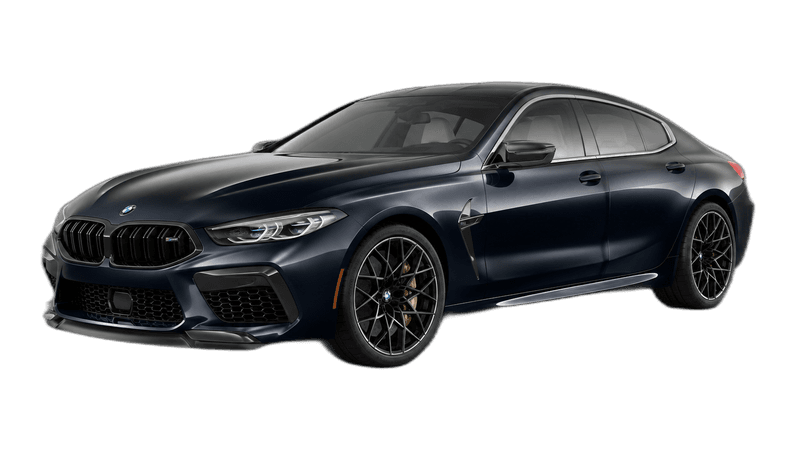
BMW M8 Competition Gran Coupe
£75,000
usedIndicative market price, updated periodically.
617bhp
Power
3.2s
0-100 km/h
250km/h
Top Speed
£75,000
Price Used
How hard it pulls.
Peak g-force the instant you bury the throttle, estimated from the car's 0–100 time and drivetrain.
BMW M8 Competition Gran CoupeEstimated peak launch g from the 0–100 time and drivetrain: an honest approximation, not a measured figure.
The BMW M8 Competition Gran Coupe is a 4-door coupe by BMW, with 617 bhp, 750 Nm of torque, a 0-100 km/h time of 3.2 seconds and a top speed of 250 km/h. Indicative used value: approximately £75,000. Actual values vary with specification, condition and history.
Dream Car Garage Editorial · Last updated 30 October 2026
Overview
We have not driven this car. This review is based on published specifications and the sources listed below.
The M8 with room behind the driver
The F93 M8 Competition Gran Coupé extends the M8 idea into a long four-door body rather than an SUV. Its attraction is the combination of a low roofline, substantial rear accommodation and a high-output all-wheel-drive powertrain. We have not driven this model for this article. This guide is based on BMW's archived launch release and the PistonHeads used buying guide. The latter's observations describe the evidence available when it was published in May 2024, not a guarantee about reliability today.
Pin down the Competition identity
BMW announced the Gran Coupé in October 2019 and specified market introduction in January 2020. This catalogue uses 2020 as the start of customer availability rather than treating the announcement as a delivery date. The Competition engine is a 4395 cc S63 twin-turbo V8 delivering 625 PS, approximately 617 bhp, with 750 Nm. BMW quotes 0 to 100 km/h in 3.2 seconds and a limited 250 km/h maximum. Higher-limit packages and non-Competition specifications should be recorded separately.
The gearbox is an eight-speed M Steptronic automatic, not the seven-speed DCT fitted to the preceding M6. M xDrive provides all-wheel drive with selectable settings, including a rear-drive configuration that requires stability-control changes. That capability is not a recommendation to disable safety systems on public roads. For a purchase assessment, ordinary road settings and a specialist inspection provide more useful evidence than a demonstration of dramatic launch or drift functions.
Four doors do not mean five equal seats
The Gran Coupé has a wheelbase 200 mm longer than the two-door M8. BMW describes four full seats and an additional occasional rear position. PistonHeads notes the centre position's compromise around the rear console, so check the actual passengers rather than relying on the number of seatbelts. Headroom, foot space and entry beneath the low roof should be assessed with the front seats positioned normally.
The independent guide quotes a 440-litre boot but also draws attention to the opening and the practical limitations of the body shape. Bring representative luggage if that matters to your use. Test rearward visibility and parking in a realistic setting: the shallow rear glass and headrests can make cameras particularly useful. A longer car can offer generous legroom while still being awkward in a short garage or a narrow parking space. Those are ownership differences that a performance table cannot resolve.
Service evidence before reliability labels
PistonHeads reported a generally encouraging reliability picture as of May 2024. That observation has a date and a limited evidence base; it is not a measured failure rate or proof that inspection is unnecessary. Obtain dated maintenance records, investigate gaps and ask about modifications. Separate factory options from later engine software, exhaust changes and aftermarket hardware, then establish what remains covered by any transferable warranty.
Have a BMW M specialist assess the engine from cold and after warm-up, review stored faults and inspect accessible cooling and oil circuits. These are hardware-led inspection recommendations, not claims that every F93 has a particular leak. Ask the inspector to identify any inaccessible areas and the limits of the examination. An apparently clean diagnostic report does not certify internal mechanical condition, while an isolated historical code needs interpretation rather than an automatic list of replacement parts.
Transmission and all-wheel-drive assessment
Check normal automatic shifts, low-speed manoeuvring and restarts after the car has warmed through. Review previous gearbox and driveline work and inspect for leaks or damaged mounts. Have the specialist assess the transfer system, differentials and tyres together, using the correct maintenance information for the VIN. Do not transfer DCT-specific assumptions from an M5 or M6 to this torque-converter transmission.
Tyre condition deserves more than a tread-depth glance. Check sizes, age, matching specifications and wear patterns on all four wheels. If there is vibration or uneven wear, establish whether wheels, alignment or suspension need work before assuming tyres alone will cure it. A documented road assessment should describe the conditions under which a symptom appeared. That is more useful for diagnosis than an unexplained verdict that a powerful all-wheel-drive car is simply meant to behave that way.
Know the suspension and brakes
The PistonHeads guide describes steel springs with adaptive dampers, rather than air suspension, and distinguishes the M8 from related large BMWs with other chassis systems. Do not budget for or diagnose it using an M760Li's air-suspension checklist. Check the fitted dampers, suspension joints and electronic functions on their own terms. Confirm any aftermarket changes and whether the original parts accompany the car.
Steel and optional carbon-ceramic brakes require different assessment methods and replacement estimates. Establish which system is fitted from the build record and physical hardware, then obtain a written condition report. Historic replacement figures from a used guide are not a current quotation. Inspect the wheels, inner rims and tyres at the same time. Large wheel and brake assemblies can make apparently minor damage significant, but the correct response is a specific estimate rather than an assumed universal ownership bill.
Cameras, screens and equipment
The independent guide mentions reports of camera images failing or becoming obscured. Test each available view repeatedly, including after a restart, and check whether an issue has an identified repair or software history. A clean lens and a functioning display are separate questions. Check parking sensors, driver-assistance functions and any warnings rather than assuming the camera proves the complete system works.
PistonHeads also describes a 2022 update with a larger central screen and an available carbon-bucket seat option. Build date, market and the actual order matter more than an advert's use of the word facelift. Try the seats over a representative period and verify the audio, climate controls, heating, ventilation and other advertised functions. Carbon buckets and highly optioned interiors may appeal to one buyer while making access or everyday use less suitable for another.
A clear route to a decision
Check the UK DVSA recall service and ask BMW for a VIN-specific campaign review. References to overseas recalls do not automatically include or exempt a UK Competition car. Combine those findings with the inspection and an itemised maintenance budget. Do not use an older guide's depreciation discussion as a promise about future values. The best reason to choose this M8 is that its particular seating, equipment and condition suit your use, with its 617 bhp performance supported by a service record and ownership budget you understand.
Specifications
Engine
4.4L (4395 cc) S63 twin-turbo V8 petrol
Displacement
4.4L
Power
617 bhp
Torque
750 Nm
0-100 km/h
3.2s
Top Speed
250 km/h
Drivetrain
AWD
Country
Germany
Body Style
4-door coupe
Years
2020–present
Price Used
£75,000
Specifications are manufacturer-published figures.
More from BMW

Frequently Asked Questions
What are the specifications of the BMW M8 Competition Gran Coupe?
The BMW M8 Competition Gran Coupe is a 4-door coupe by BMW, with 617 bhp, 750 Nm of torque, a 0-100 km/h time of 3.2 seconds and a top speed of 250 km/h. Indicative used value: approximately £75,000. Actual values vary with specification, condition and history.
How much does a BMW M8 Competition Gran Coupe cost?
Indicative used value: approximately £75,000. Actual values vary with specification, condition and history.
What drivetrain does the BMW M8 Competition Gran Coupe use?
The BMW M8 Competition Gran Coupe is configured with all-wheel drive.
What type of car is the BMW M8 Competition Gran Coupe?
The BMW M8 Competition Gran Coupe is a hyper gts manufactured by BMW in Germany. Production started in 2020.