
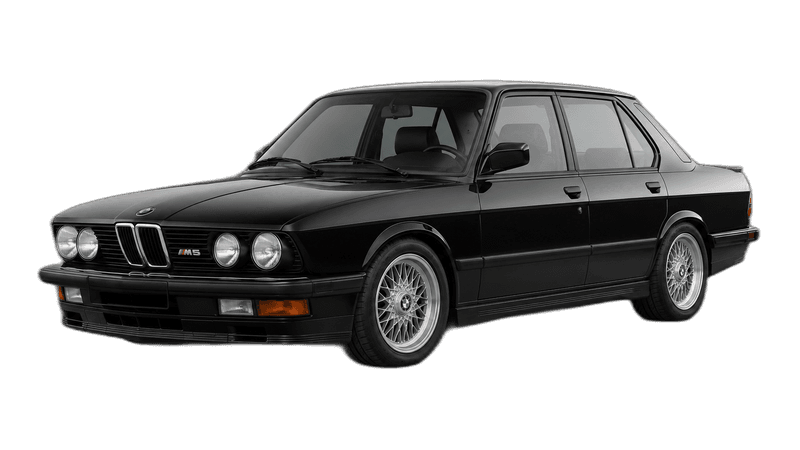
BMW M5 (E34)
£45,000
usedIndicative market price, updated periodically.
335bhp
Power
5.9s
0-100 km/h
250km/h
Top Speed
£45,000
Price Used
How hard it pulls.
Peak g-force the instant you bury the throttle, estimated from the car's 0–100 time and drivetrain.
BMW M5 (E34)Estimated peak launch g from the 0–100 time and drivetrain: an honest approximation, not a measured figure.
The BMW M5 (E34) is a 4-door saloon by BMW, with 335 bhp, 400 Nm of torque, a 0-100 km/h time of 5.9 seconds and a top speed of 250 km/h. Indicative used value: approximately £45,000. Actual values vary with specification, condition and history.
Dream Car Garage Editorial · Last updated 30 October 2026
Overview
We have not driven this car. This review is based on published specifications and the sources listed below.
Why the E34 matters
The second-generation M5 combines an ordinary-looking four-door body with a naturally aspirated straight-six and unusually involved chassis engineering. Its appeal is not simply that it predates turbocharging. It offers a particular combination of discreet presentation, manual transmission and mechanical character that requires a correspondingly specific inspection. We have not driven this model for this article. This is a desk-researched ownership guide using BMW's archived history and the PistonHeads buying guide, with inspection priorities distinguished from guarantees about an individual car.
Establish which M5 you are viewing
The E34 generation ran from 1988 to 1995, but those dates do not describe one unchanging specification. Early cars used the 3535 cc S38B36, commonly described as the 3.6 despite its actual displacement. Later European cars received the 3795 cc S38B38. Our catalogue represents that later 3.8-litre saloon: approximately 335 bhp, corresponding to BMW's 340 PS, with 400 Nm, a quoted 0 to 100 km/h time of 5.9 seconds and an electronically limited 250 km/h maximum. These are not specifications for every E34 wearing an M5 badge.
BMW's history places the final substantial update in 1994, including a six-speed manual, larger brakes and 18-inch parallel-spoke wheels. Earlier cars have a five-speed gearbox. Check the build date and original specification before treating a six-speed as a conversion or assuming every 3.8 should have one. Likewise, an earlier wheel design on a later car needs explanation rather than an immediate accusation. Production totals vary in scope across references, so this guide does not assign a verified production count to the particular saloon specification.
Rust before cosmetics
PistonHeads identifies wheelarches, sills, door bottoms, jacking points and the fuel-filler area as important corrosion checks. Arrange access to the underside rather than deciding from polished exterior photographs. An inspection should distinguish superficial corrosion from compromised structure, and should document previous welding with photographs and invoices where available. A tidy paint finish does not establish the condition of concealed metal or the quality of an older repair.
Check panel fit, paint consistency and the areas around trim and seals. Ask why any panels were replaced and whether work involved accident damage, corrosion or cosmetic refurbishment. None automatically rules a car out, but the answer affects the inspection and the budget. The same reasoning applies to a car advertised as entirely original: originality is not a substitute for sound metal, and an old untreated problem is not made desirable by its age.
The S38 service file
The S38 deserves a specialist who knows its valve adjustment requirements, ignition arrangements and cooling system. PistonHeads highlights valve-clearance attention and notes that the 3.8 uses individual ignition coils. Ask for dated evidence of the work actually performed, not just stamps stating that a service occurred. A misfire or reluctant response needs diagnosis before purchase; it should not be dismissed as normal behaviour for an older performance engine.
Start the engine from genuinely cold and let the inspecting specialist interpret noises. The source notes that the secondary-air system can make a cold start conspicuous, so noise alone is not proof of a cracked manifold or a failed engine. Persistent timing-related rattles, leaks or uneven running still merit investigation. This is not a recommendation to remove emissions equipment or replace parts based on an internet description. A recorded symptom, a diagnostic conclusion and a repair invoice are different kinds of evidence.
Cooling and driveline checks
Inspect the radiator, water pump and associated hoses for leaks or deterioration. The buying guide draws attention to the viscous fan coupling: an increasing temperature in traffic and an unusually noisy fan are reasons for assessment. Observe the car through a proper warm-up and subsequent restart, with permission and safe conditions. A short cold demonstration cannot show how it manages heat after sustained use or slow running.
Both manual gearboxes are described as durable, but condition still governs the decision. Check clutch operation, clean selection and behaviour when warm, and investigate vibration or driveline noises. High recorded mileage is not itself a diagnosis of gearbox failure. Equally, a low odometer reading without supporting maintenance does not establish good internal condition. Modifications to the clutch, differential or gearing should be documented so that the inspector knows what specification is actually being assessed.
Hydraulic suspension is not a minor detail
The rear self-levelling system has hydraulic components whose condition matters independently of how the car sits in a photograph. PistonHeads identifies leaking dampers, lines, accumulators and the regulating valve as inspection points. The 3.8's electronically controlled damping adds another layer. Ask the specialist to explain which original systems remain present, which have been rebuilt and whether suitable replacement or refurbishment support is available locally.
A conversion to conventional suspension is not automatically unacceptable, but it changes the car. Seek invoices, component identities and evidence that the conversion was properly completed rather than assuming it removes all future expenditure. Check bushes, ball joints and steering-box play as well. Uneven tyre wear or an unsettled straight-line response deserves investigation of alignment and worn components, not merely a promise that a fresh set of tyres will resolve it.
Wheels, brakes and an ownership decision
The distinctive M-System wheel covers and later parallel-spoke wheels are part of the model's history. The PistonHeads guide explains that original covered wheels are two-piece assemblies; similar-looking one-piece replicas are not identical. Inspect wheel condition, correct fitment, tyre age and the brake hardware appropriate to the build date. Include brake, fuel and hydraulic lines in the underside assessment, since replacing corroded pipework can involve considerably more labour than an exterior inspection suggests.
Use the DVSA recall service for a UK car and ask BMW to check the VIN for applicable campaigns and completion records. The inspection should leave you with separate estimates for immediate safety work, deferred maintenance and optional cosmetic improvements. Choose between individual cars on that evidence and on the specification you want to maintain. No present valuation, investment prediction or universal failure rate follows from these sources. The E34 ownership case is strongest when its quiet appearance is matched by a service file that makes its complex mechanical condition understandable.
Specifications
Engine
3.8L (3795 cc) S38 naturally aspirated inline-6 petrol
Displacement
3.8L
Power
335 bhp
Torque
400 Nm
0-100 km/h
5.9s
Top Speed
250 km/h
Drivetrain
RWD
Country
Germany
Body Style
4-door saloon
Years
1988–1995
Price Used
£45,000
Specifications are manufacturer-published figures.
More from BMW

Frequently Asked Questions
What are the specifications of the BMW M5 (E34)?
The BMW M5 (E34) is a 4-door saloon by BMW, with 335 bhp, 400 Nm of torque, a 0-100 km/h time of 5.9 seconds and a top speed of 250 km/h. Indicative used value: approximately £45,000. Actual values vary with specification, condition and history.
How much does a BMW M5 (E34) cost?
Indicative used value: approximately £45,000. Actual values vary with specification, condition and history.
What drivetrain does the BMW M5 (E34) use?
The BMW M5 (E34) is configured with rear-wheel drive.
What type of car is the BMW M5 (E34)?
The BMW M5 (E34) is a super saloons manufactured by BMW in Germany. Production ran from 1988 to 1995.