
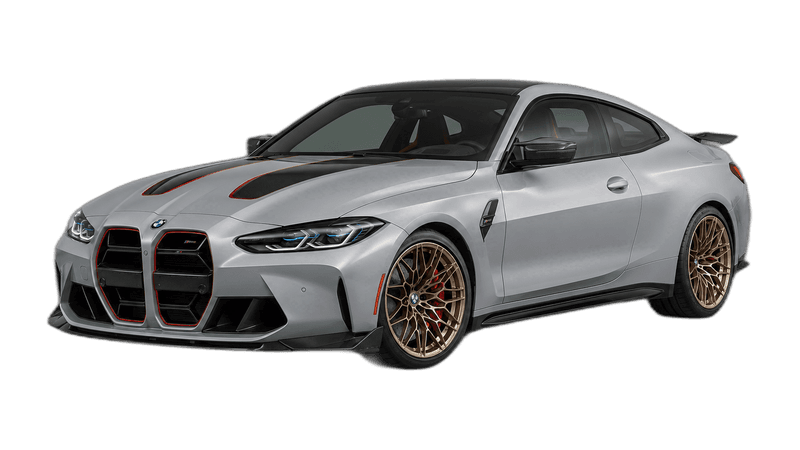
BMW M4 CSL (G82)
£135,000
usedIndicative market price, updated periodically.
543bhp
Power
3.7s
0-100 km/h
307km/h
Top Speed
£135,000
Price Used
How hard it pulls.
Peak g-force the instant you bury the throttle, estimated from the car's 0–100 time and drivetrain.
BMW M4 CSL (G82)Estimated peak launch g from the 0–100 time and drivetrain: an honest approximation, not a measured figure.
The BMW M4 CSL (G82) is a 2+2 seater fixed-head coupé by BMW, producing 543 bhp, and 650 Nm of torque, with a 0-100 km/h time of 3.7 seconds, and a top speed of 307 km/h, Valued at approximately £135,000.
Dream Car Garage Editorial · Last updated 24 October 2026
Overview
We have not driven this car. This review is based on published specifications, owner reports and market listings.
A G82 CSL with a specific brief
The M4 CSL introduced in 2022 belongs to the G82 generation and uses an S58 twin-turbocharged straight-six. It is not an F82 M4 GTS, and the earlier car's water-injection system should not be attributed to it. BMW announced a production run of 1,000 examples and a focused combination of rear-wheel drive, automatic transmission and two-seat accommodation.
This is a desk-researched guide. We have not driven this model for this article. The limited-production story explains interest but does not decide whether the car's seating, tyres or ride suit an owner. Its appeal should rest on wanting this particular engineering package, not a belief that every car carrying CSL letters must appreciate or remain easy to sell.
Understand the lightweight comparison
BMW's launch material describes a 100-kilogram reduction against the contemporary M4 Competition Coupe, not against every M4 configuration ever produced. The programme includes multiple measures, not simply fitting a carbon roof. The roof alone cannot explain that difference when related cars already use carbon roofing. Preserve the stated comparison rather than turning a marketing baseline into an independently measured weight for every vehicle.
Obtain the final build specification and check any alterations. Seats, wheels, body panels and exhaust equipment should match the records unless changes are clearly disclosed. A standard M4 with CSL-style parts is not equivalent to a factory CSL. Authentication should use the VIN and documentation rather than decorative badges, numbered accessories or a seller's description alone.
Driver fit and road usability
Try the seating position, access, visibility and pedal operation in person. Fixed-purpose seating can be an important limitation, particularly if more than one person will drive. Ask whether adjustment or replacement is possible and what implications a change would have for safety, local approval and originality. A seat suitable for one owner is not automatically comfortable or correctly fitted for another.
The absence of normal rear passenger accommodation is a substantive difference from an ordinary M4. Confirm how the available space can actually be used and what equipment is supplied. Check clearance at the intended garage and on ordinary approaches. A lower or more focused car should not be assumed practical merely because it retains registration for public roads.
S58 and transmission history
Review servicing, correct fluids, cooling checks and any warning or overheating history. Do not transfer an S55-specific issue automatically to the S58, nor assume newer hardware needs no scrutiny. A specialist should assess the installation, stored faults and the evidence behind previous repairs. A clean engine bay and a clear dashboard are only part of that investigation.
Check automatic transmission operation cold and warm, including reverse and gentle manoeuvres. Investigate unusual shifts or vibration rather than promising a simple software reset will cure them. Establish what maintenance is applicable to this drivetrain and use. If tuning or exhaust changes occurred, obtain documentation of the present calibration and confirm that insurance and local requirements are met.
Carbon components and accident repairs
Inspect the underside, aerodynamic parts, panel mounting points and evidence of impact damage. Lightweight materials need assessment appropriate to their construction. Cosmetic appearance cannot clear an underlying structural concern, and an attractive repair photograph does not establish that an approved method was followed. Request invoices, assessment records and the identity of the repairer.
Find out who can supply and repair model-specific parts before purchase, especially if damage is already visible. A small crack or missing piece may require a different process from an ordinary M4 panel repair. Obtain actual estimates and availability rather than assuming the original price or a shared platform makes every component straightforward to replace.
Brakes, wheels and tyres
Carbon-ceramic brakes need a qualified condition assessment, not just a casual check that the discs appear thick. Review the appropriate wear or damage criteria with the inspecting specialist. Obtain a written estimate for anything approaching replacement. Brake specification can dominate a near-term bill and should not be hidden within an unsupported generic annual service price.
Check wheel condition, tyre age, exact fitment and wear pattern. Track-oriented tyres have different operating characteristics from ordinary road tyres; assess suitability for the weather and roads you intend to use. No tyre label removes the need for appropriate temperatures, pressures and safe driving. The factory performance story is not a guarantee of grip in every circumstance.
Track use, storage and ownership costs
If the car has attended circuits, request preparation and post-event inspection records, plus details of incidents. Track history can be compatible with careful ownership, but low road mileage cannot describe the component workload. Check belts and any added safety equipment against the intended organiser's rules rather than treating every accessory as permanently eligible.
Build the budget from the inspection and expected use: servicing, tyres, brakes, insurance, tax, transport and a contingency for specialist repairs. This article has no current quotation or transaction survey supporting a universal annual figure. Storage still requires attention to tyres, fluids and power supplies according to the vehicle's guidance, even if the car is used only occasionally.
Value and alternatives
Compare authentic CSLs by specification, history, condition and tax position, distinguishing advertised prices from completed transactions. Limited production does not establish future returns or a minimum resale price. An independent dated valuation can help with insurance, but it is not a promise that another buyer will pay the same amount promptly.
A conventional M4 Competition may fit a road-focused brief better, while a dedicated track car changes legality and support questions. Choose the CSL because its particular compromises serve a real purpose. BMW's published launch specification establishes the model differences; the actual car's condition and documentation still require independent verification before payment.
Specifications
Engine
3.0L twin-turbo S58 inline-6 petrol
Displacement
3.0L
Power
543 bhp
Torque
650 Nm
0-100 km/h
3.7s
Top Speed
307 km/h
Drivetrain
RWD
Country
Germany
Body Style
2+2 seater fixed-head coupé
Years
2022–present
Production
1,000
Price Used
£135,000
Specifications are manufacturer-published figures.
More from BMW


Featured in Carpedia
Frequently Asked Questions
What are the specifications of the BMW M4 CSL (G82)?
The BMW M4 CSL (G82) is a 2+2 seater fixed-head coupé by BMW, producing 543 bhp, and 650 Nm of torque, with a 0-100 km/h time of 3.7 seconds, and a top speed of 307 km/h, Valued at approximately £135,000.
How much does a BMW M4 CSL (G82) cost?
The BMW M4 CSL (G82) has a used market value of approximately £135,000.
How many BMW M4 CSL (G82) were made?
BMW produced 1,000 units of the BMW M4 CSL (G82).
Is the BMW M4 CSL (G82) AWD or RWD?
The BMW M4 CSL (G82) uses a RWD drivetrain configuration in a 2+2 seater fixed-head coupé body style.
What type of car is the BMW M4 CSL (G82)?
The BMW M4 CSL (G82) is a track focused manufactured by BMW in Germany. Production started in 2022.