
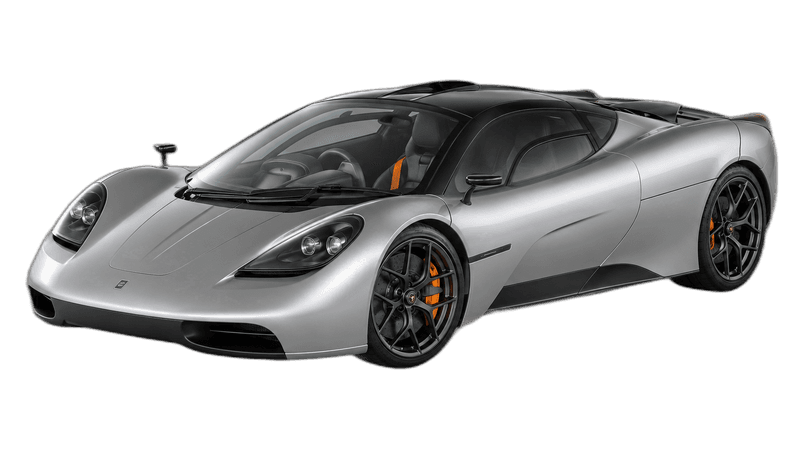
Gordon Murray T.50
£1,700,000
usatoIndicative market price, updated periodically.
654cv
Potenza
2.9s
0-100 km/h
364km/h
Velocita Massima
£1,700,000
Prezzo Usato
Quanto spinge.
La forza g di picco nell'istante in cui affondi l'acceleratore, stimata dal tempo 0–100 e dalla trazione.
Gordon Murray T.50G di partenza stimata dal tempo 0–100 e dalla trazione: un'approssimazione onesta, non un dato misurato.
The Gordon Murray T.50 is a 2-door coupe by Gordon Murray, with 654 bhp, 467 Nm of torque, a 0-100 km/h time of 2.9 seconds and a top speed of 364 km/h. Indicative used value: approximately £1,700,000. Actual values vary with specification, condition and history.
Dream Car Garage Editorial · Edited by José Teo Lorente Vallecillos · Last updated 2 November 2026
Panoramica
We have not driven this car. This review is based on published specifications and the sources listed below.
Scope of this guide
This guide is scoped to the standard Gordon Murray Automotive T.50 road car, the run of 100 three-seat, mid-engine, rear-wheel drive hypercars with the Cosworth GMA 4.0L V12 naturally aspirated petrol engine (3994 cc) and a six-speed manual gearbox, revealed in 2020 and built from 2023. It is not a guide to the T.50s Niki Lauda track-only car, which we understand is a separate programme of 25 cars with more power and less weight, nor to the later T.33, nor to the McLaren F1 that the T.50 is often compared with. Where the T.50s differs we say so below, so that you can tell which car an advert really describes.
We have not driven this model for this article. Everything here comes from three cited sources: the Gordon Murray Automotive T.50 technical specification (a press document, which we read through a copy hosted on a press site), PistonHeads' news coverage of the car (its launch report by Mike Duff, 5 August 2020, plus three later PistonHeads pieces from 2021), and the government recall checker. We also read an evo review (Henry Catchpole, 26 April 2025) and an evo production report (31 March 2023) by summary, and we flag the points that rest on them. Prices are history, not valuations, and we have no running-cost data to give you.
The figures at a glance
- Engine: 4.0L V12 naturally aspirated petrol, 3994 cc, a Cosworth GMA unit with a 65 degree vee, gear-driven double overhead camshafts, titanium valves and a dry sump.
- Power: 654 bhp. The specification gives 663 PS at 11,500 rpm, and we convert that to brake horsepower (663 x 0.98632 is about 653.9, rounded to 654). Several outlets label the same figure as 663 hp, 654 hp, 661 bhp or 664 bhp, so always check which unit a seller means.
- Torque: 467 Nm at 9,000 rpm, which the specification prints in newton metres. That is about 344 lb ft by our conversion, and evo prints 345 lb ft.
- Redline: 12,100 rpm, the maximum engine speed in the specification.
- 0-100 km/h: 2.9 seconds, which is not a manufacturer figure. See the section on performance claims below.
- Top speed: 364 km/h, about 226 mph by our conversion, again not a manufacturer figure.
- Drive: rear-wheel drive through a six-speed manual H-pattern gearbox with a limited-slip differential, and a mid-engine layout.
- Weight: 986 kg, the figure in the specification and on PistonHeads. The specification also lists a dry weight of 957 kg.
What the T.50 is
The T.50 was revealed on 5 August 2020 as the work of Gordon Murray, the designer of the McLaren F1, and PistonHeads described it as a three-seat, V12-powered hypercar with the driver in the middle. The specification describes a rear-mid engined coupe with a central driving position and two outboard passengers. The structure is bonded carbon fibre sandwich panels with an aluminium honeycomb core, and the body panels are carbon fibre. It is 4,352 mm long, 1,850 mm wide and 1,164 mm high with a 2,700 mm wheelbase.
The signature feature is a 400 mm, 8.5 kW fan at the rear, driven by a 48-volt system, which is part of what GMA calls a fan interactive aero system. The specification lists driver-selectable aero modes including Streamline, V Max Boost and High Downforce, plus automatic Auto and Brake Boost modes. The fan, spoilers and diffuser are electrically actuated, which matters to an owner because they are working parts, not trim.
How many were built and when
PistonHeads' launch report spoke of the rapidly diminishing list of 100 build slots, and evo's 2025 review says all 100 cars were sold. We therefore use 100 as the production count, but it is a build-slot figure from reports, not a chassis list we have seen. The start date is the second weak point. In March 2021 PistonHeads said customer cars were on course for delivery in the run up to 2022, and our catalogue previously said 2022. evo's report of 31 March 2023 says the first customer cars were already in production with delivery due later that year, so we now put the start at 2023. We have no confirmed end date for the run and leave it open.
Why the quoted power varies
PS (metric horsepower) is about 1.4 per cent more than bhp, so the maker's 663 PS is 654 bhp. The first PistonHeads launch report quoted 650 hp and a 3.9-litre engine, and the figure changed before the car was built. Its March 2021 report quoted 663 hp, which is the PS figure under a different label. The final specification gives a capacity of 3,994 cc, which is why this guide says 4.0 litres. If an old brochure or article says 650 hp or 3.9 litres, it describes the car as announced, not as built.
Performance claims to treat with care
evo's 2025 review says GMA does not even quote acceleration statistics. Neither the specification nor the PistonHeads pieces we read give a 0-100 km/h time or a road-car top speed. The 2.9 seconds in our catalogue is a third-party 0-60 mph (97 km/h) figure that Wikipedia attributes to Car and Driver, and the 364 km/h is the same source's 226 mph. We could not open that original article, so we cannot say whether it was a test or a repeat of an estimate. A true 0-100 km/h run would be marginally slower than a 0-60 mph run, and a search-result summary of another outlet showed 2.8 seconds to 62 mph, which we did not open. PistonHeads' only speed remark is that the 986 kg car could theoretically reach 277 mph, which it describes as theoretical, so it is not a measured or claimed top speed. Treat 2.9 seconds and 364 km/h as estimates.
Drivetrain and driving
The engine drives the rear wheels through a transverse six-speed manual gearbox, which PistonHeads describes as an Xtrac H-pattern unit, with a triple-plate carbon clutch. The specification also lists an optional overdrive sixth gear. There is traction control and ESP, both switchable, plus ABS and low-speed power steering. The engine has a 48-volt integrated generator unit that also feeds the fan. The tyres are Michelin Pilot Sport 4 S, 235/35 R19 at the front and 295/30 R20 at the rear, and the brakes are Brembo carbon ceramic, 370 mm at the front and 340 mm at the rear. We have not tested any of this and report it as the maker's description.
How the standard car differs from other versions
The T.50s Niki Lauda is a track-only derivative. We understand from a secondary source that it is limited to 25 cars, with around 772 PS and 852 kg, but we did not read a primary page on it. It cannot be registered for the road, so an advert that mentions track-only use, a higher power figure or a Niki Lauda name describes a different car from the one in this guide. Early prototypes such as the mule PistonHeads described in 2021, which was only an engine test bed, are also not production cars.
Running an owner's car
There are no published service prices, intervals or warranty terms in our sources, so we give none and we advise you not to rely on forum numbers. What the specification does tell you is practical. The fuel tank is 80 litres including a six-litre reserve, the oil capacity is 14 litres, and luggage space is 228 litres with three occupants or 288 litres with two. The car uses a dry sump, four catalytic converters, titanium and Inconel exhaust parts and PistonHeads says about 900 fasteners are titanium. All of that points to specialist work, so budget on the assumption that every job is a factory or approved-centre job.
What to check before buying
- Confirm the chassis number, that it is a standard T.50 and not a T.50s, and where it sits in the run of 100.
- Ask for the factory build record, the delivery paperwork and the full service history, including who carried out each service.
- Ask whether a driver, passenger or central-seat configuration was specified, and whether the optional overdrive sixth gear was fitted.
- Check the fan, the spoilers and the diffuser for correct operation in every aero mode, and ask whether any warning has appeared.
- Look at the carbon bodywork and the underside for repairs, and ask what the repairer was.
- Check the gearbox and clutch feel, since a manual with a 12,100 rpm engine rewards care, and ask for the mileage with evidence.
- Run the registration through the recall check described below.
Recalls and the DVSA check
We did not run the government checker, because it needs a registration number, or the manufacturer, model and year, and we are not looking at a specific car. The page says that for a serious safety defect the manufacturer will write to the owner, and that recalls for non-safety reasons come from the manufacturer. We found no recall for the T.50 in our sources, but that is not evidence that none exists. Run the registration through GOV.UK, and ask the manufacturer to confirm anything outstanding.
Verdict
The T.50 is 654 bhp, 467 Nm, a rear-wheel drive, mid-engine, three-seat hypercar with a six-speed manual and a 12,100 rpm V12, in a run of about 100 cars. Its performance figures of 2.9 seconds and 364 km/h are third-party estimates and not claims from the maker. If you are shopping for one, confirm which car it is, insist on a full factory history and recall evidence, and treat the published numbers as claims with the caveats above. We have not driven it, so use the sources and a proper specialist inspection to decide.
Specifiche
Motore
4.0L V12 naturally aspirated petrol
Cilindrata
4.0L
Potenza
654 cv
Coppia
467 Nm
0-100 km/h
2.9s
Velocita Massima
364 km/h
Trazione
RWD
Paese
UK
Carrozzeria
2-door coupe
Anni
2023–present
Produzione
100
Prezzo Usato
£1,700,000
Specifications are manufacturer-published figures.
Altre di Gordon Murray

In evidenza su Carpedia
The 10 Greatest V12 Engines Ever Made
A celebration of the twelve-cylinder engine, the most intoxicating configuration ever devised, and the ten units that defined it.
McLaren F1: The Car That Changed Everything
The McLaren F1 was designed without compromise, built without cost constraint, and remains unmatched thirty years later.
Domande Frequenti
What are the specifications of the Gordon Murray T.50?
The Gordon Murray T.50 is a 2-door coupe by Gordon Murray, with 654 bhp, 467 Nm of torque, a 0-100 km/h time of 2.9 seconds and a top speed of 364 km/h. Indicative used value: approximately £1,700,000. Actual values vary with specification, condition and history.
How much does a Gordon Murray T.50 cost?
Indicative used value: approximately £1,700,000. Actual values vary with specification, condition and history.
How many Gordon Murray T.50 were made?
Gordon Murray produced 100 units of the Gordon Murray T.50.
What drivetrain does the Gordon Murray T.50 use?
The Gordon Murray T.50 is configured with rear-wheel drive.
What type of car is the Gordon Murray T.50?
The Gordon Murray T.50 is a hypercars manufactured by Gordon Murray in UK. Production started in 2023.