
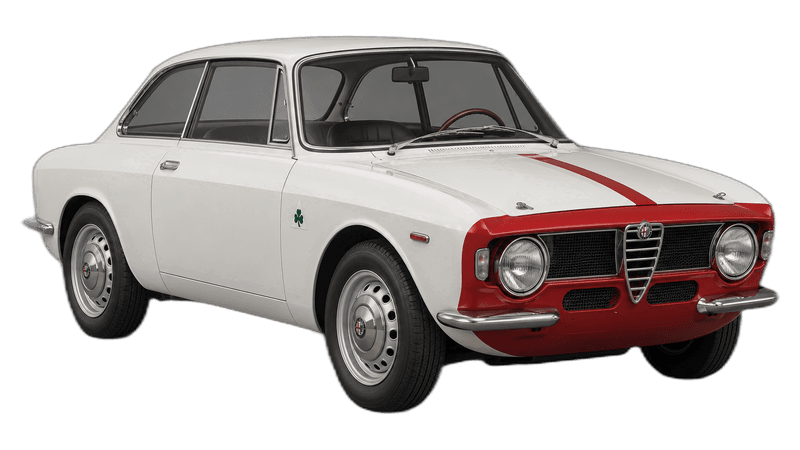
Alfa Romeo Giulia Sprint GTA
113cv
Potenza
185km/h
Velocita Massima
The Alfa Romeo Giulia Sprint GTA is a 2-door coupé by Alfa Romeo, with 113 bhp, 142 Nm of torque and a top speed of 185 km/h.
Dream Car Garage Editorial · Edited by José Teo Lorente Vallecillos · Last updated 3 November 2026
Panoramica
We have not driven this car. This review is based on published specifications and the sources listed below.
Scope of this guide
This guide is scoped to the Alfa Romeo Giulia Sprint GTA, the lightweight road-going coupe that Alfa Romeo introduced in 1965 and built until 1969, with Autodelta, Alfa's racing arm, developing the competition side. It is a front-engine, rear-wheel drive two-door coupe with a 1.6L twin-cam four-cylinder, a five-speed manual gearbox and aluminium outer panels in place of the steel ones of the Giulia Sprint GT it was based on. The letter A stands for Alleggerita, which means lightened. It is not a guide to the supercharged GTA-SA, the 2.0-litre GTAm, the smaller GTA 1300 Junior, or the modern Giulia GTA of the 2020s. We mention those only so that you can recognise them in an advert and keep them apart from the 1.6-litre car.
We have not driven this model for this article. We are an editorial desk that reads sources, and everything below comes from pages we opened: the Italian automobile club's ACI magazine feature on the car held by the Alfa Romeo museum at Arese, Wikipedia, the Dutch classic-car site AMKlassiek, the Robert Little Alfa history pages, a Motor Sport magazine feature, Silodrome, the Supercars.net blog, Conceptcarz, and auction pages from BH Auction in Japan and RM Sotheby's. This is a collector and competition car that rarely comes to market. A guide like this cannot replace an inspection by a specialist who knows these cars, and this page is for research, not a buying recommendation.
The figures at a glance
- Engine: 1.6L naturally aspirated inline-four, a twin-cam (DOHC) unit of 1,570 cc with two spark plugs per cylinder and two twin-choke carburettors. Wikipedia gives 1.6 L (1,570 cc), BH Auction gives 1,570 cc, and the Conceptcarz page gives 1,570 cc. Some pages loosely call it a 1,600 cc engine, which is the model's marketing name rather than a different engine.
- Power: 113 bhp. The ACI feature says 115 hp, up from 103 hp on the Sprint GT, and Robert Little says 115 CV. Wikipedia gives about 115 PS, written as 85 kW or 113 hp. We converted 115 PS to bhp at a factor of 0.98632, which gives about 113 bhp, and that matches the Wikipedia and RM Sotheby's road-car figure of 113 hp. Peak power was at 6,000 rpm per ACI and Wikipedia.
- Torque: 142 Nm at 3,000 rpm. We found this in only one source, Wikipedia, which cites an automobile-catalog page for it. No maker, museum or auction page we read gave a torque figure, so treat it as a single-source number.
- 0-100 km/h: no figure shown. None of the pages we read gave an acceleration time for the road car, and we will not borrow a 0-60 mph time or a figure from another model to fill the gap.
- Top speed: 185 km/h. ACI says the top speed rose from 179 km/h on the Sprint GT to 185 km/h, and Wikipedia also shows 185 km/h (115 mph).
- Drive: rear-wheel drive, five-speed manual gearbox with a magnesium casing and closer ratios per Conceptcarz and RM Sotheby's, and four-wheel disc brakes.
- Weight: about 745 kg for the road car. Robert Little gives 745 kg for the road Sprint GTA against 950 kg for the Sprint GT, AMKlassiek gives 745 kg and says it is 205 kg lighter than the GT, and the Supercars.net blog gives a dry weight of 745 kg. Other pages say 740 kg, and Wikipedia's table says 820 kg.
- Wheelbase: 2,350 mm, per the RM Sotheby's lot page.
- Price when new: Motor Sport prints 5,625 dollars next to 2,010 pounds. Those two numbers are not equivalent at any rate we would expect, so one of them may be a misprint and we do not rely on either.
Where the sources disagree
The production row we started from carried 115 as the power figure. That number is real, but it is a PS or CV style figure, not a bhp one, and it was quoted by the sources as hp, CV or PS without a consistent label. We show 113 bhp and say how we got there. The ACI feature prints 115 hp, Wikipedia prints 115 PS and 113 hp, and RM Sotheby's prints 113 hp for road trim. They describe one engine rating in different units.
Race power is a separate matter and we do not use it. The same cars appear with 160 hp (ACI and Robert Little), 170 bhp (Motor Sport, Conceptcarz, RM Sotheby's), 175 hp (Supercars.net, Conceptcarz) and a spread of 154 to 175 CV for Autodelta cars (Robert Little). These are Corsa figures for tuned engines, not the Stradale road car.
Production is the widest disagreement. AMKlassiek, Silodrome, RM Sotheby's, Motor Sport, Conceptcarz and Wikipedia all say about 500. BH Auction says 501 including the Corsa, and the Osenat result that came up in our search described a limit of 501, but we did not open that page. The ACI feature says 504 GTAs were made. Robert Little says 493 were requested in the homologation paperwork, of which 486 are documented, and that about fifty cars were moved from Alfa to Autodelta for track preparation. One Conceptcarz passage estimates only about 35 racing GTAs and the Supercars.net blog says about 28 Autodelta factory team cars. We keep 500 as the round homologation figure that most pages share, and we say plainly that the exact count depends on whether Corsa cars, prototypes and later conversions are included.
The dates differ too. Wikipedia's infobox gives 1965 to 1969, but its lead says 1965 to 1971. ACI, Supercars.net, RM Sotheby's and Silodrome all say 1965 to 1969, and we follow them. Robert Little says the 1600 GTA was built from 1966 to 1969 according to the homologation request, while the car was shown in February 1965 at Amsterdam, so the start year depends on whether you mean the debut or the homologated build.
Finally, the body material is described in different strengths. AMKlassiek says an aluminium body. Wikipedia and Silodrome say aluminium outer panels over thinner steel inner panels, and the Supercars.net blog says the sills remain steel on the car it describes. ACI says roughly half of the bodywork was stamped from peraluman. We therefore describe it as aluminium outer panels on a steel structure, not an all-aluminium car.
History and Autodelta's role
ACI says the 1600 Sprint GTA was first shown at the Amsterdam Motor Show in February 1965, with the same models displayed at Geneva a few weeks later. The coupe body was drawn for Bertone by a very young Giorgetto Giugiaro. BH Auction and Silodrome describe Autodelta as a company formed by former Ferrari engineers, and Motor Sport names Carlo Chiti and Lodovico Chizzola. ACI says Autodelta was founded in March 1963 as Alfa Romeo's racing subsidiary under Chiti, and that it mainly worked on the racing versions, not the road cars. Robert Little notes the sources disagree on whether Alfa absorbed Autodelta in 1964 or 1966, so we do not settle the date.
The racing debut came on 20 March 1966 at Monza, per Conceptcarz, and RM Sotheby's says Andrea de Adamich and Teodoro Zeccoli won the Jolly Club four-hour race that day. Silodrome says the GTA took the first seven places at the 1966 Monza season opener. Motor Sport and BH Auction describe a run of European Touring Car Championship titles from 1966, with Motor Sport naming de Adamich in 1966, a second title the following year and Spartaco Dini in 1969. These are competition results, and a road car in 2026 shares only the shape and the name with them.
What makes the road car different
ACI lists the changes. The engine kept the bore dimensions and block of the standard Giulia 1600 but most other parts were redesigned: two spark plugs per cylinder, a magnesium (Elektron) rocker cover and a larger finned sump, carburettors enlarged from 40 to 45 as on the Giulia TI Super, larger valves and specific connecting rods. The suspension had redesigned front uprights and a rear longitudinal guide for the axle. The car was painted only in white or red, with Quadrifoglio badges on the front wings and rear, 6-by-15-inch Elektron wheels, minimal door handles and plastic side windows.
The main saving was the bodywork. ACI says the alloy cut bodywork weight by more than 200 kg, and BH Auction names 1.2 mm Peraluman 25 panels with seven to ten percent magnesium. Peraluman is quoted as grade 23 in one place and 25 in another by Robert Little, so the exact designation is not settled.
There were two trims. Silodrome says the Stradale and the Corsa differ mainly in how much interior was removed, and that the Stradale is more comfortable for daily use. BH Auction adds that many Stradales have since been converted to Corsa specification, which is a reason to be careful about what a car really started life as.
Related cars we do not cover
The GTA 1300 Junior was a smaller-engined road car with some GTA features. ACI says 488 were built from 1968 to 1975 with 96 hp and 175 km/h. Wikipedia lists 450 in its text and 193 in its table, so the Junior count is also disputed. Wikipedia lists the supercharged GTA-SA at 10 built, with a power figure that conflicts inside the article, and the 1,985 cc GTAm at up to 240 PS and about 40 built. AMKlassiek mentions that a new Giulia GTA based on the Giulia Quadrifoglio was planned for a 500-unit run. All of those are outside the scope of this page and their figures are not used in the numbers above.
What to check before buying
We found no buying checklist in the pages we read, and Motor Sport states that its feature does not cover buying checks or known issues. What the sources do say points to these questions.
- Originality. Silodrome says many original cars were raced hard, often with irreparable damage, and that original aluminium panels and magnesium parts are highly desirable. Ask which panels and parts are original.
- Stradale or Corsa. BH Auction says many Stradales have been converted to Corsa specification, and RM Sotheby's describes a car delivered as a Stradale in 1965 and converted to race specification in the early 1990s. Establish which one you are looking at and when it changed.
- Numbers and papers. The sources print chassis numbers beginning AR 613 (for example AR 613042, AR613091, AK-613320 and AR 105.02/A 613345 in various forms), and Robert Little says engine numbers carry AR 00502/A with a range from 18563 to 19695 and that records for Autodelta-prepared engines do not survive. Check numbers against the car and its papers with a marque specialist.
- Right-hand drive. Robert Little and Silodrome say 50 cars were right-hand drive. If an advert says right-hand drive, ask for evidence.
- Magnesium and aluminium parts. The valve cover, sump, timing cover, bell housing and wheels are magnesium on the cars described, and the upper rear control arms are aluminium. Whether they are correct and sound is a specialist judgement.
- Provenance. The best-documented cars named in our sources come with chassis histories and period registration details. Ask for all of it.
Running costs and known issues
We found no source giving running costs, service intervals, parts availability or failure rates for the GTA, so we give none. Anyone quoting repair costs without a source is guessing. Because the sources describe a lightweight car with specialist magnesium and aluminium parts, a prospective owner should expect specialist work, but that is our inference, not a figure from a page.
Recalls and safety
We found no recall notice for the Giulia Sprint GTA in any page we read, but that is not a clean bill of health, because we did not search a recall database. A car of this age has no modern crash structure, and the thin plastic windows and removed interior parts of the Corsa trim say something about the competition intent, not about safety performance. We found no crash-test data.
Market and value notes
Prices vary widely and a few sales do not make a valuation. Conceptcarz reports a car, chassis AR 613042, that sold at Gooding and Company at Pebble Beach in 2012 for 275,000 dollars including premium, against an estimate of 250,000 to 300,000 dollars. RM Sotheby's page for a 1965 car in London in 2014 shows a result of 123,200 pounds sterling, which was a track-converted car with a Nuremberg conversion history. Motor Sport, in a feature dated June 2021, gave a range of 200,000 to 400,000 pounds for a car today and noted a 1965 car advertised at 258,000 pounds through ruotedasogno.com, but gave no date for that listing. The BH Auction lot in the Super Car Auction of 10 to 12 January 2025 shows no sold price on the page we read. These figures cover different cars, years, specifications and currencies, so treat them as a spread, not a price list.
What we could not find
We found no maker datasheet. A search for an official Alfa Romeo museum specification page turned up only the ACI feature about the museum car, so our figures come from that feature plus Wikipedia, auction houses and specialist press. We found no 0-100 km/h time for the road car, which is why the acceleration line says no figure shown, and only one source for torque. We found no running-cost, parts-supply, recall or crash-safety data. We did not settle the production total, the true start and end of production, or the Peraluman grade. We did not open the Osenat result mentioned in a search snippet, and a first attempt at a Wikipedia URL under the model's own name returned a not-found error, so we used the Alfa Romeo GTA page instead.
About the photograph
This page uses the catalogue photograph for the car. Its credit is listed on the credits page.
Verdict
The Giulia Sprint GTA is a front-engine, rear-wheel drive coupe with a 1.6L naturally aspirated inline-four making 113 bhp (115 PS) and 142 Nm on the single source we found, a quoted top speed of 185 km/h and no figure shown for 0-100 km/h. What you are buying is lightness, aluminium and magnesium construction, Autodelta's racing story and a production run that sources put at about 500 cars, with several pages giving numbers that differ by a few. The practical advice from our reading is to establish whether a car is a genuine Stradale or a converted Corsa, to verify chassis and engine numbers with a marque specialist, and to expect values to vary widely between cars. We have not driven it, so use the sources, the seller's records and an independent specialist inspection to decide.
Sources
- ACI L'Automobile: Alfa Romeo Giulia Sprint GTA (Museo Storico Alfa Romeo car)
- Wikipedia: Alfa Romeo GTA
- AMKlassiek: Alfa Romeo Giulia Sprint GTA, the original from 1965
- Robert Little: Alfa Romeo GTA 1300, 1600 and 2000 history
- Motor Sport magazine: Alfa Romeo Giulia GTA race car buying guide
- Silodrome: Alfa Romeo Giulia Sprint GTA
- Supercars.net: 1966 ex-Autodelta Alfa Romeo Giulia Sprint 1600 GTA
- Conceptcarz: 1965 Alfa Romeo Giulia Sprint GTA
- BH Auction: 1965 Alfa Romeo Giulia Sprint GTA (Super Car Auction, January 2025)
- RM Sotheby's: 1965 Alfa Romeo Giulia Sprint GTA by Bertone (London 2014)
Specifiche
Motore
1.6L naturally aspirated inline-four
Cilindrata
1.6L
Potenza
113 cv
Coppia
142 Nm
Velocita Massima
185 km/h
Trazione
RWD
Paese
Italy
Carrozzeria
2-door coupé
Anni
1965–1969
Produzione
500
Specifications are manufacturer-published figures.
Altre di Alfa Romeo

Domande Frequenti
What are the specifications of the Alfa Romeo Giulia Sprint GTA?
The Alfa Romeo Giulia Sprint GTA is a 2-door coupé by Alfa Romeo, with 113 bhp, 142 Nm of torque and a top speed of 185 km/h.
How many Alfa Romeo Giulia Sprint GTA were made?
Alfa Romeo produced 500 units of the Alfa Romeo Giulia Sprint GTA.
What drivetrain does the Alfa Romeo Giulia Sprint GTA use?
The Alfa Romeo Giulia Sprint GTA is configured with rear-wheel drive.
What type of car is the Alfa Romeo Giulia Sprint GTA?
The Alfa Romeo Giulia Sprint GTA is a sports cars manufactured by Alfa Romeo in Italy. Production ran from 1965 to 1969.