Alfa Romeo 33 Stradale
£13,000,000
usedIndicative market price, updated periodically.
227bhp
Power
5.5s
0-100 km/h
260km/h
Top Speed
£13,000,000
Price Used
The Alfa Romeo 33 Stradale produces 227 bhp, reaches 100 km/h in 5.5 seconds and has a top speed of 260 km/h. A representative example is worth about £13,000,000.
How hard it pulls.
Peak g-force the instant you bury the throttle, estimated from the car's 0–100 time and drivetrain.
Alfa Romeo 33 StradaleEstimated peak launch g from the 0–100 time and drivetrain: an honest approximation, not a measured figure.
Dream Car Garage Editorial · Edited by José Teo Lorente Vallecillos · Last updated 3 November 2026
Overview
We have not driven this car. This review is based on published specifications and the sources listed below.
Scope of this guide
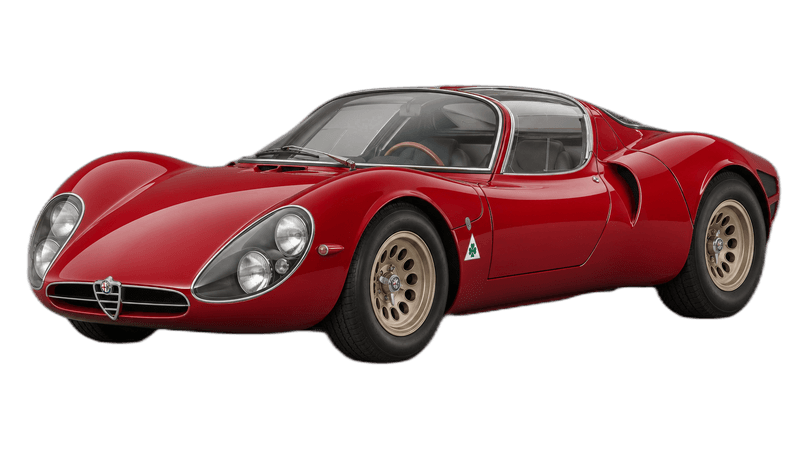
This guide is scoped to the Alfa Romeo 33 Stradale, the road-going version of the Tipo 33 sports-racing car that Alfa Romeo presented in 1967 and that was assembled in very small numbers until 1969. It is a mid-engine, rear-wheel drive two-door coupe with butterfly doors and a 2.0L naturally aspirated V8 sitting behind the seats. It is not a guide to the five or six one-off show cars that coachbuilders later built on 33 Stradale chassis (the Carabo, Iguana, 33/2 Coupe Speciale, Cuneo and Navajo among them), and it is not a guide to the modern limited-run car that Alfa Romeo has sold under the same 33 Stradale name, which we mention only so that nobody confuses the two.
We have not driven this model for this article. We are an editorial desk that reads sources, and everything below comes from pages we opened: the Alfa Romeo museum's own news page, Wikipedia, a Motor1 feature, a Motor1 list of expensive Alfas, a feature on The Drive, the specialist site Supercars.net, a history page by Robert Little, and an Autoblog news item. This is a collector car that almost never comes to market. A guide like this cannot replace an inspection by a specialist who knows these cars, and this page is for research, not a buying recommendation.
The figures at a glance
- Engine: 2.0L naturally aspirated V8, a 90-degree, all-aluminium, dry-sump, four-cam engine with Spica mechanical fuel injection. Displacement is 1,995 cc in the sources that give it, with a bore of 78 mm and a stroke of 52.2 mm.
- Power: 227 bhp. Wikipedia and Supercars.net give 230 PS, equal to 227 hp or 169 kW, at 8,800 rpm for the road car, and Motor1 prints 227 hp. We converted 230 PS to bhp at a factor of 0.98632, which gives about 227 bhp, and that matches the kilowatt figure (169 kW at 1.34102 gives about 227 bhp).
- Torque: 206 Nm at 7,000 rpm, or 152 lb-ft. Wikipedia, Motor1 and Supercars.net all agree.
- 0-100 km/h: 5.5 seconds. This is a claimed figure, not a tested one. Supercars.net gives about 5.5 seconds in its text and the Robert Little page calls 5.5 seconds the factory claim. Wikipedia only says less than 6 seconds and marks it as untested.
- Top speed: 260 km/h, or 162 mph. This is the claim shown by Wikipedia and in the Supercars.net specification table. Wikipedia also reports that the German magazine Auto Motor und Sport measured 252 km/h in 1968.
- Drive: rear-wheel drive through a six-speed manual transaxle designed by Colotti Trasmissioni.
- Weight: 700 kg, or 1,543 lb, in Wikipedia and Supercars.net.
- Size: 3,970 mm long, 1,710 mm wide and about 991 mm high on a 2,350 mm wheelbase.
- Production: 18 cars, built between November 1967 and March 1969 by Carrozzeria Marazzi in Milan, per Wikipedia and Supercars.net. Motor1 and The Drive also say 18.
- Price when new: Wikipedia and Motor1 give 17,000 US dollars, and Supercars.net gives 9,750,000 Italian lire for the same car.
Where the sources disagree
We found real disagreement, and we say so rather than choosing silently.
On power, 230 PS, 227 hp, 227 bhp and 230 hp are all the same output stated in different units or with loose labelling. Supercars.net itself prints both 227 hp and 230 hp. Wikipedia adds that the first production car, chassis 750.33.101, had a factory datasheet showing 243 PS at 9,400 rpm with a street exhaust and 254 PS with an open exhaust. We use 227 bhp because it is the road-trim figure in most of the pages we read, and we note that individual cars may differ.
On top speed, the claim is 260 km/h in Wikipedia and in the Supercars.net table. The Supercars.net text gives 262 km/h for the factory claim and says some people believed 290 km/h was possible. The Robert Little page says 280 km/h was the factory claim. We chose 260 km/h because it is the figure given by the most pages, and we kept the 252 km/h measured result in view as the only independent number we found.
On acceleration, 5.5 seconds appears in two pages, and Wikipedia says only less than 6 seconds. We use 5.5 seconds and call it a claim. The Supercars.net article also writes the unit in a way that looks like a typo, so we do not treat it as a rigorous test.
On the debut, the Alfa Romeo museum page says the car was presented on 31 August 1967, the eve of the Italian Formula 1 Grand Prix at Monza, and The Drive repeats that date. Motor1 says September 1967 at Monza. Supercars.net says 31 August at the Paris Salon, which does not fit the museum's account. We follow the museum.
On production, 18 is the figure in Wikipedia, Supercars.net, Motor1 and The Drive. The Robert Little page is more complicated: it says the Autodelta workshop produced 18 chassis in total, but also speaks of 11 or possibly 13 road cars, and it notes that some chassis numbers are disputed or are not true Stradales. We use 18 as the commonly published number and caution that the way chassis were counted, including prototypes and show cars, is not fully settled.
On the chassis and body, Supercars.net describes the frame as aluminium tubular in its table but mentions magnesium tubes and steel tubes in the text, while Wikipedia says mostly aluminium body on an aluminium tubular chassis and Robert Little says the road car used steel tubes. Body metal is given as Peraluman H350 in two places. Compression ratio appears as 10.5:1 in Wikipedia and as 10.0:1 or 10.1:1 on the Robert Little page. Weight appears as 700 kg in Wikipedia and Supercars.net but as 572 kg on the Robert Little page. We use 700 kg and treat the others as unresolved.
History and development
The Tipo 33 race car came first. Supercars.net says it debuted at the Fleron hillclimb on 12 March 1967, where it won with Teodoro Zeccoli. The road car followed from the same project. The Robert Little page says Alfa Romeo chief executive Giuseppe Luraghi wanted a small series of GT cars based on the T33, that Ing. Chiti handled the engineering and that Franco Scaglione designed the body. It dates development from January to September 1967.
The Alfa Romeo museum says the 33 Stradale's technology is directly derived from the Tipo 33 racing car and that it wears the quadrifoglio badge, which the museum says Ugo Sivocci first used in 1923. Wikipedia and Motor1 both credit the bodywork to Scaglione, and Motor1 says the bodies were handmade by Carrozzeria Marazzi. The Drive calls it one of the first non-racing Alfas to wear the cloverleaf and describes it as arguably the most beautiful Alfa ever made, which is an opinion, not a measurement.
Motor1 calls it the first production car with butterfly doors, which hinge near the A-pillar and include a glass roof section. Motor1 also says the first two prototypes had four headlights that did not meet street-legal height rules, so Scaglione redesigned the nose with a single lamp on each side. The Robert Little page agrees that prototypes had four headlamps and production cars had two, for Italian road rules.
The Robert Little page says all the produced cars sold almost immediately and that a planned run of 50 became unrealistic after changes in Alfa Romeo's leadership. We could not confirm that planned number elsewhere.
Variants, prototypes and what changed over the run
The sources describe a prototype phase and a customer-car phase, and they do not describe a facelift or model-year changes in the way a mass-produced car would have them.
- Chassis 105.33.01 is the first prototype, sold to Gallery Abarth in Japan according to Wikipedia. The Robert Little page calls it the Abarth Gallery in Osaka.
- Chassis 105.33.12 is the second, magnesium-bodied prototype, which Wikipedia and Robert Little place in the Alfa Romeo museum at Arese.
- Chassis 750.33.101 is the first production car, which the Robert Little page says went to Henry Wessels III.
- Motor1 says individual cars differ in details such as the number and mounting of the windscreen wipers.
- The Robert Little page records one racing use of a customer chassis (750.33.103, used for hillclimbs and circuit racing by SCAR of Florence and later in the Louwman collection) and another prepared by Autodelta for racing in 1968 and 1969 (750.33.106). It also records 750.33.111, built for Count Corrado Agusta in blue with helicopter seats and later repainted red.
- Several chassis became coachbuilder show cars: the Carabo by Bertone (1968), the Pininfarina roadster (1968), the 33/2 Coupe Speciale by Pininfarina (1969), the Iguana by Italdesign (1969) and the Navajo by Bertone (1976), per Motor1 and Robert Little. The museum's 2017 exhibition showed five of the six concept cars derived from the 33 chassis.
Wikipedia also describes a race-trim version of the engine at 270 PS, or about 266 bhp, which was a different state of tune and not the customer road car.
What the rarity means for a would-be buyer
With 18 cars on the commonly published count, and several of them converted into concepts or held in museums, a 33 Stradale is not something you shop for in the usual sense. Motor1 says it rarely comes up for sale. Our reading gives us no basis for a checklist of known faults, so we offer questions for a specialist instead.
- Provenance and chassis number. Ask which chassis it is and how that chassis number is recorded. The Robert Little page says several numbers (750.33.107, .110, .115 and .118) are disputed or unconfirmed, and one (.114) is not a true Stradale but a 1975 coupe on a 33TT12 chassis.
- Whether it is an original road car, a former race car, a prototype, or a converted show car. The sources describe all of these.
- Engine history. This is a high-revving racing-derived V8 with a 10,000 rpm limit according to Wikipedia and Supercars.net, so documented rebuilds matter. We found no source describing rebuild intervals or costs.
- Chassis and body material. Because the sources disagree on aluminium, magnesium and steel tubes, ask for the construction to be documented rather than assumed.
- Gearbox. The Colotti six-speed transaxle is a bespoke part and we found no source on parts supply.
- Independent inspection and expert opinion. We cannot judge a car from a web page, and nobody can judge one of these without specialist knowledge.
Running costs, parts and recalls
We found no running costs, no service schedule, no insurance cost, no failure statistics and no parts-supply programme for the original 33 Stradale in any page we read, so we give none. Anyone quoting repair figures without a source is guessing. We also found no recall notice and no crash-test or safety-equipment data. That is not a clean bill of health, because we did not search a recall database. A car of this age and construction has no modern crash structure.
Market and value notes
We found no documented public auction sale of an original 33 Stradale in the pages we read, so we give no sale price. What we did read are estimates and a price when new.
- New price: 17,000 US dollars in 1968 according to Wikipedia, which says this was then the most expensive car sold to the public, and 9,750,000 lire in Supercars.net, which compares it with the Lamborghini Miura at 7,700,000 lire.
- Estimate: Motor1, in an article dated 15 January 2025, estimates a value of 10 to 20 million euros. The author says this is an estimate and not a recorded sale, and ranks the car fourth in a list of the most valuable Alfa Romeos.
- Modern revival: an Autoblog item dated 23 February 2026 concerns a modern revival described as limited to 33 units, reportedly valued at 30 million euros and reportedly sold for 10 euros under disputed circumstances, with a Milan investigation. That story is about a different car, is a news report of allegations, and tells you nothing about the 1967 to 1969 cars. We include it only to prevent confusion.
Treat all of this as research context. A seller's asking price, a dealer listing and an insurer's valuation are different things from an auction result, and we have none of those.
What we could not find
We found no maker document giving torque, 0-100 km/h or top speed for the road car. The Alfa Romeo museum page we opened gives the debut date, the design credit and the exhibition, but no technical figures or production count, so our figures come from Wikipedia, Motor1, Supercars.net and the Robert Little page, which are not maker documents. The Robert Little page is a personal history page and we treat its numbers as a secondary opinion. We found no auction results from Gooding, RM Sotheby's or Bonhams for an original car. We found no running costs, no recall data, no crash-safety data, and no settled account of chassis materials, compression ratio, weight or the exact number of customer cars.
About the photograph
This page uses the catalogue photograph for the car. Its credit is listed on the credits page.
Verdict
The 33 Stradale is a mid-engine, rear-wheel drive coupe with a 2.0L naturally aspirated V8 rated at 227 bhp and 206 Nm, a claimed 5.5 seconds to 100 km/h and a claimed 260 km/h, with 18 built on the best published evidence. The numbers are quoted by sources that are not the maker, and the one measured top speed we found was 252 km/h. What the car offers is rarity, a direct link to the Tipo 33 racing programme and Scaglione's body, not practical ownership information, because the pages we read give none. Use this page for research and use a qualified specialist, documented history and an independent inspection for any real decision. We have not driven it.
Sources
- Museo Storico Alfa Romeo: The 33 Stradale turns 50 (31 August 2017)
- Wikipedia: Alfa Romeo 33 Stradale
- Motor1: 1967 Alfa Romeo 33 Stradale, Supercar Sunday
- Supercars.net: 1967-1969 Alfa Romeo 33 Stradale
- The Drive: Happy 50th Birthday to the Alfa Romeo 33 Stradale
- Robert Little: 33 Stradale history (Italian)
- Motor1: The ten rarest and most expensive Alfa Romeos in history
- Autoblog: Alfa Romeo 33 Stradale reportedly sold for 10 euros, now missing (23 February 2026)
Specifications
| Engine | 2.0L naturally aspirated V8 |
|---|---|
| Displacement | 2.0L |
| Power | 227 bhp |
| Torque | 206 Nm |
| 0-100 km/h | 5.5s |
| Top Speed | 260 km/h |
| Drivetrain | RWD |
| Country | Italy |
| Body Style | 2-door coupé |
| Years | 1967–1969 |
| Production | 18 |
| Price Used | £13,000,000 |
Specifications are manufacturer-published figures.
Frequently Asked Questions
What is an Alfa Romeo 33 Stradale worth?
A representative example is worth about £13,000,000. Actual values vary with specification, condition and history.
How much power does the Alfa Romeo 33 Stradale have?
The Alfa Romeo 33 Stradale produces 227 bhp and 206 Nm of torque.
How fast is the Alfa Romeo 33 Stradale from 0 to 100 km/h?
The Alfa Romeo 33 Stradale accelerates from 0 to 100 km/h in 5.5 seconds.
What is the top speed of the Alfa Romeo 33 Stradale?
The Alfa Romeo 33 Stradale has a top speed of 260 km/h.
What engine does the Alfa Romeo 33 Stradale have?
The Alfa Romeo 33 Stradale uses a 2.0L naturally aspirated V8.
How many Alfa Romeo 33 Stradale were made?
Alfa Romeo produced 18 units of the Alfa Romeo 33 Stradale.
When was the Alfa Romeo 33 Stradale built?
The Alfa Romeo 33 Stradale was built from 1967 to 1969.
Is the Alfa Romeo 33 Stradale all-wheel drive?
No. The Alfa Romeo 33 Stradale is configured with rear-wheel drive.