
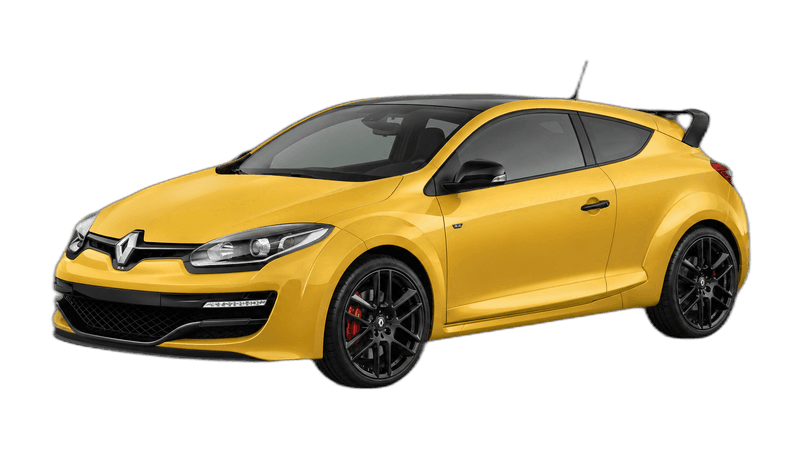
Renault Megane RS 275 Trophy
£22,000
usadoIndicative market price, updated periodically.
271cv
Potencia
6s
0-100 km/h
255km/h
Velocidad Máxima
£22,000
Precio Usado
Cómo empuja.
La fuerza g máxima en el instante en que pisas a fondo, estimada a partir del 0–100 y la tracción del coche.
Renault Megane RS 275 TrophyG de salida estimada a partir del 0–100 y la tracción: una aproximación honesta, no una cifra medida.
The Renault Megane RS 275 Trophy is a 4/5 seater hatchback by Renault, with 271 bhp, 360 Nm of torque, a 0-100 km/h time of 6 seconds and a top speed of 255 km/h. Indicative used value: approximately £22,000. Actual values vary with specification, condition and history.
Dream Car Garage Editorial · Edited by José Teo Lorente Vallecillos · Last updated 2 November 2026
Visión General
We have not driven this car. This review is based on published specifications and the sources listed below.
A limited-series Mégane RS with 275 PS
The Renault Mégane RS 275 Trophy is a three-door, front-wheel drive hot hatchback, a limited series built on the third-generation (Mégane III) Renault Sport car. Renault Sport announced it on 14 May 2014 as a successor to the earlier Trophy (2011) and Red Bull Racing RB7 and RB8 special editions, with sales planned in about twenty countries including the United Kingdom. This guide is scoped to the Mégane III RS 275 Trophy sold from 2014 and, as far as we can tell, until the end of Mégane RS production in July 2016. The Trophy-R is a separate car and is covered only where it helps you avoid confusing the two. Our catalogue lists a 2.0L turbocharged inline-4 petrol engine producing 271 bhp and 360 Nm, with 0 to 100 km/h in 6.0 seconds and a 255 km/h top speed. We have not driven this model for this article. This is a desk-researched ownership guide built from Renault's May 2014 press release (a French-language page on the Alpine media site that Renault Group now hosts), a PistonHeads used buying guide dated September 2020 and the government recall check. Neither the release nor the buying guide is about the 275 Trophy alone, so we say below where a point comes from the wider Mégane RS range.
Checking the figures
Renault's release says the 2.0-litre petrol engine was lifted to 275 chevaux, with the maximum reached at 5,500 rpm, and that this is 10 more than before. The 275 figure is the metric rating (PS), and 275 PS converts to about 271 bhp, which is the value in our catalogue. Adverts that say 275 PS, 275 hp or 271 bhp describe the same engine. The release gives 360 Nm available across a wide band from 3,000 to 5,000 rpm. The PistonHeads guide does not give a 275 Trophy specification, but it lists the closely related 275 Cup-S of 2016 at 271 hp and 266 lb ft, and 266 lb ft is about 360 Nm, so the sources agree on the output.
The correction behind this page matters. An earlier version of our catalogue row listed a 1.8-litre turbo engine with 296 bhp and 400 Nm. Neither source describes that engine for this generation. PistonHeads says a brand-new RS based on the fourth-generation Mégane arrived in 2017, and we believe the 296 bhp figure belongs to that later car, although we did not verify it in a fetched source. The 275 Trophy uses the 2.0-litre engine that PistonHeads identifies by its F4Rt code, in the 1,998 cc, twin-scroll turbocharged form. The 296 figure is also not a Trophy-R figure: Renault's Trophy-R press kit, which we read but do not cite, gives that car the same 275 hp and 360 Nm.
Neither cited source gives a 0 to 100 km/h time or a top speed for the 275 Trophy, and Renault's release gives no capacity, weight or performance figures at all. The 6.0 seconds and 255 km/h in our catalogue come from secondary reading outside our three cited sources: a PistonHeads first drive from 2014 for the 0 to 62 mph time, and a French data site that quotes 255 km/h as a manufacturer figure. Other tests report slightly different times, and PistonHeads quotes 158 mph, about 254 km/h, for the later Cup-S. Treat both numbers as approximate. Weights also differ by source: PistonHeads gives 1,387 kg for the 250 and 1,394 kg for the Cup-S, and it warns that its weight and power data is hard to pin down with certainty. Renault's release gives 7.5 litres per 100 km and 174 g/km of CO2 for the 275, while PistonHeads prints 195 g/km for the 250 at launch, so check the figure on the car's own paperwork.
Engine and gearbox
PistonHeads describes the 2.0-litre as a tough, relatively understressed engine with a 6,500 rpm redline, on which speed builds smoothly. It adds that the word bulletproof is sometimes used and calls that tempting fate. It says light tuning is straightforward and that plenty of cars run around with 300 hp and no issues, although you might want extra cooling if you sit in traffic a lot. For a Trophy you should still ask whether the car has been remapped, because the 275 is a limited-edition model and most buyers want the standard tune and the original paperwork. The same guide says some owners believe these cars produced more than their stated power when new.
The release says Renault Sport gave the 275 the Akrapovič titanium exhaust line as standard, with a deeper, hoarser sound and a carbon tailpipe trim signed by Akrapovič. Check that the exhaust is the original and that its tailpipe trim has not been swapped for a cheap one, and listen for blowing joints. PistonHeads describes a six-speed manual for this generation. Note that the PistonHeads specification box for the 250 prints rear-wheel drive while its text correctly describes the car as front-drive, so ignore that box.
The buying guide lists the mechanical items to check across the range. Rattly cambelt pulleys have been an issue, and the cambelt should be changed every six years or 75,000 miles, with some owners preferring five years. Injectors, the flywheel, the manual gearbox bearings and the clutch can be noisy. Worn differential bearings, usually the result of leaking driveshaft oil seals, can mean a new gearbox. The guide says Renault changed the gearbox bearings for the 275, but that they are still prone to failure, so listen for a whine in any gear. It also lists oil leaks at the top and bottom of the engine, rocker cover gasket seepage, black or blue smoke on start-up, tired gearbox and engine mounts, and leaking clutch slave cylinders and clutch dampers. It suggests that a shiny, low-mileage car used only for short trips may give more trouble than one that has been driven hard on track days, which is a reminder to read the history and not just the odometer.
Chassis, brakes and wheels
Renault says the Cup chassis with a limited-slip differential comes as standard on the 275 Trophy and describes it as well regarded on road and above all on track. PistonHeads agrees that the Cup cars are favoured because of their differentials, and says the Cup settings are firmer, so a test drive on an ordinary road matters. The guide's description of the wider range is that it does not drive like a typical front-drive car, helped by a Perfohub front strut designed to reduce torque steer. Its electronic stability system can be switched off completely, left on, or set to a middle mode.
The release lists options that you may find on a given car, so check the build sheet instead of assuming. Adjustable Öhlins Road and Track dampers with steel springs were optional, as were Michelin Pilot Sport Cup 2 tyres developed for this front-drive car and black 19-inch Speedline Turini wheels derived from Renault's competition cars. A car on Cup 2 tyres may have seen track use, so look at the date codes, at how evenly they have worn and at the history. PistonHeads says front tyres on these cars are used up quickly, around 8,000 miles being typical, compared with more than twice that on the rears, and that the brake discs are fairly dear. Its range-wide notes for the suspension are that top mounts have a reputation for splitting, anti-roll bars wear, creaking on full lock usually points to worn lower swivel joints, and a lot of suspension, steering and drivetrain issues appear at around 40,000 to 50,000 miles. It rates ball joints as a pain to fix and bushes, hubs and track rod ends as consumables if you use the car on track. Check the wheels for kerb damage and the alignment for signs of a hard life.
Body, interior and electronics
Renault's release describes a Trophy sticker on a platinum-grey front blade, platinum "Trophy" side stripes, a wire-frame chequered pattern on the sills and numbered sill plates that mark the limited series. The interior has Recaro bucket seats in leather and Alcantara with red stitching that continues on the rear bench, Renault Sport headrests, an Alcantara steering wheel and handbrake gaiter with red stitching, and a Zamac gear knob. The 2014 range-wide styling update brought new headlights, a new grille and a bigger badge, according to PistonHeads, so a Trophy should carry that face. PistonHeads calls the build quality of the generation pretty good, says the interior is more solid than earlier Renaults though less premium than German rivals, and adds that it is a genuine five-seater with a rear that feels a little dark. It notes that the heavily bolstered front seats are prone to wear, so inspect the side bolsters and the Alcantara trim.
The guide calls the R-Link infotainment less than slick but praises the Renaultsport Monitor software, which shows telemetry and lets you change throttle maps. Test both, and the satellite navigation and screen if fitted. Damp footwells point to blocked scuttle drains, and a faulty seat sensor will illuminate the airbag warning light, so check for both. Look for stone chips in the paint, for scrapes on the front splitter, and that the Trophy graphics and sill plates are genuine and undamaged, since replacements may be hard to source for a limited series.
How the Trophy-R differs
The Trophy-R is a separate car, announced by Renault in 2014 as a more radical version of the 275 Trophy, and PistonHeads dates it to 2015 in its guide, so the sources disagree on the year. Renault's press kit for it, mirrored on a motoring news site, gives the same 275 hp and 360 Nm, so power does not separate the two cars. What does is weight and equipment: the kit quotes 1,280 kg against 1,381 kg for a Cup-chassis Mégane RS on 19-inch wheels, with the rear seat and air conditioning removed, Öhlins dampers with Allevard composite springs, Michelin Pilot Sport Cup 2 tyres and black 19-inch Speedline Turini wheels as standard, Recaro bucket seats and a Nürburgring Nordschleife time of 7 minutes 54.36 seconds, which Renault called the fastest for a front-wheel drive production car at the time. A first-drive article we also read, but do not cite, puts the build at 250 cars with 30 for the United Kingdom. Those details are for orientation only. If an advert says Trophy-R, or the car has no back seat, it is not the car this guide covers. The 2011 265 Trophy (261 hp, 500 built worldwide, according to PistonHeads) and the 2016 Cup-S (271 hp) are also different cars.
Recalls and history
PistonHeads' guide does not list any recalls for this generation of Mégane RS, and Renault's release is a launch document, so we have no verified campaign list for the 275 Trophy. Enter the registration in the DVSA recall service and ask the seller for dealer paperwork showing that any open work was completed. Ask for a full service history, cambelt and clutch invoices, any accident repair evidence and a list of modifications. Limited-series cars should have their numbered plates and a consistent identity across the documents, the badges and the build sheet, so ask for the supplying dealer's records if you can get them. We found no official production number for the 275 Trophy, so be sceptical of any figure an advert quotes, and we have left the catalogue count empty.
Buying decision
The PistonHeads verdict on the generation is that its reliability record is not at all bad, that the cars are relatively easy to work on, and that it was superb value when new and still is for what you get. It also says public opinion favours the Cup-chassis cars because of their differentials, which is built into the 275 Trophy. Prefer a car with a documented service history that shows a recent cambelt, a gearbox that is quiet in every gear, dry gaskets and driveshaft seals, evenly worn tyres, original Akrapovič exhaust trim and a clean DVSA recall check. Treat any 0 to 100 km/h or top-speed claim as approximate, check what the car actually has fitted (Öhlins, Cup 2 tyres, 19-inch wheels), and keep dated used prices out of your decision until you have seen current adverts.
Especificaciones
Motor
2.0L turbocharged inline-4 petrol
Cilindrada
2.0L
Potencia
271 cv
Par Motor
360 Nm
0-100 km/h
6s
Velocidad Máxima
255 km/h
Tracción
FWD
País
France
Carrocería
4/5 seater hatchback
Años
2014–2016
Precio Usado
£22,000
Specifications are manufacturer-published figures.
Más de Renault
Preguntas Frecuentes
What are the specifications of the Renault Megane RS 275 Trophy?
The Renault Megane RS 275 Trophy is a 4/5 seater hatchback by Renault, with 271 bhp, 360 Nm of torque, a 0-100 km/h time of 6 seconds and a top speed of 255 km/h. Indicative used value: approximately £22,000. Actual values vary with specification, condition and history.
How much does a Renault Megane RS 275 Trophy cost?
Indicative used value: approximately £22,000. Actual values vary with specification, condition and history.
What drivetrain does the Renault Megane RS 275 Trophy use?
The Renault Megane RS 275 Trophy is configured with front-wheel drive.
What type of car is the Renault Megane RS 275 Trophy?
The Renault Megane RS 275 Trophy is a hot hatches manufactured by Renault in France. Production ran from 2014 to 2016.