
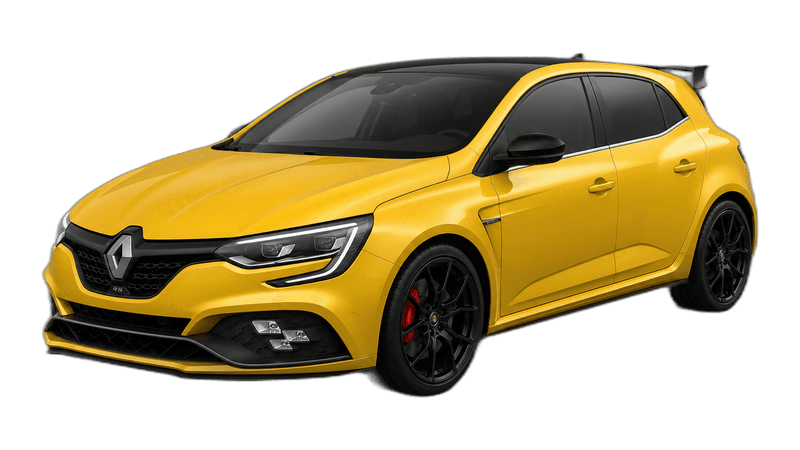
Renault Megane RS 300 Trophy
£28,000
usedIndicative market price, updated periodically.
296bhp
Power
5.7s
0-100 km/h
260km/h
Top Speed
£28,000
Price Used
How hard it pulls.
Peak g-force the instant you bury the throttle, estimated from the car's 0–100 time and drivetrain.
Renault Megane RS 300 TrophyEstimated peak launch g from the 0–100 time and drivetrain: an honest approximation, not a measured figure.
The Renault Megane RS 300 Trophy is a 5-door hatchback by Renault, with 296 bhp, 400 Nm of torque, a 0-100 km/h time of 5.7 seconds and a top speed of 260 km/h. Indicative used value: approximately £28,000. Actual values vary with specification, condition and history.
Dream Car Garage Editorial · Edited by José Teo Lorente Vallecillos · Last updated 2 November 2026
Overview
We have not driven this car. This review is based on published specifications and the sources listed below.
What this guide covers
This guide is scoped to the fourth-generation Mégane R.S. Trophy 300 five-door hatchback, the 1.8-litre turbocharged car sold in the UK and Europe with a six-speed manual or a six-speed EDC dual-clutch gearbox. It does not cover the standard Mégane R.S. 280 or 300, the track-focused Trophy-R, or the earlier three-door Mégane III cars, although each is mentioned where the contrast helps a buyer. The previous generation's R.S. 275 Trophy has its own guide on this site and is not repeated here.
The catalogue entry for this car is a 1.8L turbocharged I4 with 296 bhp (the 300 PS rating), 400 Nm of torque, a 0-100 km/h time of 5.7 seconds and a top speed of 260 km/h, driven through the front wheels as a front-wheel drive hatchback. We have not driven this model for this article. Everything below comes from manufacturer material, magazine road tests and long-term tests, and specification databases, and where they disagree we say so rather than pick a winner quietly.
Checking the figures
Five figures on this car are easy to get wrong, so we checked each against the sources we could read.
Power is 300 PS everywhere. Converted, that is about 296 bhp, which is the figure Car magazine, Top Gear and the UltimateSpecs database print. Renault's own text and PistonHeads say 300hp, which is the metric horsepower rating. They are the same engine rating.
Torque depends on the gearbox. PistonHeads, in its November 2018 first drive, says the manual gets 295 lb ft because that is all the gearbox can take, and the dual-clutch car gets 310 lb ft. Those convert to 400 Nm and 420 Nm. A Renault Japan release carried by the Japanese outlet Openers gives the same split, 400 Nm for the manual and 420 Nm for EDC, both at 3,200 rpm. The catalogue figure of 400 Nm is therefore the manual-gearbox number, and the EDC car makes 20 Nm more. One caution: Renault UK's October 2020 release for the updated car simply says the 1.8-litre delivers 420 Nm, without separating the gearboxes, so we could not verify what the 2020-onwards manual car is rated at.
Acceleration is 5.7 seconds to 62 mph in Renault UK's release and in PistonHeads' specification box, which lists the manual car. Car magazine's logbook for a standard R.S. 300 EDC quotes the same time. FastestLaps shows an estimated 5.4 seconds and Wikipedia's table shows 5.4 seconds for the Trophy-R, so a catalogue value of 5.4 seconds belongs to the harder car, not this one. We use 5.7 seconds, noting that it is a 0-62 mph claim, which is very close to 0-100 km/h.
Top speed is quoted as 162 mph for the Trophy by PistonHeads and by Renault UK, which attaches it to the EDC car. That converts to about 261 km/h; UltimateSpecs prints 260 km/h and we use that figure. Car magazine's logbook gives 158 mph for the standard R.S. 300 EDC, so do not assume that every Mégane R.S. is rated the same. We found no source for a 262 km/h figure.
Weight is a mess. PistonHeads lists 1,494 kg for the manual Trophy, the Japanese release gives 1,450 kg manual and 1,470 kg EDC, FastestLaps gives 1,419 to 1,480 kg, and UltimateSpecs shows 1,419 kg dry and 1,526 kg kerb. These use different definitions, so treat any single number with suspicion.
Engine and gearboxes
The 1,798 cc four-cylinder turbo makes its peak 300 PS at 6,000 rpm, according to the Japanese release. Wikipedia says it shares its basic engine family with the Alpine A110, and describes the Trophy as having a different cylinder head and turbocharger from the 280. PistonHeads describes it differently: mostly new mapping, a new exhaust with an active flap and a ceramic bearing in the turbo for quicker response. We could not settle which description is complete, and the practical point is the same. The Trophy is the more highly tuned of the two engines and the exhaust has a flap that gives quiet and loud modes, according to PistonHeads.
The manual is a six-speed. Auto Express's long-term tester called it clunky and the weakest link in the car, while PistonHeads found it a little notchy. Motoring Research thought the manual suits the car, probably better than the paddle-shift automatic. The EDC is also a six-speed, with paddles and launch control, and PistonHeads notes that the dual-clutch gearbox had not been available with a limited-slip differential until the Trophy. Renault UK's 2020 text adds a Multi-Change Down function that drops several ratios under braking when the left paddle is held.
Torque steer is the usual front-wheel-drive concern. A Car magazine long-term test of a standard R.S. 300 without the differential called it shocking and told readers to buy the Trophy instead. PistonHeads, driving a Trophy, found some torque steer at a manageable level. Neither is a reason to avoid the car, but it is one more reason to drive a Trophy, not a standard car, if you want the better chassis.
Chassis, 4Control, brakes and wheels
The Trophy gets the Cup chassis as standard. PistonHeads quotes dampers 25 per cent stiffer, springs 30 per cent stiffer and anti-roll bars 10 per cent stiffer than the standard car, with hydraulic bump stops and a Torsen limited-slip differential on both gearboxes. Wikipedia describes the front suspension as struts with Renault Sport's PerfoHub kingpin geometry and a torsion beam at the rear.
4Control four-wheel steering is standard. Wikipedia and Car magazine both say the rear wheels turn up to 2.7 degrees against the fronts at lower speeds, and Wikipedia adds up to 1 degree in the same direction at higher speeds. PistonHeads says the opposite-lock mode works below 37 mph, or up to 62 mph in Race mode, and Car magazine says 37 mph and 60 mph in Race mode. The sources do not agree on that last number to the mile per hour, and we would treat both as approximate. Auto Express's tester found 4Control makes parking easy but can feel unpredictable when driving hard until you learn to trust it.
Weight saving is part of the Trophy story. Top Gear lists lighter 19-inch wheels at 2 kg per corner, bi-material brake discs at 1.8 kg per corner and a lightweight battery at 8 kg, and puts the whole car at 17 kg lighter than the standard car. UltimateSpecs gives 355 mm front and 290 mm rear discs, and tyres of 245/35 R19. Wheels are less clear. PistonHeads mentions a lightweight 19-inch wheel option, Yahoo's report of the launch says lighter exclusive wheels cut unsprung weight by 8 kg, and Motoring Research calls the Trophy's 19-inch wheels Jerez alloys. We could not tell from these which wheels carry which saving, so check what is fitted to the car you are viewing.
Body, cabin and electronics
The R.S. line is a five-door hatchback only, and the interior has a portrait-style infotainment screen on the earlier cars. Motoring Research found perceived quality could be better and the media system needlessly complicated, though it has Apple CarPlay and Android Auto. Auto Express's tester criticised the infotainment, the cup-holders, and the way the car defaults to Comfort mode at every start-up. Top Gear's long-term car went back to the dealer to investigate a high-pitched chirp when the accelerator was pressed. That is one car's report, not proof of a fault pattern.
PistonHeads describes an Alcantara-trimmed, Recaro-built seat sitting 20 mm lower to the floor, while Renault UK says Alcantara upholstery with red stitching is standard and Recaro bucket seats are optional. Motoring Research notes the Trophy keeps the rear seats, sound deadening and proper infotainment that the Trophy-R trades away. Renault UK's 21 October 2020 release covers the updated car: full LED lights with C-shaped daytime running lights, a 10-inch driver display, a 9.3-inch EasyLink touchscreen, voice recognition, Bose audio and heated seats as part of the Trophy package. If a listing mentions the larger screens, you are looking at a post-update car.
Trophy-R and other Mégane R.S. variants
The Trophy-R is not the car this guide covers. Motoring Research says the Trophy shares the Trophy-R's 300 hp 1.8 and six-speed manual but is 113 kg heavier, and lists the Trophy-R's Öhlins adjustable dampers, Sabelt race seats, bespoke Bridgestone track tyres and titanium Akrapovič exhaust, in a run of 500, 32 of them for the UK. Top Gear's long-term report says it drops 4Control and 40 kg, which conflicts with Motoring Research's figure, and offers no automatic option on the R. Wikipedia also says 4Control was removed to save weight. Renault's Nürburgring lap in April 2019 was 7:40.100, a front-wheel-drive production record, per the Japanese release, and Motoring Research reports it as 3.7 seconds quicker round the lap than the Honda Civic Type R.
Below the Trophy sit the 280 Sport and the 280 Cup. Wikipedia lists them at 280 PS and 390 Nm; the Cup adds a mechanical Torsen differential to the Sport. The previous-generation Mégane III R.S. 275 Trophy has a two-litre engine, and PistonHeads says the previous three-door Mégane felt like one of the most incisive front-drive cars ever made, not far behind a Honda Integra Type R. The newer car, in PistonHeads' view, feels more showy and a little artificial next to a Hyundai i30 N or a Ford Fiesta ST, although it still calls the Trophy pretty entertaining and really fast.
Recalls and history checks
We did not find a specific recall for the Trophy 300 in any of the sources we read. The GOV.UK vehicle recall page is a checker that works from a registration number, or from make, model and year, and it also shows MOT history. Run the registration of any car you are considering and ask the retailer for evidence that open campaigns were done. Check that the car matches the Trophy 300 specification, because the standard 300 and the Trophy look very similar from the outside apart from the wheels and colour. Do not take a listing's engine output at face value.
On dates, we use 2019 to 2023 as the catalogue years. PistonHeads drove the car in November 2018, a Renault Japan release put it on sale in Japan on 31 October 2019, UltimateSpecs lists the first-phase Trophy 300 as 2019 to 2020, and FastestLaps gives the generation's years as 2019 to 2023. We did not find a manufacturer statement of when Trophy production stopped, so treat the end year as a database figure.
Running costs and daily use
Fuel economy in the sources varies. Auto Express recorded 29.8 mpg over 9,491 miles in a manual Trophy and 31.9 mpg earlier in that test; Car magazine's long-term standard R.S. 300 EDC returned 28.7 mpg against a claimed 34.0 mpg. Motoring Research lists 34.4 mpg and 183 g/km, PistonHeads lists 34.9 mpg and 183 g/km, and UltimateSpecs gives 8.1 L/100 km, so the claimed figure depends on who you ask. Expect a firm ride: Auto Express said it was woeful to be driven in and not designed for long motorway slogs, and described the ride as bruising for passengers. Plan for tyre and brake wear on a car with 19-inch wheels and sharp driving, and do not rely on any quoted price for an example you have not seen.
Buying decision
Pick the Trophy 300 if you want the best-handling Mégane R.S. that is not the track-focused Trophy-R, and you accept the firm ride and the divisive electronics. Choose manual if you want the lightest car and the simplest gearbox, EDC if you want the extra 20 Nm and paddles. On a viewing, check that all four-wheel-steering modes behave, that the stability systems do not show warnings, that the service history is complete, and that the tyres and brake discs match the specification. We have not verified any systematic mechanical fault pattern on this model, so a pre-purchase inspection by a Renault Sport specialist is sensible and not a response to a known defect.
Specifications
Engine
1.8L turbocharged I4
Displacement
1.8L
Power
296 bhp
Torque
400 Nm
0-100 km/h
5.7s
Top Speed
260 km/h
Drivetrain
FWD
Country
France
Body Style
5-door hatchback
Years
2019–2023
Price Used
£28,000
Specifications are manufacturer-published figures.
More from Renault
Frequently Asked Questions
What are the specifications of the Renault Megane RS 300 Trophy?
The Renault Megane RS 300 Trophy is a 5-door hatchback by Renault, with 296 bhp, 400 Nm of torque, a 0-100 km/h time of 5.7 seconds and a top speed of 260 km/h. Indicative used value: approximately £28,000. Actual values vary with specification, condition and history.
How much does a Renault Megane RS 300 Trophy cost?
Indicative used value: approximately £28,000. Actual values vary with specification, condition and history.
What drivetrain does the Renault Megane RS 300 Trophy use?
The Renault Megane RS 300 Trophy is configured with front-wheel drive.
What type of car is the Renault Megane RS 300 Trophy?
The Renault Megane RS 300 Trophy is a hot hatches manufactured by Renault in France. Production ran from 2019 to 2023.