
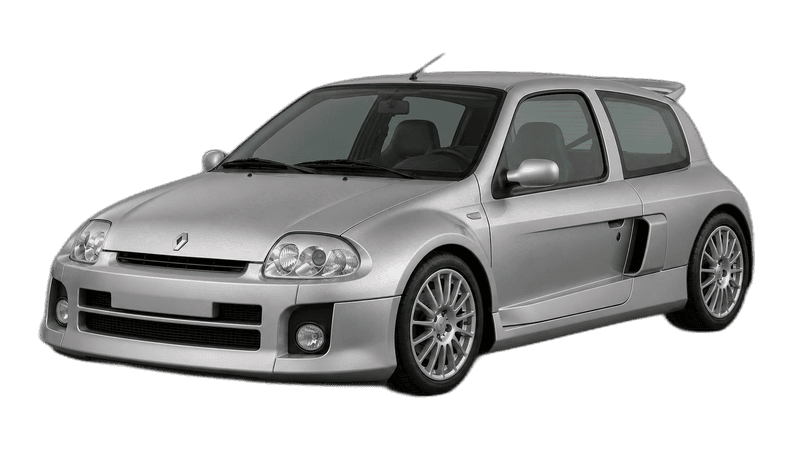
Renault Clio V6 Phase 2
£55,000
usedIndicative market price, updated periodically.
252bhp
Power
5.8s
0-100 km/h
245km/h
Top Speed
£55,000
Price Used
How hard it pulls.
Peak g-force the instant you bury the throttle, estimated from the car's 0–100 time and drivetrain.
Renault Clio V6 Phase 2Estimated peak launch g from the 0–100 time and drivetrain: an honest approximation, not a measured figure.
The Renault Clio V6 Phase 2 is a 3-door 2-seat hatchback by Renault, with 252 bhp, 300 Nm of torque, a 0-100 km/h time of 5.8 seconds and a top speed of 245 km/h. Indicative used value: approximately £55,000. Actual values vary with specification, condition and history.
Dream Car Garage Editorial · Edited by José Teo Lorente Vallecillos · Last updated 2 November 2026
Overview
We have not driven this car. This review is based on published specifications and the sources listed below.
Scope of this guide
This guide is scoped to the Renault Clio V6 Phase 2, the 2003 to 2005 car with the 3.0L naturally aspirated V6 petrol (2946 cc) engine mounted behind the seats in a mid-engine, rear-wheel-drive (MR) layout. It is not a guide to the Phase 1 car built by TWR in Sweden from 2001, to the earlier Clio V6 Trophy racing cars, or to the ordinary front-wheel-drive Clios that share its front end. We say below where Phase 1 differs so that you can tell which car an advert really describes.
We have not driven this model for this article. Everything here comes from three cited sources: a Renault Sport branded news page on the Clio V6, a PistonHeads used buying guide written in March 2023, and the government recall checker. We also read a reference-site summary of the car and several search-result summaries, and we flag every point that rests on those. Where sources disagree, or where a catalogue figure could not be confirmed word for word, we say so.
The figures at a glance
- Engine: 3.0L naturally aspirated V6 petrol (2946 cc), 60-degree, 24-valve, mounted in the middle of the car where a normal Clio has its rear seats.
- Power: 252 bhp is the figure in our catalogue. The rating is quoted as 255 PS (metric horsepower), which converts to about 252 bhp (255 x 0.98632 = 251.5). PistonHeads prints 255hp at 7,150 rpm.
- Torque: 300 Nm (about 221 lb ft), at 4,650 rpm on PistonHeads and on the Renault Sport page.
- 0-100 km/h: 5.8 seconds on the Renault Sport page, against 5.9 seconds from 0 to 62 mph on PistonHeads.
- Top speed: 245 km/h, about 152 mph by our conversion, which matches the 152 mph on PistonHeads.
- Drive: a mid-engine, rear-wheel-drive (MR) layout with a six-speed manual gearbox.
- Body: a three-door, two-seat hatchback with no rear seats.
- Weight: about 1.4 tonnes on both the Renault Sport page and PistonHeads.
- Wheelbase: 2,530 mm, from the reference-site summary, against 2,510 mm for Phase 1.
What Phase 2 changed
Phase 1 was designed by Renault Sport but developed and built by Tom Walkinshaw Racing at its Swedish factory, and it made 230 PS. The Renault Sport page says production moved in-house to Dieppe in March 2003 for Phase 2, and that power rose from 230 to 255 PS. PistonHeads lists a flowed cylinder head, new pistons, stronger valve springs, new injectors, a freer-breathing air filter and a revised engine management calibration. Together these added 25 PS and lifted the rev limit from 7,100 rpm to 7,500 rpm, while torque stayed at 300 Nm.
The gearing also changed. Both sources describe a shorter final drive, and the Renault Sport page adds closer-spaced internal ratios. The chassis was reworked as well: PistonHeads gives a wheelbase longer by 23 mm, a front track wider by 33 mm, stiffer front roll resistance, revised bump stops, more damper control and a reworked rear suspension linkage. The Renault Sport page says the suspension was stiffened all round. The reference-site summary gives the wheelbase difference as 20 mm (2,510 mm to 2,530 mm), so treat the exact number with care.
Outside, Phase 2 took the face of the facelifted Clio II, with a new bumper, bonnet and grille and automatic xenon headlamps. PistonHeads says Recaro seats were fitted as standard but adds that this is its own belief, and we could not confirm it. Phase 2 weighs about 1.4 tonnes, which is 45 to 65 kg more than Phase 1 depending on which source you trust.
Performance claims and what they mean
The catalogue figure of 5.8 seconds from 0 to 100 km/h comes from the Renault Sport page, which gives Phase 1 as 6.4 seconds. PistonHeads gives 5.9 seconds from 0 to 62 mph for Phase 2 and 6.4 seconds for Phase 1, and the reference-site summary gives 5.9 seconds from 0 to 60 mph. A 62 mph figure and a 100 km/h figure are within a rounding error of each other, but a 60 mph figure is a touch easier, so the sources are not strictly like for like. A search summary also mentioned a 2003 road test that measured 6.3 seconds, which we could not open.
The top speed of 245 km/h is the figure in the Renault Sport page table, which also says 250 km/h in its running text. PistonHeads gives 152 mph for Phase 2 and the reference-site summary gives 246 km/h, so the sources cluster around 245 km/h. All of these are claimed or published figures, not our own measurements. Phase 1 is quoted at 235 km/h on the Renault Sport page and 145 mph on PistonHeads.
Why the power figure needs care
Our catalogue says 252 bhp, but the sources print the rating in different ways. The reference-site summary gives 255 PS as 252 bhp and 188 kW. PistonHeads prints 255 in a column headed hp, and the Renault Sport page prints 255 bhp. Metric horsepower is about 1.4 percent bigger than brake horsepower, so a car sold as 255 PS is about 252 bhp. We read the 255 as a metric rating and give 252 bhp as our conversion, which is our judgement, because none of the pages we read prints a PS label from Renault itself. If an advert says 255 bhp, it is probably repeating the loose label, not describing a different engine.
Model years and production numbers
Phase 2 was built from 2003 to 2005, and the 2003 to 2005 range in our catalogue is unchanged. The Renault Sport page says 1,309 Phase 2 cars were built, and the reference-site summary says the same, citing a Renault press release. PistonHeads says at least 1,300 were made, with 350-odd right-hand-drive cars coming to the UK, and says the UK was the second-biggest market after France. Production ended in late 2005 according to PistonHeads. The car was never sold outside Europe.
The Phase 1 count is less settled. The Renault Sport page says 1,631 Phase 1 cars were sold in under two years, and the reference-site summary agrees. PistonHeads says official data suggests a little over 1,500, with some sources saying over 1600. A search-result summary of a Renault heritage page, which we could not open, gave 2,822 cars in total, and 2,822 less 1,309 would imply about 1,513 for Phase 1. That is why Phase 1 and Phase 2 totals do not add up neatly. The Phase 2 figure of 1,309 is the one the sources agree on, so we keep it.
Engine and gearbox
The V6 is a 60-degree, 24-valve unit of the PSA ES9 family. One source codes it ES9J4 and the Renault Sport page codes it L7X, so check both if you search for parts. The gearbox is the PK6 six-speed manual. PistonHeads calls the engine's reliability record good, but says failing coils cause misfires and that the fuel economy is thirsty: it quotes 23.7 mpg combined for Phase 2, low-20s mpg in normal use and mid-teens when driven hard. It lists 285 g/km of carbon dioxide.
Oil level is awkward to check because of where the engine sits, so it is often neglected between services. PistonHeads gives the service interval as 12,000 miles or 2 years. The cam belt and dephaser should be changed every 5 years or 72,000 miles, and PistonHeads quotes a 2010 dealer price of 1,500 pounds without dropping the engine, adding that the water pump and clutch should be changed at the same time. It also gives rough costs, undated, of about 150 pounds for an auxiliary belt kit, about 100 pounds for crank pulleys and about 50 pounds for each engine mount. On the gearbox, worn synchromesh shows up as crunchy changes, particularly on cars that were driven hard.
Chassis, brakes and wheels
The car uses MacPherson struts at the front, a multi-link rear and a bespoke rear subframe. PistonHeads says the rear suspension bushes often wear within 15,000 miles or less, which noticeably affects how the car drives. It says Phase 2 steering is weightier and more communicative than Phase 1 but not as sharp as the Clio 172 or 182. Its specification lists 17 inch wheels for Phase 1 and 18 inch for Phase 2, with 205/50 front and 235/45 rear tyres.
The brakes are described as 330 mm front and 300 mm rear vented discs with AP four-piston calipers, but PistonHeads makes that statement about the Phase 1 car and we did not confirm it for Phase 2. It adds that the ABS tone rings do not last indefinitely. The turning circle is poor, at over 40 feet on PistonHeads and 13 m on the reference-site summary, and the steering wheel has no reach adjustment.
Bodywork and practicality
The wide-bodied look comes from a glassfibre-reinforced plastic kit over a standard Clio shell, and the rear side intakes are functional. PistonHeads says the front end is vulnerable to stone damage, the fibreglass front spoiler is often destroyed, water can get into the front boot and the bonnet catches are fragile. It quoted original bumpers at 1,700 pounds for the rear and 900 pounds for the front in 2015, with supply tight, so budget for any panel damage you find.
Practicality is deliberately poor. The rear seats are gone, so there are only two seats, and luggage space is limited to a small area at the front, a small netted area behind the seats and a stash area under the tailgate. This is why we have changed the catalogue body style from a four or five seater to a three-door, two-seat hatchback. PistonHeads describes the interior as utilitarian Clio, but durable.
Prices and running costs
PistonHeads quotes new prices of 27,125 pounds for Phase 2, against 25,995 pounds for Phase 1. In its March 2023 article a Phase 2 was rarely under 50,000 pounds, with a late-2004 car with 24,000 miles listed at 54,995 pounds and dealer stock between about 55,000 and 57,500 pounds. Those are asking prices from one article, not sold prices, and the market has moved since, so use them only as a sign of scale. We give no current valuation, insurance or tax figures because none of the cited sources provides them for a specific date.
Recalls and the DVSA check
PistonHeads says Phase 2 cars were recalled over injection electronics that could cause a mismatch between expected and actual engine speed. We found no campaign number or full recall list in the sources we read, so we do not name one. Run the registration number through the government vehicle recall check on GOV.UK, which shows safety recalls that have not been checked or fixed, and ask a Renault dealer or a V6 specialist about any open campaign. For a car imported from France, ask whether it is covered by a UK recall record at all.
What to check before buying
- Confirm the car is a Phase 2 from the registration, the paperwork and the front end, since a Phase 1 shares the shape but has different power and gearing.
- Ask for the cam belt, dephaser and water pump history, and be wary of anything past 5 years or 72,000 miles.
- Look for misfires and ask when the coils were last changed.
- Check the oil level yourself, with the engine cool, and look for leaks.
- Test the gearbox for crunchy changes and the clutch for slip.
- Drive for rear bush wear and for the car squirming under braking or in corners.
- Inspect the front bumper, spoiler and bonnet catches for damage, and look for water in the front boot.
- Confirm that the recall for the injection electronics was carried out, using the check above.
- Check that the ABS warning light behaves normally and that the tone rings are sound.
- Ask for evidence of any modification, such as coilovers or a limited-slip differential, and who fitted it.
Verdict
The Renault Clio V6 Phase 2 is a mid-engine, rear-wheel-drive hatchback with a naturally aspirated V6, and the appeal is its layout and sound more than a single number. If you are shopping for one, confirm that it is a Phase 2, insist on the cam belt history, inspect the bodywork for stone damage, and treat the 252 bhp, 300 Nm, 5.8 seconds and 245 km/h figures as published or catalogue values, with the caveats explained above. We have not driven it, so use the sources and a proper inspection by a specialist to decide.
Specifications
Engine
3.0L naturally aspirated V6 petrol (2946 cc)
Displacement
2.9L
Power
252 bhp
Torque
300 Nm
0-100 km/h
5.8s
Top Speed
245 km/h
Drivetrain
MR
Country
France
Body Style
3-door 2-seat hatchback
Years
2003–2005
Production
1,309
Price Used
£55,000
Specifications are manufacturer-published figures.
More from Renault
Frequently Asked Questions
What are the specifications of the Renault Clio V6 Phase 2?
The Renault Clio V6 Phase 2 is a 3-door 2-seat hatchback by Renault, with 252 bhp, 300 Nm of torque, a 0-100 km/h time of 5.8 seconds and a top speed of 245 km/h. Indicative used value: approximately £55,000. Actual values vary with specification, condition and history.
How much does a Renault Clio V6 Phase 2 cost?
Indicative used value: approximately £55,000. Actual values vary with specification, condition and history.
How many Renault Clio V6 Phase 2 were made?
Renault produced 1,309 units of the Renault Clio V6 Phase 2.
What drivetrain does the Renault Clio V6 Phase 2 use?
The Renault Clio V6 Phase 2 is configured with a mid-mounted engine and rear-wheel drive.
What type of car is the Renault Clio V6 Phase 2?
The Renault Clio V6 Phase 2 is a hot hatches manufactured by Renault in France. Production ran from 2003 to 2005.