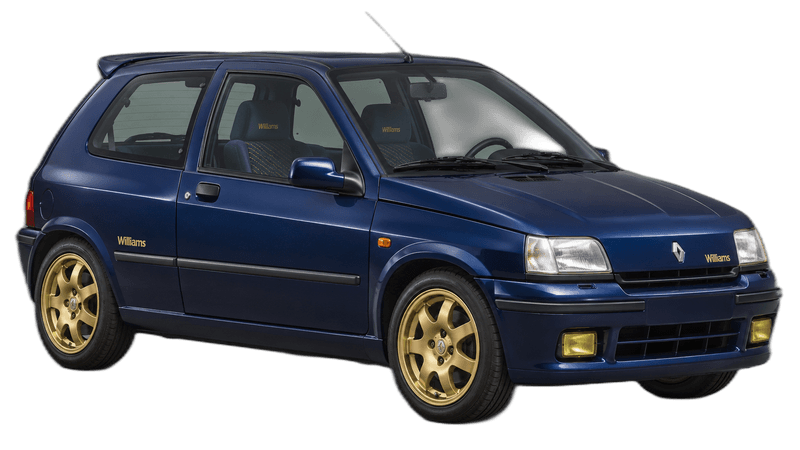
Renault Clio RS 200 (Mk3)
£8,000
usadoIndicative market price, updated periodically.
194cv
Potencia
6.9s
0-100 km/h
215km/h
Velocidad Máxima
£8,000
Precio Usado
The Renault Clio RS 200 (Mk3) produces 194 bhp, reaches 100 km/h in 6.9 seconds and has a top speed of 215 km/h. A representative example is worth about £8,000.
Cómo empuja.
La fuerza g máxima en el instante en que pisas a fondo, estimada a partir del 0–100 y la tracción del coche.
Renault Clio RS 200 (Mk3)G de salida estimada a partir del 0–100 y la tracción: una aproximación honesta, no una cifra medida.
Dream Car Garage Editorial · Edited by José Teo Lorente Vallecillos · Last updated 2 November 2026
Visión General
We have not driven this car. This review is based on published specifications and the sources listed below.
A normally aspirated hot hatch built at Dieppe
This guide is scoped to the Mk3 Clio Renaultsport 197/200 three-door hatchback, the 2.0L naturally aspirated inline-4 petrol (1998 cc) car with a six-speed manual gearbox and front-wheel drive. The 197 is the car launched in 2006 and the 200 is the facelifted car that replaced it in 2009. Where the 200, the Cup chassis and the limited editions differ, the section on variants says so, and the checks below should not be assumed to apply to any other Clio.
Listings often call every car of this generation an RS 200. Strictly, the 197 is the 2006 to 2009 car and the 200 is the 2009 facelift, so check which one you are looking at before comparing prices or reading a review. The facelift is easy to spot from the front because of the new bumper with its blade splitter, and from the back because the twin exhaust tailpipes are more visible in the diffuser.
We have not driven this model for this article. What follows comes from Renault's own launch release for the 197, PistonHeads' report on the same launch, a Car magazine used-car guide, Renault's release for the 200, and general principles for inspecting a fast, well-used hatchback. It is meant to help you ask better questions, not to replace an inspection by a Renaultsport specialist.
The figures, checked against the maker
Renault's UK press release for the 197, reposted in May 2006, gives the numbers in plain terms. The engine is the F4R RS, a 1998 cc four-cylinder, and the release says 197hp at 7,250 rpm and 215 Nm at 5,550 rpm. It quotes 62 mph in 6.9 seconds, a top speed of 134 mph, the standing kilometre in 27.5 seconds, and combined economy of 31.7 mpg with 209 g/km of CO2.
Power needs care because the horsepower in a Renault release is metric. A figure of 197 PS is 145 kW, which converts to about 194 bhp, the mechanical horsepower used in the UK. PistonHeads printed the same number as 197bhp, and many listings repeat that, so a quoted 197 bhp is the PS figure under a bhp label. The facelifted 200 is rated 200 PS, which is 147 kW and about 197 bhp, so a genuine 197 bhp belongs to the later car. This guide uses 194 bhp for the 197 and says so wherever it matters.
Two other conversions are worth knowing. The 134 mph top speed converts to about 215 km/h, and 62 mph is 99.8 km/h, so we treat 6.9 seconds as the 0-100 km/h time. Renault quotes it in miles per hour, so the metric figure is our conversion of the same sprint. The torque of 215 Nm is about 159 lb ft. All of these are claims made at launch and none was measured by us.
Engine and gearbox
The engine is the heart of the car. Renault's release says it evolved from the unit used in the Clio Renaultsport 182, with a compression ratio of 11.5:1, valve lift of 11.5 mm instead of about 9 mm, continuously variable valve timing and a steel crankshaft with eight counterweights. The red zone on the rev counter starts at 7,500 rpm, and a gear-change light sits inside it. Renault says the engine is easy to live with below 5,000 rpm and shows its character above that, and K-TEC Racing, quoted by Car magazine, says the 197 has poorer low-down performance than the later 200.
The gearbox is an evolution of the TL4 six-speed manual, which Renault says can handle up to 240 Nm. It is the first thing to think about when buying an early 197. Specialists quoted by Car magazine report that early cars, from the 56 to 07 plates, could crunch going into second and third, that most were replaced under warranty, and that the fault was remedied from late 2007, when a taller sixth gear was also added. If you are looking at an early car, ask for proof that the gearbox has been replaced, and drive it through every gear when it is cold and when it is warm.
The same guide says the F4R is sensitive to cam timing, and that Renaultsport specialists have corrected several badly done cam belt changes. Ask for an invoice that names the belt, the tensioner and the water pump, and follow Renault's schedule for age and mileage rather than a forum rule of thumb. If the history is thin, price a belt service into your offer.
Other engine points from the same guide are cracked exhaust manifolds and the fact that it is normal for a Renaultsport Clio to kangaroo along the road when cold. Neither is a reason to walk away, but a car that shakes badly once warm deserves a second opinion.
Body, suspension and steering
The 197 is not a regular Clio with stickers. Renault's release says the wheelbase is 10 mm longer at 2,585 mm and the front and rear tracks are 48 mm and 50 mm wider than a standard Clio III. The front suspension is a double-axis strut layout with aluminium components, which Renault says reduces torque steer, and the rear is a torsion beam strengthened by about 25 per cent with a 30 mm anti-roll bar. The subframe comes from the Megane Renaultsport 225.
The complexity at the front is where wear appears. The Car guide says the top swivel bearing is prone to wearing on higher-mileage cars, and that rear shock absorbers are prone to leaking on most Clios. With the car on a lift, look for play in the front hub, listen for a knock over bumps and check that the rear dampers are dry. Look closely at the front bumper and splitter, the extractors in the front wings and the diffuser, because a low front end can scrape on ramps and kerbs, and repairs are often visible in the paint.
Do not forget the flat floor. Renault says the spare wheel well was replaced by a flat panel to make room for the silencer and the twin tailpipes, and that the spare wheel was replaced by two tyre repair aerosols. Check that the repair kit is still in the car and that it is in date, and decide whether you are happy to rely on it.
Brakes, wheels and tyres
Renault says the braking system is derived from the Megane Renaultsport 225, with 312 mm front discs and Brembo four-pot calipers and 300 mm discs at the rear. Brake Assist was deliberately removed because Renault expected the car to be used on track days, and the stability control is reprogrammed to higher limits and can be disconnected. PistonHeads noted that in its own Megane 225 test the same brakes needed constant heat to work efficiently, which suits the track more than the road. Judge how the pedal feels at low speed, and check that nothing drags.
The Car guide says rear brakes can stick, which hurts economy, so check that both rear wheels spin freely after a drive. Look at the discs for lipping and at the calipers for corrosion, and check the date codes on the tyres. The launch release specifies Continental SportContact 3 tyres in 215/45 R17, although PistonHeads and a second repost of Renault UK material from the same month give 215/40, so confirm the size printed on the tyres of the car in front of you against the handbook.
How the 200, Cup and limited editions differ
Renault's UK release for the 200 says the car went on sale in May 2009, which is roughly three years after the 197. Peak power rose by 3 PS to 200 PS at 7,100 rpm, torque stayed at 215 Nm but peaked slightly earlier at 5,400 rpm, and low-down torque below 3,000 rpm was up by 20 per cent through a new cylinder head and remapped engine management. First, second and third gears were shortened. The quoted 0-62 mph time stayed at 6.9 seconds, but the top speed was raised to 141 mph, which converts to about 227 km/h. That is a very different top speed from the 197's 215 km/h, so make sure you read the right column in any comparison.
We read that release as reproduced by a motoring news site, not on a Renault host, which is why we treat it as a second-hand copy of a manufacturer document. The same release says the 200 range comes in two versions, the Cup and the better equipped 200, and that the Cup chassis is standard on the first and optional on the second. The Cup chassis sits 7 mm lower, has stiffer springs, dampers 15 per cent stiffer than the 197's Cup setting and a steering rack that is 7.5 per cent quicker. The release gives the 200 Cup a weight of 1,204 kg, and identifies the chassis by anthracite wheels and red calipers. Car magazine lists 1,240 kg for the standard 200.
There were also limited editions. Car magazine mentions the 2007 Clio 197 F1 Team R27, and a listing it quotes describes that car as one of 500 with Recaro seats and the Cup chassis. We do not cover limited editions in depth, and a car being sold as one needs documents to prove it.
Two other names come up in listings. We did not find a Renaultsport version of the Sport Tourer estate, which was a regular Clio, and we found no Mk3 Clio road car called a Trophy. That name belongs to later cars. If a seller describes one as either, ask for evidence.
Recalls, history and paperwork
We did not find an official recall list for the Mk3 Clio Renaultsport, so we name no campaign. Do not assume that means there are none. Use the DVSA vehicle recall check with the registration number, and ask a Renault dealer to check the VIN for any open campaigns. Any airbag or brake action should be confirmed as completed in writing.
Ask for the full service history, including evidence of the gearbox replacement on an early car and the cam belt invoice. Use the government MOT history service to read the advisories and the recorded mileage over time, and look for gaps. Check that the registration documents agree on the colour, the engine number and the number of keepers. The car came with a hands-free key card for unlocking and starting, so check that you receive every card, and that all of them work.
Pre-purchase checks
Start with the signs of use. These cars are often modified and tracked, so look for aftermarket exhausts, lowered springs, different wheels and non-standard seats, and ask for receipts. Look for uneven tyre wear, which can mean tracking problems after kerb strikes, and for repaired front corners.
On the drive, check that the engine pulls cleanly to the limiter, that it does not smoke and that the oil pressure is steady when hot. Test each gear, upshifts and downshifts, and listen for crunching into second and third. Feel for torque steer or vibrations under load, and check that the stability control light behaves normally and can be switched off. Make sure the air conditioning and all the electric windows work, and test every door lock and key card.
Pay for a specialist inspection. A Renaultsport garage will know the right questions about the gearbox, the cam belt and the front end, and will often be able to lift the car and measure play that you cannot find on a drive.
The buying decision
The Renaultsport Clio 197 and 200 reward careful buying because the parts that matter most, the gearbox on early cars, the cam belt and the front end, are all things a good history can answer. A 2009 or later 200 avoids the early gearbox question and has the stronger low-down torque, but it is a different car with a different top speed, so do not mix the two sets of figures. A well-kept 197 with a replaced gearbox and a clear service record can be just as good.
Buy on evidence rather than on the badge. Insist on service invoices, an MOT history that matches the odometer, a clear recall check and a professional inspection, and be wary of any listing that cannot say whether it is a 197 or a 200. If you cannot answer those questions before you pay, keep looking.
Especificaciones
| Motor | 2.0L naturally aspirated inline-4 petrol (1998 cc) |
|---|---|
| Cilindrada | 2.0L |
| Potencia | 194 cv |
| Par Motor | 215 Nm |
| 0-100 km/h | 6.9s |
| Velocidad Máxima | 215 km/h |
| Tracción | FWD |
| País | France |
| Carrocería | 4/5 seater hatchback |
| Años | 2006–2009 |
| Precio Usado | £8,000 |
Specifications are manufacturer-published figures.
Compare with
Preguntas Frecuentes
What is a Renault Clio RS 200 (Mk3) worth?
A representative example is worth about £8,000. Actual values vary with specification, condition and history.
How much power does the Renault Clio RS 200 (Mk3) have?
The Renault Clio RS 200 (Mk3) produces 194 bhp and 215 Nm of torque.
How fast is the Renault Clio RS 200 (Mk3) from 0 to 100 km/h?
The Renault Clio RS 200 (Mk3) accelerates from 0 to 100 km/h in 6.9 seconds.
What is the top speed of the Renault Clio RS 200 (Mk3)?
The Renault Clio RS 200 (Mk3) has a top speed of 215 km/h.
What engine does the Renault Clio RS 200 (Mk3) have?
The Renault Clio RS 200 (Mk3) uses a 2.0L naturally aspirated inline-4 petrol (1998 cc).
When was the Renault Clio RS 200 (Mk3) built?
The Renault Clio RS 200 (Mk3) was built from 2006 to 2009.
Is the Renault Clio RS 200 (Mk3) all-wheel drive?
No. The Renault Clio RS 200 (Mk3) is configured with front-wheel drive.