
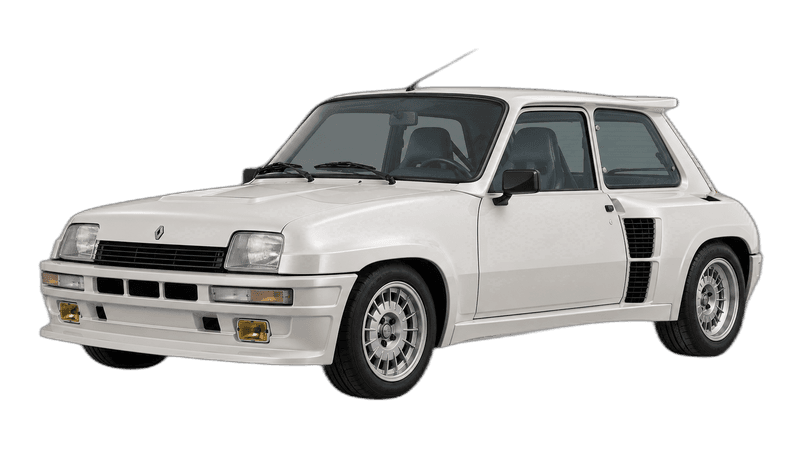
Renault 5 Turbo 2
£110,000
usadoIndicative market price, updated periodically.
158cv
Potencia
6.6s
0-100 km/h
200km/h
Velocidad Máxima
£110,000
Precio Usado
Cómo empuja.
La fuerza g máxima en el instante en que pisas a fondo, estimada a partir del 0–100 y la tracción del coche.
Renault 5 Turbo 2G de salida estimada a partir del 0–100 y la tracción: una aproximación honesta, no una cifra medida.
The Renault 5 Turbo 2 is a 2-seat 3-door hatchback by Renault, with 158 bhp, 210 Nm of torque, a 0-100 km/h time of 6.6 seconds and a top speed of 200 km/h. Indicative used value: approximately £110,000. Actual values vary with specification, condition and history.
Dream Car Garage Editorial · Edited by José Teo Lorente Vallecillos · Last updated 2 November 2026
Visión General
We have not driven this car. This review is based on published specifications and the sources listed below.
Scope of this guide
This guide is scoped to the Renault 5 Turbo 2, the road car Renault launched at the 1982 Paris Motor Show and built until 1986, with the 1.4L Garrett T3 turbocharged mid-mounted inline-four petrol (1397 cc) engine, a five-speed manual gearbox and rear-wheel drive. It is not a guide to the earlier Renault 5 Turbo (the "Turbo 1" of 1980 to 1982) with its aluminium roof and Bertone interior, to the special batch of 200 competition-approval cars with a larger engine, to the front-engined Renault 5 Alpine Turbo and Gordini, or to the front-wheel drive Renault 5 GT Turbo that followed in 1985. We say below where each of those differs, so you can tell which car an advert really describes.
We have not driven this model for this article. Everything here comes from three cited sources: Renault Classic's own bilingual history booklet on the Renault 5 Turbo, PistonHeads' PH Heroes road test of a Turbo 2, and the government recall checker. We also read a Wikipedia article on the car, a car-data page, a 2012 PistonHeads classified feature, a 2019 PistonHeads report on a Renault Classic day and a US dealer's buying page, and we flag each point that rests on them. Where sources disagree we say so rather than choose quietly.
The figures at a glance
- Engine: 1.4L Garrett T3 turbocharged mid-mounted inline-four petrol (1397 cc), with Bosch K-Jetronic fuel injection, liquid cooling and a side-mounted camshaft, according to Renault's technical sheet.
- Power: 158 bhp, which is Renault's 160 hp (ch, metric horsepower, so PS) at 6,000 rpm converted by us (160 x 0.98632 is about 157.8).
- Torque: 210 Nm at 3,250 rpm, which is Renault's 21.4 mkg (kilogram-metres) converted by us (21.4 x 9.80665 is about 209.9). Other sources print 220 or 221 Nm, discussed below.
- 0-100 km/h: 6.6 seconds, which is PistonHeads' 0-62 mph figure treated as 0-100 km/h. Renault's sheet gives no 0-100 time, only 15.15 seconds for 400 m and 28.4 seconds for 1,000 m from a standing start.
- Top speed: 200 km/h, from Renault's sheet. PistonHeads prints 130 mph, which converts to about 209 km/h.
- Drive: rear-wheel drive with the engine mounted centrally and longitudinally, so this is a mid-engine car, with a five-speed gearbox and a dual-disc clutch.
- Weight: 970 kg on PistonHeads and the car-data page, which is also the figure on Renault's sheet for the earlier car. Renault says the Turbo 2 weighed an extra 30 kg, so treat any weight as approximate.
- Size: about 3.66 m long, 1.75 m wide and 1.32 m high on a 2.43 m wheelbase, with a 93 litre fuel tank, all from the car-data page.
- Production: 3,167 Turbo 2s between 1982 and 1986, from Renault Classic.
What the Turbo 2 is
The Renault 5 Turbo was built to win rallies. Renault Classic says series production officially began on 20 May 1980, with Renault 5 bodies built at Flins, lengthened by 5 cm and fitted with aluminium roof and door panels by Heuliez at Cerizay, and then finished at the Alpine factory in Dieppe with polyester wings and bonnet, the turbocharged engine and the five-speed gearbox. The first run needed 400 cars to be approved for Group 4 competition. PistonHeads calls it the homologation special for the Renault 5 that took Jean Ragnotti to victory in the 1981 Monte Carlo Rally.
Renault launched the Turbo 2 at the Paris Motor Show in 1982, with sales as a 1983 model. Its main change was the interior: the Bertone-styled cabin and seats gave way to the fittings, seats and trim of the Renault 5 Alpine Turbo, while the roof and door panels were no longer aluminium. Renault says that steel doors had already replaced aluminium ones on the earlier car for the 1982 model year, and says the technical characteristics of the two cars were almost identical, so much so that the type number stayed R 8220. The Turbo 2 was heavier by about 30 kg but cheaper: Renault Classic quotes 102,000 francs in 1983 against 115,000 francs for the earlier model. PistonHeads adds larger wheels and wider arches for the Turbo 2, and describes dash plastics you would recognise from an ordinary Renault 5.
How the numbers differ between sources
Power is the easy one. Renault Classic says 160 hp at 6,000 rpm, the car-data page says 160 PS, 158 HP and 118 kW, and PistonHeads says 160hp. These all describe one rating in different units, and we use 158 bhp.
Torque is not so tidy. Renault Classic's technical sheet says 21.4 mkg at 3,250 rpm, which is about 210 Nm. PistonHeads prints 163 lb ft at 3,250 rpm, which converts to about 221 Nm, and the car-data page says 220 Nm. The Wikipedia article also gives 221 Nm. We chose the manufacturer's sheet because it is the primary document, but its sheet is headed for the Renault 5 Turbo and we are relying on Renault's statement that the Turbo 2 shared the same type number and characteristics. Treat 210 Nm as the better-sourced figure and 221 Nm as the commonly quoted one.
Acceleration varies more. PistonHeads gives 6.6 seconds for 0-62 mph, Wikipedia gives 6.9 seconds for 0-100 km/h, and the car-data page gives 7.7 seconds for 0-100 km/h. These are claimed figures, not tests, and we have not verified how any of them was measured. We use the PistonHeads figure because it is one of our cited sources.
Dates also differ. Renault Classic says 3,167 Turbo 2s were produced between 1982 and 1986. PistonHeads says the Turbo 2 followed in 1983, the car-data page says 1983 to 1986, and Wikipedia's infobox gives 1980 to 1984 for the whole Renault 5 Turbo family. A US dealer's page puts the Turbo 2 launch at the 1982 Geneva show, which does not match Renault's account of the Paris show, so we ignore that point. A car first registered in 1982 therefore fits Renault's dates, and PistonHeads' 2012 classified feature describes one.
Production and the other cars
Renault Classic says 802 Renault 5 Turbos were built in 1980 as 1981 models, 536 in 1981 and 352 in 1982, which adds up to 1,690 of the earlier car. Wikipedia says 1,820 Turbo 1s and 4,987 cars in total. We cannot reconcile the two and use only the 3,167 Turbo 2 figure, which both sources agree on.
Renault Classic also says a special series of 200 Renault 5 Turbos with an increased engine capacity was built to qualify for the two-litre class in Group B rallying, the type 8221. We have not found a source saying whether those cars sit inside the 3,167 count, and they are outside the scope of this guide. The Renault 5 Alpine Turbo is a different car, with the engine in the front and about 110 hp according to PistonHeads, so a front-engined car is not a Turbo 2 whatever the badge says.
What PistonHeads found on the road
PistonHeads' test is the only driving account we cite, and it was written by a journalist, not by us. It says the engine feels sluggish below about 3,000 rpm and then pulls hard on boost, so it wants to be kept busy. It says the gate is tight with a light lever that is easy to botch, that reverse sits next to second gear without a lift collar to protect it, and that the steering is unassisted and dense with feedback. It also says the steering wheel sits low against a high seat. The author says front grip was immediate with no sudden oversteer, but did not go beyond seven tenths on a circuit. The text says peak torque arrives at 3,250 rpm in the data panel but later talks about it at 6,000 rpm, and the article does not reconcile the two.
What to check before buying
None of our three cited sources is a full buying guide for the Turbo 2, so this section leans on a US dealer's buying page and on general good sense. That page is a sales page, and we have only read it through a summary, so treat each point as a prompt for an inspection, not a fact.
- Bodywork: the car began as a steel economy hatchback, and it can rust like one. The dealer page says to start with the floor pans, sills, jacking points, front inner wings, scuttle and windscreen base, and says corrosion in the bulkhead behind the seats is structural. On a Turbo 2 the steel door bottoms and tailgate need checking too. The composite wings do not rust but can hide rot in the rear arches and suspension mounts.
- Engine bay heat: a mid-mounted turbo in a tight bay means decades of heat soak, so look at hoses, vacuum lines, insulation and wiring. Smoke on boost, shaft play in the turbo or a tampered wastegate point to a rebuild.
- Fuel injection: the dealer page says K-Jetronic dislikes long storage, and that hard hot or cold starting suggests attention to the distributor, warm-up regulator or injectors.
- Gearbox: the page calls the transaxle durable but says the linkage can get vague and the synchromesh can wear. PistonHeads' tester found the shift easy to get wrong, so judge the linkage on a test drive.
- Interior: the Turbo 2 should have the Alpine Turbo-based trim, not Bertone parts. The dealer page says some Turbo 2s are fitted with aluminium panels or a Bertone-style interior and presented as the earlier car.
- Wheels and tyres: Renault's sheet lists metric TRX-style sizes of 190/55 HR 340 and 220/55 VR 365 for the earlier car, and the car-data page lists 13 and 14 inch sizes. We found no source on tyre supply, so ask a specialist what fits and what is available before you buy.
- Paperwork: ask for the registration history, service records and any Renault or Alpine confirmation of the car. Renault Classic should be able to help with the heritage of a genuine car, though we did not test that. Check the chassis number carefully, because the dealer page also warns of replicas built on ordinary Renault 5 shells, some on front-engined cars.
- Right-hand drive: PistonHeads' 2012 classified feature mentions an Irish car converted to right-hand drive, so check how any conversion was done and documented.
Values and running costs
We have no reliable current values. PistonHeads' 2012 feature spotted a Turbo 2 at 34,990 pounds with 11,000 miles, and recorded a similar car at 7,500 pounds in 1992. We treat those as history, not a guide to today, and we recommend a recent auction result or an independent valuation instead. The dealer page says a full engine and turbo overhaul with European parts is a substantial part of a Turbo 2's value, but it gives no price. We found no source for servicing intervals, parts costs or insurance, so we make no claims about them.
Recalls and the DVSA check
We found no source naming a recall campaign for the Renault 5 Turbo 2. Run the registration or VIN through the DVSA vehicle recall check on GOV.UK, which we did not do for this article because it needs a vehicle. A car this old may have no entry, and an empty result is not proof that nothing was ever done, so also ask a Renault specialist what work the car has had. A car imported from France or elsewhere may carry a different history from a car supplied through UK dealers, so ask for its documents.
Verdict
The Turbo 2 is the later, cheaper and more usable form of Renault's mid-engine rally homologation hatchback, with 158 bhp, 210 Nm, 6.6 seconds to 100 km/h, a 200 km/h top speed and rear-wheel drive from a 1.4L turbocharged inline-four petrol (1397 cc). It asks a buyer to look hard at rust, heat damage and originality, and to be sceptical about claims that a Turbo 2 is something rarer. If you are shopping for one, find a specialist, read the paperwork, and treat the published figures as claims with the caveats above. We have not driven it, so use the sources and an independent inspection to decide.
Especificaciones
Motor
1.4L Garrett T3 turbocharged mid-mounted inline-four petrol (1397 cc)
Cilindrada
1.4L
Potencia
158 cv
Par Motor
210 Nm
0-100 km/h
6.6s
Velocidad Máxima
200 km/h
Tracción
RWD
País
France
Carrocería
2-seat 3-door hatchback
Años
1982–1986
Producción
3,167
Precio Usado
£110,000
Specifications are manufacturer-published figures.
Más de Renault
Preguntas Frecuentes
What are the specifications of the Renault 5 Turbo 2?
The Renault 5 Turbo 2 is a 2-seat 3-door hatchback by Renault, with 158 bhp, 210 Nm of torque, a 0-100 km/h time of 6.6 seconds and a top speed of 200 km/h. Indicative used value: approximately £110,000. Actual values vary with specification, condition and history.
How much does a Renault 5 Turbo 2 cost?
Indicative used value: approximately £110,000. Actual values vary with specification, condition and history.
How many Renault 5 Turbo 2 were made?
Renault produced 3,167 units of the Renault 5 Turbo 2.
What drivetrain does the Renault 5 Turbo 2 use?
The Renault 5 Turbo 2 is configured with rear-wheel drive.
What type of car is the Renault 5 Turbo 2?
The Renault 5 Turbo 2 is a hot hatches manufactured by Renault in France. Production ran from 1982 to 1986.