
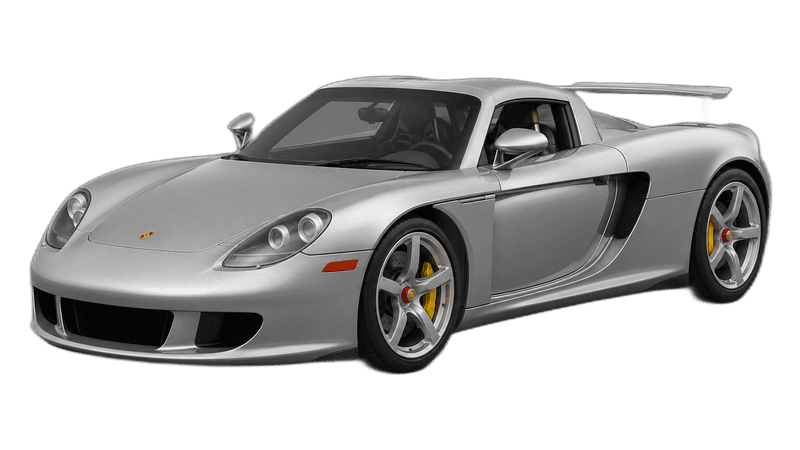
Porsche Carrera GT
£1,100,000
usadoIndicative market price, updated periodically.
603cv
Potencia
3.9s
0-100 km/h
330km/h
Velocidad Máxima
£1,100,000
Precio Usado
Cómo empuja.
La fuerza g máxima en el instante en que pisas a fondo, estimada a partir del 0–100 y la tracción del coche.
Porsche Carrera GTG de salida estimada a partir del 0–100 y la tracción: una aproximación honesta, no una cifra medida.
The Porsche Carrera GT is a 2-seater roadster (targa) by Porsche, with 603 bhp, 590 Nm of torque, a 0-100 km/h time of 3.9 seconds and a top speed of 330 km/h. Indicative used value: approximately £1,100,000. Actual values vary with specification, condition and history.
Dream Car Garage Editorial · Edited by José Teo Lorente Vallecillos · Last updated 27 October 2026
Visión General
We have not driven this car. This review is based on published specifications and the sources listed below.
A carbon structure with an analogue brief
The Carrera GT reached production for the 2003 model year with a carbon-fibre monocoque, a naturally aspirated 5.7-litre V10 mounted behind the occupants and a six-speed manual gearbox. Porsche quoted 450 kW, equivalent to 612 PS or about 603 bhp. Its ceramic clutch and lack of an automated transmission make the starting procedure and the condition of the drivetrain central to an inspection.
This is a desk-researched ownership guide. We have not driven this model for this article. The car's rarity and engineering do not remove the need for ordinary evidence: identity, maintenance records, measured wear and a specialist inspection. A low odometer figure can coexist with old tyres, incomplete campaigns or unexplained time off the road.
Clutch technique and documented measurement
PistonHeads' buying guide draws particular attention to the carbon ceramic clutch and the engine's anti-stall strategy. The correct pull-away technique is not intuitive for every driver, and a car may carry the consequences of previous misuse. A seller saying that a clutch engages is not the same as supplying a measured assessment of its remaining condition.
Ask who inspected the clutch, what was measured and when the result was recorded. Do not treat an engine warning, a difficult engagement or a demonstration drive as a substitute for diagnosis. The inspection should also distinguish clutch wear from unrelated transmission or hydraulic concerns. Any estimate of remaining life needs to come from the specialist examining that particular car, not from a generic mileage promise.
The six-speed gearbox and V10 deserve the same evidence-led approach. Check for documented work, fluid condition where appropriate and a clear explanation of any replacement components. A smooth presentation does not establish internal condition, while an old invoice without identified work does not establish a complete service history.
Valve clearances and engine-out records
The 5.7-litre engine uses dry-sump lubrication, titanium connecting rods and gear-driven camshafts. The buying guide identifies valve-clearance work as a significant engine-out procedure. The useful question is therefore not simply whether the car has a service book, but whether the file identifies the required work, the workshop and the measurements taken.
Reconcile stamps, invoices and inspection reports with the car's age and use. Long storage can leave gaps that need explanation rather than automatic condemnation. Conversely, a recent fluid change does not prove that deeper scheduled work was completed. If a seller says valve clearances were checked, request the actual report and confirm what adjustment, if any, followed.
The camshafts deserve similar scrutiny. PistonHeads identifies their sharp lobes as vulnerable to pitting when the car is used too little, so an inspection should look beyond a generic leak check. Ask the specialist to record what was visible, whether any camshaft or follower work has been documented, and how that evidence relates to the engine's history. Coil packs and clutch hydraulics should also be examined when symptoms are present. These are inspection prompts, not a claim that every car will show the same condition.
Specialist familiarity matters. A general inspection may confirm obvious leaks or damage without addressing the model-specific procedures that make this car different. The scope of the inspection and the qualifications of the person performing it should be agreed before purchase.
Suspension, campaigns and structural inspection
Check the front and rear suspension, mounting points and underbody for damage, corrosion where applicable and signs of poor repair. Porsche's recall history and the buying guide make it important to verify campaign and recall completion by VIN through an appropriate Porsche channel. Do not assume that every car received every action, or that a verbal assurance closes the question.
The carbon monocoque changes the repair conversation. Accident evidence, panel alignment and inconsistent underbody components warrant expert assessment rather than a visual dismissal. Replacement undertrays or hardware should be explained. If the car has been used on circuit, ask for that history and the inspections that followed; track use is not itself proof of damage, but undisclosed use reduces confidence in the file.
Engine and suspension mounts also belong on the inspection list. Any movement, noise or vibration should be diagnosed before it is attributed to the model's character.
Brakes and tyres are age-sensitive evidence
PCCB ceramic brakes were part of the Carrera GT specification. Inspect discs, calipers and associated hardware for damage and measured condition. A clean disc surface is not a complete assessment, and replacement components need documented provenance. Wheel removal may be necessary for the inspection a specialist considers appropriate.
Tyres deserve attention even when tread remains. Confirm the correct N-rated specification, size, age and condition across both axles. A car used infrequently can retain old tyres that look presentable in photographs. Storage marks, cracking or mismatched production dates should be assessed directly. Brake and tyre condition also affects whether a meaningful road evaluation is safe, not merely whether the car looks complete.
Roof panels, luggage and the delivered specification
The removable roof panels, their storage arrangement and the fitted luggage are part of the car's usable specification. Check that the correct panels, bags, covers and fastening pieces are present and that their condition matches the account given by the seller. Missing equipment is easier to identify before collection than after it.
Verify the VIN, option list and major numbered components against the documentation. Paint, wheels and interior changes may be legitimate, but they should be disclosed rather than discovered by comparing photographs with the factory record. A modified exhaust or suspension setup also needs invoices and an explanation of whether the original parts accompany the car.
How this review was compiled
We have not driven this model for this article. This review uses Porsche's museum material for the car's architecture and output, and PistonHeads' Carrera GT buying guide for clutch, service, suspension, brake and equipment checks. We did not conduct a transaction survey or establish a frequency for any fault. No future value is assumed here. The appropriate next step is a VIN-based campaign check and an inspection by a Carrera GT specialist with access to the service file.
Especificaciones
Motor
5.7L (5733 cc) naturally aspirated V10
Cilindrada
5.7L
Potencia
603 cv
Par Motor
590 Nm
0-100 km/h
3.9s
Velocidad Máxima
330 km/h
Tracción
RWD
País
Germany
Carrocería
2-seater roadster (targa)
Años
2003–2006
Precio Usado
£1,100,000
Specifications are manufacturer-published figures.
Más de Porsche
Destacado en Carpedia
Preguntas Frecuentes
What are the specifications of the Porsche Carrera GT?
The Porsche Carrera GT is a 2-seater roadster (targa) by Porsche, with 603 bhp, 590 Nm of torque, a 0-100 km/h time of 3.9 seconds and a top speed of 330 km/h. Indicative used value: approximately £1,100,000. Actual values vary with specification, condition and history.
How much does a Porsche Carrera GT cost?
Indicative used value: approximately £1,100,000. Actual values vary with specification, condition and history.
What drivetrain does the Porsche Carrera GT use?
The Porsche Carrera GT is configured with rear-wheel drive.
What type of car is the Porsche Carrera GT?
The Porsche Carrera GT is a supercars manufactured by Porsche in Germany. Production ran from 2003 to 2006.