
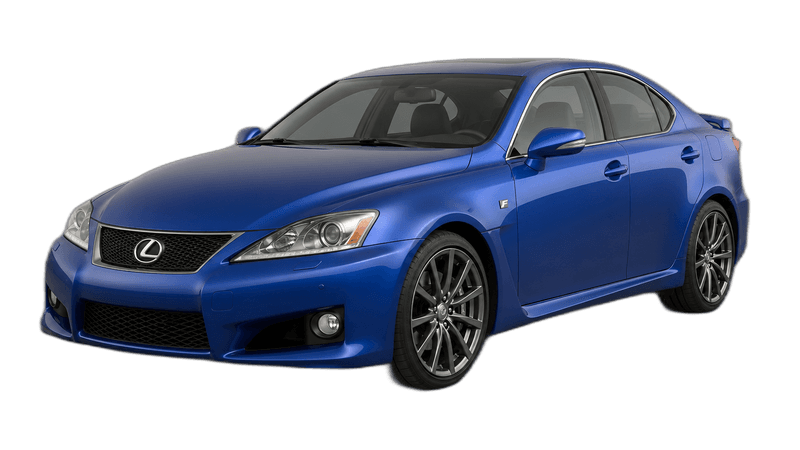
Lexus IS F
£22,000
usadoIndicative market price, updated periodically.
417cv
Potencia
4.8s
0-100 km/h
270km/h
Velocidad Máxima
£22,000
Precio Usado
Cómo empuja.
La fuerza g máxima en el instante en que pisas a fondo, estimada a partir del 0–100 y la tracción del coche.
Lexus IS FG de salida estimada a partir del 0–100 y la tracción: una aproximación honesta, no una cifra medida.
The Lexus IS F is a 4/5 seater sedan/saloon by Lexus, with 417 bhp, 505 Nm of torque, a 0-100 km/h time of 4.8 seconds and a top speed of 270 km/h. Indicative used value: approximately £22,000. Actual values vary with specification, condition and history.
Dream Car Garage Editorial · Edited by José Teo Lorente Vallecillos · Last updated 2 November 2026
Visión General
We have not driven this car. This review is based on published specifications and the sources listed below.
The V8 saloon that Lexus built to take on the M3
The Lexus IS F is the first car to wear Lexus's F performance badge: a rear-wheel-drive saloon built on the second-generation IS, with a naturally aspirated V8 and an eight-speed automatic gearbox. This guide is scoped to the Lexus IS F saloon as sold in the UK and Europe. It is the car Lexus unveiled at the Detroit show in January 2007 and the one the Lexus UK media archive describes as on sale in the UK from 2008 to 2013. Our catalogue lists a 5.0L V8 naturally aspirated petrol engine producing 417 bhp and 505 Nm, with 0 to 100 km/h in 4.8 seconds, a limited top speed of 270 km/h and rear-wheel drive. We have not driven this model for this article. Everything below comes from manufacturer releases, PistonHeads' used buying guide and the recall records we could read, and where those sources differ we say so rather than pick a winner quietly.
The car was always a niche product. PistonHeads' used buying guide puts production at about 5,100 cars between 2008 and 2014, and presents the IS F as an interesting alternative to the BMW M3, Mercedes-AMG C63 and Audi RS4. It also calls it a long way from being a typical Lexus. That small run matters when you shop: there are few cars to choose from, and the differences between early and late cars, covered below, are worth understanding before you view anything.
Checking the figures
Several different power and torque figures are in circulation, and they describe the same engine. Lexus's own UK media archive says the car launched with a 417 bhp V8, and the Lexus UK release for the 2011 model refers to the 417bhp 5.0-litre V8. Toyota's Japanese announcement gives 311 kW, which it labels 423 PS, at 6,600 rpm. Converting 423 PS gives roughly 417 bhp, so those two agree. PistonHeads' used buying guide prints 416hp at 6,600rpm, a rounding difference of one unit, and we use 417 bhp in the catalogue because that is the figure Lexus UK itself publishes.
Torque has the same pattern. Toyota's announcement and the Lexus UK 2010 release give 505 Nm, with Toyota placing the peak at 5,200 rpm. PistonHeads gives 371 lb ft at 5,200 rpm, which converts to about 503 Nm. So a listing that says 503 Nm or 371 lb ft is quoting the same engine in different units, and we use the manufacturer's 505 Nm.
Performance figures need a little more care. Lexus UK states a 0 to 62 mph time of 4.8 seconds in both its 2010 and 2011 releases, and a top speed of 168 mph, electronically limited. That 168 mph is about 270 km/h, which is the limited top speed a South African Lexus-sourced report and a European press report both give. A South African magazine attributes a 0 to 100 km/h time of about 4.8 seconds to Lexus. The European report on the 2012 model year gives 4.7 seconds, while PistonHeads says simply around five seconds to 62 mph. We use 4.8 seconds because it is the figure Lexus UK repeats, and treat 4.7 and around five seconds as the extremes of what you will read. The top speed is a limiter, not a measure of what the engine can do.
Do not confuse the figures with other cars. Lexus UK's timeline lists a separate IS F-Sport trim for the ordinary IS range, with styling inspired by the IS F but no V8. Toyota's Japanese announcement also says that Japanese-specification cars have a speed limiter that engages at 180 km/h, so a Japanese import will not behave like a UK car at the top end. If a listing quotes a figure that matches none of the above, ask where it came from.
Engine and gearbox
Lexus's 2007 Detroit release describes the engine only as a 5.0-litre V8 with more than 400 horsepower and more than 350 lb ft of torque, and a prediction of under 4.9 seconds to 60 mph. The production figures above came later. A South African magazine report describes Yamaha-designed high-flow cylinder heads, direct injection and variable valve timing, and says the car was based on the IS 250 with a reinforced structure, lowered and stiffened suspension and revised steering. The Lexus UK 2011 release adds that the engine was updated to meet Euro 5 emissions rules without affecting performance, and that CO2 emissions and fuel consumption were unchanged.
The gearbox is an eight-speed automatic, which Lexus described at launch as the first of its type in the world, with paddle shifters and upshifts of about a tenth of a second. PistonHeads' guide says it has Sports, Snow and Normal modes plus a paddle-shift Manual mode, that no manual gearbox was offered, and that the automatic is fine for daily driving. The South African report adds that downshifts include an automatic throttle blip.
The mechanical checks in PistonHeads' guide are specific. Look at the coolant level, because low coolant or dried pink residue may point to a water pump leak. The valley plate, which the guide also calls a heat exchanger, leaked more often on earlier cars, and the repair is far costlier than the part: PistonHeads describes a job of 12 to 14 hours with the intake manifold and fuel rail removed, which an independent specialist may shorten by four to five hours. Be wary of a car whose history shows a sealant-only repair, as the guide says that may not hold. Oil temperature warnings can appear quickly in warm weather or on track days, and aftermarket oil coolers exist. Lexus recommends oil changes every 5,000 miles, with a minor service at 30,000 and a major service at 60,000, so ask for evidence of that schedule.
PistonHeads also notes that the real exhaust is restrictive and that the visible tips are decorative and part of the bumper. It mentions supercharged cars making far more than the standard output. Treat any modified car as a separate purchase with its own risks and ask for the specification of every change.
Chassis, brakes and wheels
At launch Lexus specified 14.2-inch cross-drilled front discs with Brembo six-piston aluminium calipers and 13.6-inch cross-drilled rear discs with two-piston calipers, with the Lexus name on the calipers. The standard wheels were 19-inch forged aluminium wheels built to Lexus specification by BBS, with 225/40R19 tyres at the front and 255/35R19 at the rear. Toyota's Japanese announcement gives the same tyre sizes. Weight is given by PistonHeads as 1,690 kg.
PistonHeads says brakes and tyres wear out and are not cheap to replace, that drilled discs can crack radiating from the holes under hard use, that brake dust builds up on the alloys especially with performance pads, and that brake switches can fail and wheel bearings wear. The guide also says the car is sensitive to wheel alignment, so look for uneven tyre wear. Track users, it says, find the standard tyres narrow and report that 245 or 255 fronts and 275 or 285 rears fit without rubbing, but that is an owner modification, not a factory option.
The suspension changed during the car's life, and it is the clearest reason to prefer one year over another. Lexus UK says the 2010 car made the Torsen limited-slip differential standard, sending drive torque to the rear wheel with the most grip, and credits it with significantly better traction and stability in high-speed cornering. PistonHeads agrees the 2010-on differential is worth having for enthusiastic driving. For 2011 Lexus UK says the front and rear coil springs and shock absorbers were revised for ride comfort, and the rear geometry was tweaked for stability under load. PistonHeads lists softer front springs, stiffer rears, thicker anti-roll bars at both ends and other suspension and steering parts, and adds that some owners felt the result was overdamped. It describes the electric steering as lacking feel.
Body, interior and electronics
PistonHeads says rust is rarely an issue, but to check the sunroof tracks and cabling and the mirrors, which can wobble, and notes that older boot lids may need help to lift. It warns that dashtop and door-top coverings can go tacky or melt in hot climates, so a car that has lived in the sun deserves a close look. The IS F is effectively a four-seater: rear legroom and headroom are limited, so sit in the back before you commit if you carry passengers.
The model-year changes are visible. For 2010 Lexus UK lists a new navigation system on a 40GB hard disc with full European coverage, a 10GB music library, DAB reception and a USB port, along with an optional white leather interior and optional mesh-design 19-inch alloy wheels. The 2011 car added LED daytime running lights alongside HID headlights, a redesigned instrument binnacle with the tachometer and gear shift indicator in the centre, and dark silver carbon-fibre-style trim. PistonHeads adds that the 2011 headlights lost their steering-linked directional function.
There was a further European revision for the 2012 model year. A report on that revision says the engine and the 270 km/h limiter were unchanged, the chassis was revised with new shock absorbers, larger stabiliser bars and revised suspension geometry, and a set of 14-spoke 19-inch BBS wheels and two-tone leather sport seats became options. It quotes 4.7 seconds to 100 km/h for that car, which is the only source we found using that number. So this was not a single facelift but a series of updates in 2010, 2011 and 2012, and a brochure or advert that mentions the update should be matched to the build date of the car in front of you.
Test the navigation, audio, climate control, sunroof and every electric function, because the guide gives no specific electronic fault list and we would rather you find faults than assume there are none.
Recalls and history
Check recalls on any car you are considering. The DVSA vehicle recall check, linked below, is the UK route, and you should also ask the seller for the dealer's recall history. We could not find a UK recall list for the IS F, so we cannot say which campaigns apply to a UK car.
The records we could read are US campaigns. The US safety regulator's records, as shown on a recall aggregator, list passenger frontal air bag inflator recalls on the 2012 IS F, campaigns 17V006000 and 19V005000, and a separate campaign, 20V012000, for the low-pressure fuel pump in the 2014 IS F, where the fuel pump may fail and the engine can stall. These are US campaigns and we have not confirmed that they apply to a UK or European car, so treat them as a prompt to check the specific car by registration or VIN, not as a statement about every IS F.
Lexus's own UK records show the 2008 launch, the 2010 and 2011 updates and the end of UK sales in 2013, while PistonHeads dates production to 2014, so production years and UK sales years do not line up exactly and the registration paperwork is the better guide to a particular car. Ask for the full service history, bearing in mind the Lexus recommendation of oil changes every 5,000 miles.
Buying decision
PistonHeads presents the IS F as affordable to buy and cheap to run apart from fuel, with good build quality and reliability, and it values the exclusivity of a small production run. That is a favourable view, but it is a buying guide, not a long-term test, and it still lists real faults: valley plate and water pump leaks, brake and tyre costs, and some cabin materials that suffer in the heat. We have not driven this model for this article, so we cannot tell you whether the ride or the sound suits you.
If you want the most refined chassis, the 2011 and later cars carry the suspension revisions, and the 2012 European cars add the further chassis changes described above. If you want the simplest, most original car, a 2010 car has the differential and the new navigation. Whichever you choose, put the cooling system at the top of your inspection list, get proof of regular oil changes, check the brakes and tyres for wear and cracks, confirm the recall status of the exact car, and walk away from any sealant-only valley plate repair. Because there are so few cars, patience and a full history are worth more than a quick purchase.
Especificaciones
Motor
5.0L V8 naturally aspirated petrol
Cilindrada
5.0L
Potencia
417 cv
Par Motor
505 Nm
0-100 km/h
4.8s
Velocidad Máxima
270 km/h
Tracción
RWD
País
Japan
Carrocería
4/5 seater sedan/saloon
Años
2007–2014
Precio Usado
£22,000
Specifications are manufacturer-published figures.
Más de Lexus
Preguntas Frecuentes
What are the specifications of the Lexus IS F?
The Lexus IS F is a 4/5 seater sedan/saloon by Lexus, with 417 bhp, 505 Nm of torque, a 0-100 km/h time of 4.8 seconds and a top speed of 270 km/h. Indicative used value: approximately £22,000. Actual values vary with specification, condition and history.
How much does a Lexus IS F cost?
Indicative used value: approximately £22,000. Actual values vary with specification, condition and history.
What drivetrain does the Lexus IS F use?
The Lexus IS F is configured with rear-wheel drive.
What type of car is the Lexus IS F?
The Lexus IS F is a super saloons manufactured by Lexus in Japan. Production ran from 2007 to 2014.