
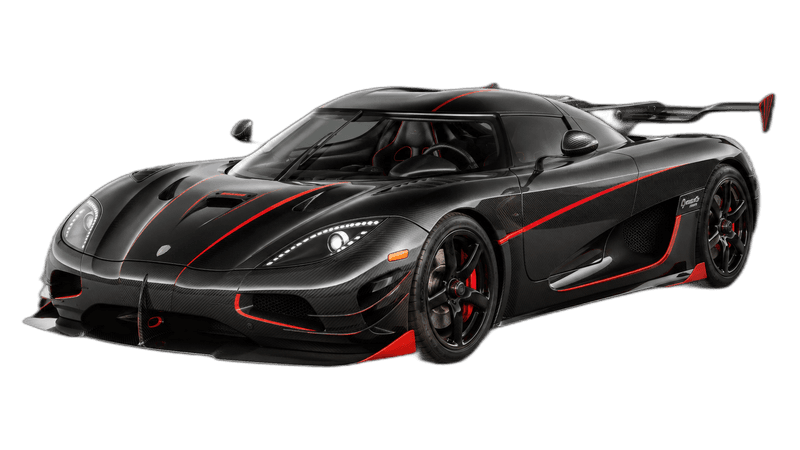
Koenigsegg Agera RS
£2,500,000
usadoIndicative market price, updated periodically.
1160cv
Potencia
3s
0-100 km/h
447km/h
Velocidad Máxima
£2,500,000
Precio Usado
Cómo empuja.
La fuerza g máxima en el instante en que pisas a fondo, estimada a partir del 0–100 y la tracción del coche.
Koenigsegg Agera RSG de salida estimada a partir del 0–100 y la tracción: una aproximación honesta, no una cifra medida.
The Koenigsegg Agera RS is a 2-seat coupé with removable hardtop by Koenigsegg, with 1160 bhp, 1280 Nm of torque, a 0-100 km/h time of 3 seconds and a top speed of 447 km/h. Indicative used value: approximately £2,500,000. Actual values vary with specification, condition and history.
Dream Car Garage Editorial · Edited by José Teo Lorente Vallecillos · Last updated 2 November 2026
Visión General
We have not driven this car. This review is based on published specifications and the sources listed below.
Scope of this guide
This guide is scoped to the Koenigsegg Agera RS, the 2015 to 2018 car that Koenigsegg describes as handcrafted in only 25 examples: a two-seat, mid-engine, rear-wheel drive coupe with a detachable hardtop and the 5.0L twin-turbocharged V8 petrol (5065 cc) engine in its standard petrol tune. It is not a guide to the earlier Agera R, which has its own entry in our catalogue and differs in build years, build count and power rating. It is also not a guide to the Agera S, the One:1, or the three-car Agera Final series that Wikipedia says paired the RS chassis with the One:1 engine. We also say below where the optional 1 MW (E85) car differs, so that you can tell which rating an advert really describes.
We have not driven this model for this article. Everything here comes from three cited sources: Koenigsegg's Agera RS model page and its technical specifications page, PistonHeads' report on the November 2017 speed record (Nic Cackett, 6 November 2017), and the government recall checker. We also read a second PistonHeads item on the end of RS production (Dafydd Wood, 5 April 2018), a Consumer Guide report on the Agera RS1 from the 2017 New York show, and the Wikipedia article on the Agera, and we flag every point that rests on them. Where sources disagree we say so rather than pick a winner quietly. Prices are not given, because none of our sources gives a reliable one.
The figures at a glance
- Engine: 5.0L twin-turbocharged V8 petrol (5065 cc), aluminium, four valves per cylinder, double overhead camshafts and dry-sump lubrication. Koenigsegg prints 5.0L with a bore of 92 mm and a stroke of 95.25 mm. We calculated 5065 cc from those two numbers (eight cylinders), so treat the displacement as our arithmetic.
- Power on petrol: 1160 bhp. Koenigsegg's technical page prints 865 kW (1160 hp) at 7800 rpm with a redline at 8250 rpm. 865 kW divided by 0.7457 is 1160, so that hp is mechanical horsepower, which is the same thing as bhp. In metric horsepower it is about 1176 PS (1160 x 1.01387).
- Power on E85 (optional 1 MW car): 1360 hp as Koenigsegg prints it, which is 1360 PS and about 1341 bhp (1360 x 0.98632) or 1000 kW. The unit label in the printed figure is not the same one it uses for the petrol rating, which we explain below.
- Torque: 1280 Nm at 4100 rpm on petrol, per Koenigsegg's technical page, which is about 944 lb ft by our conversion (1280 / 1.3558). PistonHeads prints 1,011 lb ft for the 1360 hp car, which is about 1371 Nm by our conversion.
- 0-100 km/h: 3.0 seconds. Koenigsegg's technical page prints "0-100 km/h (0-62 mph) 3 seconds", and we have written that as 3.0 seconds. Faster figures exist for the 1 MW car and are covered below.
- Top speed: 447 km/h, which is Koenigsegg's own two-way average of 446.97 km/h (277.87 mph) from 4 November 2017, rounded by us. It is a record claim for a particular car on a closed road, not a rating for a standard petrol car.
- Drive: rear-wheel drive and mid-engine, with a seven-speed paddle-shift gearbox and an electronic differential. PistonHeads says power goes to the rear wheels. The words mid-engine are our description of a V8 sitting behind the cabin, and none of the three cited pages uses them.
- Weight: 1295 kg dry and 1395 kg kerb, per Koenigsegg. PistonHeads prints 1,360 kg without saying which condition.
What the Agera RS was
Koenigsegg's model page presents the RS as the car with increased power and a raised rpm limit, built from 2015 to 2018, and it calls the Nevada run the still-undefeated top speed record for a homologated production car on a public road. The page also lists a detachable hardtop that stows inside the car and a usable luggage compartment. That is why we call it a two-seat coupe with a removable roof panel and not a fixed-head coupe. Koenigsegg's technical page lists 150 litres of luggage space and an 82-litre fuel tank, and a front and rear weight split of 44 per cent and 56 per cent.
Which power figure applies
Power is where an advert can mislead you, because the RS has two ratings and the maker's own pages are not consistent about them.
The model page prints 1150 BHP for petrol and 1360 BHP for the MW upgrade. The technical page prints 865 kW (1160 hp) and 1360 hp on E85 as an option. The two petrol numbers differ by ten, and we follow the technical page because its kilowatt figure lets us check the arithmetic. The 1360 figure is harder: 1360 PS is exactly 1000 kW, while 1360 mechanical horsepower would be about 1014 kW. Wikipedia prints 1,360 PS (1,000 kW; 1,341 hp) for the 1 MW option and 1,176 PS (865 kW; 1,160 hp) as standard, which matches our reading. PistonHeads prints 1,360hp for the record car and 1,160hp, or 1,360hp on E85, in its production report, without saying PS or bhp. So if an advert says 1360 hp, the safest reading is 1360 PS, about 1341 bhp, on E85 or with the MW package.
Koenigsegg's technical page also contains a performance section that lists 960 hp at 7100 rpm, a 7500 rpm redline and 1100 Nm at 4000 rpm. Those numbers look like left-over text from an earlier, lower-output Agera, and they conflict with the page's own engine section. We have not found anything that reconciles them, so we do not use them.
Performance claims
The technical page lists 0-100 km/h in 3 seconds and 0-200 km/h in 8.0 seconds. Consumer Guide's New York show report on the RS1 prints 2.8 seconds for 0-62 mph, with a reported 1360 hp, and Wikipedia's table shows about 2.9 seconds for 0-100 km/h with the 1 MW upgrade. Those figures come from a different power rating from the petrol car we scope this guide to, and at least one of them is described as reported, so we do not use them as the headline number. All of them are maker or press claims. We found no independent test of a standard petrol car.
Koenigsegg says its downforce is 485 kg at 250 km/h on the technical page, while the body text of the model page says up to 450 kg at 250 km/h, which is another small inconsistency in the maker's own material.
The 2017 Nevada record
PistonHeads reports that factory driver Niklas Lilja drove a closed 11-mile stretch of public highway in Nevada on 4 November 2017. The runs were 284.3 mph in one direction and 272 mph in the other, with a headline of 277.9 mph. In kilometres per hour that is about 457.5 and 437.7, which agrees with press reports of 457 km/h and 437 km/h for the two runs. Koenigsegg gives the two-way average as 446.97 km/h (277.87 mph) and says it was a customer-owned car. Wikipedia prints 447.2 km/h, and at least one outlet prints 447.236 km/h, so the third decimal place is not settled. PistonHeads says the in-car data was supplied by Racelogic, that there was no Guinness confirmation yet and that the car was the fastest "for now". Press reports tie the same car to a 1360 hp customer car, but we could not confirm that for the top-speed run itself. Do not assume that a standard petrol car will reach 447 km/h, or that any used car should be tested to it.
Drivetrain, brakes and tyres
The gearbox is a seven-speed paddle-shift unit with an automatic mode. The brakes are ventilated ceramic discs: 397 mm with six-piston calipers at the front and 380 mm with four-piston calipers at the rear. The standard tyres are dedicated Michelin Pilot Sport Cup 2, with Michelin Supersport as an option, in 265/35 R19 at the front and 345/30 R20 at the rear, both Y-rated. PistonHeads says the maker guarantees the Cup 2 tyres to 186 mph. We found no source on gearbox, clutch or brake wear costs, so we cannot tell you the weak points. Ask a specialist what a tyre and brake set costs and how old the tyres on the car are.
How many were built, and the named cars
Koenigsegg says 25 examples from 2015 to 2018. Wikipedia says 27 units were built, after an original plan of 25 plus two extra cars, and that the last one left the line on 4 April 2018. PistonHeads says the final RS had left the Angelholm production line in its report of 5 April 2018. We use 25 because it is the maker's number, and we say plainly that a different count exists. Wikipedia also lists named RS cars (the RS1, the Gryphon, the Phoenix and the Naraya), and says the Gryphon crashed in testing in May 2017 and again in May 2018 and was rebuilt in 2019. We did not verify those, so we pass them on as claims.
What to check before buying
Our sources contain no used buying guide and no running cost data, so this list is inference from the facts above and not a published inspection schedule.
- Confirm the chassis number with Koenigsegg and that the car is an RS, not an Agera R, S, One:1 or Final car.
- Ask which rating the car has: the petrol tune or the 1 MW (E85) option, and ask for the maker's paperwork showing it.
- Ask how the car has been fuelled, and who serviced the fuel system and engine.
- Check tyre date codes, the speed rating of any replacement and the condition of the ceramic brakes.
- Check that the detachable hardtop is present, fits and seals, and look for stone damage to the carbon body.
- Ask for the full service history from a Koenigsegg-approved specialist, and for any accident or rebuild records.
- Run the registration through the recall check described below.
Recalls and the DVSA check
We did not run the government checker, because it needs a registration number or the manufacturer, model and year, and we are not looking at a specific car. The page says the MOT history service shows unfixed safety recalls for a car with a registration number, that cars without one can be searched by manufacturer, model and year, and that non-safety recalls come from the manufacturer directly. It also says you may search for faults registered with the DVSA even where no recall exists. We found no recall notice for the RS in the sources we read, but that is not a clean bill of health. Run the registration through GOV.UK and ask a Koenigsegg specialist to confirm anything outstanding.
Verdict
The Agera RS is 1160 bhp on petrol, 1280 Nm, a claimed 3.0 seconds to 100 km/h and a record-run average of 447 km/h, rear-wheel drive and mid-engine, in a run of 25 by the maker's count. It rewards a buyer who treats the paperwork as seriously as the car, confirms the power rating and fuel, and accepts that every figure here is a maker or press claim with the caveats above. If you are shopping for one, confirm which car it really is, insist on a full specialist history and recall evidence, and use a proper inspection to decide. We have not driven it, so do not take this guide as a test.
Especificaciones
Motor
5.0L twin-turbocharged V8 petrol (5065 cc)
Cilindrada
5.1L
Potencia
1160 cv
Par Motor
1280 Nm
0-100 km/h
3s
Velocidad Máxima
447 km/h
Tracción
RWD
País
Sweden
Carrocería
2-seat coupé with removable hardtop
Años
2015–2018
Producción
25
Precio Usado
£2,500,000
Specifications are manufacturer-published figures.
Más de Koenigsegg

Destacado en Carpedia
Monza: The Temple of Speed
Autodromo Nazionale Monza has been defining outright speed since 1922. Its long straights reward horsepower above all else, yet its three chicanes and the Parabolica demand braking precision and mechanical balance. These are the fastest production cars ever recorded on the most storied circuit in motorsport.
The 25 Rarest Cars in the World by Production Numbers
The 25 rarest production and limited-run cars ranked by total units built. From one-off commissions to 40-unit production runs, these are the cars that most collectors will never even see in person.
Preguntas Frecuentes
What are the specifications of the Koenigsegg Agera RS?
The Koenigsegg Agera RS is a 2-seat coupé with removable hardtop by Koenigsegg, with 1160 bhp, 1280 Nm of torque, a 0-100 km/h time of 3 seconds and a top speed of 447 km/h. Indicative used value: approximately £2,500,000. Actual values vary with specification, condition and history.
How much does a Koenigsegg Agera RS cost?
Indicative used value: approximately £2,500,000. Actual values vary with specification, condition and history.
How many Koenigsegg Agera RS were made?
Koenigsegg produced 25 units of the Koenigsegg Agera RS.
What drivetrain does the Koenigsegg Agera RS use?
The Koenigsegg Agera RS is configured with rear-wheel drive.
What type of car is the Koenigsegg Agera RS?
The Koenigsegg Agera RS is a hypercars manufactured by Koenigsegg in Sweden. Production ran from 2015 to 2018.