
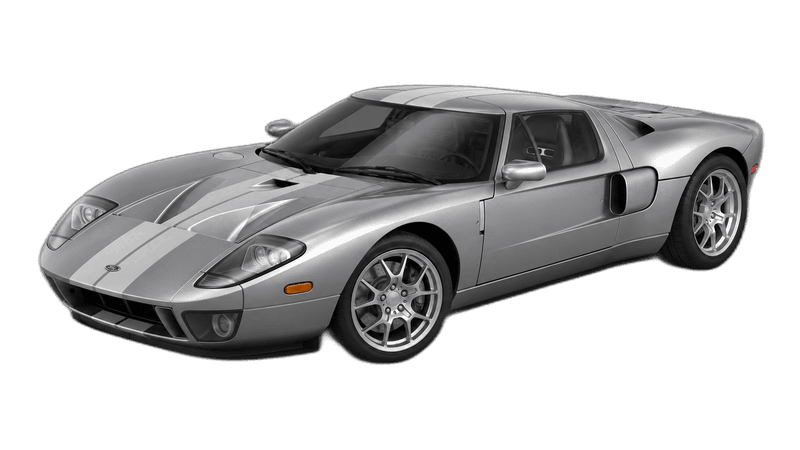
Ford GT 2017
£520,000
usadoIndicative market price, updated periodically.
647cv
Potencia
3s
0-100 km/h
348km/h
Velocidad Máxima
£520,000
Precio Usado
Cómo empuja.
La fuerza g máxima en el instante en que pisas a fondo, estimada a partir del 0–100 y la tracción del coche.
Ford GT 2017G de salida estimada a partir del 0–100 y la tracción: una aproximación honesta, no una cifra medida.
The Ford GT 2017 is a 2-door coupé by Ford, with 647 bhp, 746 Nm of torque, a 0-100 km/h time of 3 seconds and a top speed of 348 km/h. Indicative used value: approximately £520,000. Actual values vary with specification, condition and history.
Dream Car Garage Editorial · Edited by José Teo Lorente Vallecillos · Last updated 1 November 2026
Visión General
We have not driven this car. This review is based on published specifications and the sources listed below.
The end of Ford's combustion supercar era
Launched for the 2017 model year, ten years after the first modern GT ended its run, the second-generation GT was devised to celebrate the 50th anniversary of Ford's Le Mans win. Our catalogue covers the 2016-2022 car with a 3.5L twin-turbo V6 petrol, 647 bhp, 746 Nm, 0 to 100 km/h in 3.0 seconds, a 348 km/h maximum and rear-wheel drive. We have not driven this model for this article. This guide is desk-researched from the PistonHeads Ford GT used buying guide, Ford's GT technical specification material and the DVSA recall service. The numbers deserve a note. PistonHeads quotes 656 hp and 553 lb ft, a 2.8 second 0-62 mph time and a 216 mph top speed. Those figures convert to roughly 750 Nm and 348 km/h, so the torque and top speed agree with our catalogue; the power and acceleration differences reflect rounding, market declaration and test convention. The guide's 2.8 second 0-62 mph time and the catalogue's 3 seconds to 100 km/h describe the same explosive launch, and Ford announced 660 hp for the 2020 model year car with revised engine management, pistons and coils. Treat the catalogue and guide figures as describing the same car at slightly different moments.
Controversially for a Dearborn performance flagship, the engine shrank from the first GT's supercharged V8 to a twin-turbo 3.5 EcoBoost V6 sharing hardware with the Raptor F-150 unit, chosen for downsizing and to fit the GT's tightly prescribed size and shape. The result was still immense: carbon-fibre tub and bodywork, an integrated roll cage, butterfly doors, pushrod-actuated torsion bar suspension with three-mode Multimatic DSSV adaptive dampers, and a hydraulically operated system that in Track mode drops the ride height from 120 mm to 70 mm and doubles the spring rate. The Getrag seven-speed dual-clutch (DCT) transmission sits within the rear suspension, and the whole car was assembled by Multimatic. PistonHeads reports that all 1350 cars made were immediately spoken for; a final batch of 67 Mk IV special editions was scheduled for 2023 at 1.7 million dollars each, taking the total towards roughly 1,400.
Powertrain, battery care and running costs
The GT feels mechanically special. Most of the torque is available from around 3,000 to 6,000 rpm, and an anti-lag system in Sport and Track modes keeps the turbos spinning so you rarely fall into a torque trough. The gearbox shifts with real purpose, if not quite the immediacy of the best Ferrari or Porsche boxes. Reliability has so far been excellent verging on faultless, helped by tiny mileages and attentive dealers who remember the first GT's teething troubles, which included suspension control arm breakages, the odd failed head gasket and, in the UK, aftermarket immobiliser conflicts.
The one recurring issue is the battery. Few GTs are used as dailies, and a neglected battery can leave you unable to unlock or open the doors at all. The supplied trickle charger needs to be used diligently; early cars did not have a charging port in the engine compartment, and more than one owner has had a specialist fit one, with a beefed-up charger appearing on later cars. Check this on any viewing. There is a single known recall, on 2018 model year cars, to rectify a hydraulic fluid leak with the potential to cause a fire; confirm completion by VIN. A slight exhaust rattle at idle and on the overrun has also been reported. Oil services at a GT-approved dealer run to around 500 pounds, and the official combined figure of 16.8 mpg is achievable only if you dolly the car around; in fast use you will see far less.
Chassis, aero and brakes
The chassis was benchmarked against the Ferrari 458 Speciale until the McLaren 675LT appeared, at which point Ford reworked the GT to be quicker than the McLaren around its test tracks. The steering is hydraulic, which with the staggered tyre sizes makes sliding the car out of corners less daunting than its visual impact suggests. In Comfort mode the ride is usefully far from spine-punishing, though the guide notes the GT cannot quite match the best road cars for intensity and driver communication on the public highway. That is the trade for its track focus.
Braking comes from standard Brembo carbon-ceramic discs with six-piston front and four-piston rear calipers, and the force is mighty once it arrives; one vlogger reported being charged over 5,000 pounds for replacement pads, with forum posters arguing the parts should be nearer half that before labour. Original equipment tyres were Michelin Pilot Sport Cup 2s. Dropping the ride height does not lower your lap times but does sharpen the connection between your inputs and the car's responses, which an engaged driver may prefer. On the test drive, confirm the ride-height system works in all modes, check for warning lights on the suspension and hydraulic systems, and listen for the reported exhaust rattle.
Bodywork and interior
Every body panel is carbon fibre, with aluminium used for much of the structure. Eight exterior colours and various stripe options were offered, alongside a wardrobe of special series: Heritage Editions, the Competition Series, and the 15-off Carbon Series with carbon wheels, exposed carbon details, titanium wheel nuts and a polycarbonate engine cover. Options make values hard to generalise, but the direction is clear: PistonHeads reported prices had risen by at least 300,000 pounds since 2017, with used cars scarce under 700,000 pounds and a respected American valuation tool putting the average transaction near 900,000 dollars irrespective of year and mileage. A new windscreen, should you suffer stone damage, is around 2,500 pounds, cheaper than equivalent glass from some rivals, but the otherworldly headlamp internals are an unknown cost worth bearing in mind.
The cabin is where you accommodate the car, not the other way round. The moulded Sparco seats are fixed to the chassis; you set your position with the adjustable steering column and a pedal box that moves 200 mm. The luggage space behind the engine is tiny and hot, and cabin storage is essentially a phone-sized tray. The only air vents are in the doors, the crowded steering wheel makes it easy to trigger the wipers while indicating, and higher-mileage cars can show premature wear on the lower corners of the Alcantara wheel. The 10.1-inch configurable display, Sync 3 touchscreen and a GT-exclusive performance app that records video with speed, gear and GPS data are thoughtful touches, and a rear-view camera was standard, which is just as well given the width.
Rarity, provenance and the buying process
Original buyers had to apply, promise to act as brand ambassadors and agree not to flip the car for quick profit. Very few cars have exceeded 10,000 miles, and values reflect the scarcity: the guide expects a steepening upward price curve for what will never be topped on Ford's chart of combustion-engined road cars. Provenance therefore matters as much as condition. Favour cars with documented history, known ownership and the original accessories, including the battery charger. Use the DVSA service for any UK registration and confirm the 2018 model year hydraulic recall by VIN through a Ford GT specialist. Check that the seller's story matches the odometer and the condition of the pedals, wheel and seats, and commission an inspection covering the battery and charging arrangements, the hydraulic system, the dampers and carbon-ceramic brakes. The catalogue's 647 bhp, 746 Nm, 3.0 seconds and 348 km/h tell you what the car does; the buying work tells you whether the example in front of you deserves to carry the badge.
Especificaciones
Motor
3.5L twin-turbo V6 petrol
Cilindrada
3.5L
Potencia
647 cv
Par Motor
746 Nm
0-100 km/h
3s
Velocidad Máxima
348 km/h
Tracción
RWD
País
USA
Carrocería
2-door coupé
Años
2016–2022
Producción
1,350
Precio Usado
£520,000
Specifications are manufacturer-published figures.
Más de Ford

Destacado en Carpedia
Best Investment Cars to Buy in 2026
Eight cars whose combination of rarity, historical significance, and cultural resonance positions them as strong appreciation candidates in 2026 and beyond.
Dream Car Garage on a Budget: 5-Car Builds Under 500K
Four complete 5-car dream garage builds, each totalling under GBP 500,000. From track-day weapons to Italian thoroughbreds, every build uses real market prices and delivers genuine variety.
Preguntas Frecuentes
What are the specifications of the Ford GT 2017?
The Ford GT 2017 is a 2-door coupé by Ford, with 647 bhp, 746 Nm of torque, a 0-100 km/h time of 3 seconds and a top speed of 348 km/h. Indicative used value: approximately £520,000. Actual values vary with specification, condition and history.
How much does a Ford GT 2017 cost?
Indicative used value: approximately £520,000. Actual values vary with specification, condition and history.
How many Ford GT 2017 were made?
Ford produced 1,350 units of the Ford GT 2017.
What drivetrain does the Ford GT 2017 use?
The Ford GT 2017 is configured with rear-wheel drive.
What type of car is the Ford GT 2017?
The Ford GT 2017 is a supercars manufactured by Ford in USA. Production ran from 2016 to 2022.