
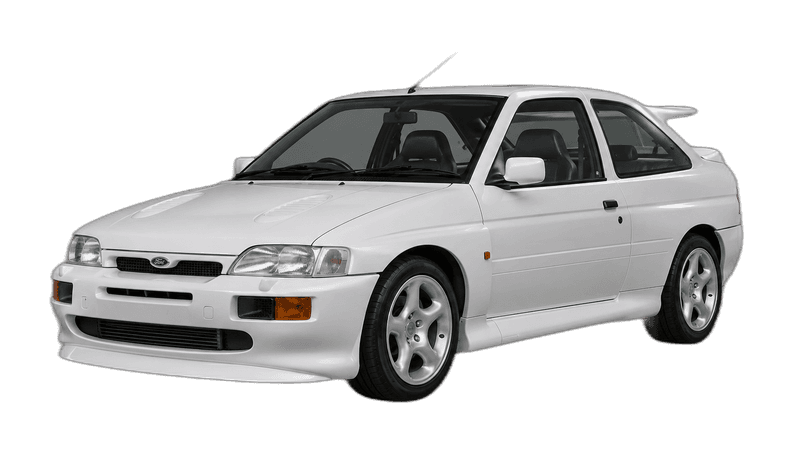
Ford Escort RS Cosworth
£65,000
usedIndicative market price, updated periodically.
227bhp
Power
5.7s
0-100 km/h
237km/h
Top Speed
£65,000
Price Used
How hard it pulls.
Peak g-force the instant you bury the throttle, estimated from the car's 0–100 time and drivetrain.
Ford Escort RS CosworthEstimated peak launch g from the 0–100 time and drivetrain: an honest approximation, not a measured figure.
The Ford Escort RS Cosworth is a 3-door hatchback by Ford, with 227 bhp, 304 Nm of torque, a 0-100 km/h time of 5.7 seconds and a top speed of 237 km/h. Indicative used value: approximately £65,000. Actual values vary with specification, condition and history.
Dream Car Garage Editorial · Edited by José Teo Lorente Vallecillos · Last updated 30 October 2026
Overview
We have not driven this car. This review is based on published specifications and the sources listed below.
The Escort RS Cosworth was built for a focused job
The Ford Escort RS Cosworth takes the familiar Escort shape and turns it into a turbocharged, all-wheel-drive homologation machine. Our catalogue uses the 1992–1996 production run: a 1993 cc Cosworth YBT turbo inline-4 with 227 bhp, 304 Nm, 0 to 100 km/h in 5.7 seconds and a 237 km/h maximum, with all-wheel drive. We have not driven this model for this article. This is a desk-researched ownership guide using RM Sotheby's auction research, the PistonHeads Escort RS Cosworth used buying guide and the DVSA recall service. Their evidence should shape a specialist inspection.
The scope needs care because the model was not one uniform car. PistonHeads separates the first 2,500 homologation cars with the larger Garrett T3/T04 turbo and 227 hp from the later 4,500 cars with the smaller T25 turbo, 220 hp and an improved inlet and oil system. RM Sotheby's confirms a total of 7,145 cars built at Karmann Rheine between 1992 and 1996, while also recording a factory rating of 224 bhp for an early June 1992 YBT car. Those figures are close, but they are not identical. Treat 227 bhp as the catalogue anchor for the early car, then verify the engine, turbo and build phase before comparing cars.
Rust and accident history can outrank the engine
The Escort RS Cosworth is old enough that the body can hide expensive problems under good paint. PistonHeads lists the usual structural areas: sills, arches, boot floor, tailgate, door bottoms, chassis legs, battery tray and floor pans. Inspect the jacking points, seam edges, underbody sealant and the areas around the rear wing and bumper mounts. A clean MOT is useful evidence of roadworthiness, but it is not a structural survey. Fresh underbody paint should be treated as a question, not reassurance, because corrosion is commonly hidden there and the model's performance reputation can distract from a tired shell.
Check panel alignment, bonnet and door gaps, headlamp surrounds, spoiler fixing points and the boot floor. The large rear wing is part of the identity, but it can also trap water and draw attention away from corrosion around its mounts. Inside, the carpets, seat mounts and pedal box area can reveal water ingress or hard use. Accident history matters because RS values are strongly affected by originality and because a poorly repaired shell will be expensive to correct later.
The turbo engine is durable only when its support systems are known
The Cosworth turbo engine is the reason the car exists, but ownership value depends on how it has been maintained. Ask for invoices covering oil changes, coolant work, fuel-pump and filter history, boost pipes, hoses, ignition parts and any turbo work. On inspection, start the car from cold and watch for smoke colour, oil leaks, unstable idle, misfire and warning lights. A small amount of condensation can be normal; persistent blue smoke under acceleration or oil around the turbo and breather system needs diagnosis.
PistonHeads also points to oil pressure and the health of the inlet and oil system, especially on early cars. The YBT blue cam cover and later YBP silver identity are useful clues, but they do not prove engine history. Ask whether the turbo is original, replacement or upgraded, and whether the ECU, injectors, intercooler and exhaust remain standard. Fast-road modifications can be well sorted, but undocumented tuning can conceal weak fuel delivery, old hoses or a tired cooling system. Check the radiator, electric fans, thermostat housing and evidence of overheating.
Gearbox, clutch and all-wheel-drive parts carry the bill
The MT75 gearbox is a known ownership point on the Escort RS Cosworth. It should select cleanly when warm, avoid jumping out of gear and show no grinding on the test route. The clutch should take up smoothly without slip or shudder. Ask about clutch, release bearing and driveshaft work, and inspect the gearbox casing for leaks. The all-wheel-drive system and rear differential should be checked for noise, fluid history and abnormal tyre wear. Because the car is powerful and turbocharged, neglect in these areas can become a four-figure bill quickly.
Brakes are another practical checkpoint. PistonHeads lists 278 mm front and 273 mm rear discs, and the calipers, hoses, fluid and pad choice should be checked by condition rather than appearance. Suspension bushes, top mounts, dampers, anti-roll-bar links and wheel bearings should be assessed on a quiet road and over low-speed bumps. A car that feels nervous under braking or darts over camber changes may need more than tyres. Tyres should be correct in size, matched across an axle and consistent with the wheels and alignment settings.
Identity and provenance are part of the mechanical check
The Escort RS Cosworth attracts replicas, modified cars and cars with mixed histories. Verify the VIN, chassis plate, engine identity, trim, wheels, spoiler, Recaro seats and dashboard details against the known factory specification. PistonHeads warns that modifications can raise output, but they can also blur originality. Ask for the history file, older MOTs, invoices and ownership trail. A lower-output later car should not be sold as an early large-turbo car, and a modified car should not be described as original without evidence.
Use the DVSA recall service to check outstanding safety campaigns, then verify manufacturer service actions through a Ford or Cosworth specialist where possible. The right car should have a consistent shell, a clear engine story, healthy gearbox and driveline, believable brakes and suspension, and documentation that explains its life. This guide combines RM Sotheby's, PistonHeads and DVSA evidence. It keeps the catalogue production total only where it is supported by the cited source.
Specifications
Engine
2.0L (1993 cc) Cosworth YBT turbo inline-4 petrol, early large-turbo
Displacement
2.0L
Power
227 bhp
Torque
304 Nm
0-100 km/h
5.7s
Top Speed
237 km/h
Drivetrain
AWD
Country
UK
Body Style
3-door hatchback
Years
1992–1996
Production
7,145
Price Used
£65,000
Specifications are manufacturer-published figures.
More from Ford
Frequently Asked Questions
What are the specifications of the Ford Escort RS Cosworth?
The Ford Escort RS Cosworth is a 3-door hatchback by Ford, with 227 bhp, 304 Nm of torque, a 0-100 km/h time of 5.7 seconds and a top speed of 237 km/h. Indicative used value: approximately £65,000. Actual values vary with specification, condition and history.
How much does a Ford Escort RS Cosworth cost?
Indicative used value: approximately £65,000. Actual values vary with specification, condition and history.
How many Ford Escort RS Cosworth were made?
Ford produced 7,145 units of the Ford Escort RS Cosworth.
What drivetrain does the Ford Escort RS Cosworth use?
The Ford Escort RS Cosworth is configured with all-wheel drive.
What type of car is the Ford Escort RS Cosworth?
The Ford Escort RS Cosworth is a hot hatches manufactured by Ford in UK. Production ran from 1992 to 1996.