
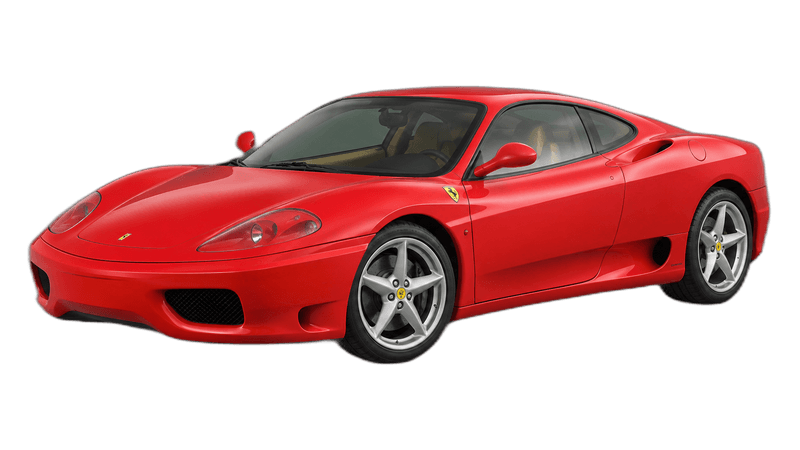
Ferrari 360 Modena
£85,000
usadoIndicative market price, updated periodically.
395cv
Potencia
4.5s
0-100 km/h
295km/h
Velocidad Máxima
£85,000
Precio Usado
The Ferrari 360 Modena produces 395 bhp, reaches 100 km/h in 4.5 seconds and has a top speed of 295 km/h. A representative example is worth about £85,000.
Cómo empuja.
La fuerza g máxima en el instante en que pisas a fondo, estimada a partir del 0–100 y la tracción del coche.
Ferrari 360 ModenaG de salida estimada a partir del 0–100 y la tracción: una aproximación honesta, no una cifra medida.
Dream Car Garage Editorial · Edited by José Teo Lorente Vallecillos · Last updated 2 November 2026
Visión General
We have not driven this car. This review is based on published specifications and the sources listed below.
A mid-engined V8 berlinetta from Maranello
The Ferrari 360 Modena covered here is the rear-wheel drive, two-seat berlinetta with a mid-mounted 3.6-litre V8 and a choice of six-speed manual or F1 paddle-shift gearbox. Ferrari presented it at the Geneva motor show in March 1999 as the successor to the F355, and built it until 2004. Our catalogue lists a 3.6L V8 naturally aspirated engine of 3,586 cc producing 395 bhp and 373 Nm, with 0 to 100 km/h in 4.5 seconds and a top speed of about 295 km/h. We have not driven this model for this article. This is a desk-researched ownership guide built from Ferrari's own 1999 press releases as reproduced on the Mitorosso Ferrari Online Magazine, the PistonHeads Ferrari 360 buying guide from May 2013 and its Powertrain, Rolling Chassis, Body and Interior pages, and the government recall check. We also read the Hagerty UK buying guide of October 2022 and the evo history, specs and buying guide of August 2020, and name them where we use them.
Ferrari's own website refused our automated request with an access error, and we did not try to get round it, so the manufacturer material here comes from a fan magazine that reprints the company's releases with a Ferrari copyright notice. That makes it a secondary copy of the original text. We could not check it against the company's own pages, so treat the figures as Ferrari's published claims as reproduced, not as figures we confirmed ourselves.
This guide is scoped to the Ferrari 360 Modena berlinetta. The 360 Spider and the Challenge Stradale are separate models with their own figures and issues, and we say where they differ in the section below. The sources are mostly buying advice from 2013 and earlier, so condition, prices and which faults are common today may have moved on. Where a source is silent we say so rather than invent a fault.
Checking the figures
Ferrari's release for the Modena gives 400 hp at 8,500 rpm and 373 Nm at 4,750 rpm. The 400 is a metric horsepower (PS) figure, and converting it gives about 395 bhp, which is what we list. Hagerty prints 395 bhp and evo prints 394 bhp, so the sources agree once the unit is allowed for. An advert that says 400 bhp has taken the metric figure and written the wrong unit. The torque figure of 373 Nm is the same as the 275 lb ft that PistonHeads and evo print.
The 4.5 seconds is Ferrari's 0 to 100 km/h figure, and PistonHeads and evo print the same time to 62 mph. Ferrari's release also gives 22.9 seconds for 0 to 1,000 metres and a Fiorano lap of 1 minute 30 seconds. Top speed is stated as approximately 295 km/h in the release, and PistonHeads, Hagerty and evo give 183 or 184 mph, which is about the same. Treat it as a manufacturer claim, not a figure we have measured.
Ferrari quotes a weight of about 1,390 kg with a 43 to 57 front to rear split, and evo gives the same kerb weight. The release lists 4,477 mm in length, 1,922 mm in width, 1,214 mm in height and a 2,600 mm wheelbase. Those are useful for a tight garage. The car was not built with a published production count that we could verify, so we do not quote one. One unofficial table on the Mitorosso page says about 8,800 cars were built, but it has no attribution, so we have not used it.
The Spider, the Challenge Stradale and other versions
Do not mix this car up with its siblings. PistonHeads lists the Spider as launched in 2000 and the Challenge Stradale in 2003. The Spider has a folding fabric roof, which PistonHeads says can stretch with age, and Hagerty says the hydraulic motor that raises and lowers the roof can leak. Neither is an issue on a berlinetta, so a Spider quote is not a guide to a coupé.
The Challenge Stradale is the road-going track special. PistonHeads gives it 425 hp, a 0 to 62 mph time of 4.2 seconds, 186 mph, a weight saving of about 110 kg and a higher 11.2 to 1 compression ratio, and says it was built only with the F1 gearbox and with carbon-ceramic brakes. If an advert carries those numbers, it is not describing a Modena. The Modena's own compression ratio, from Ferrari's release, is 11 to 1.
Ferrari's 1999 release said the 360 would replace the F355 over about six months, with the F355 Spider continuing for a while, so early advertising for the two overlaps. Check that the badge, chassis plate and paperwork all say 360 Modena.
Engine, cambelt and service
Ferrari's release describes a 90-degree V8 with a bore of 85 mm and a stroke of 79 mm, five valves per cylinder, variable valve timing on the exhaust camshafts, a variable-length intake, dry-sump lubrication and Bosch Motronic ME 7.3 drive-by-wire engine management. The engine is called the F131B in the release. The release describes an aluminium chassis, with a body designed by Pininfarina and built by Scaglietti.
The belt is the headline service item. PistonHeads, Hagerty and evo all say the 360 cambelts can be changed without removing the engine and PistonHeads says this is unlike the F355, so ask why if a quote includes engine removal. The sources disagree on the interval. PistonHeads says every four years, Hagerty says every three to five years, and Hagerty says the job is done through a service panel at the rear bulkhead. Use the shorter figure as the cautious reading, and ask for the date of the last belt change, not just the mileage.
Other engine points from PistonHeads are a tappet rattle when the engine is cold, oil leaks from the cam covers and the crankshaft seal, a worn engine mount, and the need for a battery charger because the car should not be jump started. PistonHeads also says the car can go into a safe mode in cold weather, at roughly 7 degrees Celsius or lower, so a car that has been stored may behave oddly on a cold start. Hagerty says the variators on cars built up to 2001 were a weak point and that the exhaust manifolds can crack, and evo says there was a variator recall, so ask for evidence of the work. We take the variators to be the variable valve timing units named in Ferrari's release, but none of our sources says so directly.
PistonHeads gives a routine service every 6,000 miles with a major service at 18,000 miles. Ask a Ferrari specialist to confirm the schedule for the specific car, and ask for invoices that show each visit.
Manual or F1 gearbox
Ferrari's release says the 360 came with a six-speed manual or the second generation of its F1 gearbox, and that a limited-slip differential and a hydraulic single-plate clutch are fitted. PistonHeads says manual cars are about 30 percent of production. Both Hagerty and evo prefer the manual coupé, but manuals are the minority, so most used examples you see will have the F1 gearbox.
The F1 gearbox is where the biggest running cost sits. PistonHeads gives a single-plate clutch life of about 30,000 miles, and says F1 cars used in town traffic wear clutches sooner. Hagerty gives up to 30,000 miles and says the F1 hydraulic actuators can fail. evo is more cautious, with about 20,000 miles for a manual and 15,000 for an F1. That is a wide spread, so the honest reading is that a clutch is a service item that will need doing, and the figure depends on how the car was used. Ask whether the clutch wear has been read with a diagnostic tool and when the clutch was last replaced.
PistonHeads adds that many early F1 cars got the Challenge Stradale software, so ask if the car has it and what was changed. On the manual, PistonHeads says a notchy third to second change is a sign of linkage wear. Drive any car both cold and warm, and be wary of one that has had its clutch replaced recently with no records.
Chassis, brakes and wheels
Ferrari's release lists double wishbone suspension at each end with coil springs, anti-roll bars and Sachs electronically controlled dampers. PistonHeads calls these CDC dampers and says they have Normal and Sport settings, so test both and check the dashboard shows no fault. PistonHeads says the ball joints are a service item, and evo says the same, so ask when they were last replaced.
The brakes in Ferrari's release are Brembo 330 mm cross-drilled ventilated discs with four-piston calipers, and PistonHeads confirms steel discs of 330 mm on the Modena, with carbon-ceramic only on the Challenge Stradale. The release lists Bosch 5.3 ABS and traction control with Normal, Sport and Off modes. Standard tyres were 215/45 ZR18 at the front and 275/40 ZR18 at the rear. PistonHeads says 19-inch wheels ride worse and can rub, so check the tyre size and look at the arches for signs of rubbing. Inspect the wheels for kerb damage and the tyres for age as well as tread.
Body, corrosion and interior
PistonHeads says the aluminium monocoque has riveted panels and can suffer corrosion, with bubbling and a white powder around the front bulkhead and the windscreen frame. evo adds that bubbling can appear around the front side repeaters and the nose welds. Aluminium corrosion can be hard to see, so a specialist inspection with the car on a lift is worth the cost. Also look for signs of past accident damage, as a repair to a bonded and riveted aluminium shell needs the right workshop.
For the interior, PistonHeads mentions wear to the seat bolsters, weak door handles and a key set made up of two black keys and one red master key. Check you get all three. We did not find a source on the electrical systems beyond the cold-weather and battery notes above, so test the windows, locks, climate control and every dashboard warning light on a long drive.
Recalls and history
None of our sources gives a full recall list. evo says to check the chassis number with a main dealer for the variator recall. Enter the registration in the DVSA recall service, and ask the seller for dealer paperwork showing any open work was completed. Ask for a full service history, proof of each cambelt change, clutch replacement records, any accident repair record, and a list of what has been changed. Hagerty says cars built up to 2001 are most exposed to the variator problem, so the build year matters when you read the history.
Buying decision
Our reading of the sources is that the 360 Modena is a car to buy on history, not on its looks or its cost. Both Hagerty and evo prefer a manual coupé, and evo's figures give the F1 car the shorter clutch life. Prefer a car with a documented service history, a cambelt change within the recommended window, a clutch with a known age and wear, working dampers, no sign of corrosion around the bulkhead and windscreen frame, and a recall check that comes back clean. Compare current adverts for prices, and check the paperwork on any that quote 400 bhp, a Spider or Challenge Stradale figure, or an engine-out service price, because they may not describe the berlinetta you are looking at.
Especificaciones
| Motor | 3.6L V8 naturally aspirated |
|---|---|
| Cilindrada | 3.6L |
| Potencia | 395 cv |
| Par Motor | 373 Nm |
| 0-100 km/h | 4.5s |
| Velocidad Máxima | 295 km/h |
| Tracción | RWD |
| País | Italy |
| Carrocería | 2-door berlinetta (2-seat coupé) |
| Años | 1999–2004 |
| Precio Usado | £85,000 |
Specifications are manufacturer-published figures.
Preguntas Frecuentes
What is a Ferrari 360 Modena worth?
A representative example is worth about £85,000. Actual values vary with specification, condition and history.
How much power does the Ferrari 360 Modena have?
The Ferrari 360 Modena produces 395 bhp and 373 Nm of torque.
How fast is the Ferrari 360 Modena from 0 to 100 km/h?
The Ferrari 360 Modena accelerates from 0 to 100 km/h in 4.5 seconds.
What is the top speed of the Ferrari 360 Modena?
The Ferrari 360 Modena has a top speed of 295 km/h.
What engine does the Ferrari 360 Modena have?
The Ferrari 360 Modena uses a 3.6L V8 naturally aspirated.
When was the Ferrari 360 Modena built?
The Ferrari 360 Modena was built from 1999 to 2004.
Is the Ferrari 360 Modena all-wheel drive?
No. The Ferrari 360 Modena is configured with rear-wheel drive.
Más de Ferrari
Destacado en Carpedia
Best Supercars Under €200,000 in 2026
Eight legitimate supercars available for under €200,000 in 2026, including a Gallardo, two McLarens, and the car that rewrote the performance rulebook in 2007.
Dream Car Garage on a Budget: 5-Car Builds Under 500K
Four complete 5-car dream garage builds, each totalling under GBP 500,000. From track-day weapons to Italian thoroughbreds, every build uses real market prices and delivers genuine variety.