
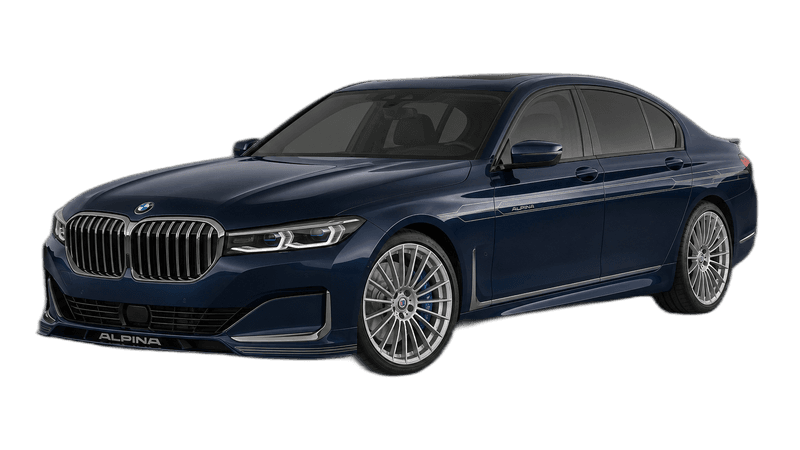
BMW Alpina B7 (G12)
£72,000
usadoIndicative market price, updated periodically.
600cv
Potencia
3.6s
0-100 km/h
330km/h
Velocidad Máxima
£72,000
Precio Usado
Cómo empuja.
La fuerza g máxima en el instante en que pisas a fondo, estimada a partir del 0–100 y la tracción del coche.
BMW Alpina B7 (G12)G de salida estimada a partir del 0–100 y la tracción: una aproximación honesta, no una cifra medida.
The BMW Alpina B7 (G12) is a 4/5 seater sedan/saloon by BMW, with 600 bhp, 800 Nm of torque, a 0-100 km/h time of 3.6 seconds and a top speed of 330 km/h. Indicative used value: approximately £72,000. Actual values vary with specification, condition and history.
Dream Car Garage Editorial · Edited by José Teo Lorente Vallecillos · Last updated 2 November 2026
Visión General
We have not driven this car. This review is based on published specifications and the sources listed below.
Scope of this guide
This guide is scoped to the 2019-on facelift Alpina B7 xDrive (G12) long-wheelbase saloon, powered by the 4.4L twin-turbo V8 petrol engine and driving all four wheels. It is not a guide to the standard BMW 7 Series it is built from, to the short-wheelbase G11, or to any later Alpina such as the XB7 or the B8. Where the 2016 to 2018 B7 differs from the facelift car we say so, so you can tell which one an advert is describing.
We have not driven this model for this article. The specification figures come from a German magazine data page for the facelift car, a PistonHeads article about a facelift example, and the government recall checker. We also read other pages, named in the text where we use them, to cross-check a figure or to establish the end of production. Where those pages disagree, or where a number in our catalogue could not be matched word for word, we say so.
A note on sources
Alpina's own website no longer carries the car. The BMW press release PDF for the launch refused our request, and we did not try to get round that. The first source listed below is therefore a magazine that prints the manufacturer's figures in metric units, not a manufacturer page. Please read every number here as a published claim and not as a measurement.
The figures at a glance
- Engine: 4.4L twin-turbo V8 petrol, 4,395 cc.
- Power: 608 PS (447 kW) according to the German data page, which is 600 bhp after conversion (608 x 0.9863).
- Torque: 800 Nm, available from 2,000 rpm, about 590 lb ft.
- Gearbox: eight-speed automatic by ZF, with Alpina-specific software.
- Drive: all-wheel drive, a rear-biased BMW xDrive system.
- 0-100 km/h: 3.6 seconds.
- Top speed: 330 km/h.
- Body: long-wheelbase four-door saloon, with a four or five seat layout.
- Weight: 2.1 tonnes according to the German page, 2,175 kg according to evo.
- Production: 2019 to 2022 for this facelift car, with the end date explained below.
Why the power figure needs care
The most common mistake with this car is the unit. The 608 figure is metric horsepower, PS. A British brake horsepower figure is about 1.4 per cent lower, so 608 PS converts to roughly 600 bhp. evo printed 599bhp when it covered the launch, and the manufacturer's American material, which we saw only quoted in search summaries, gave a round 600 hp. PistonHeads prints 608hp, which is the PS number carrying an hp label and not a more powerful engine.
Our own production catalogue previously carried 608 as brake horsepower. That is the PS figure under the wrong label, so this guide uses 600 bhp and keeps 608 PS alongside it. Torque is simpler. Auto Bild gives 800 Nm and evo and PistonHeads give 590 lb ft, and the two agree once converted.
PistonHeads gives the peak power band as 5,500 to 6,000 rpm for the facelift car and the torque plateau as 2,000 to 5,000 rpm. A separate PistonHeads article about a 2016 car gives 600hp at 5,750 to 6,250 rpm and 590 lb ft from 3,000 rpm. That matches Auto Bild's statement that the facelift torque arrives 1,000 rpm earlier than before.
Performance claims and what they mean
Auto Bild lists 3.6 seconds for 0-100 km/h, 11.9 seconds to 200 km/h and a top speed of 330 km/h. evo, covering the launch, quotes 3.6 seconds for 0-62 mph, 11.9 seconds to 124 mph and 205 mph. Because 62 mph is almost exactly 100 km/h and 124 mph is almost exactly 200 km/h, these are the same claim stated in two sets of units. PistonHeads says 3.6 seconds and 206 mph, which is about 331 km/h and therefore consistent with 330 km/h once you allow for rounding.
None of these is a measured figure from our team. evo itself calls them claimed performance figures without naming the source, and the 330 km/h top speed is a manufacturer claim that depends on conditions most owners will never meet. Treat 3.6 seconds and 330 km/h as the published ratings for the car and not as a promise about any particular example.
evo also compares the car with its rival from BMW's own range. It says the B7 had 22 bhp more than the BMW M760Li, was 120 kg lighter, and reached 62 mph in 3.6 seconds against 3.8 seconds for the M760Li. It also puts the standard 750i at 522 bhp, which is the engine Alpina starts from.
Which years this guide covers
The long-wheelbase G12 B7 first arrived in 2016, and the facelifted car was shown at the Geneva motor show in March 2019. Our catalogue row begins in 2019, so this guide covers the facelift car and not the 2016 to 2018 version. Auto Bild's data page is dated 16 August 2019, and the PistonHeads example we read was first registered in 2020.
On the end date, PistonHeads reported on 27 September 2022 that Alpina had confirmed B7 production was wound up, and a later PistonHeads article from 2025 says Alpina ended B7 production in 2022. We therefore show 2022 as the end year. Neither article gives an exact last build date, and both come from the same publication, so treat 2022 as the best available year and not a confirmed day.
The wider Alpina story is different. BMW Group announced on 10 March 2022 that it would secure the rights to the Alpina brand without buying shares in the company. It said the current Alpina vehicle programme would be discontinued at the end of 2025, with the cooperation agreement expiring on 31 December 2025. The B7 stopped earlier than that date, because PistonHeads reports that the Dingolfing plant moved on to the new G70 7 Series, which would not get the Alpina treatment.
What changed with the facelift
The visible change is the large grille and enlarged air intakes of the facelifted 7 Series. Auto Bild notes that the grille divides opinion among BMW fans, and that the facelift was shaped with Chinese customers in mind. PistonHeads adds that Alpina fitted a slightly deeper front splitter and a quad exhaust arrangement in a redesigned rear bumper, and it describes a car on 21-inch multi-spoke wheels.
Mechanically, PistonHeads says power stayed the same before and after the facelift, but the torque band broadened so that the full 590 lb ft is available from 2,000 rpm. Alpina's work centres on engine output and delivery, according to Auto Bild: uprated pistons, bigger turbochargers, a new intercooler and revised engine management, as PistonHeads describes them, on top of the standard 4,395 cc unit.
Engine and gearbox
The engine is the same 4,395 cc twin-turbo V8 as the 750i, reworked as above. We found no engine-specific faults described in the pages we read, and PistonHeads says its article contains no reliability data. We therefore cannot list common failures with any authority. For a car of this value, a full Alpina or BMW specialist inspection is the sensible route, and we would ask for the service history, including any engine-management software updates.
The gearbox is the ZF eight-speed automatic. evo says it runs Alpina-specific software, and that the car comes with an optional Drexler locking differential with 40 per cent lock. Check whether the car in front of you has that option, because it changes the car and may not be obvious from the advert.
Drive, suspension and steering
evo describes a rear-biased xDrive all-wheel drive system, twin-axle air suspension, active integral steering at the rear axle and active anti-roll mitigation. It also describes an Alpina Sport+ mode with its own chassis calibration and a ride height 15 mm lower than the standard setting. Auto Bild confirms the adaptive air suspension and four-wheel steering, and says the reviewer found the steering takes getting used to.
One PistonHeads detail needs correcting before you rely on it. The specification panel in its 2025 article calls the car rear-wheel drive. Auto Bild and evo both describe all-wheel drive for the facelift car, and our catalogue says AWD, so we treat the panel as an error. A 2024 PistonHeads article on a 2016 car does list rear-wheel drive, so that may be what the panel template carried over.
Running costs
Auto Bild lists 11.9 litres per 100 km, 268 g/km of CO2 and the Euro 6d-Temp standard. The PistonHeads example lists 25.4 mpg and 264 g/km. Those are different cars and different test conditions, and the mpg figure converts to about 11.1 litres per 100 km, so expect real consumption to vary a lot with how you drive a car of this size and power.
We give no prices, insurance or road tax figures. Both magazines print dated prices that will have changed, and nothing we read supports an insurance estimate. PistonHeads argues that Alpinas rarely depreciate as hard as the equivalent BMW, but that is an opinion about one example, so get current quotes and valuations before you buy.
Parts, servicing and support
The BMW Group announcement says the service, parts and accessories business for the existing and legacy Alpina vehicles would continue at Buchloe in the long term, with no change to the existing aftersales cooperation. That is a statement of intent from 2022. It does not tell you what an independent garage can do, so ask the seller who has serviced the car and what they can document.
Alpina cars are built on BMW lines at Dingolfing and finished at Buchloe, according to the same announcement, so a standard BMW dealer may not hold Alpina-specific parts. This is our own reasoning from the announcement and not a statement from either company.
What to check before buying
- Confirm it is a 2019-on facelift long-wheelbase B7 xDrive, not a 2016 to 2018 car, a standard 750i or an M760Li.
- Ask for the full service history and any record of Alpina or BMW software updates.
- Check that the air suspension raises and lowers evenly and that the Sport+ mode works as described.
- Drive slowly at low speed and listen to the rear-axle steering for noise or hesitation.
- Look at the wheels and tyres for matching brands and even wear, and read the sidewalls to confirm the size.
- Check whether the car has the optional locking differential, which evo lists as an option.
- Ask whether the car has an Alpina build plate number, because PistonHeads describes one car as number 15 of its run.
- Check every warning light, screen function and driver assistance feature.
- Confirm every recall is closed, using the check below.
Recalls and the government check
We did not find a recall specific to the Alpina B7 in the pages we read, and we did not run any vehicle through the government checker, so we cannot say whether any car has an open recall. Recalls on the donor BMW 7 Series may or may not carry over to an Alpina, and we do not know how they are recorded. Ask the seller and a dealer.
The GOV.UK recall checker lets you check a car using its registration number, or its make, model and year if you do not have the registration. It covers safety recalls, and GOV.UK says the manufacturer will tell you about recalls for any other reason. It also says you must not drive a vehicle with a serious safety defect, and that you will not usually pay for the repair. Run the check before you buy and again after.
Verdict
The facelift Alpina B7 xDrive is a very fast, very large luxury saloon with an engine that most buyers will find more than adequate. Choose the right year, confirm the specification, ask for the documents and treat the 600 bhp, 800 Nm, 3.6 seconds and 330 km/h figures as published ratings, with the caveats above. We have not driven it, so use the sources and a proper specialist inspection to decide.
Especificaciones
Motor
4.4L twin-turbo V8 petrol
Cilindrada
4.4L
Potencia
600 cv
Par Motor
800 Nm
0-100 km/h
3.6s
Velocidad Máxima
330 km/h
Tracción
AWD
País
Germany
Carrocería
4/5 seater sedan/saloon
Años
2019–2022
Precio Usado
£72,000
Specifications are manufacturer-published figures.
Más de BMW
Destacado en Carpedia
Preguntas Frecuentes
What are the specifications of the BMW Alpina B7 (G12)?
The BMW Alpina B7 (G12) is a 4/5 seater sedan/saloon by BMW, with 600 bhp, 800 Nm of torque, a 0-100 km/h time of 3.6 seconds and a top speed of 330 km/h. Indicative used value: approximately £72,000. Actual values vary with specification, condition and history.
How much does a BMW Alpina B7 (G12) cost?
Indicative used value: approximately £72,000. Actual values vary with specification, condition and history.
What drivetrain does the BMW Alpina B7 (G12) use?
The BMW Alpina B7 (G12) is configured with all-wheel drive.
What type of car is the BMW Alpina B7 (G12)?
The BMW Alpina B7 (G12) is a luxury manufactured by BMW in Germany. Production ran from 2019 to 2022.