
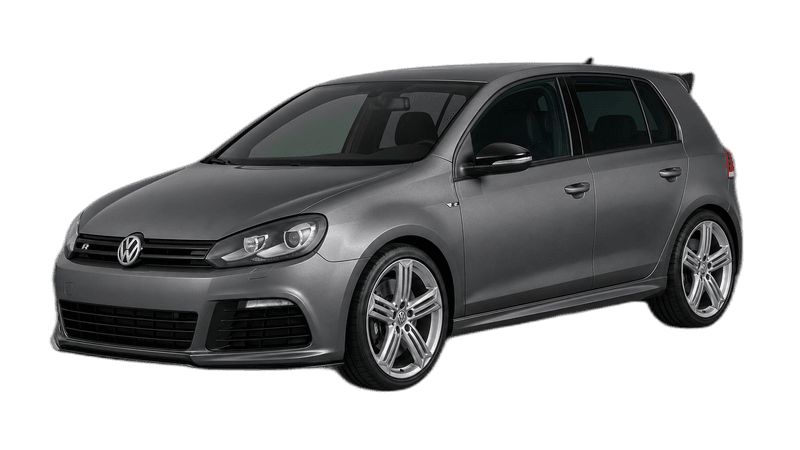
VW Golf R (Mk6)
£15,000
usedIndicative market price, updated periodically.
266bhp
Power
5.5s
0-100 km/h
250km/h
Top Speed
£15,000
Price Used
How hard it pulls.
Peak g-force the instant you bury the throttle, estimated from the car's 0–100 time and drivetrain.
VW Golf R (Mk6)Estimated peak launch g from the 0–100 time and drivetrain: an honest approximation, not a measured figure.
The VW Golf R (Mk6) is a 3/5-door hatchback by VW, with 266 bhp, 350 Nm of torque, a 0-100 km/h time of 5.5 seconds and a top speed of 250 km/h. Indicative used value: approximately £15,000. Actual values vary with specification, condition and history.
Dream Car Garage Editorial · Last updated 30 October 2026
Overview
We have not driven this car. This review is based on published specifications and the sources listed below.
The R after the R32
Volkswagen's history places an important change at the 2009 Frankfurt motor show: the Golf's highest-performance derivative moved from the R32's naturally aspirated six-cylinder to a turbocharged two-litre four-cylinder and a shorter R badge. UK sales followed in 2010. We have not driven this model for this article. This desk-researched ownership guide uses that manufacturer history for context and the PistonHeads buying guide for inspection priorities. Neither source can establish the condition of an individual car without examination.
Our catalogue represents the European hatchback with the six-speed DSG: a 1984 cc EA113 turbocharged petrol inline-four, approximately 266 bhp corresponding to 270 PS, 350 Nm, 0 to 100 km/h in 5.5 seconds and a limited 250 km/h maximum. It has all-wheel drive. The six-speed manual's quoted acceleration is 5.7 seconds. Three- and five-door hatchbacks belong to this generation, while the later R Cabriolet is a different proposition and should not be assumed to share the hatchback's driven-wheel layout.
An R engine is not the ordinary Mk6 GTI engine
The EA113 distinction matters because the normal Mk6 GTI uses EA888 architecture. Do not apply a standard GTI's timing-chain discussion to this R and assume it settles the service requirements. Ask a Volkswagen specialist to identify the engine and any modifications, then confirm the appropriate cambelt schedule and the work already completed. The R's more powerful specification is not simply a normal Mk6 GTI with another badge and four exhaust tips.
Look for the original build information and a coherent record of any turbocharger, intake, exhaust or software changes. A modified example is not automatically unsuitable, but it requires an inspection based on its actual hardware. Claimed power and a tuning-stage name do not establish reliability, emissions compliance or insurance suitability. A return to factory-looking parts also cannot prove that the car has spent its whole life at the catalogue's original output.
Belt evidence and fuel-pump follower condition
PistonHeads highlights cambelt servicing and the high-pressure fuel pump's cam follower. Obtain dated invoices identifying the belt kit, tensioners and associated water-pump work where performed. Ask the specialist to confirm what is due now under the correct schedule, rather than relying on an interval copied from an older article. Low mileage and a clean engine bay do not establish the age or condition of concealed service parts.
The follower is a specific mechanical inspection point, not a reason to order a pump without diagnosis. Ask about evidence of follower wear, related cam damage and the condition of the pump. A small replacement component can be part of a sensible service history, but the invoice should explain whether it was preventive work or a response to damage. That distinction helps the buyer understand what has been checked and what remains uncertain.
Running symptoms need diagnosis, not folklore
The buying guide discusses coolant leaks around the pump and thermostat, as well as ignition, injector and diverter-valve concerns. Inspect for residue, ask about topping-up and let a specialist investigate misfires or inconsistent boost response. One symptom may have several causes. Do not buy an unresolved fault on the assumption that a cheap coil or valve will certainly repair it, particularly where the engine has been modified.
Arrange a genuinely cold start and a proper warm-up. An unfamiliar rattle should be assessed rather than labelled belt failure or harmless character from a written description. Check oil leaks and the owner's account of consumption between services. The objective is a documented diagnosis where needed, not a dramatic prediction of engine life. If the inspection identifies a warning that makes driving unsafe, follow the vehicle instructions rather than extending the test drive to see what happens.
Haldex needs more than an AWD badge
The hatchback uses a Haldex-controlled all-wheel-drive system. PistonHeads identifies the pump and corroded wiring as inspection concerns. Ask for the separate coupling-service record and have an appropriate specialist confirm that rear-drive engagement works correctly using a safe diagnostic procedure. A dashboard without warning lights does not prove that torque is reaching the rear axle when required, and an ordinary dry-road demonstration may reveal little.
Do not attempt to diagnose the system through aggressive launches or deliberately provoking wheelspin on public roads. If a fault is found, distinguish the pump, electrical supply, connections and control system before accepting a repair estimate. A receipt for Haldex fluid does not necessarily establish what additional work was performed or whether operation was checked afterwards. Keep that evidence separate from gearbox servicing, even if both appear on the same workshop visit.
DSG history or manual-clutch history
The six-speed wet-clutch DSG needs the appropriate oil and filter servicing; the PistonHeads guide quotes a mileage interval, which should be checked against the actual gearbox and current schedule. Request invoices rather than an assurance that the car was always serviced. Test take-up, reverse, gentle shifts and warm manoeuvring. A transmission that changes quickly under acceleration may still behave poorly in the low-speed conditions that matter to daily use.
A manual needs its own checks for clutch slip, dual-mass-flywheel symptoms and selection quality. The guide notes the additional demands of tuned engines. Establish the identity and reason for any clutch replacement. Neither a heavy pedal nor a new aftermarket component proves that the rest of the drivetrain has been inspected. Obtain an estimate for unresolved vibration or noise before treating it as a harmless characteristic.
The chassis and body complete the assessment
PistonHeads identifies top-mount noises, optional adaptive dampers and brake-system faults as points to investigate. Inspect all dampers for leaks and confirm the operation of any adaptive system. Check wheels for damage, tyre suitability and uneven wear. Larger optional wheels change replacement cost and comfort without making a neglected car a better example. Brake and stability warnings need diagnosis of the actual fault, not a blanket promise that resetting the system is sufficient.
Inspect the underside, panel fit and evidence of previous repairs. Check doors and carpets for trapped water or ingress and operate the equipment fitted to the individual car. Optional seats deserve examination of their mechanisms and condition, not just recognition in an advert. A tidy presentation can coexist with worn suspension or incomplete servicing, so the mechanical report should remain independent of cosmetic appeal.
A decision based on functioning systems
Use the DVSA recall service for a UK car and ask Volkswagen to check applicable campaigns against its identity. The sources do not supply a current valuation or a verified production count for this DSG hatchback specification. Obtain separate estimates for safety work, maintenance and optional improvements. A convincing Mk6 R is one with an identified EA113, understandable belt and follower records, a properly assessed gearbox and demonstrably functioning rear-drive system, rather than one resting its ownership case on the R badge alone.
Specifications
Engine
2.0L (1984 cc) EA113 turbo inline-4 petrol, European DSG
Displacement
2.0L
Power
266 bhp
Torque
350 Nm
0-100 km/h
5.5s
Top Speed
250 km/h
Drivetrain
AWD
Country
Germany
Body Style
3/5-door hatchback
Years
2010–2013
Price Used
£15,000
Specifications are manufacturer-published figures.
More from VW
Frequently Asked Questions
What are the specifications of the VW Golf R (Mk6)?
The VW Golf R (Mk6) is a 3/5-door hatchback by VW, with 266 bhp, 350 Nm of torque, a 0-100 km/h time of 5.5 seconds and a top speed of 250 km/h. Indicative used value: approximately £15,000. Actual values vary with specification, condition and history.
How much does a VW Golf R (Mk6) cost?
Indicative used value: approximately £15,000. Actual values vary with specification, condition and history.
What drivetrain does the VW Golf R (Mk6) use?
The VW Golf R (Mk6) is configured with all-wheel drive.
What type of car is the VW Golf R (Mk6)?
The VW Golf R (Mk6) is a hot hatches manufactured by VW in Germany. Production ran from 2010 to 2013.