
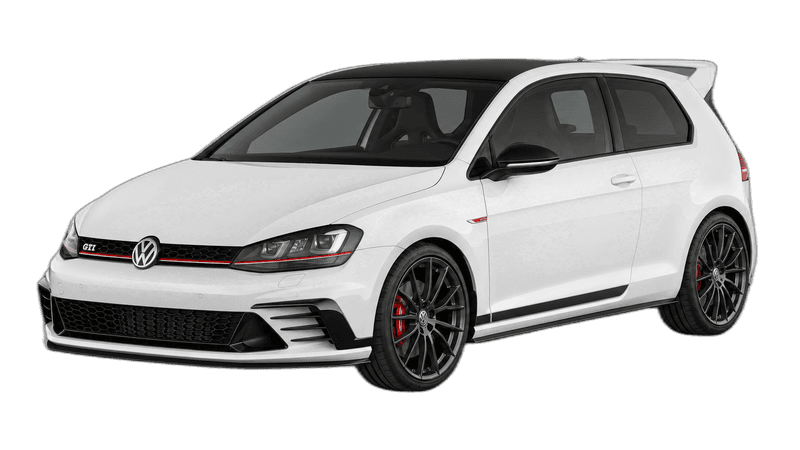
VW Golf GTI Clubsport S (Mk7)
£42,000
usedIndicative market price, updated periodically.
306bhp
Power
5.8s
0-100 km/h
265km/h
Top Speed
£42,000
Price Used
How hard it pulls.
Peak g-force the instant you bury the throttle, estimated from the car's 0–100 time and drivetrain.
VW Golf GTI Clubsport S (Mk7)Estimated peak launch g from the 0–100 time and drivetrain: an honest approximation, not a measured figure.
The VW Golf GTI Clubsport S (Mk7) is a 3-door hatchback by VW, with 306 bhp, 380 Nm of torque, a 0-100 km/h time of 5.8 seconds and a top speed of 265 km/h. Indicative used value: approximately £42,000. Actual values vary with specification, condition and history.
Dream Car Garage Editorial · Edited by José Teo Lorente Vallecillos · Last updated 2 November 2026
Overview
We have not driven this car. This review is based on published specifications and the sources listed below.
A two-seat Golf GTI built in a run of 400
This guide is scoped to the 2016 Golf VII GTI Clubsport S, the numbered, limited-edition two-seat three-door hatchback that Volkswagen built on top of the ordinary Golf GTI Clubsport. It is a front-wheel drive, manual-only car with a 2.0-litre turbocharged four-cylinder engine, semi-slick tyres and no rear seats. The standard Golf GTI Clubsport, the Golf GTI Performance and the Golf R are different cars and are covered here only where a comparison helps. The catalogue lists the engine as 2.0L turbo I4 (1984 cc), producing 306 bhp and 380 Nm, with 0 to 100 km/h in 5.8 seconds and a top speed of 265 km/h. We have not driven this model for this article. This is a desk-researched ownership guide built from Volkswagen's own German-language press release for the car, a PistonHeads used buying guide for the wider Mk7 Golf GTI range and the government recall check. The PistonHeads guide is not written about the Clubsport S, so we use it for general Mk7 checks and flag where its figures differ from Volkswagen's. We also read Volkswagen UK's September 2016 press pack as a cross-check, and where a figure comes only from that pack, such as the UK allocation, the air conditioning option or the standard Clubsport's specification, we say so.
Checking the figures
Volkswagen's German release gives 228 kW and 310 PS at 5,800 to 6,500 rpm, and 380 Nm from 1,850 to 5,700 rpm, from 1,984 cc. The 310 figure is in PS, the metric horsepower unit, not bhp. At 0.98632 bhp per PS, 310 PS is 305.8, which we round to 306 bhp, and 228 kW converts to the same figure. A listing that says 310 bhp is quoting the metric number with the wrong unit, and the difference is about four horsepower. Volkswagen's release gives 0 to 100 km/h in 5.8 seconds and a top speed of 265 km/h without a limiter, which sits between the 164 mph and 165 mph that other sources print. The UK press pack says 0 to 62 mph in 5.8 seconds and 164 mph, and 62 mph is 99.8 km/h, so we treat the two 5.8 second figures as the same claim. PistonHeads prints 5.7 seconds and 165 mph. We use Volkswagen's numbers and treat every one of these as a manufacturer claim that we have not measured.
The release also records a Nordschleife lap of 7:49.21 set by Benjamin Leuchter in spring 2016, which Volkswagen presented as a record for series-production front-wheel-drive cars at the time. PistonHeads quotes a slightly different time and says the car held the record until a later rival arrived. We did not verify either claim, and a lap time says little about how a used car feels to own, so treat it as background only. The production run is 400 cars worldwide, numbered 001/400 to 400/400 on the centre console, with about 100 allocated to Germany and 150 to the UK according to the UK press pack.
How it differs from the standard GTI Clubsport
The Clubsport S starts from the Golf GTI Clubsport, which Volkswagen built as a 40th-anniversary car. Volkswagen UK's press pack lists that car at 265 PS, with a 290 PS overboost for about ten seconds, 0 to 62 mph in 5.9 seconds and 155 mph. It came as a three-door or five-door and with a manual or a dual-clutch gearbox. The S has 310 PS available all the time, 380 Nm, a manual gearbox only and a three-door body only. Volkswagen says the idea came out of testing the Golf GTI Performance, and the S carries engine control changes, a new fuel pump with higher flow, a stronger gearbox, firmer engine mounts and a new pendulum support between gearbox and front axle.
The weight story is easy to misread. Volkswagen quotes 1,285 kg DIN for the S, or 1,360 kg on the EU basis with driver and luggage, and says it is about 30 kg lighter than a comparably equipped Clubsport. PistonHeads gives the same 30 kg and adds roughly 15 kg more if the air conditioning is left off, and the UK pack calls air conditioning a no-cost option worth about 10 kg. The pack also prints 1,375 kg for the ordinary Clubsport, but the sources do not say that figure shares a weighing basis with the S, so do not subtract one from the other.
Engine and gearbox
The engine is the third-generation EA888 two-litre. Volkswagen lists a larger 65 mm tailpipe instead of 55 mm, retuned engine control and a pop and backfire character that is strongest in Race mode. The standard-fit front differential lock is electronically controlled and tied into the stability, electronic differential lock and XDS+ systems. The traction control also intervenes later and cuts torque less abruptly, which Volkswagen says largely removes front-wheel hop under full throttle.
For the buying checks, PistonHeads' general Mk7 guide is the best evidence available, and none of it is specific to this limited car. It reports oil consumption on the EA888 engine, a timing chain tensioner problem on the earlier Mk6 that it believes is resolved, failures of the in-tank fuel pump, and leaks from the thermostat housing and water pump. Volkswagen says the S has a different fuel pump from the ordinary car, so ask a specialist whether any general fuel-pump advice applies. Check the oil level and service history, look for coolant weeping around the front of the engine, and listen for a rough cold start. The manual clutch is a wear item, and a car that has been launched hard or used on circuits will be harder on it. Ask what has been done and by whom, and be cautious of an engine tune, because the car is already running a specific calibration.
Chassis, brakes and wheels
The Clubsport S rides on 19-inch Pretoria wheels with Michelin Sport Cup 2 semi-slick tyres in 235/35 ZR sizing, according to Volkswagen's German release. The UK press pack contradicts itself, printing 225/35 in its equipment list and 235/35 in its text, so check the tyre sidewalls on any car you view. Semi-slicks generally wear faster than ordinary tyres and give less grip when cold and wet, so look at the tread, the age codes, the condition of the shoulders and whether all four match. A set of tyres with this specification is a real running cost and it is wise to allow for it when comparing cars.
The chassis changes include an aluminium front subframe, a strut brace, more negative front camber and adaptive dampers as standard, with a Nordschleife-specific damper setting inside the Individual profile. Volkswagen describes a modified brake system for the 17-inch class, with built-up front discs that have an aluminium bell and a cast steel friction ring joined by pins so it can expand when hot, plus special pads. Check that the discs and pads are the correct parts, that the pedal is firm and that the calipers are not seized. PistonHeads warns generally about wheels damaged by kerbs, and the large alloys are worth inspecting for bends and corrosion. Test the adaptive damper modes on a drive, because a failed adaptive damper can be costly to put right.
Aerodynamics matter here as well. Volkswagen mentions a large roof spoiler, a rear diffuser and a front splitter that together nearly remove the understeer of the standard car, and PistonHeads quotes downforce of 8 kg at the front and 17 kg at the rear. Treat damaged splitters and spoilers as paint and plastic repairs that may point to a hard life on track.
Body, interior and electronics
The cabin is where the car differs most from an ordinary GTI. The rear seat system, including the centre armrest, is removed. Motorsport-style bucket seats take the front positions, with a net behind them, and the UK pack describes them as heated. Volkswagen deleted much of the insulation, the load floor, the parcel shelf, the mats and the bonnet damping, and fitted a smaller battery, which means more noise and a less refined cabin than a standard car. A numbered plaque sits on the centre console and Clubsport S badges are fitted. The release lists the colours as Tornado Red, Pure White and Deep Black with a pearl effect, black roofs on the white and red cars, and rear windows tinted 65 per cent. The hero photograph on this page shows a white car with a white roof, so do not rely on roof colour alone as proof of authenticity.
From PistonHeads' Mk7 guide, common faults include rattles and leaks around doors and sunroofs, a blanking infotainment screen that usually clears with a ten-second reset, a failing heater matrix and a flaking start and stop button. The fuel tank is small at 50 litres, which matters if you plan to use the car on track. Because many of these cars were used hard, ask for records of every service and any track days.
Recalls and history
Use the government's DVSA vehicle recall check at gov.uk with the car's registration or VIN, and ask a Volkswagen dealer to run the VIN as a second check. We found no recall specific to the Clubsport S in the sources we read, and that is not proof that none exists. Confirm the plaque number against the paperwork, then check the VIN with Volkswagen. A standard Clubsport with a decal set and wheels is not an S, and the two-seat layout, plaque and tyre fitment are the first things to verify. Ask the seller about modifications, insurance history and whether the car has been tracked, and keep the paperwork.
Buying decision
The Clubsport S is a rare, focused hot hatch, and its value depends on being genuine, original and well kept. It is not a practical Golf: it has two seats, no automatic option, a noisier cabin and tyres that need care. The checks that matter most are the numbering and VIN, the condition and age of the semi-slicks, the front brakes, the dampers, the oil level and service record, any sign of track use, and open recalls. Prefer an unmodified car with complete documentation over one with an uprated tune, and arrange an independent inspection by a Volkswagen performance specialist. If you want an everyday car, the ordinary Clubsport is easier to live with, and if you want rarity, buy the best-documented S you can find and keep it that way.
Specifications
Engine
2.0L turbo I4 (1984 cc)
Displacement
2.0L
Power
306 bhp
Torque
380 Nm
0-100 km/h
5.8s
Top Speed
265 km/h
Drivetrain
FWD
Country
Germany
Body Style
3-door hatchback
Years
2016–present
Production
400
Price Used
£42,000
Specifications are manufacturer-published figures.
More from VW
Featured in Carpedia
Frequently Asked Questions
What are the specifications of the VW Golf GTI Clubsport S (Mk7)?
The VW Golf GTI Clubsport S (Mk7) is a 3-door hatchback by VW, with 306 bhp, 380 Nm of torque, a 0-100 km/h time of 5.8 seconds and a top speed of 265 km/h. Indicative used value: approximately £42,000. Actual values vary with specification, condition and history.
How much does a VW Golf GTI Clubsport S (Mk7) cost?
Indicative used value: approximately £42,000. Actual values vary with specification, condition and history.
How many VW Golf GTI Clubsport S (Mk7) were made?
VW produced 400 units of the VW Golf GTI Clubsport S (Mk7).
What drivetrain does the VW Golf GTI Clubsport S (Mk7) use?
The VW Golf GTI Clubsport S (Mk7) is configured with front-wheel drive.
What type of car is the VW Golf GTI Clubsport S (Mk7)?
The VW Golf GTI Clubsport S (Mk7) is a hot hatches manufactured by VW in Germany. Production started in 2016.