
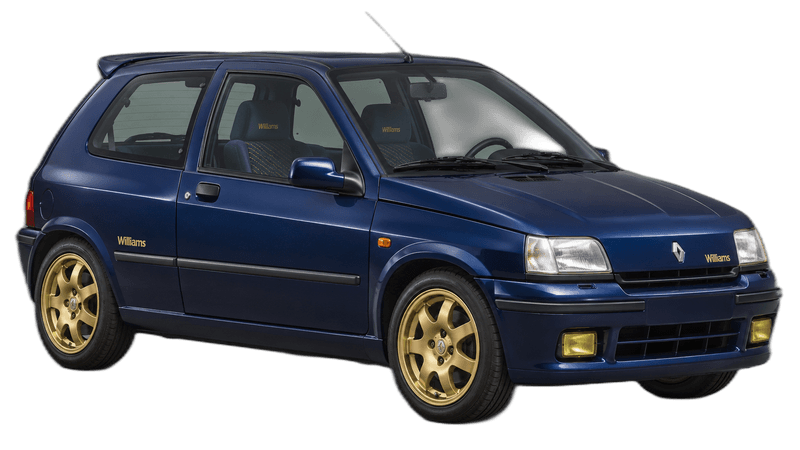
Renault Clio Williams
148bhp
Power
7.8s
0-100 km/h
215km/h
Top Speed
How hard it pulls.
Peak g-force the instant you bury the throttle, estimated from the car's 0–100 time and drivetrain.
Renault Clio WilliamsEstimated peak launch g from the 0–100 time and drivetrain: an honest approximation, not a measured figure.
The Renault Clio Williams is a 3-door hatchback by Renault, with 148 bhp, 175 Nm of torque, a 0-100 km/h time of 7.8 seconds and a top speed of 215 km/h.
Dream Car Garage Editorial · Edited by José Teo Lorente Vallecillos · Last updated 3 November 2026
Overview
We have not driven this car. This review is based on published specifications and the sources listed below.
Scope of this guide
This guide is scoped to the Renault Clio Williams, the 2.0 litre 16-valve hot hatch that Renault built from 1993 and sold in three phases until about 1996. It is a front-engine, front-wheel drive hatchback with a transverse four-cylinder engine and a five-speed manual gearbox. It is not a guide to the 1.8 litre Clio 16V that it was based on, to the later Clio Renault Sport cars with 172 or 182 PS, or to the V6 mid-engine Clio. Where we mention those cars it is only to explain what made the Williams different.
We have not driven this model for this article. We are an editorial desk that reads sources, and everything below comes from pages we opened: Wikipedia, evo, Autozine, Planète Renault, Auto-Data, the French edition of Motor1 and the Classic Trader magazine buying guide. We have not inspected, owned or tested a car. This page is for research, not a buying recommendation, and it cannot replace an inspection by a specialist who knows these cars.
The figures at a glance
- Engine: 2.0L naturally aspirated inline-four, 1,998 cc, 16 valves, double overhead camshafts, multipoint fuel injection, mounted at the front and across the car.
- Drivetrain: front-wheel drive, five-speed manual gearbox with revised ratios.
- Power: 148 bhp at 6,100 rpm. Renault quoted 150 PS. Converting 150 PS at 0.98632 gives 147.9 bhp, which rounds to 148 bhp, and evo prints 148bhp directly, so we use 148 bhp throughout.
- Torque: 175 Nm at 4,500 rpm. Planète Renault, Auto-Data and Wikipedia print 175 Nm. evo and Classic Trader print 126 lb ft, which at 1.35582 is 170.8 Nm, and Autozine prints 129 lb ft, which is 174.9 Nm. We use 175 Nm because it is the figure in the metric sources.
- 0-100 km/h: 7.8 seconds, as printed by Planète Renault and Auto-Data. The Motor1 France page prints 7.6 seconds, and we explain below why we did not use it.
- Top speed: 215 km/h. Wikipedia, Auto-Data and Motor1 print 215 km/h, and evo prints 134 mph, which at 1.60934 is 215.6 km/h. Planète Renault prints 216 km/h.
- Weight: sources disagree, from 981 kg (evo) through 990 kg (Planète Renault and Autozine) to 1,010 kg (Auto-Data) and 1,035 kg (Motor1).
- Years: 1993 to 1996 is the span we use. Production total: 12,100 cars, according to evo, Autozine and Planète Renault.
Why the car exists
The Williams name refers to the Williams Formula 1 team and its partnership with Renault. Planète Renault says the car was launched in 1993 as a limited series, built partly to celebrate Alain Prost's 1993 title with Williams-Renault, and partly because rallying homologation needed at least 2,500 road cars. Motor1 France says it was created in 1992 to celebrate the Williams-Renault constructors' title, so the sources do not agree on the exact celebration. Wikipedia says Renault planned a limited edition of three thousand eight hundred cars, which it describes as one thousand three hundred more than needed for homologation, and that those sold out so quickly that one thousand six hundred more were built.
The Clio Williams also had a brief Formula 1 link. Wikipedia says it served as the sport's Safety Car in 1996. The same page says it was, and still is, a very popular rally car.
How it differed from the Clio 16V
The engine is the main story. Autozine says the unit was derived from the 1.8 litre 16V and was bored and stroked to reach two litres, with larger valves, hotter camshafts, polished intake manifolds and a new exhaust. evo describes it as a development of the Clio 16V engine that gave 137 bhp, with a longer stroke and a bigger bore. Planète Renault gives a bore and stroke of 82.7 by 93 mm and a redline of 6,500 rpm, and Auto-Data adds a compression ratio of 10:1. Classic Trader says the Williams has about 15 bhp more than the 1.8 litre car. The engine code is given as F7R by evo, Wikipedia, Planète Renault and Auto-Data, although the Classic Trader guide uses F7P in one place and F7R in another.
The chassis was changed too. evo lists a reinforced front subframe from the Clio Cup racing car, uprated springs and dampers, rear torsion arms, thicker anti-roll bars, a stronger gearbox and a track wider by 34 mm. Planète Renault credits the wider front track to lower wishbones from the Renault 19 16S, a slightly lower ride height and specific dampers. Autozine agrees on the Renault 19 lower control arms and adds retuned steering. The wheels were 7J by 15 inch alloys finished in gold, which evo says were half an inch wider than the 16V wheels.
Sources disagree on some hardware. Planète Renault and Autozine give 185/55 VR15 tyres, and the Planète Renault page names Michelin Pilot HX, while Auto-Data prints 195/50 R15. Planète Renault says the front discs are ventilated at 259 mm and the rear discs are solid at 238 mm, while Autozine says ventilated discs all round. Auto-Data lists ABS, but evo, Autozine and Classic Trader say the first cars had none. We did not find a source that settles these points.
Performance and what the numbers mean
Planète Renault gives a 0-100 km/h time of 7.8 seconds, a top speed of 216 km/h, 15.6 seconds for the four hundred metres from a standing start and 29.0 seconds for the standing kilometre. It also lists the speeds in each gear: 55 km/h in first, 92 in second, 130 in third, 167 in fourth and 216 in fifth, which suggests the car is geared to reach its top speed in fifth. Auto-Data agrees on 7.8 seconds. Wikipedia lists 215 km/h for the Williams.
The 0-60 mph times are a different measurement and we have not relabelled any of them as 0-100 km/h. evo and Classic Trader print a claimed 7.6 seconds to 60 mph. Autozine prints 7.7 seconds in its table, which it attributes to Autocar testing, and 7.5 seconds in its text, along with 20.8 seconds to 100 mph. Auto-Data's 7.4 seconds to 60 mph is its own calculation. The Motor1 France page prints 7.6 seconds to 100 km/h with no source, and because that number is the same as the evo 0-60 mph claim we suspect the two have been mixed up, though we cannot prove it. We prefer the two sources that give a plain 7.8 seconds to 100 km/h.
evo calls its 134 mph a limited figure, and Autozine prints 130 mph in its table and 134 mph in its text. We use the 215 km/h that several metric sources print.
Three phases and how many were built
Production is where the sources disagree most. All of the following should be read as what each page says, not as a settled history.
- Williams 1 (1993): Metallic Sports Blue, number 449 according to evo and Wikipedia, with gold wheels, Williams badges, a numbered dashboard plaque and no ABS. evo says Renault had to build 2,500 road cars to qualify the car for rallying. Classic Trader says 390 were imported to the UK, and evo says the UK cost 13,275 pounds.
- Williams 2 (1994): based on the revised Clio shape. evo says it was almost identical in specification and colour and had no numbered plaque. Planète Renault says it had a facelifted front and rear, rounded rear lights, wider side skirts with 2.0 badges, electric heated mirrors and upgraded audio. Classic Trader says 482 were imported to the UK.
- Williams 3 (1995): evo says it was painted Monaco Blue, a lighter shade, and had ABS. Classic Trader adds a sunroof and says ABS was fitted only to this version, with 308 imported to the UK. Wikipedia names the colour 432 Monaco Blue and calls it slightly brighter.
Planète Renault tells a different story for the third phase. It says the third phase was an export-only run of 1,618 cars in 1995, including 500 Swiss Champion editions in Bleu Methyl with plaques numbered one to five hundred, a specific steering wheel and a Sony radio-cassette. We cannot say whether this is the same car as the Monaco Blue Williams 3 that the UK sources describe, so we treat them as related but not identical in our reading.
On totals, evo, Autozine and Planète Renault all give 12,100 cars, and Wikipedia says more than 12,000. Planète Renault splits the total as 5,417 for the first phase, 5,065 for the second and 1,618 for the third, and these add up to 12,100. Classic Trader says the first run was originally planned at three thousand eight hundred and extended to over five thousand four hundred, with the second and third phases adding another 6,700. Motor1 France says about 4,500 at first and more than 12,000 later. The totals broadly agree, while the phase splits depend on which page you read, so we give the 12,100 total and treat the split as one source's account.
What to check before buying
Classic Trader's buying guide, dated 5 March 2021, is the only page we read that gives specific inspection advice, so this section follows it and does not add anything from outside it.
- Engine: check that the three oil gauges for level, pressure and temperature work and read correctly. Noisy tappets can improve with regular oil changes, which the guide recommends every 6,000 miles or sooner if the car is used infrequently. Blue smoke under hard acceleration may mean worn rings, and white smoke may point to a head gasket problem, so look under the oil filler cap for a mayonnaise-like deposit.
- Gearbox and clutch: excessive movement or crunching when engaging gears may indicate a hard life, worn engine mounts can make changes feel sloppy, and the clutch stiffens with age.
- Suspension and steering: wheel bearings can grumble, front springs can crack and are described as expensive to replace, steering column play may mean the linkages need checking, and the power-steering pump can be noisy when the fluid is low.
- Bodywork: look for rust under the rear arches, around the footwells and around the door frames. Missing trim or poorly applied stickers may indicate a respray, and ill-fitting panels or the wrong colour for the phase may point to accident damage.
- Interior: the seats wear easily, so torn or threadbare seats suggest high mileage. Lift the blue carpets to check for damp, which can mean a faulty heater matrix or rust. Original interior trim is scarce.
- Authenticity: the guide warns of fakes and says only the first batch has the numbered plaque.
evo adds that many cars were scrapped and that plenty have since corroded past the point of no return. It also notes that the steering wheel is raked forward, which makes the top of the rim hard to reach, and that the car has more body roll than later Renault Sport cars, though it found the body well controlled.
Market and value notes
We found limited price evidence. Classic Trader says values are going up steadily and that prices across the three phases remain relatively constant, but gives no figure. Planète Renault reports that a 1994 second-phase car with 15 km on the clock sold at auction on 26 June 2022 for 75,880 euros, against an estimate of 45,000 to 60,000 euros, and gives a 1993 launch price in France of 129,500 francs, about 28,000 euros. Motor1 France says well-kept cars in France approach 30,000 euros, without a date we could pin down. We are not giving a current value, because the pages we read do not agree on one and a single auction result is not a market.
What we could not find
- A single agreed production span. Planète Renault and Motor1 France put it at 1993 to 1996, Autozine says 1993 to 1995 and Auto-Data says 1993 to 1997.
- A clear split of cars by phase. Only Planète Renault gives one, and the UK-facing pages describe the third phase differently.
- A torque figure in newton metres from a period road test. The metric pages agree on 175 Nm but we did not see a test that measured it.
- Repair costs and failure rates. The guide we read gives no figures, so we give none.
- Two further pages did not open for us. We did not try to work around either one.
- A confirmed body style. The pages we read describe a hatchback and give no door count, so we do not state one.
About the photograph
The page uses the catalogue photograph, and its credit is listed on the credits page.
Verdict
The Clio Williams is a well-documented car in outline and a messy one in detail. The headline specification is stable across the sources we read: a 2.0L naturally aspirated inline-four with 148 bhp and 175 Nm, front-wheel drive, 7.8 seconds to 100 km/h and 215 km/h flat out, built in about 12,100 cars over three phases from 1993. The phase details, production splits, brakes, tyres and weights are where the sources split, and a buyer who cares about originality should confirm each of them from the car's own paperwork and from a specialist. Treat this page as a starting point for research, not as advice to buy.
Sources
Specifications
Engine
2.0L naturally aspirated inline-four
Displacement
2.0L
Power
148 bhp
Torque
175 Nm
0-100 km/h
7.8s
Top Speed
215 km/h
Drivetrain
FWD
Country
France
Body Style
3-door hatchback
Years
1993–1996
Production
12,100
Specifications are manufacturer-published figures.
More from Renault


Frequently Asked Questions
What are the specifications of the Renault Clio Williams?
The Renault Clio Williams is a 3-door hatchback by Renault, with 148 bhp, 175 Nm of torque, a 0-100 km/h time of 7.8 seconds and a top speed of 215 km/h.
How many Renault Clio Williams were made?
Renault produced 12,100 units of the Renault Clio Williams.
What drivetrain does the Renault Clio Williams use?
The Renault Clio Williams is configured with front-wheel drive.
What type of car is the Renault Clio Williams?
The Renault Clio Williams is a hot hatches manufactured by Renault in France. Production ran from 1993 to 1996.