
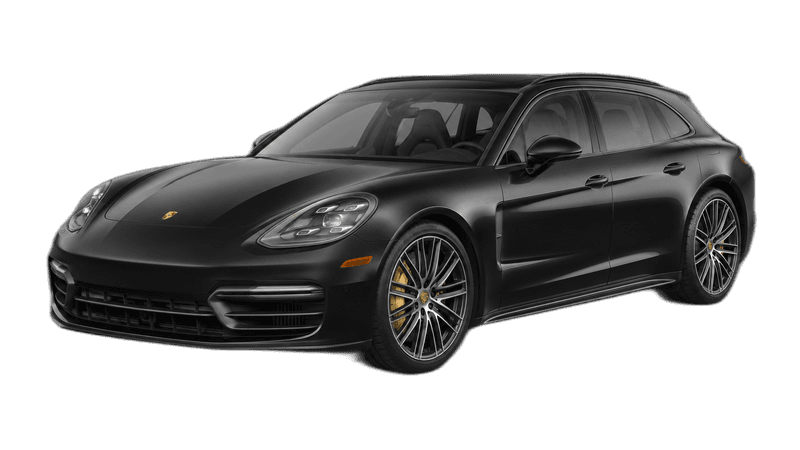
Porsche Panamera Turbo S Sport Turismo (971)
£95,000
usedIndicative market price, updated periodically.
621bhp
Power
3.1s
0-100 km/h
315km/h
Top Speed
£95,000
Price Used
How hard it pulls.
Peak g-force the instant you bury the throttle, estimated from the car's 0–100 time and drivetrain.
Porsche Panamera Turbo S Sport Turismo (971)Estimated peak launch g from the 0–100 time and drivetrain: an honest approximation, not a measured figure.
The Porsche Panamera Turbo S Sport Turismo (971) is a five-door estate/wagon (sport turismo) by Porsche, with 621 bhp, 820 Nm of torque, a 0-100 km/h time of 3.1 seconds and a top speed of 315 km/h. Indicative used value: approximately £95,000. Actual values vary with specification, condition and history.
Dream Car Garage Editorial · Last updated 2 November 2026
Overview
We have not driven this car. This review is based on published specifications and the sources listed below.
Scope of this guide
This guide is scoped to the Porsche Panamera Turbo S Sport Turismo of the second-generation 971 range, the five-door estate with the 4.0L twin-turbo V8 petrol engine, all-wheel drive and an eight-speed PDK gearbox, introduced with the 2020 update. It is not a guide to the Panamera Turbo S saloon, to the Turbo S E-Hybrid Sport Turismo (a plug-in hybrid with a different powertrain), to the 550 PS Panamera Turbo Sport Turismo that the Turbo S replaced, or to the GTS and 4S estates. Where those cars differ we say so below, because an advert that says only "Panamera Turbo S" can describe several quite different cars.
We have not driven this model for this article. Everything here comes from three cited sources: Porsche's own Turbo S facts and figures sheet on its newsroom, PistonHeads' used buying guide to the 971 Panamera (28 September 2025), and the government recall checker. We also read Porsche's German launch release of August 2020, Car Enthusiast's first drive of the Turbo S Sport Turismo (22 September 2020), a GTspirit report of the launch and the auto-data.net specification page, and we flag every point that rests on them. Where sources disagree we say so rather than pick a winner quietly. Prices are history, not valuations.
The figures at a glance
- Engine: 4.0L twin-turbo V8 petrol, 3,996 cc, with an Otto particle filter according to Porsche, mounted at the front and driving all four wheels through an eight-speed PDK dual-clutch gearbox.
- Power: 630 PS, which is 463 kW, at 6,000 rpm on Porsche's sheet. We convert that to 621 bhp (630 x 0.98632 is about 621.4), which is the figure our catalogue stores. PistonHeads prints 620 hp at 5,750 to 6,000 rpm for the same engine, a rounding of the same output. Three units are in play here, so check which one an advert uses: PS, kW or bhp are not interchangeable without conversion.
- Torque: 820 Nm from 2,300 to 4,500 rpm, as Porsche prints. PistonHeads gives 604 lb ft, which matches (820 x 0.7376 is about 605).
- 0-100 km/h: 3.1 seconds. Porsche's footnote says this is with Sport Plus selected, and the same sheet gives 2.9 seconds for 0-60 mph, 7.2 seconds to 160 km/h and 11.2 seconds to 200 km/h. PistonHeads also gives 2.9 seconds for 0-60 mph.
- Top speed: 315 km/h, from Porsche, and 196 mph from PistonHeads and Car Enthusiast, which is the same speed.
- Drive: all-wheel drive.
- Weight: Porsche's sheet says 2,080 kg empty weight to DIN, but it does not separate the saloon from the estate. auto-data.net lists 2,135 kg kerb weight for the Sport Turismo, which is a third-party figure we could not check against Porsche.
Where the quoted numbers differ
Our catalogue used to hold 3.2 seconds for 0-100 km/h. We changed it to 3.1 seconds because Porsche's sheet, Porsche's German launch release, GTspirit and auto-data.net all say 3.1 seconds, and we found no source that gives 3.2 seconds for this car. Porsche's footnote ties the figure to Sport Plus. We did not find the Sport Chrono package named in the pages we read, so we cannot tell you which option boxes a particular car needs for that time. Treat the time as a manufacturer claim for a prepared, optimally launched car, not as a promise for every used example.
Boot size also varies by source. Car Enthusiast gives 520 to 1,390 litres, PistonHeads says the Sport Turismo has a 515 litre boot against the saloon's 495 litres, and auto-data.net gives 487 to 1,356 litres. We cannot say whether this reflects seat count, measurement method or typing errors, so measure the load space yourself if it matters to you.
Years and how long it was built
We store 2020 as the start year and 2023 as the end year. Porsche revealed the updated Panamera in August 2020, and Car Enthusiast drove the Turbo S Sport Turismo in September 2020. auto-data.net gives production as 2020 to 2023. PistonHeads gives the Turbo S as 2021 to 2024 in its specification table, probably reflecting UK model years, and says the estate body was dropped when the third-generation 976 arrived for 2024. Both views agree that this is the last Panamera estate, so the range may be a year either way depending on whether you count build date, model year or registration. Our production row had no end year, and we added one.
How this car differs from the others
Porsche says the Turbo S has 80 PS more power and 50 Nm more torque than the previous Panamera Turbo. That implies 550 PS and 770 Nm for the earlier car, by our arithmetic. The Turbo S is a top-of-range petrol model with Porsche's four-litre V8, and Car Enthusiast concluded that the 971.2 range is the best large executive sports car or estate on sale while preferring the cheaper GTS Sport Turismo for its cohesion. The Turbo S E-Hybrid adds a battery and motor and is a separate car, which we have not covered. The saloon has a smaller boot, and PistonHeads says the estate is slightly more practical.
Ownership: what the sources say to check
PistonHeads' buying guide is the most useful ownership source we found. It calls the build quality sumptuous and says faults are few. Its points for the V8 estate include:
- Engine: mechanical faults are rare. One owner had low-rev stuttering in second gear fixed by an ECU recalibration, and high-pressure fuel pumps have occasionally failed.
- PDK gearbox: clutch slip is possible on older, higher-mileage cars, while healthy examples shift almost imperceptibly.
- Air suspension: on cars with 50,000 miles or more, compare ride height cold and warm, and reconsider if there is a difference.
- Brakes: the guide describes carbon ceramic discs of 420 mm at the front and 410 mm at the rear. Ask what is fitted and how worn it is before you buy.
- Electrics: wireless Apple CarPlay is standard and Android Auto is not offered. A cracked night-vision camera is very expensive to replace, and one owner reported cracked roof glass after opening the tailgate in icy weather.
Servicing is another point. PistonHeads says independent UK specialists charged 240 pounds for an annual minor service and 360 pounds for a major one on this generation. Those are guide figures from one specialist group, not Porsche list prices, and we have not seen a service plan or parts price list.
Prices as history
Car Enthusiast listed a car at 137,760 pounds as tested in 2020, and PistonHeads gives the new price as 135,600 pounds. It reports used Turbo S cars from about 90,000 pounds with 20,000 to 30,000 miles, such as a 2022 car with 23,000 miles at 89,950 pounds. It also found no Turbo S Sport Turismos for sale when it wrote the guide, which tells you this body style is hard to find. Official combined fuel use is 10.8 to 10.7 litres per 100 km with 247 to 245 g/km of CO2, according to Porsche, so budget for fuel accordingly. All of this is historical, not a current price.
What to check before buying
- Confirm the car is the V8 Turbo S Sport Turismo and not the E-Hybrid or a Turbo S saloon, using the VIN and the build sheet.
- Ask for the full service history from a Porsche centre or a specialist who has worked on the 971, and the receipts for any PDK, fuel pump or suspension work.
- Check ride height cold and warm, and inspect the air suspension and carbon ceramic brake discs if fitted.
- Test every screen, camera and driver assistance function, especially the night-vision camera.
- Check the glass, tailgate and roof for cracks.
- Ask whether any recall work has been carried out, and run the registration through the recall check described below.
Recalls and the DVSA check
We did not run the government recall checker and did not read its pages for this article. PistonHeads mentions two recalls on the 971 range: a rear seatbelt screw safety check, and moisture in the coolant pump control unit on cars built before 2021. We have not verified either against an official notice, and we found no Turbo S Sport Turismo specific recall in the sources we read. That is not a clean bill of health. Run the registration of any car you are considering yourself, and ask the seller for evidence that any open recall has been done.
About the photograph
The picture at the top of this page is from Wikimedia Commons, taken in May 2021 by Alexandre Prevot and licensed CC BY-SA 2.0. Commons files it under the Turbo S E-Hybrid Sport Turismo, so it may show the plug-in hybrid rather than the V8-only car in this guide. The estate body is shared, but we have not compared the exterior differences. We cropped and resized it, and the number plate is blank in the original, so we did not need to blur it. We use it only to show the shape.
Verdict
The car in this guide is a 621 bhp, 820 Nm, 3.1 seconds to 100 km/h and 315 km/h estate with all-wheel drive, built from 2020 until about 2023 or 2024. It is a very fast and, by PistonHeads' account, well built car with few faults, and it is the final Panamera estate. The cautions are the unit conversions, the Sport Plus condition on the 0-100 km/h time, the disagreement over boot size and end year, and the high cost of the few expensive items such as carbon ceramic brakes and the night-vision camera. We have not driven it, so use the sources and a proper inspection to decide.
Specifications
Engine
4.0L twin-turbo V8 petrol
Displacement
4.0L
Power
621 bhp
Torque
820 Nm
0-100 km/h
3.1s
Top Speed
315 km/h
Drivetrain
AWD
Country
Germany
Body Style
five-door estate/wagon (Sport Turismo)
Years
2020–2023
Price Used
£95,000
Specifications are manufacturer-published figures.
More from Porsche
Frequently Asked Questions
What are the specifications of the Porsche Panamera Turbo S Sport Turismo (971)?
The Porsche Panamera Turbo S Sport Turismo (971) is a five-door estate/wagon (sport turismo) by Porsche, with 621 bhp, 820 Nm of torque, a 0-100 km/h time of 3.1 seconds and a top speed of 315 km/h. Indicative used value: approximately £95,000. Actual values vary with specification, condition and history.
How much does a Porsche Panamera Turbo S Sport Turismo (971) cost?
Indicative used value: approximately £95,000. Actual values vary with specification, condition and history.
What drivetrain does the Porsche Panamera Turbo S Sport Turismo (971) use?
The Porsche Panamera Turbo S Sport Turismo (971) is configured with all-wheel drive.
What type of car is the Porsche Panamera Turbo S Sport Turismo (971)?
The Porsche Panamera Turbo S Sport Turismo (971) is a luxury manufactured by Porsche in Germany. Production ran from 2020 to 2023.