
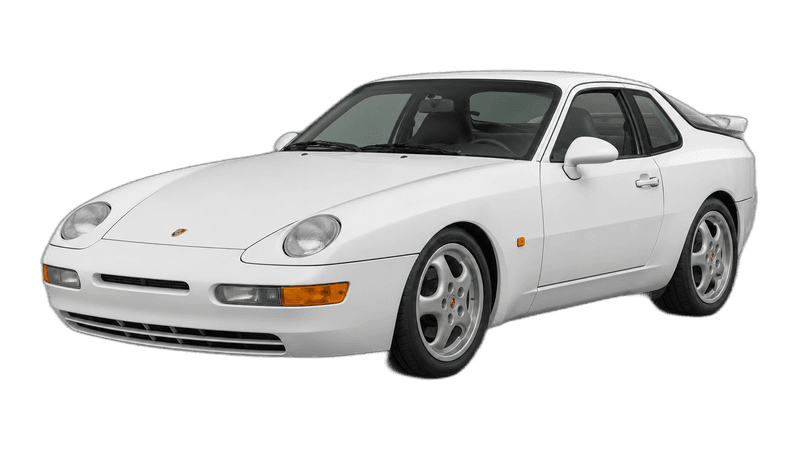
Porsche 968 Club Sport
£55,000
usedIndicative market price, updated periodically.
236bhp
Power
6.5s
0-100 km/h
252km/h
Top Speed
£55,000
Price Used
How hard it pulls.
Peak g-force the instant you bury the throttle, estimated from the car's 0–100 time and drivetrain.
Porsche 968 Club SportEstimated peak launch g from the 0–100 time and drivetrain: an honest approximation, not a measured figure.
The Porsche 968 Club Sport is a 2 seater coupe by Porsche, with 236 bhp, 305 Nm of torque, a 0-100 km/h time of 6.5 seconds and a top speed of 252 km/h. Indicative used value: approximately £55,000. Actual values vary with specification, condition and history.
Dream Car Garage Editorial · Last updated 2 November 2026
Overview
We have not driven this car. This review is based on published specifications and the sources listed below.
A lightened 968 sold as the cheaper car
The Porsche 968 Club Sport is the stripped-out version of the last four-cylinder transaxle Porsche built at Zuffenhausen, according to Porsche's own data sheet. Our catalogue lists a 3.0L inline-4 NA engine with 236 bhp (Porsche's 240 PS), 305 Nm, a six-speed manual gearbox and rear-wheel drive in a two-seat coupe. This guide is scoped to the Porsche 968 Club Sport coupe, the lightened and de-specced version that Porsche abbreviates to CS. It does not cover the standard 968 Coupe or Cabriolet, the 16 Turbo S cars that PistonHeads mentions, or the UK Sport. The UK Sport is a different car from the Club Sport, and a section below explains how.
We have not driven this model for this article. This is a desk-researched ownership guide built from a Porsche newsroom data sheet for the 968 CS Coupe, a second Porsche data sheet for the 968 CS Cabriolet, PistonHeads' 968 buying guide and the government recall check. We also queried the US NHTSA recall database. We could not read Porsche's own Club Sport feature on porsche.com because the site refused automated access, and we did not try to work around that. PistonHeads' guide dates from 2016, so we use it for mechanical and body points and not for money.
Checking the figures
Porsche's data sheets give the output as 176 kW (240 PS). A PS is a metric horsepower, and 240 PS is about 236 bhp, which is the figure we store. PistonHeads prints 240hp at 6,200rpm. An advert that says 240 bhp is using the PS number and is not describing a tuned car.
Torque is 305 Nm at 4,100 rpm on Porsche's Cabriolet sheet. PistonHeads prints 225 lb ft at 4,100rpm, which converts to about 305 Nm, so the two sources agree. The engine displaces 2,990 cc according to Porsche, with a 104 mm bore, an 88 mm stroke and an 11.0:1 compression ratio according to PistonHeads.
Both Porsche sheets give 0 to 100 km/h in 6.5 seconds and a top speed of 252 km/h. PistonHeads gives 0 to 62 mph in 6.5 seconds and 156 mph for the manual 968, and 252 km/h is about 156.6 mph, so the sources are consistent. These are manufacturer claims with no stated conditions. If a listing quotes a quicker time or a higher top speed, ask where the figure came from, because neither source we read supports it.
Porsche lists a weight of 1,320 kg. Both sheets print identical performance and weight tables even though the second one describes a single CS Cabriolet test car, so read the table as a nominal factory figure for the CS and not as a measured result for each body. The weight saving is 50 kg compared with the standard Coupe, and both Porsche and PistonHeads give that number.
Years and how many were built
Porsche's Coupe sheet says the first CS appeared in 1993 and its Cabriolet sheet says the CS joined the range from autumn 1993. PistonHeads says the Club Sport arrived in 1992. Our catalogue keeps 1993 to 1995, because Porsche says it built 1,538 CS Coupes by 1995. No source we read gives a month for the last car, so check the registration date and the chassis plate on any car you are shown.
PistonHeads says the 968 was launched in August 1991 and that only 12,776 were sold during its three-year production life. Against that total, 1,538 is roughly one car in eight. Porsche's Cabriolet sheet repeats the 1,538 figure for the lightweight car and says that only one CS Cabriolet was ever built, as a test car. Neither sheet says whether the 1,538 includes the UK Sport cars described below, so treat it as Porsche's stated total and not as a registry count.
What Porsche removed and what it fitted
Porsche says the CS is 50 kg lighter than the standard Coupe because comfort and safety equipment was left out, including airbags, central locking and electric windows. The Coupe sheet adds that the car has no rear seats and that a limited slip differential and an optimised brake system were fitted as standard. The suspension sits 20 mm lower and is tuned more firmly. Porsche says the car suited amateur racing, which is a reason to ask any seller about track use.
PistonHeads describes the deletions slightly differently. It lists electric windows, mirrors, seat adjustment and hatch release, plus the rear wiper, central locking and back seats. It does not mention airbags. It says the car has Recaro front seats, while the Porsche Coupe sheet describes plastic bucket seats of 13.6 kg each and the Cabriolet sheet describes seats from the 911 Carrera RS. The Coupe sheet also says Porsche offered manually adjustable versions of the standard seats and the electric rear lid release at no extra charge. So seats and a few small items varied. Check what a given car has against the paperwork, and do not assume a missing item is a fault.
Unlike modern Porsches, where less weight means more money, PistonHeads says the Club Sport cost less than the standard Coupe when new, and Porsche says the same of its 1993 price. PistonHeads called it the most sought-after 968 in 2016, citing its handling balance.
The UK Sport is a different car
PistonHeads says Porsche GB noticed that some buyers liked the CS's look but wanted some luxuries back, so the Sport arrived at the start of 1994. It had the same 20 mm lowered suspension as the CS but gained the electric items to make it more civilised. PistonHeads' chassis page says both the Club Sport and the Sport were lowered by 20 mm with stiffer springs and adjustable Koni dampers, and its body page says the electric mirror adjustment should be checked on all the non-Club Sport models.
That is all the sources we read say. No source we read gives a weight, a seat specification or a production number for the Sport, so we make no claim about them, and the 50 kg saving belongs to the Club Sport. In practice the two cars can look alike from the outside while being equipped differently. A car sold as a Club Sport should have the deletions that Porsche describes, such as manual windows. If an advert says Club Sport but the car has electric windows and mirrors, ask for documents that show how it left the factory.
Engine and gearbox
PistonHeads says the all-aluminium 3.0-litre engine is derived from the 944 S2 unit, with lighter pistons and con-rods, VarioCam valve timing and Motronic engine management. It calls the 16-valve water-cooled engine generally very reliable and robust, and warns that this can lead to neglect from previous owners, so the service history deserves a careful read.
The main warning concerns the cam drive. PistonHeads says the 968 does not suffer the 944's rubber-toothed timing belt problems, but says the belt that drives the exhaust camshaft can stretch beyond what the tensioner can take up. If it breaks or jumps a tooth, the valves can hit the pistons and the repair is very expensive. Its at-a-glance page asks for belts, cam chains and tensioners to have been replaced within the last four years or 40,000 miles. PistonHeads' wording moves between belts and chains, so ask a Porsche specialist exactly what this engine needs, and get dated invoices for the work. We have not priced it, because PistonHeads' figures date from 2016.
PistonHeads' other engine points are short. A vibration through the steering wheel on a test drive is probably a worn engine mount. A leaky clutch master cylinder is worth looking for. A whine from the differential can point to a worn pinion bearing, which PistonHeads calls a costly fix, and that matters on a CS because Porsche fitted a limited slip differential as standard. The gearbox is the six-speed manual that both Porsche and PistonHeads describe. We found no source that comments on gearbox wear, so a test drive and a specialist inspection do that job.
Chassis, brakes and wheels
PistonHeads describes MacPherson struts, a light lower arm and an anti-roll bar at the front. At the rear it describes light alloy semi-trailing arms, transverse torsion bars, telescopic dampers and an anti-roll bar. It calls the suspension hardwearing and unlikely to cause big bills. It adds that the aluminium lower front A-arms can crack, that replacing them is within the scope of a competent DIY mechanic and that the ball joints should be replaced at the same time. Rear suspension arms can rust, particularly on cars left standing for a long time, so look at the whole underside.
Brake calipers can separate from their back plates and need to be rebuilt, according to PistonHeads' at-a-glance page. Porsche says the CS had an optimised brake system as standard but does not describe the parts, so we cannot say what changed. Porsche's Cabriolet sheet says the CS used 17-inch wheels adopted from Cup racing. Check that a given car still has the wheel size and the lowered, firmer suspension it left with, because the point of the CS is its chassis balance.
Body, interior and electrics
PistonHeads says the 968's body is fully galvanised and that the plastic bumpers are impact absorbing, so any damage or rust is likely to come from a collision. With the bonnet up, look at the front chassis rails for kinks or creases that suggest a poor repair, and check that the hydraulic struts hold the bonnet open. Feel along the bulkhead too, because water drain holes can become blocked with leaves. The pop-up headlights are raised by power and drop under gravity, so a light stuck up probably has a seized and rusty mechanism. Lubrication cures most of them, but a rebuild is fiddly.
PistonHeads says the Club Sport is easier to inspect inside because it lacks many of the electrically operated features of the standard car, and that its heating works by cables instead of the vacuum-operated controls used elsewhere in the range, which should make it less prone to failures. Make sure the heating works. If the car has optional air conditioning, make sure it blows cold. PistonHeads says re-gassing is the easiest fix, but you should also have the system checked for leaks. The rear seats of a standard Coupe are cramped, and the CS does without them, so use the space behind the seats for luggage.
Recalls and history
Neither Porsche sheet nor the PistonHeads guide covers recalls. We queried the US NHTSA recall database for Porsche 968 model years 1993, 1994 and 1995 on 2 November 2026, and it returned no campaigns. That is not evidence that a UK car has none, because it is a US record and we have not established that the CS was sold there.
The recall check on GOV.UK is the UK route. You can enter the registration number to see safety recalls that have not been checked or fixed, and the car's MOT history. You can also check a car without the registration if you know the manufacturer, model and year of manufacture. The page does not say how far back its records go for a car this old, so treat a clear result as one input and not as a clean bill of health. Ask the seller for the MOT history, the service invoices and any documents that show whether the car is a Club Sport or a Sport.
Buying decision
PistonHeads' view is that the 968 was a strong last chapter for the transaxle line and that the Club Sport is the one to want. The reasons are balance and a lighter, simpler car, with the usual price of fewer comforts. A PistonHeads reader describes the 968's balance as forgiving, which is one owner's opinion and not a test result.
Before you buy, confirm that the car is a Club Sport and not a Sport, check the seats and the deletions against the paperwork, and ask about track use. Look for evidence of the cam drive work, listen for differential whine, inspect the front A-arms and the rear arms, and test the pop-up headlights and the heating. Run the DVSA recall check. We have not seen a used price source we could cite, so compare current listings and arrange a pre-purchase inspection by a specialist who knows the 968.
Specifications
Engine
3.0L inline-4 NA
Displacement
3.0L
Power
236 bhp
Torque
305 Nm
0-100 km/h
6.5s
Top Speed
252 km/h
Drivetrain
RWD
Country
Germany
Body Style
2 seater coupe
Years
1993–1995
Production
1,538
Price Used
£55,000
Specifications are manufacturer-published figures.
More from Porsche
Frequently Asked Questions
What are the specifications of the Porsche 968 Club Sport?
The Porsche 968 Club Sport is a 2 seater coupe by Porsche, with 236 bhp, 305 Nm of torque, a 0-100 km/h time of 6.5 seconds and a top speed of 252 km/h. Indicative used value: approximately £55,000. Actual values vary with specification, condition and history.
How much does a Porsche 968 Club Sport cost?
Indicative used value: approximately £55,000. Actual values vary with specification, condition and history.
How many Porsche 968 Club Sport were made?
Porsche produced 1,538 units of the Porsche 968 Club Sport.
What drivetrain does the Porsche 968 Club Sport use?
The Porsche 968 Club Sport is configured with rear-wheel drive.
What type of car is the Porsche 968 Club Sport?
The Porsche 968 Club Sport is a gts manufactured by Porsche in Germany. Production ran from 1993 to 1995.