
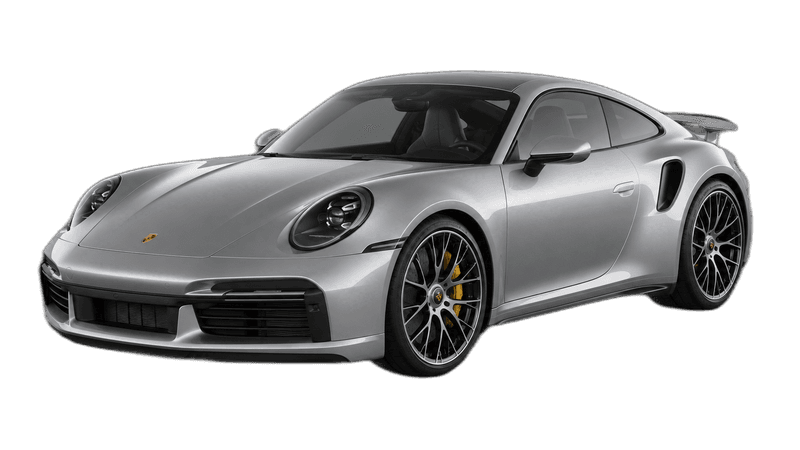
Porsche 911 Turbo (992)
£165,000
usedIndicative market price, updated periodically.
572bhp
Power
2.8s
0-100 km/h
320km/h
Top Speed
£165,000
Price Used
How hard it pulls.
Peak g-force the instant you bury the throttle, estimated from the car's 0–100 time and drivetrain.
Porsche 911 Turbo (992)Estimated peak launch g from the 0–100 time and drivetrain: an honest approximation, not a measured figure.
The Porsche 911 Turbo (992) is a 2+2 coupe / cabriolet by Porsche, with 572 bhp, 750 Nm of torque, a 0-100 km/h time of 2.8 seconds and a top speed of 320 km/h. Indicative used value: approximately £165,000. Actual values vary with specification, condition and history.
Dream Car Garage Editorial · Last updated 27 October 2026
Overview
We have not driven this car. This review is based on published specifications and the sources listed below.
The regular Turbo has its own specification
Porsche introduced the 992 Turbo coupe and Cabriolet in 2020 with 580 PS and 750 Nm from a 3,745 cc twin-turbocharged flat-six. An eight-speed PDK and all-wheel drive are standard. Porsche quoted 2.8 seconds to 100 km/h and 320 km/h. Symmetrical variable-geometry turbochargers, electrically controlled bypass valves and redesigned charge-air cooling distinguish the installation from its predecessor.
This is a desk-researched ownership guide. We have not driven this model for this article. The ordinary Turbo should not be described as a Turbo S with fewer badges. Power, standard equipment and available packages differ, and a regular Turbo can be assessed on its own merits rather than treated as an incomplete flagship.
Separate factory packages from later additions
Obtain the build record and confirm the actual equipment. Porsche offered Sports and Lightweight Design packages, a sports exhaust and a lower sports chassis on the regular Turbo. The Lightweight Design package for the coupe removes the rear seats among other changes, so a nominal 2+2 catalogue description does not describe every configured cabin. A written options list also helps distinguish a factory lightweight car from one with rear seats removed later.
PDCC and PCCB are optional on the regular Turbo, not features to assume from a Turbo S photograph. Confirm the brake system, anti-roll equipment, seat type and suspension fitted. Record any aftermarket tune, exhaust, wheels or ride-height change and ask whether the original components and software are available.
Eight-speed PDK and low-speed behaviour
The Turbo-specific eight-speed PDK is central to the ownership experience. Examine engagement, manoeuvring, ordinary shifts and manual selection cold and warm. StuttCars' 992 guide suggests investigating harsh or abnormal low-speed behaviour rather than accepting every characteristic as normal. A diagnostic assessment is more useful than a generic promise about dual-clutch transmissions.
Review service documentation, software history and any transmission-related warnings. A recent update can explain changed behaviour but does not certify the hardware. Modified power output makes the exact software and maintenance record especially important. Do not present a tuned figure as the manufacturer's original specification.
Cooling, front end and engine ancillaries
The 992's charge-air coolers sit in airflow beneath the rear lid, while the side intakes draw process air rather than serving the earlier cooling arrangement. Inspect accessible intake, undertray and cooling areas for damage, blockage or poor repairs. Review coolant condition and any leaks or overheating history with a specialist.
Front radiators, condensers and body openings remain vulnerable to debris and impact. Test air conditioning and examine the front bumper and underbody carefully. A clean visible surface does not prove the condition of concealed pipework. Investigate warning lights or running faults with scan data rather than replacing sensors on speculation.
PASM, sports chassis and rear steering
The standard PASM chassis and optional lower sports suspension offer different setups. Identify which is fitted and assess dampers, mounts, bushes, alignment and tyre wear. Rear-axle steering should operate without warnings and be checked after suspension or accident repairs. Any calibration or component fault needs specific diagnosis.
Examine wheel condition and tyre sizes, model consistency and manufacturing dates. The 992 Turbo uses mixed wheel and tyre sizes, so a matching set does not mean identical tyres at both ends. Request alignment findings where wear or modifications raise questions, and do not assume that lower always means better for the intended roads.
Active aero and body verification
Electronically controlled cooling-air flaps, the active front spoiler and the variable rear wing all require functional checks. Look for warnings, impact damage and evidence of poor repair. Inspect undertrays and mounting points as well as the visible painted surfaces. An aero component that does not move should not be dismissed as a cosmetic inconvenience.
Check structural condition, panel alignment and previous paintwork. On a Cabriolet, operate the roof and inspect drainage, seals and moisture. On a Lightweight Design coupe, verify the factory deletion of rear seats rather than treating an empty rear cabin as evidence of a later modification.
Brakes and standard-versus-optional equipment
Porsche specified larger grey cast-iron discs as standard on the regular Turbo, with PCCB optional. Inspect the system actually fitted, including disc measurements, pads, hoses and evidence of inactivity or circuit use. Ceramic discs require close specialist inspection for damage. Do not infer PCCB from calliper appearance alone if the build record or conversion history is unclear.
Check tyres, brakes and alignment together when assessing prior track use. Ask for preparation, incident and consumable records. The manufacturer's performance figures assume specified conditions and equipment; they are not an inspection result for an individual used car.
Electronics, cabin and the complete decision
Test PCM, phone integration, cameras, parking aids, seat functions and climate control. StuttCars identifies PCM software and suspension noises as useful ownership checks, but neither proves a widespread fault. Confirm that installed options work and that any electronic modifications are properly integrated.
Request a written pre-purchase inspection with separate mechanical, diagnostic and cosmetic findings. Compare a regular Turbo with other cars only after aligning equipment and body style. This guide makes no claim about future values or maintenance frequency. Buy on documented condition and suitability, not on the assumption that every optional feature or every Turbo S component is present.
How this review was compiled
Porsche's 2020 Turbo launch material and official generation history supplied the technical baseline. StuttCars' 992 guide and Romans' model comparison helped distinguish equipment and inspection questions. We did not test a car, obtain service quotes or analyse transactions. Any symptom requires individual diagnosis.
Specifications
Engine
3.7L (3745 cc) twin-turbocharged flat-6
Displacement
3.7L
Power
572 bhp
Torque
750 Nm
0-100 km/h
2.8s
Top Speed
320 km/h
Drivetrain
AWD
Country
Germany
Body Style
2+2 coupe / cabriolet
Years
2020–present
Price Used
£165,000
Specifications are manufacturer-published figures.
More from Porsche
Frequently Asked Questions
What are the specifications of the Porsche 911 Turbo (992)?
The Porsche 911 Turbo (992) is a 2+2 coupe / cabriolet by Porsche, with 572 bhp, 750 Nm of torque, a 0-100 km/h time of 2.8 seconds and a top speed of 320 km/h. Indicative used value: approximately £165,000. Actual values vary with specification, condition and history.
How much does a Porsche 911 Turbo (992) cost?
Indicative used value: approximately £165,000. Actual values vary with specification, condition and history.
Is the Porsche 911 Turbo (992) AWD or RWD?
The Porsche 911 Turbo (992) uses a AWD drivetrain configuration in a 2+2 coupe / cabriolet body style.
What type of car is the Porsche 911 Turbo (992)?
The Porsche 911 Turbo (992) is a sports cars manufactured by Porsche in Germany. Production started in 2020.