
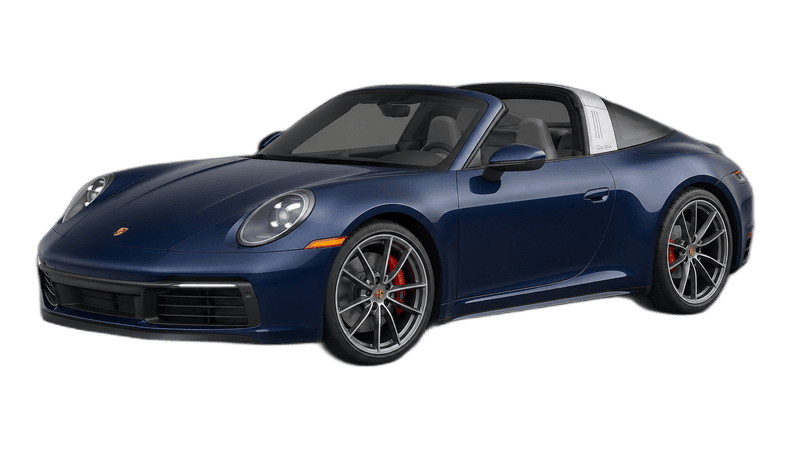
Porsche 911 Targa 4S (992)
£125,000
usedIndicative market price, updated periodically.
443bhp
Power
3.6s
0-100 km/h
304km/h
Top Speed
£125,000
Price Used
How hard it pulls.
Peak g-force the instant you bury the throttle, estimated from the car's 0–100 time and drivetrain.
Porsche 911 Targa 4S (992)Estimated peak launch g from the 0–100 time and drivetrain: an honest approximation, not a measured figure.
The Porsche 911 Targa 4S (992) is a 2-door targa by Porsche, with 443 bhp, 530 Nm of torque, a 0-100 km/h time of 3.6 seconds and a top speed of 304 km/h. Indicative used value: approximately £125,000. Actual values vary with specification, condition and history.
Dream Car Garage Editorial · Last updated 28 October 2026
Overview
We have not driven this car. This review is based on published specifications and the sources listed below.
An open 911 with a fixed architecture
The Porsche 911 Targa 4S arrived in 2020 with a 3.0-litre twin-turbo flat-six producing 331 kW, or 450 PS and approximately 443 bhp, and 530 Nm. All-wheel drive and an eight-speed PDK were standard, with a seven-speed manual offered at no cost. Porsche quoted 3.6 seconds to 100 km/h with Sport Chrono and a 304 km/h top speed. The Targa is not a conventional cabriolet: its wide roll hoop and wraparound rear window remain part of the body.
We have not driven this model for this article. This is a desk-researched guide using Porsche's launch material, the PistonHeads 992 buying guide and the official VIN recall service. No model-specific production total is established by those sources, so the count remains unset. Roof condition and operation must be assessed on the individual car rather than inferred from its model year.
Demonstrate the automatic roof fully
Porsche states that the Targa roof opens and closes in 19 seconds. With the seller's permission and suitable conditions, watch a complete cycle from closed to open and back. Listen for uneven movement, inspect the final alignment and check for warnings. A roof photographed in the open position does not show whether the mechanism, latches and sensors complete their sequence correctly.
Ask for invoices covering roof adjustment, seals, sensors or motor work. Inspect the fabric, seals, roll hoop, rear window surround and cabin for water marks or dampness. Check accessible drainage paths and distinguish a reason for further investigation from a confirmed leak. If weather or battery condition prevents a demonstration, arrange another visit rather than accepting a video as proof.
Targa body and rear visibility
The fixed roll hoop and wraparound rear window define the Targa's appearance and its visibility. Check the glass, trim and surrounding seals carefully. Look for evidence of poor previous repair around the hoop and rear quarters. Confirm that the rear window heating, demisting and any fitted camera or mirror functions operate. A rare body style makes trim and glass damage more than a cosmetic issue, so obtain parts availability and cost information before assuming a repair is straightforward.
Test the windows, including any automatic movement associated with roof operation. The PistonHeads guide notes Cabriolet windows that did not auto-close after the roof cycled; that is a prompt to demonstrate the Targa's own sequence, not proof that every car is affected. Check wind buffeting and road noise on a test drive with the roof both closed and open.
All-wheel drive, tyres and chassis
The Targa 4S uses Porsche Traction Management and all-wheel drive. Inspect all four tyres for matching specification, age, condition and wear. The official fitment is 245/35 ZR20 front and 305/30 ZR21 rear. A mismatched circumference deserves specialist assessment. Compare tyre wear with a geometry report and the physical suspension inspection, especially after wheel or suspension repairs.
PASM and Porsche Torque Vectoring Plus are part of the launch specification, and Smartlift was available. Confirm the actual equipment from the build record and demonstrate the front lift if fitted. Watch for leaks, settling or incomplete operation, and inspect the front bumper and underbody independently. A working lift does not prove that earlier contact damage is absent.
Brakes and drivetrain checks
The launch release lists 350 mm brake discs front and rear, with six-piston front calipers and four-piston rear calipers; PCCB was optional. Obtain measured disc and pad condition and a brake-fluid history. Do not judge remaining life from the visible surface alone. If the car has been driven on circuit, ask for subsequent brake and fluid work.
Assess the PDK or manual gearbox according to the car's actual specification. A manual Targa is a different ownership proposition from a PDK car, so verify the pedals, shifter and build record. Ask a specialist to check clutch behaviour on a manual and PDK operation on an automatic. Record any software or exhaust changes and confirm their effect on warranty coverage.
Cabin, storage and service evidence
Try the seats and driving position with the roof closed and open. Check headroom, entry, wind management and luggage space against your intended use. Demonstrate the PCM screen, camera, climate controls and audio. The buying guide records cabin rattles, connectivity concerns and a long screen reach across the 992 range; use those as demonstration prompts rather than a Targa-specific fault list.
Request dated invoices for the two-year or 20,000-mile service schedule, brake fluid, tyres, roof work and diagnostics. Confirm battery condition and storage practice. Historic prices quoted in a 2024 article are not current estimates, so obtain written quotations for this car. Verify any remaining warranty and its exclusions directly with the provider.
Recall status and scope
Use the 17-character VIN in Porsche's recall lookup, which covers campaigns published on or after 1989, and retain confirmation from a Porsche centre. A recall listed for another 992 does not establish applicability. Ask for campaign letters and completed-work records, and keep them with the roof and service file.
An independent inspection should cover the roof cycle, seals, drainage, all-wheel drive, brakes, tyres, battery and underbody. Record anything that could not be demonstrated, particularly if the roof was not operated. Resolve important gaps before treating the assessment as complete.
We have not driven this model for this article. No present transaction price, future-value assurance or universal reliability claim is offered. The Targa 4S should be judged on its actual roof, chassis and history rather than on an assumed production total.
Specifications
Engine
3.0L (2981 cc) twin-turbo flat-six
Displacement
3.0L
Power
443 bhp
Torque
530 Nm
0-100 km/h
3.6s
Top Speed
304 km/h
Drivetrain
AWD
Country
Germany
Body Style
2-door targa
Years
2020–2024
Price Used
£125,000
Specifications are manufacturer-published figures.
More from Porsche
Frequently Asked Questions
What are the specifications of the Porsche 911 Targa 4S (992)?
The Porsche 911 Targa 4S (992) is a 2-door targa by Porsche, with 443 bhp, 530 Nm of torque, a 0-100 km/h time of 3.6 seconds and a top speed of 304 km/h. Indicative used value: approximately £125,000. Actual values vary with specification, condition and history.
How much does a Porsche 911 Targa 4S (992) cost?
Indicative used value: approximately £125,000. Actual values vary with specification, condition and history.
What drivetrain does the Porsche 911 Targa 4S (992) use?
The Porsche 911 Targa 4S (992) is configured with all-wheel drive.
What type of car is the Porsche 911 Targa 4S (992)?
The Porsche 911 Targa 4S (992) is a sports cars manufactured by Porsche in Germany. Production ran from 2020 to 2024.