
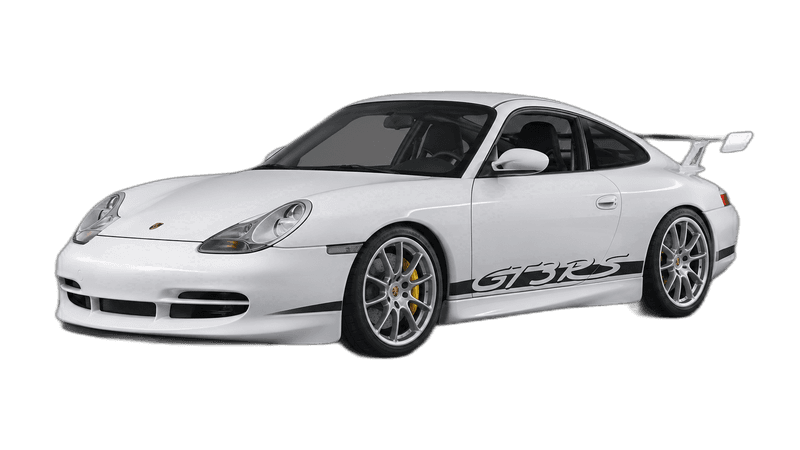
Porsche 911 GT3 RS (996)
£180,000
usedIndicative market price, updated periodically.
376bhp
Power
4.4s
0-100 km/h
306km/h
Top Speed
£180,000
Price Used
How hard it pulls.
Peak g-force the instant you bury the throttle, estimated from the car's 0–100 time and drivetrain.
Porsche 911 GT3 RS (996)Estimated peak launch g from the 0–100 time and drivetrain: an honest approximation, not a measured figure.
The Porsche 911 GT3 RS (996) is a 2-door coupe by Porsche, producing 376 bhp, and 385 Nm of torque, with a 0-100 km/h time of 4.4 seconds, and a top speed of 306 km/h, Valued at approximately £180,000.
Dream Car Garage Editorial · Last updated 26 October 2026
Overview
We have not driven this car. This review is based on published specifications, owner reports and market listings.
What the RS is
The 996 GT3 RS arrived in 2003 as a more focused development of the 996.2 GT3. Porsche built it as the road-going base for the GT3 RSR racing programme, which explains why the specification reads like a competition parts list rather than a trim package. The engine is a 3.6-litre naturally aspirated flat-six from the Mezger family, quoted at 381 PS, or about 376 bhp. It drives through a close-ratio six-speed manual gearbox. Period material describes the RS as roughly 50 kg lighter than the GT3, though published weight figures vary with measurement standard and equipment. There is no PDK and no all-wheel drive.
This is a desk-researched ownership guide. We have not driven this model for this article. The RS is defined by a combination of reduced weight, aerodynamic changes, a more focused chassis and a production run tied to motorsport. Those qualities can make a well-documented car rewarding to own, but they also make identity and condition more important than a seller's description of the model's reputation.
Identify a genuine RS
Start with the vehicle identification number, the original build record and any Porsche documentation that connects the two. The RS was produced in a small run, but a small run also attracts conversions and cosmetic imitations. A rear wing, decals and lightweight seats are not sufficient evidence on their own. Check the RS-specific front lid, engine cover, rear wing, window arrangement and other lightweight components against the build specification.
The RS was not sold in North America and production is commonly cited at 682 cars, with 140 right-hand-drive examples. Period material describes a white car with red or blue graphics and matching wheels. Those details are useful context, not a substitute for authentication. Paint and decals can be changed, and a car that has been restored or repainted should still have a coherent identity and a credible account of the work.
Ask a marque specialist to inspect the stampings, carbon components and mounting points. Carbon fibre can be repaired or replaced, so establish what is original, what has been renewed and whether the repair was appropriate. A replacement part is not automatically a problem, but it should be declared and reflected in the assessment of the car.
Engine, gearbox and driveline
The Mezger-derived engine shares the M96 designation with the contemporary Carrera but uses a different motorsport-oriented architecture. Carrera intermediate-shaft advice should not be transferred to the GT3 as though the engines were identical. That distinction does not make the GT3 engine maintenance-free. Ask for a cold and warm start, listen for abnormal mechanical noise, inspect for oil and coolant leaks, and review records for valvetrain, camshaft, bearing and cooling work.
A compression or leak-down test can provide useful evidence, but it is only part of the assessment. Oil analysis may add context if the history is known and the sample is taken correctly. Neither test replaces a visual inspection by someone familiar with this engine family. Any rebuild should be documented with its scope, the parts used and the workshop responsible. The word rebuilt does not establish that every wearing component was addressed.
The six-speed manual uses a single-mass flywheel and a mechanical limited-slip differential. Check clutch take-up, gear selection when cold, synchromesh behaviour and noise under load. A single-mass flywheel can produce more driveline noise than a dual-mass arrangement, but a new noise still needs diagnosis rather than being accepted as character. Inspect the differential for evidence of wear and confirm that the correct lubricant and service history are documented.
Period material lists no traction-control or stability intervention. That is part of the RS proposition, not a defect to be corrected with an aftermarket system. The absence of those aids places more responsibility on the driver and makes tyre condition, alignment and brake maintenance especially important.
Chassis, steering and brakes
Inspect the front boot area for creases, previous repairs and evidence of impact. The aluminium structure can be damaged in ways that are not obvious from the exterior. Check suspension mounting points, subframes and the areas around the front and rear turrets. A low mileage car can still have accident history, and a track car can have repairs that were never recorded in an ordinary service book.
The RS uses a more focused suspension specification than the standard GT3, but age and use matter more than the original marketing description. Inspect dampers for leaks and noise, springs for correct fitment, bushes and ball joints for play, and top mounts for cracking. Ask for an alignment report and establish whether the current settings suit road use. An aggressive track alignment can wear tyres quickly and make the car less pleasant on ordinary roads.
Porsche offered PCCB carbon-ceramic brakes on the RS, and period material also describes carbon brakes as part of the lightweight package. Identify what is actually fitted. Carbon-ceramic discs need a proper wear and damage assessment, including edge condition and any sign of impact. Iron discs may be more straightforward to replace, but they still need correct pads, fluid and cooling. Do not assume that a car with expensive brakes has been maintained to a higher standard.
Check the wheels for cracks and repairs, and inspect tyre specification, matching and manufacturing dates. Centre-lock or five-stud fitment should be confirmed rather than inferred from photographs. Brake lines, hoses, master cylinder and handbrake mechanism all deserve attention. A car that has seen track use may have high-temperature fluid, modified cooling and non-standard pads, so ask for the relevant records.
Body, glass and aero
The RS uses a plastic rear window, carbon front lid, carbon engine cover, carbon mirrors and a large rear wing. Inspect the rear window for cracking, clouding and correct sealing. Check the carbon panels for delamination, impact damage and poor repairs. The wing and its mounts should be secure and correctly fitted; a loose or modified wing can indicate a cosmetic build rather than a factory car.
Panel gaps and paint condition should be assessed together. Fresh paint on one area is not proof of damage, but it is a reason to look closer at the adjacent structure. Check the doors, sills, rear quarter panels and underbody for corrosion or repair. The 996 platform is old enough that rubber seals, drainage paths and electrical connectors need inspection as well as the visible bodywork.
The narrow colour and graphics programme is part of the model's identity, but it should not be used to dismiss a car that has been repainted. What matters is whether the current finish is consistent with the declared history and whether the underlying body is sound. A specialist can compare the build record with the physical car and explain any discrepancy.
Cabin, equipment and use
Some RS cars were delivered without air conditioning or audio, and period material indicates those items could be reinstated. That means two apparently similar cars may offer very different ownership experiences. Check whether the climate system and audio are present and working, and whether the installation looks factory-complete. A stripped cabin is not necessarily more authentic, and a comfort-equipped car is not automatically less desirable.
Inspect the seats, harnesses, cage, fire extinguisher and electrical cut-off if fitted. Harnesses and extinguishers have service lives, and a cage should be inspected for mounting, welding and interference with the interior. Aftermarket seats and steering wheels need to be compatible with the airbag and restraint system. Do not assume that track-oriented equipment is safe or current simply because it looks professional.
Test the windows, locks, wipers, lights and instruments. Check the heater and ventilation, the radio if present, and the condition of the carpets and trim. Water leaks can affect a car that is used regularly or stored outside. A compact cabin and limited storage are part of the 911 package, but the car should still be tried with the people and luggage it will actually carry.
Inspection and records
A pre-purchase inspection should cover the engine, gearbox, differential, suspension, brakes, structure, body and electrical systems. Ask for the over-rev history where the engine management supports it, and have the report explain what the data does and does not prove. A clean report is not a warranty, and an incident or repair does not automatically make a car unsuitable.
Assemble the history file: registration documents, service invoices, MOT or equivalent test records, track-day preparation, tyre and brake purchases, and any engine or bodywork repairs. Compare the dates and mileages for inconsistencies. A car with a thick file can still have gaps, while a simpler file may be coherent. The quality of the evidence matters more than the number of receipts.
If the car is advertised as a collector piece, ask what documentation supports that description. Production numbers and competition provenance can be checked, but they do not replace an inspection. A car with a famous previous owner or a display history still needs its structure, engine and safety equipment assessed.
Decide without a forecast
Compare the car with other RS examples on specification, documented history and condition, not on a promise about future values. This guide establishes no resale floor and no appreciation trend. A rare car can be expensive to maintain, and a modified car can be harder to return to standard. Budget for tyres, brakes, fluids, suspension work and the possibility that an inspection finds something significant.
The RS makes most sense for someone who wants a focused manual 911 and is prepared to use it within its limits. If the priority is comfortable regular transport, a standard GT3 or a later Carrera may be the better starting point. If the priority is track use, confirm the safety equipment, cooling and consumables are suitable for the intended events. Choose the car whose identity, condition and specification you can verify, not the one with the most dramatic description.
How this review was compiled
Porsche's RS history, a specialist 996 GT3 buying guide and a detailed 996 GT3 RS technical appraisal inform the specification and inspection points. No test drive, production audit, current transaction sample or workshop quotation survey was undertaken. The links are further reading, not certification of an advertised car. Have the actual identity, engine, structure and safety equipment assessed together before purchase.
Specifications
Engine
3.6L (3600 cc) naturally aspirated Mezger flat-6 (M96/79)
Displacement
3.6L
Power
376 bhp
Torque
385 Nm
0-100 km/h
4.4s
Top Speed
306 km/h
Drivetrain
RWD
Country
Germany
Body Style
2-door coupe
Years
2003–2004
Production
682
Price Used
£180,000
Specifications are manufacturer-published figures.
More from Porsche
Frequently Asked Questions
What are the specifications of the Porsche 911 GT3 RS (996)?
The Porsche 911 GT3 RS (996) is a 2-door coupe by Porsche, producing 376 bhp, and 385 Nm of torque, with a 0-100 km/h time of 4.4 seconds, and a top speed of 306 km/h, Valued at approximately £180,000.
How much does a Porsche 911 GT3 RS (996) cost?
The Porsche 911 GT3 RS (996) has a used market value of approximately £180,000.
How many Porsche 911 GT3 RS (996) were made?
Porsche produced 682 units of the Porsche 911 GT3 RS (996).
Is the Porsche 911 GT3 RS (996) AWD or RWD?
The Porsche 911 GT3 RS (996) uses a RWD drivetrain configuration in a 2-door coupe body style.
What type of car is the Porsche 911 GT3 RS (996)?
The Porsche 911 GT3 RS (996) is a track focused manufactured by Porsche in Germany. Production ran from 2003 to 2004.