
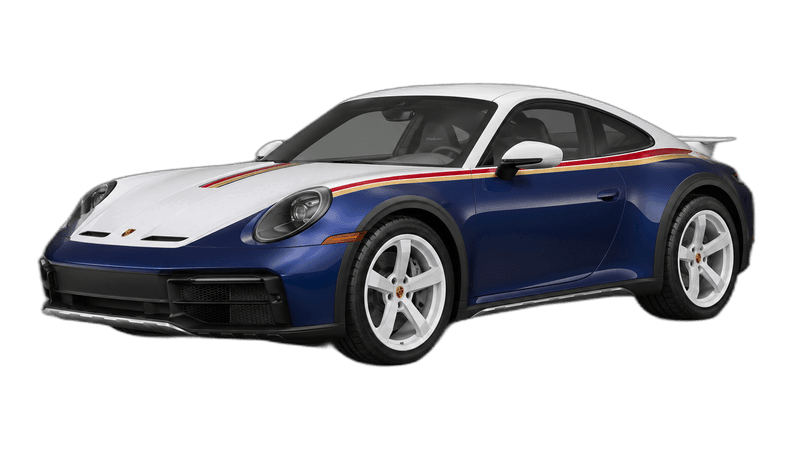
Porsche 911 Dakar
£250,000
usedIndicative market price, updated periodically.
473bhp
Power
3.4s
0-100 km/h
240km/h
Top Speed
£250,000
Price Used
How hard it pulls.
Peak g-force the instant you bury the throttle, estimated from the car's 0–100 time and drivetrain.
Porsche 911 DakarEstimated peak launch g from the 0–100 time and drivetrain: an honest approximation, not a measured figure.
The Porsche 911 Dakar is a 2-door coupe by Porsche, with 473 bhp, 570 Nm of torque, a 0-100 km/h time of 3.4 seconds and a top speed of 240 km/h. Indicative used value: approximately £250,000. Actual values vary with specification, condition and history.
Dream Car Garage Editorial · Last updated 28 October 2026
Overview
We have not driven this car. This review is based on published specifications and the sources listed below.
A 911 built for loose surfaces
The Porsche 911 Dakar was revealed in 2022 as a limited-run all-wheel-drive model with a 2,981 cc twin-turbo flat-six producing 353 kW, or 480 PS and approximately 473 bhp, and 570 Nm. Porsche quoted 3.4 seconds to 100 km/h and a 240 km/h top speed. Its raised suspension, all-terrain tyres, fixed carbon-fibre rear spoiler and Rallye and Offroad modes separate it from a conventional Carrera.
We have not driven this model for this article. This guide uses Porsche's Dakar press kit, the PistonHeads 992 buying guide and the official VIN recall service. Porsche states a limited run of 2,500 units, so the catalogue records that figure. The older buying guide covers the wider 992 range and is not evidence of a Dakar-specific fault pattern.
Lift system and raised suspension
The Dakar came with a standard lift system that raises the body for rough ground. Demonstrate it fully and inspect for leaks, settling, uneven operation or warning messages. Ask for invoices covering hydraulic or electronic components. A lift that works on the day should still be checked for correct height, repeatability and any signs of previous repair. Ask for ride-height measurements and confirm that both axles return to the same setting after cycling.
Inspect the suspension arms, dampers, mountings and underbody for contact damage. Off-road use is part of the model's purpose, so evidence of gravel or trail use is not automatically a reason to reject it. The useful questions concern what was checked afterwards, whether protective panels were replaced and whether any damage reached structural or suspension components. A polished upper body cannot answer those questions.
All-terrain tyres and wheel condition
Porsche specified 19-inch front and 20-inch rear wheels with all-terrain tyres. Confirm the actual fitment, sizes, dates and condition. Check for cuts, sidewall damage, uneven wear and evidence of low-pressure use. A tyre designed for mixed surfaces may age differently from a road tyre, so do not judge it by tread depth alone. Ask whether a second wheel and tyre set is included. Confirm that the pressure-monitoring system recognizes the sensors fitted to each wheel. Ask for the wheel-lock key and lifting tools before relying on a roadside repair.
Inspect the wheels for rock damage, bent rims and correct torque. Compare wear across the axle and ask for a geometry report after any suspension work. The Dakar's taller stance and tyre package make a standard Carrera alignment assumption inappropriate. A specialist familiar with the model should assess the actual setup.
Drivetrain, modes and brakes
Assess the all-wheel-drive system, PDK transmission and driving modes with a model-familiar specialist. Rallye Launch Control and the Offroad modes are part of the car's equipment; confirm that they operate and that no warnings remain. Do not attempt launch or off-road demonstrations in unsuitable conditions merely to prove a function. Diagnostic records and a controlled evaluation are more useful than an improvised stunt.
Measure the brake discs and pads and review fluid history. The Dakar's weight, tyres and intended use place different demands on the braking system from a road-focused Carrera. Ask for post-use inspections if the car has been driven on loose surfaces. Obtain current written estimates for any work rather than relying on historic servicing prices.
Body, spoiler and cabin equipment
The fixed carbon-fibre rear spoiler, widened body and protective elements should be inspected for damage and correct repair. Check panel gaps, mountings and the underbody. Ask whether any body parts were replaced and who carried out the work. A limited-production model can make cosmetic repairs more expensive, but a documented repair is not automatically disqualifying. Photograph the accessible underbody and record any protective panels that could not be removed.
The Dakar used full bucket seats and omitted the rear seats in its launch specification. Try the seats, entry and headroom before assuming the cabin suits you. Check restraint equipment and confirm what was delivered for the market. Test the PCM, camera, climate controls, windows and washers. Listen for rattles and road noise on a test drive, recognizing that the all-terrain tyres will sound different from road rubber.
Storage, battery and service records
Ask how the car has been stored and whether a battery maintainer was used. The 992's electrical demands make battery condition important, and the buying guide notes charger behaviour on stored cars. Obtain a battery and charging-system test rather than accepting that the engine started. Check tyre dates even if tread looks deep, because a low-mileage Dakar may have aged rubber.
Request dated invoices for the two-year or 20,000-mile service schedule, brake fluid, tyres and any off-road inspection. Confirm remaining warranty and its exclusions, especially if the car has been modified or used on trails. Verify that original parts and accessories accompany the car.
Recall status and inspection limits
Use the 17-character VIN in Porsche's recall lookup, which covers campaigns published on or after 1989, and retain confirmation from a Porsche centre. A recall affecting another 992 does not establish that this car is included. Ask for campaign letters and completed work.
An independent inspection should cover the lift system, suspension, underbody, all-terrain tyres, all-wheel drive, brakes and electronics. Record anything that could not be demonstrated, particularly if off-road functions were not exercised. Resolve important gaps before treating the report as complete.
We have not driven this model for this article. No present transaction price, future-value assurance or universal reliability claim is offered. The Dakar's limited build is documented, but its condition and history still require individual evidence.
Specifications
Engine
3.0L (2981 cc) twin-turbo flat-six
Displacement
3.0L
Power
473 bhp
Torque
570 Nm
0-100 km/h
3.4s
Top Speed
240 km/h
Drivetrain
AWD
Country
Germany
Body Style
2-door coupe
Years
2022–present
Production
2,500
Price Used
£250,000
Specifications are manufacturer-published figures.
More from Porsche
Frequently Asked Questions
What are the specifications of the Porsche 911 Dakar?
The Porsche 911 Dakar is a 2-door coupe by Porsche, with 473 bhp, 570 Nm of torque, a 0-100 km/h time of 3.4 seconds and a top speed of 240 km/h. Indicative used value: approximately £250,000. Actual values vary with specification, condition and history.
How much does a Porsche 911 Dakar cost?
Indicative used value: approximately £250,000. Actual values vary with specification, condition and history.
How many Porsche 911 Dakar were made?
Porsche produced 2,500 units of the Porsche 911 Dakar.
What drivetrain does the Porsche 911 Dakar use?
The Porsche 911 Dakar is configured with all-wheel drive.
What type of car is the Porsche 911 Dakar?
The Porsche 911 Dakar is a gts manufactured by Porsche in Germany. Production started in 2022.