
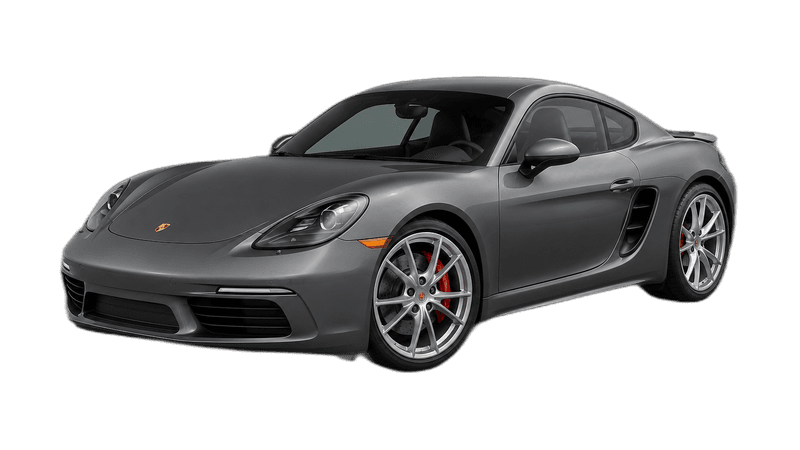
Porsche 718 Cayman S
£48,000
б/уIndicative market price, updated periodically.
345л.с.
Мощность
4.6с
0-100 км/ч
285км/ч
Максимальная Скорость
£48,000
Цена Б/У
Как она тянет.
Пиковая перегрузка в момент полного газа, оценка по времени 0–100 и приводу.
Porsche 718 Cayman SОценка пиковой стартовой перегрузки по времени 0–100 и приводу: честное приближение, не измерение.
The Porsche 718 Cayman S is a 2 seater fixed-head coupé by Porsche, producing 345 bhp, and 420 Nm of torque, with a 0-100 km/h time of 4.6 seconds, and a top speed of 285 km/h, Valued at approximately £48,000.
Dream Car Garage Editorial · Last updated 25 October 2026
Обзор
We have not driven this car. This review is based on published specifications, owner reports and market listings.
A turbocharged S, not a smaller GTS 4.0
The 718 Cayman S uses a 2.5-litre turbocharged flat-four. Porsche's original announcement identifies variable turbine geometry for the S, distinguishing it from the base two-litre installation. The engine also separates it from earlier six-cylinder Caymans and the later naturally aspirated GTS 4.0. Confirm the generation and derivative before applying service advice or comparing specifications taken from different cars.
We have not driven this model for this article. This desk-researched guide considers its particular drivetrain and fixed-roof body as a purchase proposition, not personally measured sound, response or handling. The cylinder-count debate does not establish whether the car suits a buyer. Try the actual transmission, seating and controls on representative journeys rather than treating someone else's engine preference as a verdict on every example.
Build records explain the chassis
Obtain the factory equipment information and original market. Adaptive suspension, Sport Chrono, seat types, audio and other options should not be assumed present from the S badge alone. A later GTS launch specification does not establish what was standard on this car. Compare the build with current equipment and document retrofits, especially where they affect insurance or future diagnosis.
Wheels and seats should serve the intended use. Larger wheels may change ride and consumable costs without improving ordinary journeys, while a specialised seat must fit its driver. Check visibility, access and pedal reach. Ask about suspension changes and clearance at the intended garage rather than assuming a popular aftermarket setup will suit every road or owner.
Inspect the four-cylinder installation
Review dated servicing, fluids, ignition maintenance and cooling history. Ask a suitably equipped specialist to inspect leaks, damaged plumbing and any recorded warning messages. Variable turbine geometry is a feature requiring accurate diagnosis if a fault occurs, not evidence that every power-delivery symptom has the same cause. Obtain findings before accepting either a reassuring dismissal or a costly speculative replacement proposal.
Repeated coolant loss, overheating or poor running needs an explanation supported by repair records. A recent top-up or service reset is not proof of resolution. Diagnostic information can identify questions but does not certify every internal engine component. Ask what was tested, what remains uncertain and whether further investigation is appropriate before payment, especially if the seller has recently cleared fault codes.
Manual and PDK assessment
The model offered a six-speed manual and seven-speed PDK. Test cold and warm operation in the actual configuration, including reverse and low-speed manoeuvres. A manual needs clutch and selection checks; PDK needs an appropriate diagnostic and maintenance assessment. Neither configuration should be described as requiring no upkeep, and an unidentified fault should not be promised a simple cure through fluid or software work.
Review engine software, exhaust changes and prior performance modifications. Standard-looking hardware does not prove that the calibration or operating history is original. Ask who performed the work, what remains installed and whether the car meets local requirements. A dyno graph can document one output measurement without proving durability, emissions compliance or insurer acceptance of the complete configuration.
Bodywork and storage spaces
Inspect panel alignment, underbody condition and evidence of accident repairs. Low front components can contact entrances and road debris, but that does not excuse unexplained structural damage. Obtain photographs and invoices where repairs occurred and assess their method. A clear history check cannot reveal every privately funded incident, so it complements rather than replaces a physical inspection.
The fixed roof removes a folding mechanism from the ownership brief, not every possible leak. Check seals, glass, hatch operation and moisture in luggage or cabin areas. Try actual bags in the front and rear storage spaces, respecting the guidance for loads and temperature-sensitive items. The two-seat layout can be practical for some journeys while remaining unsuitable when passengers or particular equipment must be carried.
Cooling surfaces, suspension and brakes
Inspect the accessible front radiator and condenser areas for debris, leakage and impact damage. Confirm air-conditioning function and investigate a history of repeated recharging rather than treating it as ordinary scheduled maintenance. An exposed component's condition should be assessed directly; its location does not establish that every car needs replacement parts or a fixed annual allowance for them.
Check suspension, tyre fitment and age, wheel damage and alignment. Identify the installed brake system before obtaining a condition assessment and replacement estimate, particularly if optional ceramic equipment is present. Track use can increase consumable demand without producing large road mileage. Ask for preparation and incident records rather than assuming either that all circuit-used cars are abused or that low mileage means light use.
Cabin and time-based maintenance
Test climate control, windows, locks, infotainment, phone connection and both keys. Confirm the functions fitted rather than importing expectations from a newer model. Inspect seat adjustment and cabin wear against the claimed history. A worn control is not a complete mileage diagnosis, but inconsistencies deserve a coherent explanation supported by records instead of being ignored because the exterior is polished.
Check service dates and storage history as well as distance. A lightly used car still has tyres, fluids and seals that age. Ask what recommissioning occurred and obtain the scope rather than accepting a new battery as proof of complete readiness. Establish a workshop relationship before purchase so that routine service and more complex diagnosis have a realistic support route.
A purchase budget without an investment story
Request written estimates separating scheduled work, worn consumables and unresolved faults. Include insurance, tax, fuel and transport where needed. This guide has no current invoice sample supporting a universal annual cost or a claim that fewer cylinders necessarily make every repair cheaper. Warranty cover should be read for exclusions, claim limits and repair procedures on the actual vehicle.
Compare equivalent gearbox, equipment, condition and history. A base Cayman, a GTS and a GT4 are not interchangeable market evidence. Asking prices do not establish completed transactions or a floor beneath future values. Choose a car whose purchase and care remain affordable without expecting a changing engine-fashion debate to repay maintenance or selling expenses.
Alternatives and research method
A Boxster S provides related drivetrain context with an opening roof; an earlier six-cylinder Cayman or a later GTS 4.0 offers a different engine proposition. Compare those engineering and practical differences before deciding whether their additional cost or age serves a real purpose. Porsche's original specification and published 718 coverage inform these questions. No test drive, cost survey or measured reliability study was undertaken, and an independent inspection remains necessary.
Характеристики
Двигатель
2.5L turbocharged flat-four petrol
Объём
2.5L
Мощность
345 л.с.
Крутящий момент
420 Нм
0-100 км/ч
4.6с
Максимальная Скорость
285 км/ч
Привод
RWD
Страна
Germany
Кузов
2 seater fixed-head coupé
Годы
2016–2024
Цена Б/У
£48,000
Specifications are manufacturer-published figures.
Ещё от Porsche
В центре внимания Carpedia
Часто Задаваемые Вопросы
What are the specifications of the Porsche 718 Cayman S?
The Porsche 718 Cayman S is a 2 seater fixed-head coupé by Porsche, producing 345 bhp, and 420 Nm of torque, with a 0-100 km/h time of 4.6 seconds, and a top speed of 285 km/h, Valued at approximately £48,000.
How much does a Porsche 718 Cayman S cost?
The Porsche 718 Cayman S has a used market value of approximately £48,000.
Is the Porsche 718 Cayman S AWD or RWD?
The Porsche 718 Cayman S uses a RWD drivetrain configuration in a 2 seater fixed-head coupé body style.
What type of car is the Porsche 718 Cayman S?
The Porsche 718 Cayman S is a sports cars manufactured by Porsche in Germany. Production ran from 2016 to 2024.