
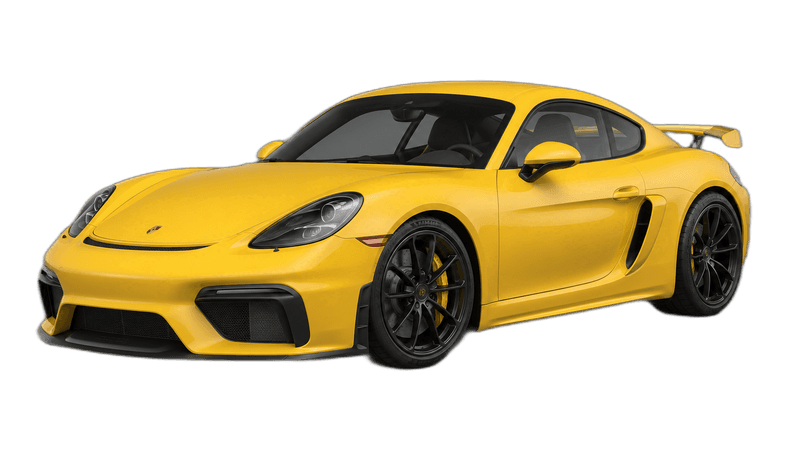
Porsche 718 Cayman GT4
£78,000
usedIndicative market price, updated periodically.
414bhp
Power
4.4s
0-100 km/h
304km/h
Top Speed
£78,000
Price Used
How hard it pulls.
Peak g-force the instant you bury the throttle, estimated from the car's 0–100 time and drivetrain.
Porsche 718 Cayman GT4Estimated peak launch g from the 0–100 time and drivetrain: an honest approximation, not a measured figure.
The Porsche 718 Cayman GT4 is a 2 seater fixed-head coupé by Porsche, producing 414 bhp, and 420 Nm of torque, with a 0-100 km/h time of 4.4 seconds, and a top speed of 304 km/h, Valued at approximately £78,000.
Dream Car Garage Editorial · Last updated 25 October 2026
Overview
We have not driven this car. This review is based on published specifications, owner reports and market listings.
Identify the four-litre 718 GT4
The 718 Cayman GT4 introduced in 2019 uses a naturally aspirated four-litre flat-six and a chassis developed for a more focused brief than the ordinary Cayman. It follows the earlier 981 GT4, which used a different engine specification. Confirm the generation and build rather than treating every car named Cayman GT4 as one interchangeable mechanical package.
We have not driven this model for this article. This desk-researched guide considers the equipment and ownership decisions that follow from its GT role, not personally measured handling or lap times. The case for buying one should involve wanting the chassis, seating and aero configuration, not simply acquiring the most celebrated badge that fits a budget.
GT4 does not mean GT4 RS or Clubsport
The GT4 RS uses a different engine proposition and additional specialised equipment. The racing Clubsport is a separate vehicle again. A wing or track preparation does not turn a road GT4 into either. Ask for the factory build, drivetrain and installed safety equipment, and establish what has changed since delivery before comparing prices or planning events.
The 718 GT4's chassis and aerodynamic work are substantive, not just a GTS equipment bundle. Porsche's contemporary launch documents explain that development. A buyer should nevertheless identify the actual seats, brakes and optional packages fitted to the example. The presence of expensive equipment does not prove that it suits road use, remains in good condition or is eligible for every intended circuit event.
Manual first, PDK later
The car launched with a six-speed manual; Porsche subsequently announced PDK availability for the six-cylinder 718 range. Avoid describing every 718 GT4 as manual-only. Build date and original market should be established through records. An early road test cannot determine the transmission choices available on a later used example or provide the performance figures of every version.
Choose by use as well as preference. Assess clutch engagement and gear selection on a manual, and cold and warm behaviour on PDK. An appropriate technician should investigate warnings, leaks or abnormal operation. A fluid change or adaptation procedure is not a guaranteed remedy for an unidentified symptom, and a manual gearbox is not inherently exempt from expensive wear or repairs.
Engine condition and campaign checks
Review servicing, fluids, cooling work and any warnings or overheating. A diagnostic report should be interpreted by someone familiar with the car, with its limits stated clearly. Relevant operating-history information can prompt questions but does not certify all internal components. A clean start or low odometer is not proof that the engine needs no further assessment.
Published advice discusses a limited connecting-rod campaign within the six-cylinder 718 family. Check applicability and completion against the actual VIN with Porsche rather than assuming every GT4 is included. Obtain documentation of work and clarify any engine replacement or repair. A campaign's existence is neither proof that a particular car is defective nor a reason to omit an ordinary mechanical inspection.
Aerodynamics and underside inspection
Inspect the front splitter, underbody components, rear wing and mounting areas for impacts, poor repairs and non-standard settings. Low-clearance parts can suffer damage on ordinary entrances as well as circuits. Obtain estimates for damaged components before treating them as inexpensive cosmetic details. Examine the body and suspension mounting areas too; an intact wing does not establish an undamaged structure.
Request records for any collision, repainting or track incident and assess alignment appropriately. A history-check result cannot reveal every privately repaired event. Photographs and invoices should explain what was damaged and how it was restored, including specialist materials where relevant. A repaired car needs evaluation of the repair rather than an automatic rejection or an unsupported assurance that appearance proves everything is sound.
Consumables reveal the intended use
Identify the installed brake system and obtain a condition assessment appropriate to conventional or optional ceramic equipment. A visual glance is not an estimate of remaining life. Check wheel condition, tyre type, age and wear, then ask whether the fitted tyres suit the intended weather and roads. Circuit-focused rubber should not be treated as universally better for ordinary use.
Ask for alignment and suspension records, including changes made for events. A track setting may not suit daily driving or tyre life on public roads. Document the current setup and the cost of returning it to the desired configuration. A component list alone cannot establish that the final adjustment is coherent or that the car remains within relevant approval and insurance conditions.
Seats and track preparation
Try the actual seats, access and pedal reach. Optional specialised seating can be a decisive comfort issue, particularly if several people will drive. Confirm what adjustment is possible and the implications of changing seats. For road touring, those practical questions may matter more than a small difference in published weight or a specification's popularity among collectors.
If track use is intended, verify organiser requirements, noise limits, insurance and recovery. Harnesses and other safety equipment need appropriate installation and current eligibility, not simply visible presence. Previous circuit use can coexist with careful maintenance, but it should be documented. Low road mileage is not a complete account of mechanical demand from repeated sessions.
Budget and alternatives
Obtain separate quotations for maintenance due, worn consumables, setup changes and unresolved faults. Add storage, tax, insurance and specialist transport. There is no current invoice survey here supporting one routine annual budget, and no price sample proving that a GT4 will retain its purchase price. Asking prices are not transactions, while maintenance and selling costs remain real.
A Cayman GTS 4.0 may fit a less specialised road brief. A 981 GT4 is an earlier mechanical proposition, while the GT4 RS changes engine, transmission and operating demands. Choose the 718 GT4 when its particular compromises serve the owner, not on the assumption that every more focused variant is automatically a better car to live with.
How this review was compiled
Porsche's original launch and subsequent PDK material establish the generation and transmission distinctions. Published 718 buying advice informs inspection questions, not a quantified reliability rating. No test drive, transaction survey or workshop-price survey was undertaken. Have the actual vehicle independently assessed and obtain VIN-specific campaign information before purchase.
Specifications
Engine
4.0L naturally aspirated flat-six petrol
Displacement
4.0L
Power
414 bhp
Torque
420 Nm
0-100 km/h
4.4s
Top Speed
304 km/h
Drivetrain
RWD
Country
Germany
Body Style
2 seater fixed-head coupé
Years
2019–2024
Price Used
£78,000
Specifications are manufacturer-published figures.
More from Porsche

Frequently Asked Questions
What are the specifications of the Porsche 718 Cayman GT4?
The Porsche 718 Cayman GT4 is a 2 seater fixed-head coupé by Porsche, producing 414 bhp, and 420 Nm of torque, with a 0-100 km/h time of 4.4 seconds, and a top speed of 304 km/h, Valued at approximately £78,000.
How much does a Porsche 718 Cayman GT4 cost?
The Porsche 718 Cayman GT4 has a used market value of approximately £78,000.
Is the Porsche 718 Cayman GT4 AWD or RWD?
The Porsche 718 Cayman GT4 uses a RWD drivetrain configuration in a 2 seater fixed-head coupé body style.
What type of car is the Porsche 718 Cayman GT4?
The Porsche 718 Cayman GT4 is a sports cars manufactured by Porsche in Germany. Production ran from 2019 to 2024.