Mercedes-Benz 300 SEL 6.8 AMG
£380,000
usedIndicative market price, updated periodically.
422bhp
Power
6.1s
0-100 km/h
265km/h
Top Speed
£380,000
Price Used
The Mercedes-Benz 300 SEL 6.8 AMG produces 422 bhp, reaches 100 km/h in 6.1 seconds and has a top speed of 265 km/h. A representative example is worth about £380,000.
How hard it pulls.
Peak g-force the instant you bury the throttle, estimated from the car's 0–100 time and drivetrain.
Mercedes-Benz 300 SEL 6.8 AMGEstimated peak launch g from the 0–100 time and drivetrain: an honest approximation, not a measured figure.
Dream Car Garage Editorial · Edited by José Teo Lorente Vallecillos · Last updated 3 November 2026
Overview
We have not driven this car. This review is based on published specifications and the sources listed below.
Scope of this guide
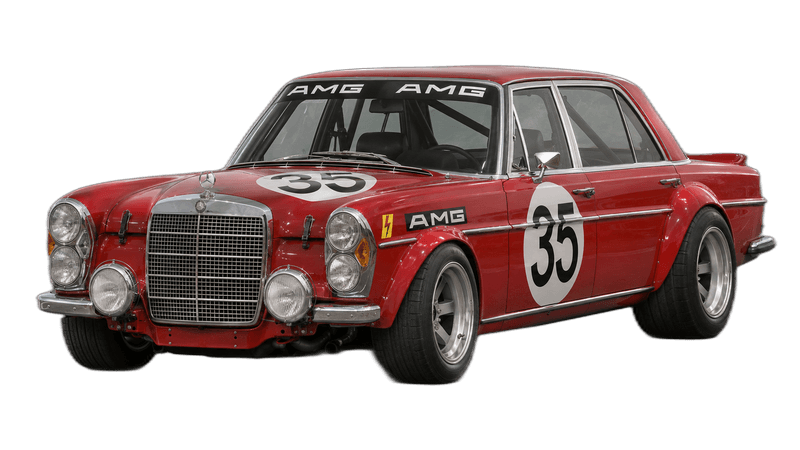
This guide is scoped to the Mercedes-Benz 300 SEL 6.8 AMG, the red racing saloon that the young tuning firm AMG entered in the 1971 24 Hours of Spa-Francorchamps and that the press and rivals nicknamed "Die Rote Sau", the Red Pig. It is a front-engine, rear-wheel drive four-door saloon with an enlarged V8, and it was a competition car, not something you could order from a dealer. It is not a guide to the factory Mercedes-Benz 300 SEL 6.3 road car that it was based on, which we mention only for comparison, and it is not a guide to the modern replica that Mercedes-AMG built in 2006, although we discuss that car because it is the one most people can actually see.
We have not driven this model for this article. We are an editorial desk that reads sources, and everything below comes from pages we opened: the Mercedes-AMG Petronas F1 team news page, PistonHeads, Motor1 Germany, Secret Classics, Autohaus, auto motor und sport, two MBpassion articles, The Jalopy and Wikipedia. This is a competition car that does not come to market in any ordinary sense, so a guide like this cannot replace a specialist inspection or museum-grade provenance research, and this page is for research, not a buying recommendation.
The figures at a glance
- Engine: 6.8L naturally aspirated V8, the enlarged M100 engine from the 300 SEL 6.3. No page we read mentions a supercharger or turbocharger, which is why we call it naturally aspirated.
- Displacement: 6,835 cc. Motor1, Autohaus, both MBpassion pages and The Jalopy print 6,835 cc (the 2021 MBpassion article writes 6.835 L). The Mercedes-AMG F1 page prints 6834cc. We use 6,835 cc because four independent pages agree on it and the base engine is given as 6,330 cc by MBpassion in 2023 (Wikipedia gives 6,333 cc for the production M 100).
- Power: 422 bhp. The sources print 315 kW (428 PS), and several pages write 428 hp or 428 bhp. Because the original rating is metric, we converted it: 428 PS x 0.98632 gives 422 bhp, and 315 kW x 1.34102 gives the same 422 bhp. If you see 428 bhp elsewhere, it is the PS number with a different unit label.
- Torque: 620 Nm. Motor1, Autohaus, MBpassion (2021), The Jalopy, Secret Classics and auto motor und sport give "up to 620 Nm". MBpassion's 2023 article gives 608 Nm instead.
- 0-100 km/h: 6.1 seconds. Motor1, Autohaus, MBpassion (2021) and The Jalopy all print 6.1 seconds, and they appear to repeat the same manufacturer text. None says how or when the time was measured.
- Top speed: 265 km/h. The Daimler-derived pages say "more than 265 km/h", and auto motor und sport and MBpassion (2023) say 265 km/h. Secret Classics says up to 165 mph, which is the same speed in miles per hour. Treat it as a claimed figure, not a certified one.
- Drive: rear-wheel drive in our catalogue. The base 300 SEL is a conventional front-engine, rear-drive saloon, but none of the pages we read states the layout in words, so this is the one entry above that we are carrying over without a direct quotation. PistonHeads says the replica has a four-speed automatic.
- Weight: 1,635 kg without driver per Motor1, Autohaus and MBpassion, which is 195 kg less than the series car. MBpassion (2023) gives the series car as 1,830 kg. The Mercedes-AMG F1 page says 1600kg and auto motor und sport says about 1.5 tonnes, so weights differ by source.
- Production: one race car. See the next section for what that does and does not mean.
One car, not a series
The catalogue lists one car, and that is the best reading of what we found, with caveats. Motor1, MBpassion (2021) and The Jalopy all describe a single car entered by the engineering office of Hans Werner Aufrecht and Erhard Melcher, which was founded in 1967. The Mercedes-AMG F1 page also refers to a single car and to modern replicas of that first car. None of these pages gives a build count, and none says that a second 6.8 was built, so "one" is our reading of the sources and not a number any of them prints.
The base car is a different matter. Wikipedia gives 6,526 units of the 300 SEL 6.3 built from December 1967 to September 1972, and PistonHeads says about 6,500 300 SELs were built between 1968 and 1972. Those are road-car figures and have nothing to do with the racer. AMG did not sell a 6.8 to customers in our sources.
The year range needs care too. The car raced in July 1971, and we have 1971 as both start and end year. The Mercedes-AMG F1 page says Waxenberger tested an enlarged racing SEL in early 1970 and that management refused a works entry, but that page does not make clear whether it means this exact car. Auto motor und sport says the car was crashed by Helmut Kelleners at Hockenheim 14 days before Spa and then rebuilt in time. We keep 1971 only.
History and development
Several pages tell the same outline. AMG was founded by the former Mercedes engineers Hans Werner Aufrecht and Erhard Melcher, and Secret Classics gives the date as 1 June 1967 in Grossaspach (the name AMG combines their initials with Grossaspach, per Motor1). The Mercedes-AMG F1 page says that in 1965 their 300 SE engine won the German touring car championship, and that in 1966 Erich Waxenberger fitted the 6.3-litre V8 from the 600 into a 300 S, which led to the 300 SEL 6.3 shown in Geneva in 1968.
For Spa, AMG took a 300 SEL 6.3 and bored it out. MBpassion in 2023 says displacement rose from 6,330 to 6,835 cc, output to 428 PS at 5,500 rpm and torque from 500 to 608 Nm. It says the standard 300 SEL 6.3 makes 250 PS at 4,000 rpm and a top speed of 220 km/h, and Wikipedia agrees on 250 PS (DIN) and about 220 km/h, with 500 Nm. The Mercedes-AMG F1 page says the finished car got aluminium doors, perspex instead of glass and Bilstein gas dampers, and was painted cardinal red. MBpassion in 2023 mentions aluminium doors as part of the weight saving from 1,830 kg to 1,635 kg. Secret Classics says AMG's earlier 1969 Spa attempt ended after three laps because of tyre problems.
The car was not a works entry. Motor1, Autohaus and The Jalopy all say so. That matters for how you read the story: this was a small firm's car, run on its own, that happened to beat many factory-backed competitors.
Spa 1971 and what happened next
The 24 Hours of Spa-Francorchamps began on 24 July 1971 at 15:00 on the old 14.863 km circuit. Motor1 says nearly 80 touring cars started, while MBpassion in 2023 says 60 entries, so the field size depends on whether you count entries or cars that took the start. The Mercedes-AMG F1 page and MBpassion both say the car qualified fifth. Hans Heyer and Clemens Schickentanz finished second overall and won their class, and Motor1 says it was the highest finish of any car in the field. Auto motor und sport names the overall winner as Dieter Glemser in a Ford Capri RS, and Autohaus and MBpassion also say the car finished behind a Ford Capri. MBpassion in 2023 gives 308 laps. Motor1 says 18 touring cars were classified, and only 23 cars were still running in the morning.
Motor1 quotes Road and Track describing an insatiable thirst for fuel and rapid tyre wear, with straight-line speed more than offsetting these weaknesses, and Autohaus gives fuel use in racing as 35 to 45 litres of high-octane fuel without saying over what distance. Auto motor und sport says the car then ran the 24 Hours at the Nurburgring, where it led but retired.
The original car and the replica
Sources disagree about what became of the original. PistonHeads, the Mercedes-AMG F1 page and MBpassion (2023) say it was sold to Matra in France. PistonHeads says Matra used it to test aircraft landing gear and that its ultimate fate is unclear, and MBpassion says aircraft tyre tests and that its whereabouts are unknown. Auto motor und sport says it was lengthened by one metre and calls the original missing, adding that the original 6.8-litre engine survives only as an exhibit. The Jalopy says the team sold it to an airline, holes were cut in the floor and the car was destroyed shortly after. We cannot reconcile these, and we would not claim that the original survives.
The replica is better documented. PistonHeads says AMG built it for the 2006 Geneva motor show, that every panel except the front passenger door was replaced and that the rebuild took six weeks. MBpassion (2023) says Mercedes-AMG built it in early 2006 from original documentation. Auto motor und sport says it uses a 6.3-litre donor and is tuned to about 350 PS, so the replica does not necessarily match the 428 PS race engine. It was shown at the Mercedes-Benz Museum atrium in Stuttgart from 20 July to 19 September 2021 (Autohaus, MBpassion, The Jalopy), and MBpassion reported it at the Mercedes-Benz Kundencenter in Sindelfingen until mid-January 2024. Check current display details with the museum, because we did not.
What to check if you ever meet one
There is no ownership route for the original in our sources, so the usual used-car checklist does not apply. What our reading suggests is simply this:
- Know which car you are looking at. A replica, a tribute built on a 300 SEL 6.3 and the 1971 race car are three different things.
- Treat power and speed claims as period or manufacturer-text claims. The 6.1 seconds and 265 km/h figures come with no stated test conditions.
- Expect the replica to differ from the race car in engine detail, as the auto motor und sport article describes.
- Ask any seller or exhibitor for documentation, and treat a vague chain of ownership as a warning.
Running costs, recalls and market notes
We found no running-cost data, no service schedule and no recall or safety information for this car in any page we read, and none of them gives an auction price or valuation. We do not give one. PistonHeads quotes about 420hp for the race engine and a single replica, but gives no cost either. A car like this would be a museum or collection piece, and any value would depend on a specialist appraisal that we have not seen.
What we could not find
We found no Daimler or AMG primary document of our own: the closest to a maker source is the Daimler-derived text repeated by Motor1, Autohaus, MBpassion and The Jalopy. We found no statement of drivetrain layout in words, no confirmed production count printed by any source, no explanation of the 608 versus 620 Nm torque difference, no explanation of 6,834 versus 6,835 cc, and no clear answer on whether the original car survives. We also found no 0-100 km/h test method for the 6.1 seconds and no weight that all pages agree on. PistonHeads is dated 9 August 2010, Motor1 is dated 27 July 2021, Secret Classics 26 July 2021, Autohaus 9 August 2021, MBpassion 27 July 2021 and 24 November 2023, auto motor und sport 15 July 2012, and the Mercedes-AMG F1 and Jalopy pages show no date we could rely on. We did not search any registry, and we did not work around any access restriction.
About the photograph
This page uses the catalogue photograph for the car. Its credit is listed on the credits page.
Verdict
The 300 SEL 6.8 AMG is a front-engine, rear-wheel drive four-door racing saloon with a 6.8L naturally aspirated V8, quoted at 428 PS or 422 bhp and 620 Nm, 6.1 seconds to 100 km/h and 265 km/h, built as one car in 1971 and remembered for a class win and second place overall at Spa. What matters is the story: a small firm, a bored-out 6.3, and a result that put AMG on the map. For a researcher the practical advice is to separate the lost original from the 2006 replica, to treat every performance number as a claim, and to remember that the 6.3 road car is a different machine. We have not driven it, so use the sources and a museum or specialist before relying on any detail, and treat this page as research, not a buying recommendation.
Sources
- Mercedes-AMG Petronas F1: 55 years of the Rote Sau
- PistonHeads: Driven, Mercedes 300 SEL 6.8 AMG, The Red Pig (9 August 2010)
- Motor1 Germany: AMG 300 SEL 6.8, die Rote Sau (27 July 2021)
- Secret Classics: 50 Years of Mercedes-Benz 300 SEL 6.8 AMG (26 July 2021)
- Autohaus: Sensation vor 50 Jahren, als die Rote Sau Geschichte schrieb (9 August 2021)
- auto motor und sport: Die Rote Sau von AMG (15 July 2012)
- MBpassion: Die Rote Sau schaffte vor 50 Jahren die Sensation in Spa (27 July 2021)
- MBpassion: Die Rote Sau steht in Sindelfingen (24 November 2023)
- The Jalopy: AMG took 2nd at Spa 1971 with the 300 SEL 6.8
- Wikipedia: Mercedes-Benz W108/W109, 300 SEL 6.3
Specifications
| Engine | 6.8L naturally aspirated V8 |
|---|---|
| Displacement | 6.8L |
| Power | 422 bhp |
| Torque | 620 Nm |
| 0-100 km/h | 6.1s |
| Top Speed | 265 km/h |
| Drivetrain | RWD |
| Country | Germany |
| Body Style | 4-door saloon |
| Years | 1971 |
| Production | 1 |
| Price Used | £380,000 |
Specifications are manufacturer-published figures.
Frequently Asked Questions
What is a Mercedes-Benz 300 SEL 6.8 AMG worth?
A representative example is worth about £380,000. Actual values vary with specification, condition and history.
How much power does the Mercedes-Benz 300 SEL 6.8 AMG have?
The Mercedes-Benz 300 SEL 6.8 AMG produces 422 bhp and 620 Nm of torque.
How fast is the Mercedes-Benz 300 SEL 6.8 AMG from 0 to 100 km/h?
The Mercedes-Benz 300 SEL 6.8 AMG accelerates from 0 to 100 km/h in 6.1 seconds.
What is the top speed of the Mercedes-Benz 300 SEL 6.8 AMG?
The Mercedes-Benz 300 SEL 6.8 AMG has a top speed of 265 km/h.
What engine does the Mercedes-Benz 300 SEL 6.8 AMG have?
The Mercedes-Benz 300 SEL 6.8 AMG uses a 6.8L naturally aspirated V8.
How many Mercedes-Benz 300 SEL 6.8 AMG were made?
Mercedes-Benz produced 1 units of the Mercedes-Benz 300 SEL 6.8 AMG.
When was the Mercedes-Benz 300 SEL 6.8 AMG built?
The Mercedes-Benz 300 SEL 6.8 AMG was built from 1971 to 1971.
Is the Mercedes-Benz 300 SEL 6.8 AMG all-wheel drive?
No. The Mercedes-Benz 300 SEL 6.8 AMG is configured with rear-wheel drive.