
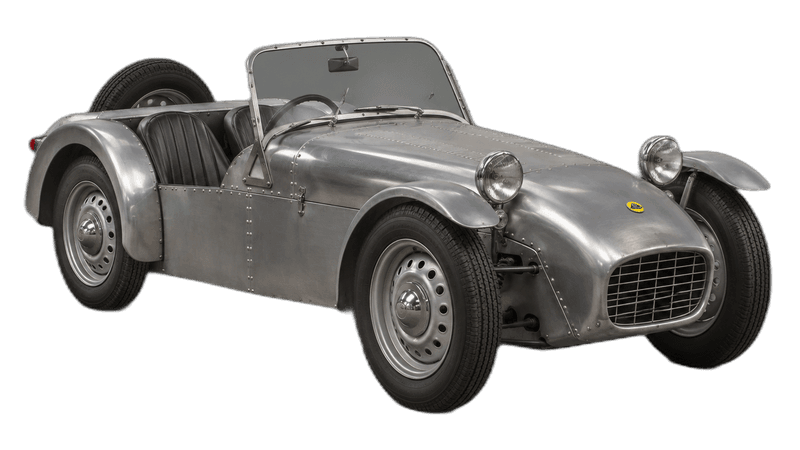
Lotus Seven Series 2
105bhp
Power
165km/h
Top Speed
The Lotus Seven Series 2 is a 2-door roadster by Lotus, with 105 bhp and a top speed of 165 km/h.
Dream Car Garage Editorial · Last updated 3 November 2026
Overview
We have not driven this car. This review is based on published specifications and the sources listed below.
Scope of this guide
This guide is scoped to the Lotus Seven Series 2, the second generation of Colin Chapman's lightweight kit-built sports car, produced from June 1960 to August 1968 according to Wikipedia. It is a two-seat open car with a tubular spaceframe chassis, a front-engine, rear-wheel drive layout, and fibreglass nose and wings in place of the aluminium panels of the Series 1. It is not a guide to the Series 1 of 1957 to 1960, the Series 3 of 1968 and 1969, the Series 4, or the Caterham cars that followed.
We have not driven this model for this article. We are an editorial desk that reads sources, and everything below comes from pages we opened: Wikipedia, motor-car.net, sportscar2.com, two conceptcarz pages, the Motor Museum in Miniature, Secret Classics, an online auction page from Berlinetta Auctions for a 1962 car, and a Sports Car Market profile of a 1963 car. We have not inspected, owned or tested a car. This page is for research, not a buying recommendation, and it cannot replace an inspection by a Lotus Seven specialist.
A word of warning before the figures: the Series 2 was not one car with one engine. It was sold over eight years with a changing list of Ford and other engines, and as a kit that owners often modified or re-engined. Every power, speed and weight number below belongs to a particular version, and we say which.
The figures at a glance
The numbers below describe the most powerful factory version, the Super Seven 1500 with the Cosworth-modified Ford engine. They do not describe a typical early Series 2 car.
- Engine: 1.5L naturally aspirated inline-four, the 1,498 cc Ford Kent engine of the Cosworth-tuned Super Seven 1500, ahead of the driver (front-engine).
- Layout: front-engine, rear-wheel drive, four-speed manual gearbox.
- Power: 105 bhp. Wikipedia prints 105 bhp (78 kW; 106 PS) for the Super Seven 1500 and motor-car.net prints the same. Converting 106 PS at 0.98632 gives about 104.6 bhp, and converting 78 kW at 1.34102 gives about 104.6 bhp, so we round to 105 bhp.
- Torque: no figure shown. See the power section below for why.
- Top speed: 165 km/h. motor-car.net gives 102.5 mph (165 km/h) for the 1,498 cc Super Seven, and 102.5 mph multiplied by 1.60934 is 164.97 km/h.
- 0-100 km/h: no figure shown. Sources give 0-60 mph times, and we do not relabel a mile-based time as a metric one.
- Weight: about 431 kg (950 lb) dry in the Super Seven specification on motor-car.net, against about 500 kg (1,100 lb) for early Sevens.
- Production: about 1,310 Series 2 cars (Wikipedia, motor-car.net, Secret Classics, conceptcarz). Other pages say 1,350 or 1,370, discussed below.
- Years: 1960 to 1968.
Why engines varied by version
The Series 2 is best understood as a chassis that took whatever suitable Ford engine was current. The sources do not agree on every detail, so here is what each says.
- Wikipedia says the 1,172 cc Ford sidevalve stayed available until 1962, and that Series 2 cars typically used Ford Kent engines of 1,340 cc or 1,499 cc taken from the Ford Consul Classic. It adds that some 1968 cars, sometimes called Series 2 and a half, used the 1,599 cc crossflow Kent.
- sportscar2.com dates the changes: the 997 cc Ford 105E from the Anglia in January 1961, the 1,340 cc Ford 109E in mid-1961, and the 1,498 cc Ford 116E in September 1962, fed by a single SU carburettor. It lists the 1,340 cc car in its Series 2 table column and puts 1,498 cc in the Series 3 column, which contradicts its own text, and we note that inconsistency.
- The Motor Museum in Miniature page says the range grew to three engine options, 997 cc, 1,340 cc and 1,498 cc, each described there with a single Weber carburettor. That conflicts with sportscar2.com's single SU carburettor, and a Berlinetta Auctions lot page describes a 1962 Super Seven with twin Weber 40 DCOE carburettors on the 1500 Cosworth engine, so we expect carburation varied by version and by owner.
- The conceptcarz page for the Seven lists a 2A with a BMC A-Series engine and BMC Sprite gearbox (American versions at 948 cc or 1098 cc) and a 2F with a Ford 100E, later replaced by the 997 cc 105E. motor-car.net separately lists the 7 America and other early Series 2 variants for 1960 and 1961, the 7 105E from 1961 to 1968, the Super 7 Cosworth 1340 for 1961 and 1962, the Super 7 1500 from 1962 to 1968, and a Series 2 and a half in 1968.
So the answer to which engine does a Series 2 have is that it depends on the year, the market and the previous owners. The engine we show at a glance, a 1.5 litre Kent-based four, is the one that appears most often in the sources as the late Series 2 headline version, and the only one tied to the 105 bhp figure.
Which power figure we use, and why
Power figures in the sources range widely, partly because the engines differ and partly because old brake horsepower numbers were not always measured the same way.
- Wikipedia: Cosworth-modified 1,340 cc Super Seven at 85 bhp (63 kW; 86 PS), and the later Super Seven 1500 at 105 bhp (78 kW; 106 PS).
- motor-car.net: the same 85 bhp and 105 bhp in its engines section, but a variations note elsewhere on the page gives 90 hp for the 1,340 cc car, a Series 2 table gives 66-100 hp for the 1500, and a separate specification block for the 1,498 cc Super Seven gives 75 hp DIN at 5200 rpm and 75 lb ft at 3,500 rpm.
- Berlinetta Auctions says the twin-carburettor 1500 Cosworth set-up would have given a reputed 90 to 95 brake horse power.
- Sports Car Market says a street engine of this kind on Webers makes maybe 100 horsepower, and that race preparation adds another 30 to 40 horses.
- sportscar2.com gives 54 bhp and 66 lb ft for its 1,340 cc Series 2 column, which looks like a different, much milder state of tune.
We use 105 bhp because it is the most powerful production version named by two separate pages, it is consistent with the metric figures printed beside it, and it matches the version, the Super Seven 1500, that the production history identifies as the top Series 2 specification. If you are looking at a base Series 2 with a 997 cc or 1,340 cc engine, read every figure on this page as optimistic for your car. The 85 bhp number that sometimes appears for a 1.5 litre Series 2 belongs to the 1,340 cc Cosworth car on Wikipedia, not to the 1,498 cc one.
For torque there is no figure shown on this page. The only 1,498 cc torque figure we found, 75 lb ft, sits beside a 75 hp DIN rating that is far below 105 bhp, so combining it with our headline power would mix two different ratings. We would rather show nothing than a mismatched number.
Performance claims
The sources give very different performance numbers, and none comes from a test we carried out.
- Top speed: motor-car.net gives 102.5 mph (165 km/h) for the 1,498 cc Super Seven and says early low-powered models had difficulty exceeding 90 mph (140 km/h). sportscar2.com gives 95 mph for its 1,340 cc column, which is about 153 km/h at 1.60934. The Sports Car Market profile says the 1963 car runs into a wall of drag at about 80 mph on the road and about 100 mph on track. The conceptcarz pages say the Seven in general reaches about 100 mph.
- Acceleration: Wikipedia says early-1960s Ford-Cosworth Sevens reached 60 mph in the low seven second range, and motor-car.net repeats the low seven seconds. The Berlinetta Auctions text claims just over six seconds to sixty for the 1500 Super Seven. sportscar2.com lists 10.70 seconds to 60 mph for its milder 1,340 cc column. The conceptcarz and Motor Museum pages say around five seconds, but they describe the Seven in general and not the Series 2.
- A race-prepared Seven was clocked at 127 mph (204 km/h) at the 1962 Natal Grand Prix according to Wikipedia and motor-car.net, but neither says which series it was.
All of these are 0-60 mph figures, and none of the pages we read gives a 0-100 km/h time, so for 0-100 km/h there is no figure shown.
Weight and dimensions
Wikipedia and the other pages we opened do not give a Series 2 weight. motor-car.net is the only page with specific weights: 950 lb (431 kg) dry for the Super Seven specification, a weight distribution of 55 percent front and 45 percent rear, a useful load of 353 lb (160 kg), and about 1,100 lb (500 kg) for early Sevens with weights growing as production continued. The Sports Car Market profile says a Super Seven weighs 1,100 pounds dripping wet. Secret Classics says only that the earlier Seven had an unladen weight of less than 500 kilograms. We give no wheelbase or length because none of the pages we opened gave one for the Series 2.
History and what changed from the Series 1
Wikipedia dates the Series 2 to June 1960, with the Super Seven following in 1961, and calls it slightly more road-oriented than the Series 1 with a somewhat simpler chassis. sportscar2.com dates the launch to July 1960 and lists these differences from the Series 1:
- Less tubing in the spaceframe chassis.
- Fibreglass replacing the aluminium nose section and wings.
- A rear axle from the Standard 10 saloon instead of the Nash Metropolitan.
- A smaller rear under-tray and a larger fuel tank.
- A redesigned rack-and-pinion steering system, which lengthened the pedal box.
sportscar2.com says these changes reduced production costs. The conceptcarz page for the Super Seven says export models added a windshield wiper, spare tyre, hubcaps, side curtains and a top, and that the car brought full fenders instead of the original cycle fenders. Wikipedia says cycle fenders were standard at first, and clamshell fenders were standard on the 1500, Super Seven and America and optional otherwise.
The business side shaped the car too. sportscar2.com says Chapman was never fully committed to the Seven, that Caterham Cars took a growing role in marketing it, that the car's future was in doubt in 1966, and that Caterham became the sole distributor in 1967. By 1968 the Seven needed updating, which led to the Series 3. The same page credits the car's appearance in the television series The Prisoner with helping its marketing.
The Series 2 was cheap to build because the buyer assembled much of it. The Berlinetta Auctions text says the car was relatively quick to produce by getting the buyer to bolt much of it together, and claims a 1962 car was an absolute bargain at under 500 pounds when an MGB was 950 pounds. That is a lot description, not an official price list, but it matches the Sports Car Market statement of an original list price of about 2,100 dollars. The Super Seven 1500 engine, the Berlinetta text says, was introduced in September 1962, and an eight gallon Serck fuel tank was fitted from April 1962.
Production numbers
The sources disagree on how many Series 2 cars were built.
- About 1,310: Wikipedia (production ended in August 1968 after 1,310 examples), motor-car.net, Secret Classics and the conceptcarz Super Seven page.
- 1,350: the conceptcarz Seven page, the Motor Museum in Miniature page and the Sports Car Market profile.
- 1,370: sportscar2.com.
We show about 1,310 as the production figure because four pages give it, including Wikipedia and a page with a detailed series-by-series table, but it is an estimate rather than a factory record, and some of those pages may copy one another. None of the pages breaks the total down by engine, so we cannot say how many were Super Seven 1500 cars.
What to check before buying
None of the pages we read is a full buying guide for the Series 2, so this section is short, and we do not invent a checklist. The specifics the sources do give are these.
- Rear axle and differential: Wikipedia says the Standard Companion estate-car axle and differential could not cope with the power and cornering forces, and the Series 3 solved this with a Ford Cortina rear end. The Motor Museum page says the axle was known to literally twist itself into pieces. sportscar2.com says the Standard 10 back axle tended to leak under acceleration, which could seize the differential, and that the fix was more and stronger bolts on the differential casing.
- Originality: the Berlinetta Auctions lot stressed numbers matching throughout, the correct Serck fuel tank, an early painted nose badge, and a list of non-original items such as a fuel gauge, an external filler and an electric cooling fan. That shows the sort of detail a specialist would look at on a car sold as original.
- History: the same lot noted that the registration document carried a note about a commercial insurance claim where repair costs were deemed to exceed the car's value, with no further detail. A prospective buyer would want to understand any such entry.
- Use: Sports Car Market warns that these cars are not for the faint of heart, on the road or on the track.
Values and auction results
Prices are exactly as printed on the pages we read and are not a current valuation.
- Sports Car Market: a 1963 Super Seven Series 2 1500 Cosworth sold for 37,236 dollars including buyer's premium as lot 550 at the Silverstone Classic on 4 September 2015, with a valuation range of 25,000 to 45,000 dollars.
- Berlinetta Auctions: a 1962 Super Seven 1500 Cosworth (chassis SB1615) showed a winning amount of 24,550 pounds on its page, with the seller saying bidding was approaching the reserve and not confirming that it was met. The seller also said a recent auction suggested over 33,000 pounds was the going rate for such a car. We did not see a date on the part of the page we read.
- sportscar2.com: a very good 1960 Series 2 in the region of 25,000 to 30,000 pounds (40,000 to 50,000 dollars), and an excellent fully restored example around 40,000 pounds (60,000 dollars). The page is undated, so treat these as indicative only.
The gap between these figures is large, and it shows how far originality, engine and history move the price. We have not tried to turn them into a single value.
What we could not find
- No page we opened gives a torque figure that matches the 105 bhp rating, so torque is no figure shown. No page gives a 0-100 km/h time either, so that is no figure shown too.
- The Classic Car Weekly timeline and a supercars.net page returned a refusal or covered only the Series 1, so we did not use them, and we did not work around the block. A car dealer listing and one auction house page would not load for us.
- We found no page giving build counts per engine or per market.
- We did not find a recall or safety campaign in anything we read, and we do not claim there was none.
- We found no dimensions for the Series 2 and no detailed period road test text, only later pages that summarise performance.
About the photograph
The page uses the catalogue photograph for this model, and its credit is listed on the credits page.
Verdict
The Seven Series 2 is best known for what it did with very little: a light spaceframe, fibreglass panels, a small Ford engine and a kit that the owner finished at home. The sources agree on the broad story and disagree on the detail, on power from 85 to 105 bhp for the Cosworth versions, on production from 1,310 to 1,370 cars, and on engines that changed with the year and market. Check the rear axle history, the originality of the engine and fittings and the paperwork, and remember that a car built from a kit and modified by owners can differ widely from the pages written about it. This page is a research aid built from published pages, and it cannot replace a specialist inspection of a specific car.
Sources
- Wikipedia: Lotus Seven
- motor-car.net: Lotus Seven 1957-72
- sportscar2.com: The Lotus Seven Series 2 sports car
- Conceptcarz: Lotus Seven
- Conceptcarz: Lotus Super Seven
- Motor Museum in Miniature: 1964 Lotus Seven Series II
- Secret Classics: Lotus Seven
- Berlinetta Auctions: 1962 Lotus Super Seven S2
- Sports Car Market: 1963 Lotus Super Seven Series 2 1500 Cosworth
Specifications
Engine
1.5L naturally aspirated inline-four
Displacement
1.5L
Power
105 bhp
Top Speed
165 km/h
Drivetrain
RWD
Country
United Kingdom
Body Style
2-door roadster
Years
1960–1968
Production
1,310
Specifications are manufacturer-published figures.
More from Lotus
Frequently Asked Questions
What are the specifications of the Lotus Seven Series 2?
The Lotus Seven Series 2 is a 2-door roadster by Lotus, with 105 bhp and a top speed of 165 km/h.
How many Lotus Seven Series 2 were made?
Lotus produced 1,310 units of the Lotus Seven Series 2.
What drivetrain does the Lotus Seven Series 2 use?
The Lotus Seven Series 2 is configured with rear-wheel drive.
What type of car is the Lotus Seven Series 2?
The Lotus Seven Series 2 is a sports cars manufactured by Lotus in United Kingdom. Production ran from 1960 to 1968.