
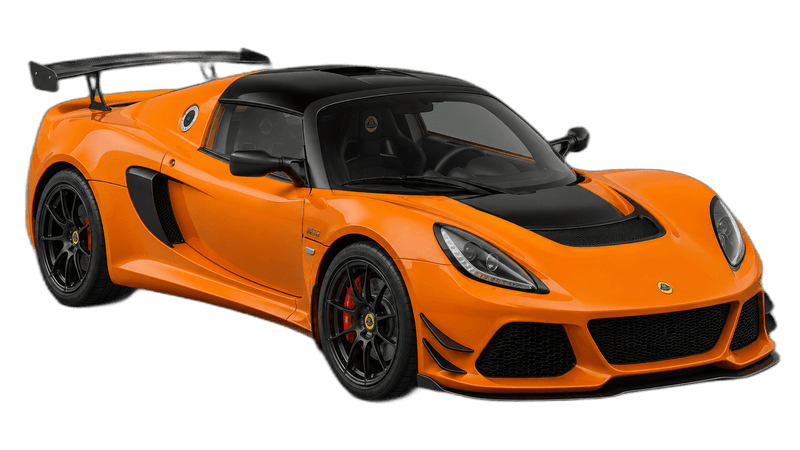
Lotus Exige Sport 350
345bhp
Power
3.9s
0-100 km/h
274km/h
Top Speed
How hard it pulls.
Peak g-force the instant you bury the throttle, estimated from the car's 0–100 time and drivetrain.
Lotus Exige Sport 350Estimated peak launch g from the 0–100 time and drivetrain: an honest approximation, not a measured figure.
The Lotus Exige Sport 350 is a 2-door coupé by Lotus, with 345 bhp, 400 Nm of torque, a 0-100 km/h time of 3.9 seconds and a top speed of 274 km/h.
Dream Car Garage Editorial · Last updated 3 November 2026
Overview
We have not driven this car. This review is based on published specifications and the sources listed below.
Scope of this guide
This guide is scoped to the Lotus Exige Sport 350, the two-door coupe version of the Series 3 Exige that Lotus revealed on 9 December 2015 and that replaced the Exige S. It is a mid-engine car with a transversely mounted, supercharged Toyota V6 behind the seats, and it is rear-wheel drive. The Sport 350 was also built as a Roadster, which Lotus showed at the 2016 Geneva Motor Show, and that open car is outside the scope of this page. We also leave out the more powerful Exige variants that Lotus sold alongside it, such as the Sport 410 and the Cup 430, because they have their own figures.
We have not driven this model for this article. We are an editorial desk that reads sources, and everything below comes from pages we opened: Wikipedia, New Atlas, GTspirit, Motoring Research, Ultimatecarpage, evo, PistonHeads, the RAC, auto-data.net, Alvolante and the Lotus Cars website. We have not owned, inspected or tested a Sport 350, and a guide like this cannot replace a pre-purchase inspection by a Lotus specialist.
The figures at a glance
- Engine: 3.5L supercharged V6, the Toyota 2GR-FE. Ultimatecarpage lists 3,456 cc, an aluminium block and head, four valves per cylinder and dual VVT-i. Auto-data.net and Alvolante also give 3,456 cc.
- Power: 345 bhp at 7,000 rpm. Wikipedia prints 345 hp, 350 PS and 257 kW, Ultimatecarpage prints 345 bhp and 257 kW, and New Atlas prints 345 hp. 350 PS converts to about 345 bhp, so the badge number and the bhp figure describe the same output. Auto-data.net rounds it to 350 hp, which we treat as the same figure rounded in a different unit.
- Torque: 400 Nm at 4,500 rpm, or 295 lb-ft. Wikipedia, Ultimatecarpage, New Atlas, auto-data.net and Alvolante agree on 400 Nm. We did not find any source for a higher torque number.
- 0-100 km/h: 3.9 seconds. New Atlas, GTspirit and Alvolante give 3.9 seconds. New Atlas adds that the automatic is marginally quicker at about 3.8 seconds. This is a manufacturer-derived claim reported by the press, not an independent test.
- Top speed: 274 km/h, which is 170 mph. New Atlas, GTspirit and Ultimatecarpage give 274 km/h, and Motoring Research, the RAC and auto-data.net give 170 mph. Alvolante prints 273 km/h, a rounding difference of one.
- Drive: rear-wheel drive through a six-speed manual gearbox, with an automatic as an option.
- Weight: 1,125 kg, which is 51 kg less than the Exige S at 1,176 kg. GTspirit says 1,115 kg with the optional two-piece brakes and lightweight wheels.
- Price when new: Motoring Research and New Atlas give 55,900 pounds sterling in the UK, and GTspirit gives 74,000 euros in Europe.
Where the sources disagree
Several figures vary between pages, and we say which we chose.
The 0-60 mph time is the widest spread. New Atlas and Ultimatecarpage give 3.7 seconds, the RAC gives 3.8 seconds for standard-form Series 3 cars, and auto-data.net gives 3.6 seconds. Motoring Research gives 3.9 seconds for 0-62 mph. A 0-60 mph time is not a 0-100 km/h time, so we do not convert one into the other. We show only the 0-100 km/h figure of 3.9 seconds that three pages give directly. Auto-data.net lists 4.1 seconds for 0-100 km/h, which is the one outlier we saw, and we did not use it.
Power is the same output quoted three ways, and top speed differs only by rounding. Torque is consistent.
The production dates are less settled. Wikipedia's heading for the Sport 350 reads 2015 to 2019 for the coupe, while Alvolante gives June 2017 to December 2021 for its Sport 350 entry. The RAC says the Sport 350 was a 2016 derivative of the Series 3 that sold until 2021, and evo reports that a Sport 390 Final Edition replaced the Sport 350 in a line-up announced on 8 February 2021. We use 2016 to 2021: reveal in December 2015, European deliveries from February 2016 according to GTspirit, and replacement in the 2021 Final Edition range. No page we read gives the build date of the last Sport 350, so the end year is our reading of the replacement report, not a stated fact.
The gearbox description also varies. New Atlas describes a five-speed automatic option with paddle shifters, while PistonHeads names the automatic as a Toyota U660E torque-converter unit and does not state the number of speeds. We do not give a speed count for the automatic.
History and what Lotus changed
Lotus presented the Sport 350 as a lighter, sharper Exige S. The Toyota-derived V6 was unchanged and Lotus did not fit the more powerful engine from the Evora, because GTspirit says that would have added weight. The work was in the weight and the chassis tuning. According to Lotus as reported by Motoring Research and New Atlas, the 51 kg saving came from many small items:
- A black louvered composite tailgate replaced the large glass panel, which saves weight, helps aerodynamics and lowers the centre of gravity.
- A lighter battery, lighter engine mounts, less filling in the centre console, lighter heater and climate pipework, and less sound insulation.
- A new aluminium gearshift mechanism with an open gate, mounted directly to the floor and exposed in the cabin, replacing a shift that the Lotus boss described as loose.
- A redesigned chassis subframe and revised suspension tuning, and the Evora-derived switch panel for the Drive, Sport and Race modes.
- Optional lighter wheels, which save 5 kg, and optional cross-drilled, vented brake discs, which save another 5 kg.
New Atlas quotes 42 kg of rear downforce at 100 mph. Lotus says the Sport 350 lapped its Hethel test track in 1:29.8, which is 2.5 seconds quicker than the best Exige S and, according to GTspirit, a new record for the Exige. Interiors used hand-stitched leather and an optional heritage tartan. Motoring Research notes traction control rather than stability control, and criticised the standard stereo.
Variants and the end of the run
Lotus had said the Sport 350 would be the only Exige orderable from the factory when it replaced the Exige S, per GTspirit. That did not last. Wikipedia lists the Sport 380, the Cup 380, the Sport 410 and the Cup 430 with date ranges overlapping the Sport 350, and PistonHeads quotes a 2020 Sport 350 at 62,375 pounds sterling in October 2020, which shows it was still on sale four years after launch.
The end came with the Final Editions. In its report of 8 February 2021, evo says the Sport 390 Final Edition replaced the previous Exige Sport 350 and made 397 bhp, 47 bhp more than the Sport 350, at a price of 64,000 pounds sterling, 1,625 pounds more. Lotus also said its Elise, Exige and Evora would stop production later in 2021 to make way for a new generation of sports cars. The Lotus Cars website lists the third-generation Exige as running to 2021.
What to check before buying
Our sources do not contain a checklist written for the Sport 350 alone. The PistonHeads buying guide of 26 October 2020 and the RAC review of 28 November 2022 cover the Series 3 V6 generally, and the points below come from them.
- Track use. Both pages warn about cars that have been used hard at track days. Check tyres, brakes and the clutch, and be cautious if a seller's claimed lap times sound unrealistic.
- Clutch. PistonHeads says you can download a hard-launch count from the car to gauge how the clutch has been used.
- Brake pedal switch. Both pages call it a known weak point. If replacing the switch does not cure a fault, PistonHeads says the ABS unit may be the cause.
- Geometry. The RAC says handling geometry is sensitive, so even light kerbing can matter, and PistonHeads says geometry should be checked more often than the service schedule.
- Engine and supercharger. PistonHeads says the V6 has no major common issues, that noisy cooling fan bearings should mostly have been replaced under a warranty upgrade, and that the timing chain and supercharger are low-maintenance.
- Automatic cars. PistonHeads says the automatic can develop a harsh downshift when coasting, and suggests checking the mass airflow sensor and throttle body for carbon build-up if no fault codes appear.
- Body and trim. The panels are composite, so there is no body corrosion to discuss, but PistonHeads advises looking at the front end for chips and scrapes. The RAC says trim wears quickly.
- Fit. Both the cabin and the boot are small. The RAC says the boot is about 98 litres and the steering wheel does not adjust, and PistonHeads says anyone over 6 ft 2 in may struggle to fit, especially with a helmet.
Running costs and known issues
The cost figures here are approximate and come from the RAC and PistonHeads, which based them on a 2015 Exige S3 V6 S, so they are close to but not exactly a Sport 350.
- Service interval: 9,000 miles or annually. A minor service is about 500 pounds sterling and a major service about 800 pounds sterling, needed about every four years.
- Clutch: about 600 pounds sterling for the kit, or roughly 2,000 pounds sterling fitted.
- Tyres: Pirelli P Zero Corsa at about 180 pounds sterling at the front and 200 pounds sterling at the rear, in sizes 205/45 R17 and 265/35 R18.
- Brakes: front discs just under 500 pounds sterling, with pads about 200 pounds sterling more.
- Dampers: getting on for 700 pounds sterling each. ABS unit: over 1,000 pounds sterling plus fitting.
- Fuel: Motoring Research lists 28.0 mpg combined and 235 g/km of CO2. PistonHeads says real-world use falls to the low 20s on public roads.
Both pages describe Lotus spares as agreeably cheap, with a long wait for replacement body panels as the main parts complaint. Motoring Research adds that road tax was almost 500 pounds sterling a year when the car was new and that the tyres are expensive. Treat all these figures as dated indications from 2015 to 2022, not as quotes.
Recalls and safety
The RAC review mentions no recalls and no Euro NCAP rating, and we found neither in the other pages. That is not a clean bill of health, because we did not search a recall database. The Sport 350 has an unassisted steering rack, no mechanical limited-slip differential, and a bonded extruded aluminium monocoque, according to PistonHeads and Ultimatecarpage. Check any individual car against the official recall lookup for its market using the chassis number.
Market and value notes
PistonHeads reported on 26 October 2020 that 2012 to 2016 Series 3 V6 cars started at around 35,000 pounds sterling for an S Roadster and 40,000 pounds sterling for an S Coupe, against the Sport 350 at 62,375 pounds sterling new. Motoring Research said in 2015 that Lotus was building fewer cars, so retained values were high. We found no recent auction results or current used prices for the Sport 350, so we give none. Those figures cover different cars and years and should not be read as a valuation.
What we could not find
We found no production count for the Sport 350, so the catalogue count stays blank and the page shows no figure shown for it. Ultimatecarpage lists no number built, and Wikipedia gives only 10,497 for the whole Exige range from 2000 to 2021. The Lotus Cars website gives about 2,700 for all third-generation models, which does not isolate the Sport 350. We found no independent road test with measured acceleration, no end-of-production date for the Sport 350 itself, no recall data and no crash-test result. We could not open the Auto Express article (HTTP 410), the Drive.com.au pages (403), Encycarpedia (403) or one evo Roadster page (host not found), so we did not use them. We did not open a registry or recall search.
About the photograph
This page uses the catalogue photograph for the car. Its credit is listed on the credits page.
Verdict
The Exige Sport 350 coupe is a mid-engine, rear-wheel-drive car with a 3.5L supercharged V6 making 345 bhp and 400 Nm, a claimed 3.9 seconds to 100 km/h and a claimed 274 km/h. At 1,125 kg it is a small, light car whose appeal is the work Lotus did on weight and handling, not extra power. On the evidence we read, the main purchase risks are hard track use, the clutch, the brake pedal switch and geometry, while the engine looks robust. Running costs are given only as dated approximations from 2015 to 2022, and the end of production is reported through the 2021 Sport 390 Final Edition. We have not driven it, so use the sources, the seller's records and an independent Lotus specialist inspection to decide.
Sources
- Wikipedia: Lotus Exige (Sport 350)
- New Atlas: Lotus Exige Sport 350 (9 December 2015)
- GTspirit: Lotus Exige Sport 350 review (10 December 2015)
- Motoring Research: Lotus Exige Sport 350 first drive (2015)
- Ultimatecarpage: Lotus Exige Sport 350 specifications
- evo: Lotus Elise and Exige Final Edition models (8 February 2021)
- PistonHeads: Lotus Exige S3 used buying guide (26 October 2020)
- RAC: Lotus Exige S3 (2012-2021) used car review
- auto-data.net: Lotus Exige III S Coupe facelift 2018 Sport 350
- Alvolante: Lotus Exige Coupe Sport 350 data sheet
- Lotus Cars: Exige
Specifications
Engine
3.5L supercharged V6
Displacement
3.5L
Power
345 bhp
Torque
400 Nm
0-100 km/h
3.9s
Top Speed
274 km/h
Drivetrain
RWD
Country
United Kingdom
Body Style
2-door coupé
Years
2016–2021
Specifications are manufacturer-published figures.
More from Lotus
Frequently Asked Questions
What are the specifications of the Lotus Exige Sport 350?
The Lotus Exige Sport 350 is a 2-door coupé by Lotus, with 345 bhp, 400 Nm of torque, a 0-100 km/h time of 3.9 seconds and a top speed of 274 km/h.
What drivetrain does the Lotus Exige Sport 350 use?
The Lotus Exige Sport 350 is configured with rear-wheel drive.
What type of car is the Lotus Exige Sport 350?
The Lotus Exige Sport 350 is a sports cars manufactured by Lotus in United Kingdom. Production ran from 2016 to 2021.