
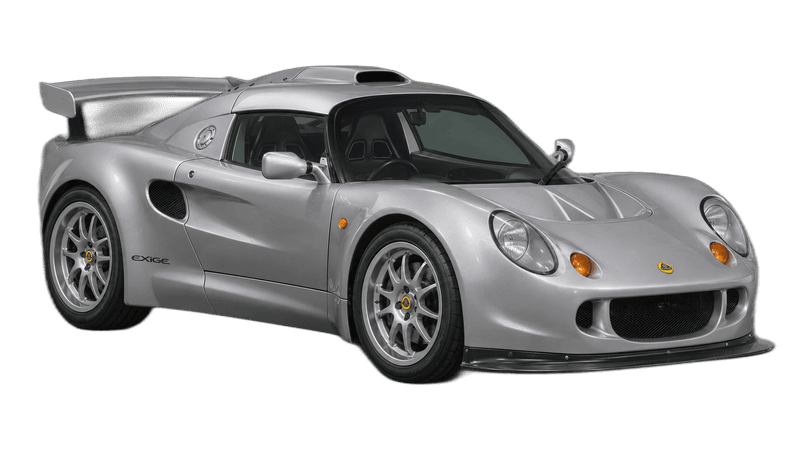
Lotus Exige S1
177bhp
Power
4.9s
0-100 km/h
219km/h
Top Speed
How hard it pulls.
Peak g-force the instant you bury the throttle, estimated from the car's 0–100 time and drivetrain.
Lotus Exige S1Estimated peak launch g from the 0–100 time and drivetrain: an honest approximation, not a measured figure.
The Lotus Exige S1 is a 2-door coupé by Lotus, with 177 bhp, 172 Nm of torque, a 0-100 km/h time of 4.9 seconds and a top speed of 219 km/h.
Dream Car Garage Editorial · Last updated 3 November 2026
Overview
We have not driven this car. This review is based on published specifications and the sources listed below.
Scope of this guide
This guide is scoped to the Lotus Exige S1, the first-generation Exige, also called the Series 1 or Type 111 Exige. It is a two-seat, mid-engine, rear-wheel drive coupé with a fixed roof, a bonded aluminium tub and a 1.8 litre Rover K-series four-cylinder engine mounted behind the seats. It was launched in April 2000 and built at Hethel until late 2001 according to the sources we read. It is not a guide to the Series 2 Exige that followed in the mid-2000s, nor to the Elise it was derived from.
We have not driven this model for this article. We are an editorial desk that reads sources, and everything below comes from pages we opened: Wikipedia, the supercars.net entry for the 2000 Exige, the Supercar Nostalgia article on the Exige S1, the PistonHeads used buying guide published in December 2024, an evo model page dated January 2009, a Petrolicious feature on one owner's car, the Lotus Drivers Guide genealogy page, and a PistonHeads dealer listing for a low-mileage car. We have not inspected, owned or tested a car. Please treat this page as research, not as a buying recommendation, and do not use it in place of an inspection by a Lotus specialist.
The figures at a glance
- Engine: 1.8L naturally aspirated inline-four, the Rover K-series in VHPD (Very High Performance Derivative) tune, 1,796 cc, with a double overhead camshaft and four valves per cylinder.
- Layout: mid-engine, rear-wheel drive, five-speed manual gearbox.
- Power: 177 bhp at 7800 rpm in standard form. Wikipedia and supercars.net both print 177 bhp (132 kW; 179 PS). Converting 179 PS at 0.98632 gives about 176.6 bhp and converting 132 kW at 1.34102 gives about 177.0 bhp, so the units agree.
- Torque: 172 Nm. PistonHeads and Supercar Nostalgia both print 127 lb ft for the standard car, and 127 lb ft multiplied by 1.35582 is 172.2 Nm. Other pages print a larger number, explained below.
- Top speed: 219 km/h, the claimed 136 mph. Wikipedia and supercars.net both print 219 km/h, and 136 mph multiplied by 1.60934 is 218.9 km/h.
- 0-100 km/h: 4.9 seconds. Wikipedia and supercars.net both print this as a 0-100 km/h time. Several other pages print 4.7 seconds to 62 mph or 60 mph instead (see the performance section).
- Weight: sources give from 724 kg to 785 kg, with 780 kg the most common.
- Production: 604 cars according to most sources, though one page says 583 (see the production section).
- Years: 2000 to 2001.
Which power figure we use, and why
The standard Exige S1 is rated at 177 bhp at 7800 rpm by Wikipedia, supercars.net, Supercar Nostalgia, PistonHeads, Petrolicious (which says 177 hp) and the Lotus Drivers Guide. We use 177 bhp throughout this guide because it is the figure on the largest number of pages and it describes the car as it left the factory.
Higher figures exist, and they cause confusion. Wikipedia and supercars.net both mention a track-spec version at 190 bhp (142 kW; 193 PS). Supercar Nostalgia describes a dealer-supplied 190 upgrade with remapped engine management, a 101 degree inlet cam pulley, an 82 degree thermostat, removed resonator valve and secondary air filter, and a catalyst replacement pipe. PistonHeads mentions 190 hp with a factory decat kit that it prices at 900 pounds in its December 2024 text. Meanwhile evo prints 192 bhp at 7800 rpm for the VHPD engine, with 177 bhp as the basic version, and the supercars.net specification table also prints 192 bhp even though the text of the same page says 177 bhp. None of those pages reconcile the numbers, and we cannot tell from them whether 192 bhp and 190 bhp describe the same upgraded state. One dealer listing prints 178 bhp, which we treat as a small rounding variation. We therefore treat 177 bhp as the standard figure and 190 bhp as an optional upgrade, and if you are looking at a particular car you should ask what engine management and exhaust parts it carries.
Torque: why sources disagree
Torque is the most inconsistent figure we found. Wikipedia does not state it. PistonHeads and Supercar Nostalgia print 127 lb ft for the standard 177 bhp car, but they disagree on where it peaks: PistonHeads shows 4,250 rpm in its specification box and 6,750 rpm in the engine section, while Supercar Nostalgia gives 6,750 rpm and lists 126 lb ft at 5,000 rpm for the 190 upgrade. By contrast evo prints 146 lb ft at 5,000 rpm (about 198 Nm) and supercars.net prints 197.9 Nm (146.0 lb ft) at 5,000 rpm, and those two pages pair that torque with the 192 bhp output.
We use 172 Nm because it comes from two pages that describe the standard 177 bhp car, and because a torque peak near 6,750 rpm sits sensibly with a power peak at 7800 rpm in a small high-revving engine. We cannot prove that the larger figure is wrong. It may belong to the upgraded engine, or it may be an error that was copied between pages.
Origins and design
Wikipedia credits Julian Thomson as the designer. The bodywork was based on the Series 1 Elise, which ran from 1996 to 2000, but with a non-removable hardtop, a fastback rear with a tinted engine cover, a pylon-mounted rear wing, a front splitter and front air intakes that were blanked off on road cars. Both the front and rear clamshells were widened to fit a wider track. Supercar Nostalgia quotes the Exige as 29 mm wider, 35 mm longer and 53 mm taller than a standard Elise, and says the first Exige kept the round headlights of the first-generation Elise. Wikipedia gives a wheelbase of 2,300 mm, a length of 3,785 mm, a width of 1,719 mm and a height of 1,182 mm.
Supercar Nostalgia describes it as a road-going version of the Motorsport Elise, which replaced the 340R and Sport 190 as the most extreme Type 111. Petrolicious says much the same. The car was launched in April 2000 at Brands Hatch, during the opening round of the Autobytel Lotus Championship, according to both Supercar Nostalgia and PistonHeads.
How it is built
Supercar Nostalgia says the tub is bonded extruded aluminium and weighs 68 kg. It lists a bore and stroke of 80 mm by 89.3 mm, a compression ratio of 10.5:1, electronic multi-point fuel injection with Lotus in-house engine management, and a close-ratio five-speed manual gearbox with an AP Racing clutch and a limited-slip differential. Wikipedia names the gearbox as a five-speed Rover PG-1. Brakes are 282 mm ventilated discs, with AP Racing calipers at the front and Bremo calipers at the rear, and wheels are 7 by 16 inches at the front and 8.5 by 17 inches at the rear. The original tyres were Yokohama A039 in 195/50 R16 and 225/45 R17. The supercars.net page adds that the steering is unassisted rack and pinion and that the discs are cross-drilled.
Factory options listed by Supercar Nostalgia were sports seats, leather or Alcantara trim, metallic paint, air conditioning and a removable steering wheel it describes as suitable for track use only. Air conditioning became standard in October 2000, and a running change in July 2000 deleted the screws on the sail panels.
Performance claims against other figures
None of this is a test we ran.
- 0-100 km/h: Wikipedia and supercars.net both print 4.9 seconds. They are the only pages we read that print a time against 100 km/h.
- 0-62 mph: Supercar Nostalgia, PistonHeads and evo print 4.7 seconds for 0-62 or 0-60 mph, and Supercar Nostalgia notes it was 5.8 seconds for a standard Elise. Wikipedia also prints 4.7 seconds to 60 mph, and the supercars.net table prints about 4.6 seconds. Petrolicious says about 4.5 seconds to 60 mph. A mile-based time is not the same as a kilometre-based one, so we do not relabel them, and we give 4.9 seconds for 0-100 km/h only because two pages print it as such. Treat it as a claimed figure.
- Top speed: Supercar Nostalgia, PistonHeads, evo, Wikipedia and supercars.net all print 136 mph, or 219 km/h. Supercar Nostalgia says the standard Elise managed 126 mph. This is a claimed figure, not a measured one.
- Weight: Wikipedia, supercars.net and evo print 780 kg. PistonHeads prints 785 kg and adds that its weight and power figures are approximate. Petrolicious prints 760 kg, and Supercar Nostalgia prints 724 kg, which it says is 31 kg less than a standard Elise. We use 780 kg as the most common figure.
Production and years
The number of cars is not agreed. Wikipedia, supercars.net, Supercar Nostalgia, the Lotus Drivers Guide and the Petrolicious feature (which says its subject car is number 73 of 604) all print 604. The PistonHeads dealer listing agrees on 604 and says the cars were built at Hethel from June 2000 to November 2001. By contrast evo prints 583, and the PistonHeads buying guide says only that about six hundred or more were built. Of the 604, Supercar Nostalgia says about two-thirds were right-hand drive, the dealer listing says around four hundred were right-hand drive, and Petrolicious says only 177 were left-hand drive. 604 less 177 is 427, which fits both descriptions. We found no page that gives 601, so we use 604 and note that it is a widely repeated number rather than one we could trace to Lotus itself.
On dates, Supercar Nostalgia and the PistonHeads listing give production from June 2000 to November 2001, while Wikipedia gives 2000 to 2001 and the supercars.net page and the Lotus Drivers Guide say 2000 to 2002. We use 2000 to 2001 because the two pages with exact months agree. PistonHeads adds that fewer than two hundred and fifty Series 1 cars were licensed in the UK as of 2001, and that fewer than one hundred unmodified cars were still on UK roads in 2024.
What to check before buying
Only the PistonHeads guide by Tony Middlehurst (December 2024) and the evo page (January 2009) give specifics, and the guide warns that its figures are approximate. We pass on what they say and do not add to it.
- Accident damage: evo calls it the most crucial check, because the aluminium chassis cannot be repaired and replacing it is almost uneconomical. PistonHeads says a replacement chassis costs over ten thousand pounds, plus around one hundred and twenty hours of labour to refit the car. Lift the floor coverings to check the floorpan is flat, and look for spotty repaint marks under the sills.
- Track use: evo says many Exiges were used on track, so check that the undertrays are not hiding damage.
- Head gasket: PistonHeads says to check the coolant for emulsion and look for a light-coloured exhaust pipe. evo quotes the specialist Paul Matty saying the head gasket reputation is undeserved, and advises checking coolant levels and looking for leaks. The dealer listing we read records a head gasket replacement as part of a recent service.
- Engine and cooling: PistonHeads says around one hundred thousand miles without major work is achievable, and some cars reach two hundred thousand. It names failing radiator end-caps and expansion tank caps, rotted original exhausts, and wearing clutch slave cylinders and fuel pumps. It advises a cambelt change at four years or 36,000 miles, and servicing every 6,000 miles or six months.
- Corrosion: the rear subframe and uprights are steel, and PistonHeads says electrolytic corrosion can occur where they join aluminium if moisture and debris collect.
- Suspension and tyres: front ball joints, rear toe links and shock absorbers wear, and PistonHeads says clonks signal replacement. It says rear tyres may last only 8,000 to 10,000 miles. evo says nothing is horrendously expensive to replace.
- Body and electrics: the fibreglass panels have inconsistent gaps, and cracks may indicate damage. PistonHeads reports failing heater motors, central locking, air conditioning and window winders.
Prices
Prices are dated, and we have not checked any of them against a current market. PistonHeads in December 2024 gives a new price of 30,020 pounds and a spec box price of from 35,000 pounds, while its bullet points say available from 40,000 pounds. It also mentions 75,000 pounds for a car stored for twenty years with 8,000 miles, and 38,000 pounds for a car with a supercharged K20 unit. The dealer listing we read showed 65,950 pounds for a car with 13,970 miles, but the listing was marked deposit taken and carries no date. evo, in January 2009, gave 32,995 pounds new and about 17,000 pounds used. The gap between those two used figures is a reminder that values have moved a great deal, and that you should check current listings.
What we could not find
We found no maker-issued specification sheet for this car, so every figure above is secondary. We could not open the Practical Classics page on PressReader, the Classic Driver listing or the Lapmeta page, because each returned a refusal and we did not try to work around it. No page we read gave a verified torque figure for the standard car that all sources agree on, nor a measured performance test. We also found no source for a total of 601 cars. Where a page printed a figure only in miles per hour, we report that as such and do not convert it into a time against 100 km/h.
About the photograph
This page uses the catalogue photograph, and its credit is listed on the credits page.
Verdict
The Exige S1 was a fixed-roof, widened-bodied take on the Series 1 Elise with a 177 bhp, 1.8L naturally aspirated inline-four, a claimed 219 km/h and a claimed 4.9 seconds to 100 km/h. It was a short run of about 604 cars. The sources agree on the basics and disagree on torque, on the power of the upgraded cars, on the exact number built and on the end of the run. Those disagreements are the main thing to take away: if you are researching a particular car, ask for its chassis number and its history, and have a Lotus specialist look at the tub, the cooling system and the subframe before any decision. This page is for research, not a buying recommendation.
Specifications
Engine
1.8L naturally aspirated inline-four
Displacement
1.8L
Power
177 bhp
Torque
172 Nm
0-100 km/h
4.9s
Top Speed
219 km/h
Drivetrain
RWD
Country
United Kingdom
Body Style
2-door coupé
Years
2000–2001
Production
604
Specifications are manufacturer-published figures.
More from Lotus
Frequently Asked Questions
What are the specifications of the Lotus Exige S1?
The Lotus Exige S1 is a 2-door coupé by Lotus, with 177 bhp, 172 Nm of torque, a 0-100 km/h time of 4.9 seconds and a top speed of 219 km/h.
How many Lotus Exige S1 were made?
Lotus produced 604 units of the Lotus Exige S1.
What drivetrain does the Lotus Exige S1 use?
The Lotus Exige S1 is configured with rear-wheel drive.
What type of car is the Lotus Exige S1?
The Lotus Exige S1 is a sports cars manufactured by Lotus in United Kingdom. Production ran from 2000 to 2001.