
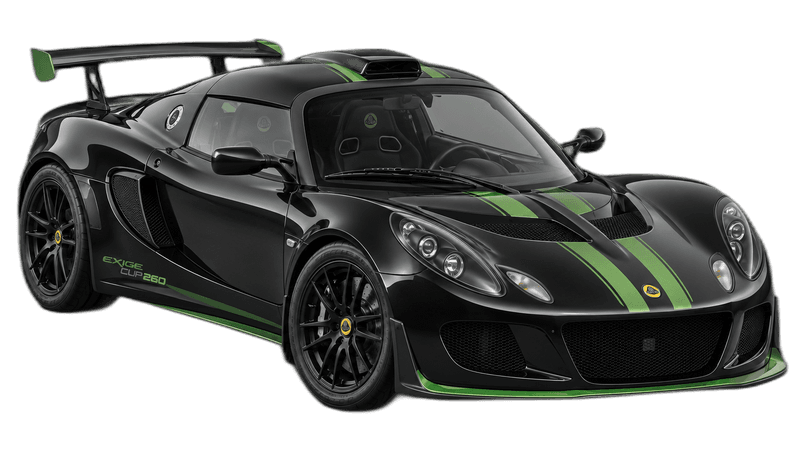
Lotus Exige Cup 260
257bhp
Power
4.1s
0-100 km/h
245km/h
Top Speed
How hard it pulls.
Peak g-force the instant you bury the throttle, estimated from the car's 0–100 time and drivetrain.
Lotus Exige Cup 260Estimated peak launch g from the 0–100 time and drivetrain: an honest approximation, not a measured figure.
The Lotus Exige Cup 260 is a 2-door coupé by Lotus, with 257 bhp, 236 Nm of torque, a 0-100 km/h time of 4.1 seconds and a top speed of 245 km/h.
Dream Car Garage Editorial · Last updated 3 November 2026
Overview
We have not driven this car. This review is based on published specifications and the sources listed below.
Scope of this guide
This guide is scoped to the Lotus Exige Cup 260, the track-focused Series 2 Exige that Lotus first showed in February 2008 as the Exige Sport Cup 260 and then moved into series production for the 2009 model year. It is a two-seat, mid-engine, rear-wheel drive coupé with a supercharged 1.8 litre four-cylinder engine of Toyota origin mounted behind the seats. It is not a guide to the earlier Cup 240 or Cup 255, to the road-biased Exige S 240 or S 260, to the later V6 Exiges, or to the 2017 Elise Cup 260, which is a different car.
We have not driven this model for this article. We are an editorial desk that reads sources, and everything below comes from pages we opened: Wikipedia's Exige article, an evo news piece, two 2008 launch reports from PistonHeads and Autoblog, a Car Enthusiast launch report and a Car Enthusiast first-drive article, the zeperfs and Cars-Data specification pages, the PistonHeads Series 2 Exige buying guide summary, and one private-seller listing. We have not inspected, owned or tested a car. The Cup 260 is a rare track-oriented car, so treat this page as research, not as a buying recommendation, and do not use it in place of an inspection by a Lotus specialist.
The figures at a glance
- Engine: 1.8L supercharged inline-four, a Toyota 2ZZ-GE of 1,796 cc with an Eaton M62 Roots-type supercharger, mounted behind the seats.
- Layout: mid-engine, rear-wheel drive, six-speed manual gearbox.
- Power: 257 bhp at 8,000 rpm. The same sources that print 257 bhp often also print 260 PS, and Wikipedia prints 260 PS (256 bhp; 191 kW). Converting 260 PS at 0.98632 gives about 256.4 bhp and converting 191 kW at 1.34102 gives about 256.1 bhp, so the sources sit within one bhp of each other.
- Torque: 236 Nm at 6,000 rpm. Wikipedia prints 236 Nm (174 lb ft) and evo prints 174 lb ft, and 174 lb ft multiplied by 1.35582 is 235.9 Nm. zeperfs prints 237 Nm (175 lb ft), which is one Nm higher.
- 0-100 km/h: 4.1 seconds, which is the figure Cars-Data prints against 0-100 km/h. Car Enthusiast prints the same 4.1 seconds for 0-62 mph, so the two agree. evo and the 2008 launch reports give about four seconds to 60 mph, which we do not treat as a 0-100 km/h time.
- Top speed: 245 km/h, which is the Cars-Data figure. evo, the Car Enthusiast first drive and Wikipedia's S 260 Final Edition entry give 152 mph, and 152 mph multiplied by 1.60934 is 244.6 km/h. zeperfs prints 247 km/h (153 mph) as the maker's figure.
- Weight: 890 kg for the 2009 car (evo, Car Enthusiast and the DIN figure on zeperfs). See the weight section for the other numbers.
- Years: 2009 to 2010 for the series-production car, after a 2008 launch as the Sport Cup 260.
- Production: no figure shown for the series-production Cup 260. See the production section.
Which power figure we use, and why
Every launch-era English-language report we read says 257 bhp: evo, PistonHeads, Autoblog and Car Enthusiast. Wikipedia and zeperfs describe the same engine as 260 PS, with zeperfs also showing 256 bhp and Wikipedia showing 256 bhp. A rating of 260 PS converts to about 256 bhp, so the three numbers 256, 257 and 260 describe one engine in different units and rounding. We use 257 bhp throughout this guide because it is the figure printed on the largest number of contemporary pages. Cars-Data prints 261 hp in its headline and 257 hp in its performance section for the same car, and a PistonHeads search listing we saw only as a snippet showed 243 bhp, which we did not open and do not rely on.
History and what changed over the run
The car started life in 2008. Autoblog's report dated 14 February 2008 describes the Lotus Exige Sport Cup 260 as a limited-edition model available immediately in Europe, with a Toyota-sourced 1.8 litre supercharged engine, a heavy-duty clutch, a plate-type limited-slip differential as an option, a revised instrument pack, new aerodynamic parts claimed to produce 40 kg of downforce at 100 mph, and variable traction and launch control. The standard equipment it lists includes 16-inch cast wheels with Yokohama A048R tyres, four-piston AP Racing front calipers on 282 mm discs, an adjustable anti-roll bar and dampers, FIA-approved Recaro seats with a six-point roll cage, and a 70 litre fuel cell. PistonHeads, dated 18 February 2008, adds that the engine uses the Eaton M62 supercharger and that a straight-cut dog gearbox, slick tyres, a race exhaust and a plate-type differential were extras.
Sources disagree on the 2008 differential. PistonHeads says a limited-slip differential is standard and the plate type is optional. The Car Enthusiast news report says a limited-slip differential is optional. We cannot reconcile those two pages.
The 2009 series-production car followed. evo's news piece dated 8 October 2008 gives 257 bhp at 8,000 rpm, 174 lb ft at 6,000 rpm, a weight of 890 kg that it calls 38 kg less than the car it replaces, about four seconds to 60 mph, about 152 mph, and a price of 45,995 pounds plus 950 pounds on-the-road costs. It says launch and traction control come from the 2-Eleven, that the springs are Eibach, that dampers and the front anti-roll bar are adjustable, and that the car is eligible for the 2009 Lotus Cup Europe, a six-round, twelve-race series. The Car Enthusiast first-drive article gives an on-the-road price of 46,945 pounds, which matches evo's two prices added together, and says the car began as a Lotus Sport model and went into series production after strong demand.
The Car Enthusiast article lists the weight-saving work in detail. A carbon fibre roof panel, tailgate, front access panels, splitter, side air ducts and rear spoiler save 12 kg, lightweight forged wheels save 10 kg, a motorsport battery saves 5 kg, and the flywheel is lightened. Inside there is a carbon dashboard panel, a composite panel in place of the rear window, and the rear-view mirror is deleted. A torque-sensing limited-slip differential and Lotus Traction Control with about 30 steps from fully on to fully off are listed as standard. That article describes a carbon fibre rear spoiler, so we do not repeat the popular description of a huge rear wing as a fact from our sources.
Wikipedia's Exige article does not give the Cup 260 its own section. It lists a Cup 260 line with 260 PS at 8,000 rpm and 236 Nm at 6,000 rpm, and notes that the Cup 260 engine was reused in the Exige Stealth and Scura. It places the road-biased S 260 at 2009 to 2011 and says the S 260 Final Edition of 2011 for North America made 257 hp and 236 Nm, with a top speed of 245 km/h, and that only 30 of those were built. That Final Edition is a different model from the Cup 260.
The engine
Wikipedia describes the Series 2 supercharged Exiges as using a Toyota 2ZZ-GE engine, a 1.8 litre inline-four with double overhead cams and variable valve timing and lift, supercharged and intercooled, with an 82 mm bore, an 85 mm stroke and 11.5 to one compression. Wikipedia lists the Sport 240, S 240 and S 260 as using the same family of engine, and for the Cup 260 the rating is 257 bhp at 8,000 rpm. Cars-Data prints a fuel consumption of 8.5 litres per 100 km and 199 g/km of CO2, zeperfs prints 9.1 litres per 100 km, and Car Enthusiast prints 31.0 mpg combined and 216 g/km. These do not agree, and they were measured under different conditions or for different model years, so we give them only as a range.
Performance claims against other numbers
None of the following is a test we ran.
- 2008 Sport Cup 260: about four seconds to 60 mph, 9.9 seconds to 100 mph, 147 mph (Autoblog, PistonHeads, Car Enthusiast news).
- 2009 Cup 260: about four seconds to 60 mph and just under ten seconds to 100 mph, about 152 mph (evo). Car Enthusiast prints 4.1 seconds to 62 mph and 152 mph.
- Cars-Data: 4.1 seconds to 100 km/h and 245 km/h. zeperfs: 247 km/h as the maker's figure, and a measured maximum of 195 km/h on its page, which we treat as a curiosity of that table rather than a car limit.
Weight
- 2008 Sport Cup 260: 2,046 lb in PistonHeads and Autoblog, which multiplied by 0.45359 is about 928 kg. Car Enthusiast prints 930 kg all-up.
- 2009 Cup 260: 890 kg (evo, Car Enthusiast and zeperfs DIN). zeperfs also prints 965 kg on an EU basis.
- Wikipedia lists the road-biased S 260 at 916 kg with a full tank. That is a different model.
- A private seller's listing gives about 930 kg in its description and 1,166 kg on its technical data table, which we cannot reconcile.
Wikipedia notes its S 260 figure is with a full tank, which shows that quoted weights are not always on the same basis, so compare like with like if you see a car advertised.
Production numbers
We found no production total for the series-production Cup 260, so for production there is no figure shown. The only count we saw is a private seller's claim, in a listing for a model-year 2008 car, that it is number 16 of 39 early Cup 260s built worldwide, of which 32 were left-hand drive. That is the seller's own statement, we cannot verify it from the page, and it concerns the early 2008 run rather than the 2009 series-production car. Car Enthusiast simply says demand pushed the car into series production, and Autoblog's launch report describes the Sport Cup 260 as limited but does not give a number. We therefore show no count.
What to check before buying
We did not find a buying guide written for the Cup 260 itself. The closest source is the PistonHeads Series 2 Exige buying guide summary, which does not mention the Cup 260 and does not give prices. Its points are general Series 2 checks, so treat them as a starting list rather than a Cup 260 condition report.
- Service history: the guide's benchmark is regular maintenance every 9,000 miles or 12 months.
- Gearbox: listen for crunching when cold, because third gear synchros can wear.
- Radiator: the original radiator's plastic ends can crack and leak, and an aluminium replacement is suggested.
- Chassis and dampers: uprated dampers improve track performance but need more upkeep, and a full geometry check is worth paying for to confirm handling balance.
- Differential: the guide says opinions on limited-slip differentials vary, though many owners treat one as a worthwhile upgrade where a car lacks it. The Cup 260 is described by Car Enthusiast as having a torque-sensing unit as standard, so check what a particular car actually has.
- Tyres and wheels: aftermarket wheels are common, so make sure original wheels come with the car. The guide suggests quality tyres from brands such as Avon, Toyo and Yokohama.
- Body: the front and rear clamshells are vulnerable to parking knocks, so check for cracks, and look under stripes or vinyl wraps that could hide damage. Front indicators can drop out because a plastic tab shears.
- Interior: Car Enthusiast says air conditioning is not standard on the Cup 260 and the cabin is stripped, so confirm the specification of any car you see.
- Track history: this model was sold for the Lotus Cup Europe series (evo) and with race-oriented parts, so ask whether a car has been used for track days or racing.
Values and prices
We read launch prices only. The 2009 price from evo was 45,995 pounds, plus 950 pounds on-the-road costs, and Car Enthusiast gives 46,945 pounds on the road. For the 2008 car the sources disagree: PistonHeads prints 42,000 pounds and says an earlier report had said 56,000 pounds, Autoblog prints 56,034 pounds, and the Car Enthusiast news report prints 54,034 pounds. Cars-Data prints a list price of 80,930 euros for 2011, and zeperfs an indicative base price of 67,950 euros. The private seller listing asks 68,900 euros for a 2008 car with 38,000 km, four previous owners and an original Lotus Sport plaque. A single asking price is not a valuation, and we did not find a sold-price result for a Cup 260, so we give no current market value.
What we could not find
- Autocar's Exige page, the Top Gear specification page, the Encycarpedia page, the Parkers engines page and the lapmeta page each returned a refusal, a payment wall or an error when we tried to open them, so we did not use them and did not work around the block.
- A Hagerty past-sale page redirected to a login screen, so we did not read it.
- No page we opened gives a build total for the series-production Cup 260, so production is no figure shown.
- We found no Cup 260 specific buying guide, no period long-term test, no recall or safety campaign for this model, and no sold-price results. We do not claim there was no recall.
- We could not confirm the end of production from a maker page. zeperfs says 2009 to 2010, while Cars-Data files the car under 2011.
About the photograph
The page uses the catalogue photograph for this model, and its credit is listed on the credits page.
Verdict
The Exige Cup 260 is a weight-saving exercise on an already light Series 2 Exige. Its 257 bhp supercharged four-cylinder, a figure the sources give as 260 PS or 256 bhp in other units, drives the rear wheels through a six-speed manual gearbox, and the reported weight of 890 kg gives performance of roughly 4.1 seconds to 100 km/h and about 245 km/h. The sources describe a firm, track-oriented car with lightweight parts, adjustable traction and launch control and a stripped interior, so it will suit a driver who wants a road-legal trackday car rather than a comfortable tourer. The details that matter to a buyer are the early 2008 cars against the 2009 series cars, which differential a car actually has, and its track history, and the sources disagree on production totals, price and weight, so treat any single number you see with care. This page is a research aid built from published pages, and it cannot replace a specialist inspection of a specific car.
Sources
- Wikipedia: Lotus Exige
- evo: Lotus Exige Cup 260 news, October 2008
- PistonHeads: Updated Lotus Exige Sport Cup 260, February 2008
- Autoblog: Lotus reveals 2008 Exige Sport Cup 260
- Car Enthusiast: 2009 Lotus Exige Cup 260 first drive
- Car Enthusiast: 2008 Lotus Exige Sport Cup 260, new Exige variant
- zeperfs: Lotus Exige Cup 260 PS (2009-2010) specifications
- Cars-Data: Lotus Exige Cup 260
- PistonHeads: Lotus Exige S2 buying guide at a glance
- AutoScout24: Lotus Exige Cup 260 MY2008 No. 16/39 listing
Specifications
Engine
1.8L supercharged inline-four
Displacement
1.8L
Power
257 bhp
Torque
236 Nm
0-100 km/h
4.1s
Top Speed
245 km/h
Drivetrain
RWD
Country
United Kingdom
Body Style
2-door coupé
Years
2009–2010
Specifications are manufacturer-published figures.
More from Lotus
Frequently Asked Questions
What are the specifications of the Lotus Exige Cup 260?
The Lotus Exige Cup 260 is a 2-door coupé by Lotus, with 257 bhp, 236 Nm of torque, a 0-100 km/h time of 4.1 seconds and a top speed of 245 km/h.
What drivetrain does the Lotus Exige Cup 260 use?
The Lotus Exige Cup 260 is configured with rear-wheel drive.
What type of car is the Lotus Exige Cup 260?
The Lotus Exige Cup 260 is a sports cars manufactured by Lotus in United Kingdom. Production ran from 2009 to 2010.